
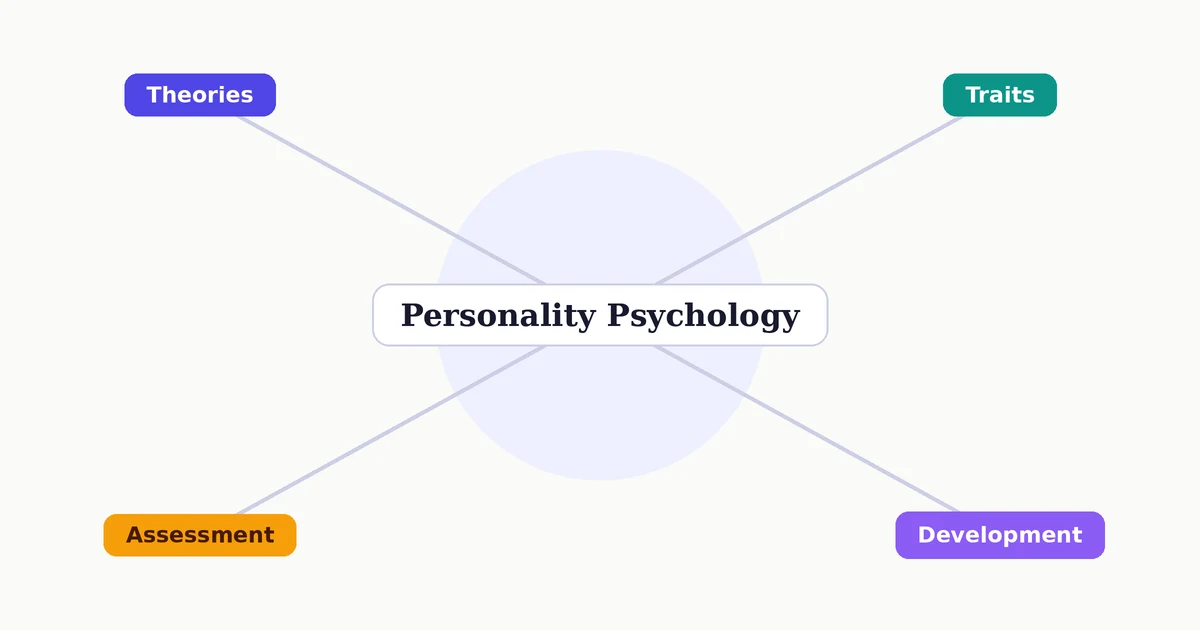
Personality psychology is the branch of psychology that studies individual differences — the patterns in how people think, feel, and behave, and why those patterns vary from person to person. The American Psychological Association defines personality itself as “the enduring configuration of characteristics and behavior that comprises an individual’s unique adjustment to life,” shaped by forces ranging from heredity and physical maturation to culture and critical life experiences [1].
In other words, this field asks one of the most human questions there is: why are people the way they are? You’ve asked it every time you’ve wondered why two people react so differently to the same situation — why one person comes alive at a crowded party while another recharges with a quiet evening alone. This guide explains what personality psychology actually is, the major theories behind it, how researchers study personality, and why any of it matters in everyday life.
Table of Contents
Personality Psychology Definition
The APA’s definition points to something important: personality isn’t a single thing you “have” — it’s a configuration, an organized pattern. An open psychology textbook puts it similarly: personality refers to “the long-standing traits and patterns that propel individuals to consistently think, feel, and behave in specific ways” [2]. The key words are patterns and consistency. A single act doesn’t reveal your personality; the pattern across time and situations does.
Even the word itself hints at this. Personality comes from the Latin persona — the mask worn by actors in the ancient world, originally used to project a character’s traits to the audience [2].
Personality vs. Character vs. Temperament
These three words get mixed up constantly, so let’s separate them:
- Personality is the whole package: the full pattern of your traits, thoughts, feelings, and behaviors.
- Character refers to the moral dimension of personality — your values, moral beliefs, and ethical behavior, such as honesty, loyalty, or fairness.
- Temperament refers to biologically influenced tendencies that emerge early in life — for example, some infants are calm and adaptable while others are reactive and intense. Temperament isn’t simply fixed at birth, though: it interacts with experience and environment throughout development, and personality is what emerges from that ongoing interaction.
What Personality Psychology Studies
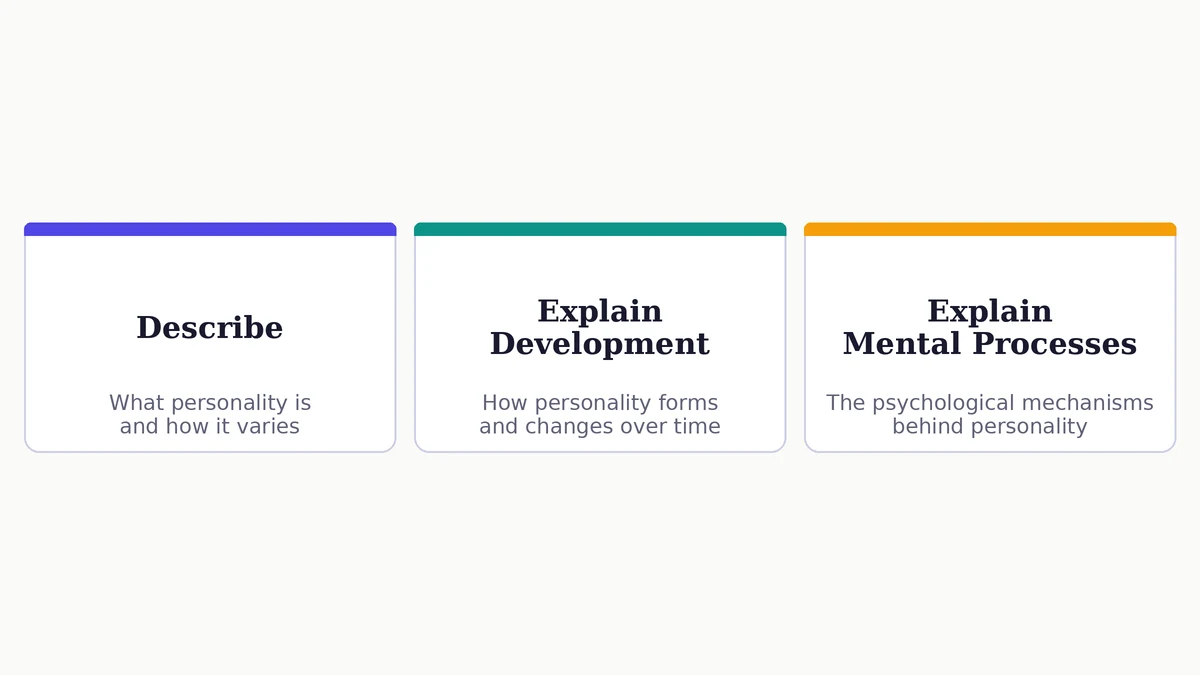
The field traditionally organizes itself around three big questions [3]:
- Describing personality — what personality is and how it varies between people.
- Documenting development — how personalities form, stabilize, and sometimes change across a lifetime.
- Explaining mental processes — the psychological mechanisms behind personality and how they shape the way we function day to day.
Everything in this guide — and much of this website — connects back to one of those three questions.
Major Theories of Personality
No single theory explains personality completely. Over the last century, psychologists have built several major families of theories, each illuminating a different part of the picture. Here’s an honest summary of each. (We’ll publish a dedicated deep-dive on personality theories soon — this section will link to it.)
Trait Theories
Trait theories describe personality as a set of measurable dimensions — and a widely used version of this idea is the Big Five, also called the five-factor model. It maps personality onto five broad traits: openness, conscientiousness, extraversion, agreeableness, and neuroticism, remembered by the acronym OCEAN [4]. Each trait is a spectrum, not a box: you fall somewhere along each one, usually near the middle rather than at an extreme [5]. Among researchers, the Big Five is a widely used framework, supported by decades of replicated research [4][5].
Psychodynamic Theories
Freud’s psychodynamic perspective was the first comprehensive theory of personality: it holds that unconscious drives — influenced by sex and aggression — along with childhood experiences, shape personality [2]. These ideas profoundly influenced psychology’s history and popular culture. But honesty matters here: many of Freud’s specific claims have weak empirical support, and modern personality science has largely moved toward models it can test and measure [6].
Humanistic Theories
Humanistic psychologists took the opposite stance from Freud. They emphasized conscious experience, free will, and humanity’s drive to grow — the humanistic perspective emerged as one of the major alternatives to psychodynamic thinking [2].
Social-Cognitive Theories
Social-cognitive theories explain personality through the way we think about ourselves in relation to others and the social world around us — our thoughts and social perceptions are part of what makes us who we are [6]. Where trait theory asks “what are you like?”, this approach asks how your thinking shapes who you become.
Behavioral Theories
Behavioral theories look further outward: they view personality as patterns of behavior shaped largely by conditioning and reinforcement from the environment — the learning perspective on personality [2]. Here the question is not what’s inside you, but what your experience has taught you.
| Theory family | Core idea | What it explains best |
|---|---|---|
| Trait | Personality is a set of measurable dimensions | Consistent patterns across situations |
| Psychodynamic | Unconscious drives and childhood experiences shape us | Inner conflict and early influences |
| Humanistic | People are driven to grow and fulfill their potential | Personal growth and self-concept |
| Social-cognitive | Personality is shaped by how we think about ourselves and others in social contexts | The role of thought in social behavior |
| Behavioral | Personality is learned behavior shaped by conditioning and reinforcement | How experience molds behavior |
Table: the five major families of personality theory at a glance.
Key Concepts in Personality Psychology
A few core concepts show up everywhere in this field. Knowing them makes everything else easier to follow.
Traits
Traits are central to personality psychology: enduring patterns of thinking, feeling, and behaving that describe a person’s tendencies. Generosity, extroversion, and perfectionism are all traits. What makes something a trait rather than a passing mood is consistency — a trait must be part of an enduring behavior pattern, showing up as a consistent, predictable quality [2].
The Self
The self is your conscious reflection on your own being — your identity as you experience it from the inside. While traits describe how you tend to act, the self is the story you tell about who you are, and the two constantly influence each other: your self-concept shapes your choices, and your experiences reshape your self-concept.
Motives
Motives are the underlying needs and desires that drive behavior — the ‘why’ behind what people do. Two people might both work long hours, but one is driven by ambition and the other by anxiety about security. Same behavior, different motive — and personality psychology cares about the difference.
How Personality Is Measured
Psychologists measure personality the way they’d measure anything invisible: indirectly, and from multiple angles. The main methods are self-report questionnaires (the workhorse of the field), behavioral observations, and interviews [6]. Many widely used measures in research today are based on the Big Five.
Whatever the method, psychologists judge a measure by two standards. Reliability asks: does it give consistent results? If you take the same well-built test twice, your scores should look similar. Validity asks: does it measure what it claims to measure — and does it predict anything real, like behavior or life outcomes? The Big Five has strong support on these dimensions, including evidence of reliability and associations with meaningful outcomes [4][5][6].
One practical note: these tools work best with honest answers about your typical behavior — and they describe tendencies, not destinies. A score suggests where you usually land, not who you must be.
Why Personality Psychology Matters
Personality psychology isn’t just academic — it shows up wherever people differ:
- Relationships — understanding that people genuinely process the world differently defuses an enormous amount of friction.
- Work — researchers and organizations study how traits relate to teamwork, leadership, and career fit.
- Self-understanding — knowing your own patterns helps you play to your strengths and work deliberately on what matters to you.
- Mental health — personality patterns intersect with well-being, which is one reason clinicians pay attention to them. In one peer-reviewed study of university students during the COVID-19 pandemic, researchers found that higher conscientiousness, agreeableness, and openness were associated with more adaptive coping strategies, while negative emotionality (the Big Five term for neuroticism) emerged as a risk factor [7].
Common Misconceptions About Personality Psychology
“Personality is fixed for life.” / Longitudinal research shows traits are relatively stable, yet mean levels do change — for example, people tend to increase in conscientiousness and emotional stability during young adulthood, roughly ages 20 to 40 [8].
“A test tells you exactly who you are.” / No test captures a whole person. Good assessments estimate tendencies; the map is not the territory.
“There’s an ideal personality.” / There isn’t. Different traits are advantages in different contexts — the useful question is fit, not rank.
“Introvert and extrovert are boxes you fall into.” / They’re ends of a spectrum, and most people live somewhere in the middle.
Frequently Asked Questions
What is personality psychology in simple terms?
It’s the branch of psychology that studies individual differences — the patterns in how people think, feel, and behave, and why those patterns vary from person to person.
What are the main theories of personality?
The five major families are trait theories (like the Big Five), psychodynamic theories (Freud), humanistic theories, social-cognitive theories, and behavioral theories. Each explains a different slice of personality.
What does a personality psychologist do?
They research how personality works, develop and validate assessments, and apply findings in areas like counseling, hiring, and education.
How is personality measured in psychology?
Mostly through validated questionnaires, plus behavioral observation and interviews. Inventories based on trait models such as the Big Five are widely used in personality research [6].
Is personality psychology a science?
Yes — modern personality psychology uses statistical methods, replicated studies, and validated measurement. Some historical theories, like Freud’s, are less empirically supported than current trait research [6].
What’s the difference between personality psychology and clinical psychology?
Personality psychology studies individual differences and normal variation between people. Clinical psychology is a broader applied field concerned with understanding, preventing, and treating psychological distress and dysfunction — diagnosis and therapy are central, but so are assessment, research, and prevention. The fields overlap, but their aims differ.
References & Further Reading
- Personality — APA Dictionary of Psychology. https://dictionary.apa.org/personality
- What Is Personality? — Psychology (OpenStax, via Maricopa Community Colleges). https://open.maricopa.edu/psy101brown/chapter/what-is-personality/
- Personality psychology — Wikipedia. https://en.wikipedia.org/wiki/Personality_psychology
- Big Five personality traits — Wikipedia. https://en.wikipedia.org/wiki/Big_Five_personality_traits
- Big 5 Personality Traits — Psychology Today. https://www.psychologytoday.com/us/basics/big-5-personality-traits
- Personality — Department of Psychology, Penn State. https://psych.la.psu.edu/about-us/research/personality/
- Burro et al. (2023). Big Five personality traits and coping strategies of Italian university students during the COVID-19 pandemic first wave. Frontiers in Psychology. https://www.frontiersin.org/journals/psychology/articles/10.3389/fpsyg.2023.1150674/pdf
- Roberts, Walton, & Viechtbauer (2006). Patterns of mean-level change in personality traits across the life course: A meta-analysis of longitudinal studies. Psychological Bulletin, 132(1), 1–25. https://psycnet.apa.org:443/doi/10.1037/0033-2909.132.1.1
Keep Exploring
Personality psychology is a big field — start with the foundations: browse all psychology topics. As the cluster grows, this section will link to our guides on personality traits, the Big Five, and major theories of personality.
14 thoughts on “What Is Personality Psychology? The Complete Guide”