
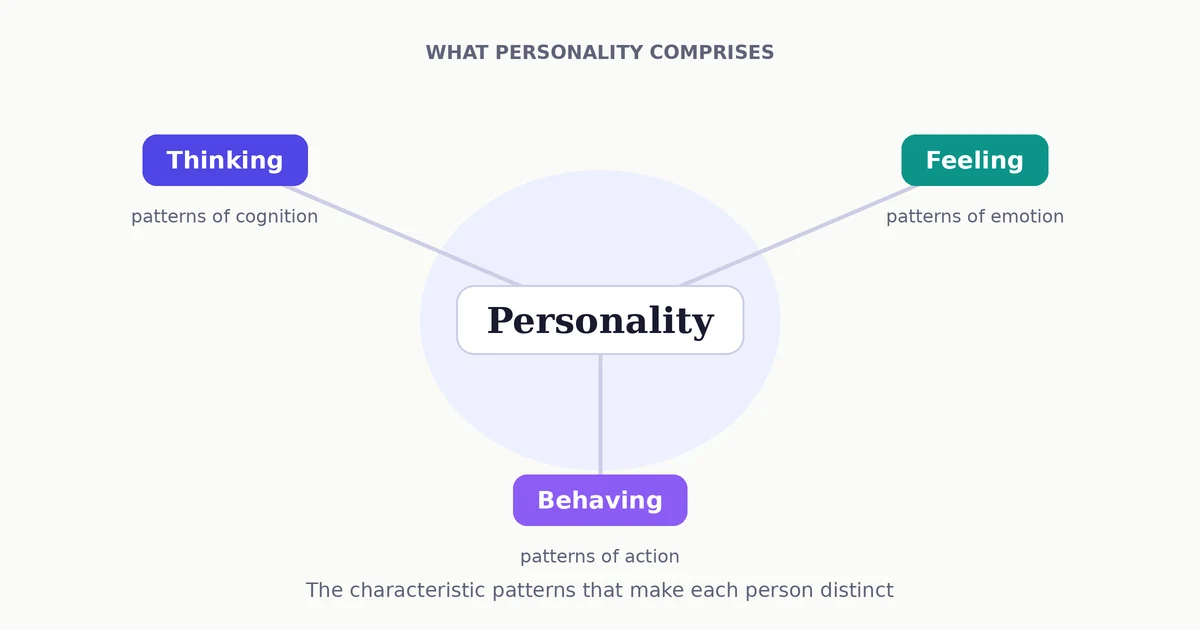
Personality is the characteristic pattern of how you think, feel, and behave — the tendencies that make your reactions recognizably yours across time and situations. The American Psychological Association defines personality as “the enduring configuration of characteristics and behavior that comprises an individual’s unique adjustment to life,” including traits, interests, drives, values, self-concept, abilities, and emotional patterns [1].
Notice the key words: patterns and enduring. Personality isn’t one thing you do — it’s the way you tend to be, again and again. One angry outburst doesn’t make someone an angry person; a lifetime of snapping at small frustrations might.
This guide explains what personality actually is: what it means to “have” a personality, the three components it’s built from, how it differs from character and temperament, the key concepts psychologists use to describe it, and how it shows up in ordinary life. (For the science that studies personality as a field, see our guide to personality psychology.)
Table of Contents
The Scientific Definition of Personality
Psychologists define personality in strikingly similar ways, and they all point to the same core idea. An open psychology textbook describes it as “the long-standing traits and patterns that propel individuals to consistently think, feel, and behave in specific ways” [2]. Penn State’s psychology department calls it “the set of unique and relatively stable patterns of thought, emotion, and behavior that define an individual and their distinctive way of experiencing and interacting with the world” [4].
Three ideas run through every serious definition:
- It’s a pattern, not a moment. What matters is what you do characteristically — your typical way of responding. A single act reveals a situation; a pattern reveals a person [2].
- It’s relatively stable. It doesn’t reinvent itself every morning. Personality is long term and not easily changed [2] — which is why people who know you can predict your reactions.
- It’s what makes you distinct. Everyone has a personality, and no two are identical. The APA notes it’s shaped by many forces: heredity, physical maturation, early experiences, identification with significant people and groups, culture, and critical life experiences [1].
Even the word itself carries this meaning. Personality comes from the Latin persona — the mask worn by actors in the ancient world, originally used to project a character’s traits to the audience [2]. Your personality is, in a sense, the character you play most consistently: yourself.
The Three Components of Personality: Thinking, Feeling, Behaving
Every definition of personality names the same three ingredients: characteristic patterns of thinking, feeling, and behaving — constantly shaping one another.
Thinking: Patterns of Cognition
This is your characteristic way of interpreting the world. Given the same ambiguous email from a boss — “Come see me” — one person immediately thinks I’m in trouble while another thinks maybe there’s good news. Neither thought is forced by the email itself; each reflects a habitual pattern of interpretation. Optimists, worriers, planners, and daydreamers differ largely in these automatic thought patterns.
Feeling: Patterns of Emotion
This is your characteristic emotional life: which emotions come easily to you, how intensely you feel them, and how quickly they pass. Some people are quick to anger and slow to calm down; others are rarely ruffled but also slow to feel excitement. Two people can face the same stressful day and feel it completely differently — one flooded with anxiety, the other merely tired. The feeling pattern is as much a part of personality as any behavior.
Behaving: Patterns of Action
This is what people can actually see: your habits, social choices, routines, and reactions. The friend who always arrives early, the colleague who talks through every problem out loud, the neighbor who waves at everyone on the street — these are behavioral patterns, the visible surface of personality.
The three components feed into each other. A habitual thought (“people can’t be trusted”) breeds a habitual feeling (suspicion) which breeds a habitual behavior (keeping distance) — and the behavior then confirms the thought. Personality is this whole loop, running in the background of your life.
Personality vs. Character vs. Temperament
People use these three words interchangeably, but they mean different things. Getting them straight clears up a lot of confusion about what personality is — and what it isn’t.
| Personality | Character | Temperament | |
|---|---|---|---|
| What it is | The whole package: your full pattern of traits, thoughts, feelings, and behaviors | The moral and ethical dimension of personality — your values and moral conduct | The biologically rooted foundation of personality, present early in life |
| Scope | Broadest — everything characteristic about you | Narrow — only the moral dimension | Narrow — basic tendencies like energy level, emotional responsiveness, and reactivity |
| Origins | Genes, maturation, experience, culture — all of it [1] | Shaped by upbringing, culture, and personal choice | “Usually assumed to be biologically determined and present early in life” [3] |
| Example | Being the reliably upbeat, organized person in every group you’re part of | Returning a lost wallet even when no one would know | An infant who startles easily at loud sounds while another barely reacts |
Think of it this way: temperament is the raw material you’re born with — your basic reactivity and energy. Character is the part of you that answers moral questions — honesty, loyalty, fairness. Personality is the whole structure built from temperament, character, habits, self-image, and everything else [1][3]. Character and temperament are both parts of personality, not synonyms for it.
Key Concepts: Traits, the Self, and Motives
Three concepts do most of the heavy lifting whenever psychologists talk about personality. Here’s what each one actually means.
Traits
Traits are the building blocks of personality: enduring patterns of thinking, feeling, and behaving that describe a person’s tendencies. Generosity, punctuality, curiosity, and anxiety-proneness are all traits. What makes a quality a trait rather than a passing state is consistency — it must be “part of an enduring behavior pattern,” a consistent and predictable quality [2].
A crucial point: traits are spectrums, not boxes. Nobody is purely “organized” or “disorganized” — everyone falls somewhere along a continuum, most of us near the middle. One of the most influential ways researchers map these spectrums is the Big Five model, which describes personality along five broad dimensions: openness, conscientiousness, extraversion, agreeableness, and neuroticism [4].
The Self
If traits describe how you tend to act, the self is your conscious reflection on your own being — your identity as you experience it from the inside. The APA includes self-concept among the core ingredients of personality [1], and for good reason: the story you tell about who you are shapes your choices, and your experiences keep rewriting that story.
Consider someone who thinks of herself as “not a math person.” That self-concept will steer her away from quantitative courses and careers — and each avoided course then confirms the story. Traits and the self constantly influence each other: your patterns feed your self-image, and your self-image steers your patterns.
Motives
Motives are the underlying needs and desires that drive behavior — the why behind what people do. The APA’s definition of personality explicitly includes drives alongside traits and values [1], because the same outward behavior can spring from very different inner engines.
Example: two people volunteer every weekend at the same animal shelter. One is driven by genuine compassion for animals; the other is driven mainly by a need for social recognition. Same behavior, different motive — and understanding the difference tells you far more about each person’s personality than the volunteering itself does. Personality isn’t just what people do; it’s what moves them to do it.
How Personality Shows Up in Daily Life
Personality is abstract until you watch it operating. Here are two everyday scenes:
Exam week. Two students face the same final exam. One has color-coded notes, a study schedule made three weeks ago, and a packed bag the night before. The other studies in intense last-night bursts fueled by panic and energy drinks. Same goal, same intelligence possibly — but their characteristic patterns of planning, anxiety, and effort are on full display. That’s personality: not the grade they get, but the way each of them gets there.
The surprise visitor. A friend drops by unannounced. One host lights up, pulls out snacks, and talks for two hours. The other is polite but visibly drained afterward, needing quiet time to recover. Neither reaction is “correct” — they’re different characteristic patterns of responding to social spontaneity.
A few honest caveats matter here:
- Personality describes tendencies, not scripts. A shy person can still give a brilliant presentation; a disorganized person can still meet a deadline. Traits tilt the odds — they don’t dictate every act.
- Situations matter too. Personality explains the pattern across situations, not any single one. Someone calm at work but explosive in traffic isn’t “faking” either version — strong situations can override typical patterns.
- There’s no ideal personality. Different patterns are advantages in different contexts: the cautious planner thrives where the spontaneous improviser struggles, and vice versa. The useful question is fit, not rank.
This is also why personality matters so much in relationships. Much everyday friction comes down to people genuinely processing the world differently — the planner frustrated with the improviser, the talk-it-out partner baffled by the need-space-to-think partner. Recognizing these as personality patterns rather than personal attacks defuses an enormous amount of conflict.
Is Personality Fixed?
No — but it’s not fluid, either. Personalities are “long term, stable, and not easily changed” [2], yet they also “develop and evolve throughout an individual’s lifespan,” rooted in both genetic and environmental factors [4].
Your core tendencies tend to stay recognizable across decades — the cautious child often becomes the careful adult. But their expression shifts with age, roles, and experience: people commonly become more planful and emotionally steady as they move through adulthood, and major life events can nudge patterns in new directions.
The practical takeaway: personality is stable enough to be you, and flexible enough that deliberate effort — new habits, new environments, new self-understanding — can genuinely reshape it over time. Change is slow and gradual, not overnight.
Why Understanding Personality Matters
Understanding personality pays off in ordinary life: naming your own patterns helps you play to your strengths and choose environments that fit who you are; seeing others’ behavior as expressions of their patterns makes empathy much easier; and recognizing differences as patterns rather than personal attacks defuses an enormous amount of everyday conflict.
One important boundary: this knowledge is educational. Understanding personality helps you reflect and empathize; it doesn’t diagnose mental health conditions, and reading about traits is not a substitute for professional guidance. If you’re struggling, a qualified professional is the right next step.
Frequently Asked Questions
What’s the difference between personality and character?
Personality is the whole package — your full pattern of traits, thoughts, feelings, and behaviors. Character is just the moral dimension of that package: your values and ethical conduct, like honesty and fairness. Character is part of personality, not a synonym for it.
What’s the difference between personality and mood?
Mood is a temporary emotional state — you can wake up irritable and feel fine by lunch. Personality is the enduring pattern underneath: the characteristic way you tend to think, feel, and behave across time and situations [1][2]. A mood passes; a pattern persists.
Are you born with your personality?
Partly. Temperament — your biologically rooted reactivity and energy level — is present early in life [3]. But personality as a whole develops from the ongoing interaction of those biological foundations with experience, culture, and relationships [1][4]. You’re born with the raw material, not the finished product.
Can personality change over time?
Yes, gradually. Personality is relatively stable and not easily changed [2], but it also develops and evolves across the lifespan under the influence of genes and environment [4]. Core tendencies stay recognizable, while their expression shifts with age and experience.
Why do psychologists define personality as “patterns” rather than single behaviors?
Because a single behavior is mostly explained by the situation. It’s the repetition — the characteristic way someone responds again and again — that reveals personality [2]. Patterns are what let you predict, with reasonable accuracy, how someone will handle the next unfamiliar situation.
References & Further Reading
- Personality — APA Dictionary of Psychology. https://dictionary.apa.org/personality
- What Is Personality? — Psychology, OpenStax via Maricopa Community Colleges. https://open.maricopa.edu/psy101brown/chapter/what-is-personality/
- Temperament — APA Dictionary of Psychology. https://dictionary.apa.org/temperament
- Personality — Department of Psychology, Penn State. https://psych.la.psu.edu/about-us/research/personality/
Keep Exploring
Personality is the foundation this site is built on — start with the science that studies it in our guide to personality psychology. Coming soon: dedicated guides to personality traits, the major theories of personality, and how personality develops across the lifespan.
1 thought on “What Is Personality? Definition & Key Concepts”