
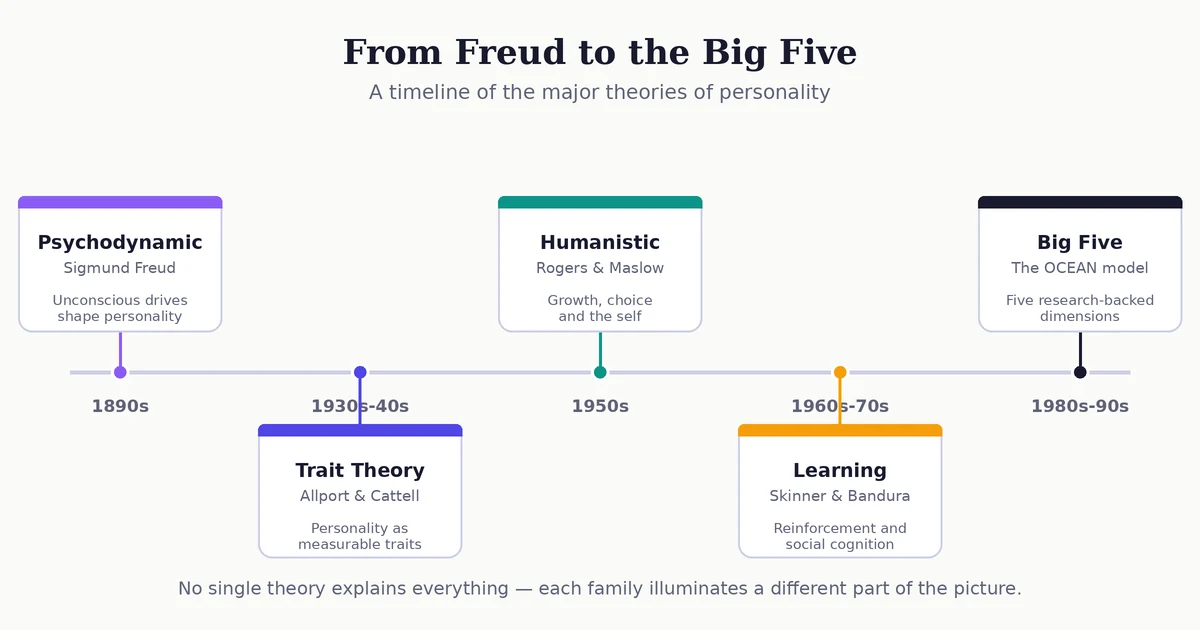
Why do people behave the way they do? Over more than a century, psychologists have answered that question with at least six major families of theory — from Freud’s unconscious drives to the Big Five trait model widely used in research today. Each one captures something real, and each one misses something important. This guide tours all six honestly: what each theory claims, what it explains best, and where the evidence falls short.
(Our complete guide to personality psychology summarizes these families briefly — this article is the deep-dive. And if you’re still fuzzy on what personality itself means — those enduring patterns of thinking, feeling, and behaving — start there.)
Table of Contents
Psychodynamic Theories: Freud and the Unconscious
Sigmund Freud (1856–1939) built the first comprehensive theory of personality, and its core idea is conflict. According to Freud, personality develops from a struggle between two forces: our biological aggressive and pleasure-seeking drives, and our internalized social control over those drives. Personality is what emerges as we try to balance the two [1].
Freud pictured the mind as an iceberg: roughly a tenth conscious, the rest — the unconscious — hidden from us yet still shaping our behavior. Unacceptable urges get pushed out of awareness through repression, leaking out in disguised form — the famous “Freudian slip” [1].
Freud described three interacting systems inside this divided mind [1]:
- The id — present from birth, it holds our most primitive drives (hunger, thirst, sex) and operates on the pleasure principle: it wants immediate gratification, consequences be damned.
- The superego — our conscience and moral compass, built from social rules about right and wrong. It strives for perfection and judges us, producing pride when we measure up and guilt when we don’t.
- The ego — the rational self, the part others actually see. It operates on the reality principle, finding realistic ways to satisfy the id without triggering the superego’s guilt.
A strong ego that can balance id and superego means a healthy personality, in Freud’s view. Imbalances cause trouble: a person dominated by the id may be narcissistic and impulsive, while a person ruled by a harsh superego may be strangled by guilt and deny themselves even ordinary pleasures [1].
When the ego fails to mediate the conflict, anxiety follows — and the ego deploys defense mechanisms: unconscious, reality-distorting behaviors that reduce anxiety. We all use them, Freud argued; overuse is the problem. The roster includes repression (blocking painful memories), reaction formation (expressing the opposite of what you feel), regression, projection, rationalization, displacement, and sublimation [1].
Here’s a defense mechanism in everyday life: a job applicant rejected after a final-round interview tells friends the company was “too corporate for me anyway.” That may be true — or it may be rationalization, the ego recasting a bruising outcome into a comfortable story.
Freud also claimed personality forms in early childhood through psychosexual stages — oral, anal, phallic, latency, and genital — in which the id’s pleasure-seeking focuses on different parts of the body. Poor handling of a stage’s conflicts leaves a person “fixated”: harsh toilet training, for example, could produce an anal-retentive adult — stingy, stubborn, compulsively orderly — while overly lenient training could produce an anal-expulsive one — messy and disorganized [1].
What it explains best: inner conflict, and why childhood experiences can echo through adult life. Freud was also the first to study the unconscious systematically, and the “talking cure” he developed from it founded psychotherapy [1].
The honest appraisal: many of Freud’s specific claims — the psychosexual stages, the Oedipus complex, dream interpretation, the literal id/ego/superego — are difficult to test and have weak direct empirical support. Modern personality science has largely moved toward models it can measure. But the nuance: psychologist Drew Westen’s landmark 1998 review in Psychological Bulletin argued that the broad propositions of contemporary psychodynamic theory — unconscious mental processes exist, we harbor ambivalent motives, childhood shapes adult dispositions, we carry mental models of self and others — are supported by research across cognitive, social, developmental, and personality psychology. Critics, he noted, typically attack an archaic 1920s version of the theory that most clinicians themselves consider obsolete [5]. In short: Freud’s machinery is largely historical, but his two biggest hunches — the unconscious and the power of early experience — survived in refined form.
Trait Theories: Personality as Measurable Dimensions
Trait theories take a completely different approach: instead of asking why you’re the way you are, they ask what you’re like — and try to measure it. The core claim is that personality consists of traits, characteristic ways of behaving, and that everyone has the same traits, differing only in degree [2].
The idea matured in stages:
- Gordon Allport combed the English language and found some 4,500 words that describe people. He sorted traits into cardinal traits (one trait dominating an entire life — think Ebenezer Scrooge’s greed or Mother Teresa’s altruism), central traits (the main building blocks of personality, like kindness or grouchiness), and secondary traits (situational preferences, like always ordering salad dressing on the side) [2].
- Raymond Cattell trimmed the list to about 171 traits and, using statistical analysis, identified 16 underlying factors — warmth, emotional stability, dominance, liveliness, and others. His 16PF questionnaire scores each factor on a continuum from high to low rather than present-or-absent [2].
- Hans and Sybil Eysenck went biological, arguing personality is largely governed by genetics. They proposed two dimensions — extraversion/introversion and neuroticism/stability — and later added a third, psychoticism versus superego control [2].
Then came the model that stuck. The Big Five — openness, conscientiousness, extraversion, agreeableness, neuroticism (OCEAN) — is “the most popular theory in personality psychology today and the most accurate approximation of the basic personality dimensions” [2]. Everyone has all five, each on a spectrum, with most people near the middle. The factors are relatively stable across life with slight shifts — conscientiousness rises into middle age, agreeableness peaks around 50–70, neuroticism and extraversion dip slightly — and they replicate across cultures and show substantial genetic components [2]. Practical payoff: conscientiousness predicts academic success across numerous studies [2].
This section is the overview, not the deep-dive — see our overview of personality traits for the foundations, and we’ll publish a dedicated guide to the Big Five soon.
What it explains best: consistent patterns across situations — and it predicts real outcomes, from grades to job performance, better than any rival.
The honest appraisal: trait theory describes better than it explains. It tells you where someone falls on five dimensions but says less about how those traits develop or the mechanisms behind them. And the model still evolves: the HEXACO model adds a sixth factor, honesty-humility, alongside variants of the other five [2].
Humanistic Theories: The Drive to Grow
Humanistic psychology emerged as the “third force” — a reaction both to psychoanalysis, with its pessimistic determinism, and to behaviorism, which treated humans as passively reacting to the environment, “personality-less robots.” Humanists didn’t claim the other views were wrong; they argued those views missed the depth of human experience and our innate capacity for self-directed change. Where Freud studied disturbance, humanists studied how healthy people develop [3].
Abraham Maslow studied people he considered healthy, creative, and productive — including figures like Albert Einstein and Eleanor Roosevelt — and found they shared traits like openness, creativity, spontaneity, compassion, and self-acceptance. His best-known idea, the hierarchy of needs, proposes that humans have needs that must be met in a certain order, topped by self-actualization: the achievement of our fullest potential. He distinguished needs that fill something missing from needs that inspire growth, and argued that many emotional and behavioral problems come from failing to meet these hierarchical needs [3].
Carl Rogers centered personality on self-concept — our thoughts and feelings about ourselves. Ask “Who am I?” and your answer reveals it. Rogers split the self into the ideal self (who you’d like to be) and the real self (who you actually are). When the two align, we experience congruence — and with it, self-worth and a healthy, productive life. A large gap produces incongruence and maladjustment. Parents help, Rogers argued, by giving children unconditional positive regard — unconditional love: “As persons are accepted and prized, they tend to develop a more caring attitude towards themselves” [3].
What it explains best: personal growth, self-concept, and the therapeutic relationship — Rogers’ client-centered therapy remains influential.
The honest appraisal: this is the hardest family to test. Concepts like self-actualization resist precise measurement, so humanistic theories have generated far less empirical research than trait or learning approaches. The standard criticism is that they’re inspiring but scientifically soft — and arguably too optimistic, downplaying the darker, less rational sides of human nature that Freud (for all his flaws) took seriously.
Behavioral Theories: Personality as Learned Behavior
The learning approaches flip the lens outward: they focus only on observable behavior. That’s also their stated advantage over psychodynamics — because they deal in observable, measurable phenomena, they can be scientifically tested [4].
B. F. Skinner, the strict behaviorist, rejected biological determinism entirely: personality is significantly shaped by reinforcements and consequences in the environment. We behave consistently because we’ve developed response tendencies — we increase behaviors that lead to positive consequences and decrease those that lead to negative ones. Crucially, Skinner disagreed with Freud that personality is fixed in childhood: it develops over our entire life, and because our responses can change with new situations, we should expect more variability over time than Freud allowed [4].
Watch the principle in action: a thrill-seeking twenty-something speeds on highways and takes up rock climbing. A decade later, as a parent, the reinforcement landscape has changed — reckless driving now risks what matters most — and she describes herself as a cautious person. Same person, learned patterns.
What it explains best: how experience molds behavior — and the hopeful message that personality isn’t cemented in childhood.
The honest appraisal: behaviorism treats the inner life as a black box. Thoughts, expectations, and biology are all sidelined in favor of rewards and punishments. As you’ll see next, even learning theorists found that omission too costly.
Social-Cognitive Theories: Thinking in a Social World
Albert Bandura agreed with Skinner that personality develops through learning — but insisted that thinking and reasoning are essential parts of it. His social-cognitive theory rests on three ideas [4]:
- Reciprocal determinism. Behavior isn’t determined by the environment alone. Instead, cognitive processes (beliefs, expectations, learned characteristics), behavior, and context all influence each other simultaneously [4].
- Observational learning. Much learning is vicarious: we watch others, note whether their behavior is reinforced or punished, and learn new behavior patterns from models — including which behaviors our culture rewards and which it punishes [4].
- Self-efficacy. Our confidence in our own abilities, built through social experience. People with high self-efficacy see goals as within reach, treat challenges as tasks to master, and recover quickly from setbacks; people with low self-efficacy avoid challenges, fixate on failure, and lose confidence after setbacks. It can be domain-specific — confident in English class, shaky in math [4].
Two fellow travelers belong here. Julian Rotter proposed locus of control: our beliefs about how much power we have over our lives. “Internals” credit their own efforts for outcomes; “externals” credit luck, chance, or other people. Research has linked an internal locus of control with better academic performance, career achievement, independence, health, coping, and lower depression [4].
Walter Mischel shook the field with the person-situation debate. Surveying decades of research, he concluded that personality traits are far less consistent across situations than trait theory assumed — behavior is consistent within similar situations instead. People, he argued, are “situation processors”: they interpret each situation cognitively and act on that interpretation. His famous marshmallow test found that preschoolers who could delay gratification did better years later — higher SAT scores, better relationships, less substance abuse, and as adults, more stable marriages. But a later, larger study found weaker associations, sensitive to cognitive ability, family background, and home environment — a correction, not a refutation [4]. Today the debate is mostly settled: psychologists consider both the person and the situation [4].
What it explains best: the role of thought in social behavior — and why the same person can act like two different people in two different rooms.
The honest appraisal: social-cognitive theory is strong on processes and weaker on structure. It explains variability beautifully but says less about why people differ in stable, enduring tendencies — which is exactly trait theory’s home turf.
Biological and Evolutionary Perspectives
The newest lens looks at the body. Biological approaches explain personality through the brain, nervous system, and genetics — the systems that shape how strongly we react to stress, how sensitive we are to rewards, and how we regulate emotion and attention. The key takeaway is not “genes determine who you are”: biology explains tendencies, and those tendencies develop through experience [6].
Behavioral genetics asks how much of the variation in personality across a population is associated with genetic differences — a quantity called heritability. Twin and family studies consistently find traits moderately heritable: some genetic influence, some environmental, not all-or-nothing. The Minnesota Study of Twins Reared Apart (1979–1999) found identical twins more similar than fraternal twins on many personality measures — even when raised in different homes. Two caveats: heritability describes groups, not individuals, and it is not destiny — it doesn’t mean a trait is fixed. Nor is there a single “personality gene”: many genes interact with environments that shape how they’re expressed [6].
Evolutionary psychology asks two questions: which traits are common across humans (because they helped us survive and cooperate), and why do individuals differ (because different traits pay off in different environments)? Boldness might win resources and status in one context; caution might keep you alive in another. Some theories explore how we allocate time and energy — to growth, mating, parenting, long-term planning — and how we signal our qualities through reputation, generosity, and displays of competence [6].
The honest appraisal: this is more a lens than a full theory of personality. Adaptive “why” stories are hard to test directly, and the field is young. Its strength is complementing trait theory’s what with a candidate why.
One Behavior, Three Explanations
Theories are easier to feel than to memorize. So meet Daniel: in every team meeting he talks over colleagues, steers decisions his way, and calls it “passion.” Two teams in a row have found him exhausting — and he has no idea why.
- Trait theory says Daniel scores high on extraversion (assertive, excitement-seeking) and low on agreeableness (competitive rather than cooperative). It’s a consistent pattern across situations — and it’s measurable [2].
- Social-cognitive theory says Daniel has high leadership self-efficacy and an internal locus of control: he believes he’s good at this, and that outcomes follow his efforts. Reciprocal determinism does the rest — his dominance earns him airtime (rewarded), which reinforces the behavior, while his belief that “meetings are battlegrounds” shapes how he reads every room [4].
- Psychodynamic theory hears rationalization in “I’m just passionate” — the ego protecting itself from an uncomfortable thought (“people dislike working with me”) — and wonders what early experience taught him that attention equals safety. Notice the honest caveat: this interpretation is far harder to test than a trait score, which is exactly the theory’s weakness [1].
Same behavior, three different questions. Trait theory asks what Daniel is like. Social-cognitive theory asks how his thinking and context sustain the pattern. Psychodynamic theory asks what hidden conflict it might express. Modern personality psychology keeps all three questions — but trusts most the answers it can measure.
Comparing the Major Theories
| Theory family | Key figures | Core idea | Main criticism |
|---|---|---|---|
| Psychodynamic | Sigmund Freud | Unconscious drives and childhood conflict shape personality | Specific claims are hard to test; weak direct empirical support |
| Trait | Allport, Cattell, Eysenck, McCrae & Costa | Personality is a set of measurable dimensions everyone shares in different degrees | Describes traits better than it explains how they develop |
| Humanistic | Maslow, Rogers | People are driven to grow; self-concept and choice matter | Key ideas resist precise measurement; less empirical research |
| Behavioral | B. F. Skinner | Personality is learned behavior shaped by reinforcement | Ignores the inner life — thoughts, feelings, and biology |
| Social-cognitive | Bandura, Rotter, Mischel | Cognition, observation, and situations shape who we become | Strong on processes, weaker on stable trait structure |
| Biological / evolutionary | — (research field) | Genes, brain systems, and evolved adaptations influence traits | Adaptive “why” explanations are hard to test directly |
Table: the six families of personality theory at a glance.
Where Modern Psychology Lands
No single theory won. Modern personality psychology is pluralist — it keeps the questions from every family and trusts the answers that survive testing.
On the evidence, one family clearly leads: trait research, especially the Big Five, is the most widely used and replicated framework in the field, and the best-supported approximation of personality’s basic dimensions [2]. When researchers want to predict real outcomes — academic success, job performance, relationship patterns — they reach for traits first.
Freud’s specific machinery is largely historical, but his two biggest hunches survived in refined form: much of mental life operates outside awareness, and early experience shapes the adult — propositions with genuine research support [5]. Social-cognitive ideas like self-efficacy underpin enormous amounts of applied work in therapy and education. Learning principles explain how patterns change. Biology grounds it all in the body.
The direction of the field is integration: trait structure, plus social-cognitive processes, plus biological bases — no single winner, but a clear empirical frontrunner.
Frequently Asked Questions
Which personality theory is most accepted by psychologists today?
Trait theories — specifically the Big Five. It’s the most widely used framework in personality research, described as the most accurate approximation of personality’s basic dimensions, with support replicated across cultures and ages [2].
Do psychologists still use Freud’s theories?
Not the literal apparatus. Freud’s cultural influence is enormous, but specific claims like the psychosexual stages and the id/ego/superego have weak empirical support, and research psychology has moved to testable models. What survived are the refined versions of his core ideas — unconscious mental processes and the lasting influence of early experience — which do have research support [5].
Is there one theory that explains all of personality?
No. Each family illuminates a different part of the picture: traits describe stable patterns, social-cognitive theories explain thought and context, psychodynamic ideas probe hidden conflict, and biology grounds it all. Modern research integrates them rather than picking a winner.
What’s the difference between trait theories and social-cognitive theories?
Trait theories describe structure — what you’re like, as stable dimensions. Social-cognitive theories describe process — how your thinking, observations, and situations shape who you become. The person-situation debate taught the field that you need both: the person and the situation together [4].
Can personality theories actually predict behavior?
To a degree. Traits predict tendencies and life outcomes — conscientiousness correlates with academic success [2], and an internal locus of control is linked with better academic, career, and health outcomes [4]. But behavior also depends on situations, so predictions are probabilistic, not destiny.
References & Further Reading
- Freud and the Psychodynamic Perspective — Psychology 2e (OpenStax). https://openstax.org/books/psychology-2e/pages/11-2-freud-and-the-psychodynamic-perspective
- Trait Theorists — Psychology 2e (OpenStax). https://openstax.org/books/psychology-2e/pages/11-7-trait-theorists
- Humanistic Approaches — Psychology 2e (OpenStax). https://openstax.org/books/psychology-2e/pages/11-5-humanistic-approaches
- Learning Approaches — Psychology 2e (OpenStax). https://openstax.org/books/psychology-2e/pages/11-4-learning-approaches
- Westen, D. (1998). The scientific legacy of Sigmund Freud: Toward a psychodynamically informed psychological science. Psychological Bulletin, 124(3), 333–371. https://psycnet.apa.org:443/doi/10.1037/0033-2909.124.3.333
- Explaining Personality: Learn It 4—Biological Approaches — Introduction to Psychology (Lumen Learning). https://content.one.lumenlearning.com/introductiontopsychology/chapter/biological-approaches/
Keep Exploring
Theories are the engine room of personality psychology — now see the rest of the machine: our complete guide to personality psychology, what personality actually is, and our overview of personality traits.
2 thoughts on “Major Theories of Personality: From Freud to the Big Five”