
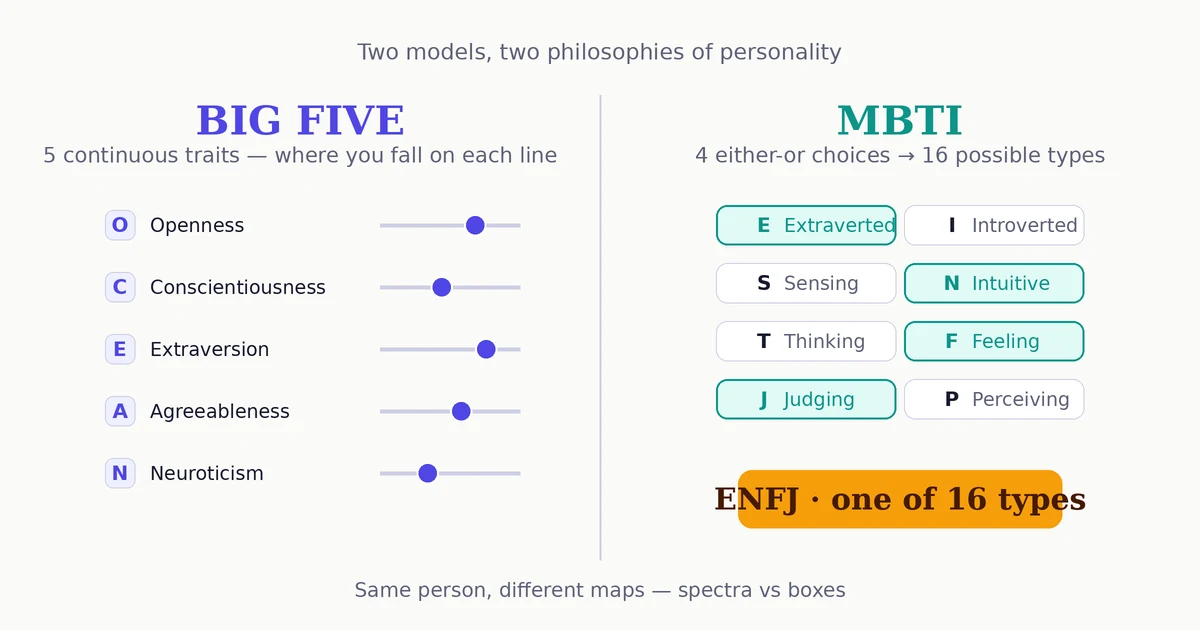
The Big Five describes your personality as five continuous traits — openness, conscientiousness, extraversion, agreeableness, and neuroticism. MBTI sorts you into one of 16 types, like INTJ or ESFP, based on four either-or preferences. That’s the core difference: the Big Five places you somewhere along five lines, while MBTI puts you in a box on each of four pairs — and researchers consider those two philosophies very different in scientific strength.
Of the two, the Big Five is the framework researchers actually use, backed by decades of replicated trait research. MBTI is far more popular and genuinely useful for self-reflection — but it has real measurement limits worth knowing before you take your four-letter code too seriously. Here’s an honest comparison: what each measures, what the research found, and what each is actually good for.
Key takeaways:
- The Big Five measures five traits as continua; MBTI sorts you into one of 16 types from four either-or pairs.
- Their scientific standing is not equal: the Big Five is the researchers’ standard, while the APA Dictionary notes the MBTI “has little credibility among research psychologists” [1].
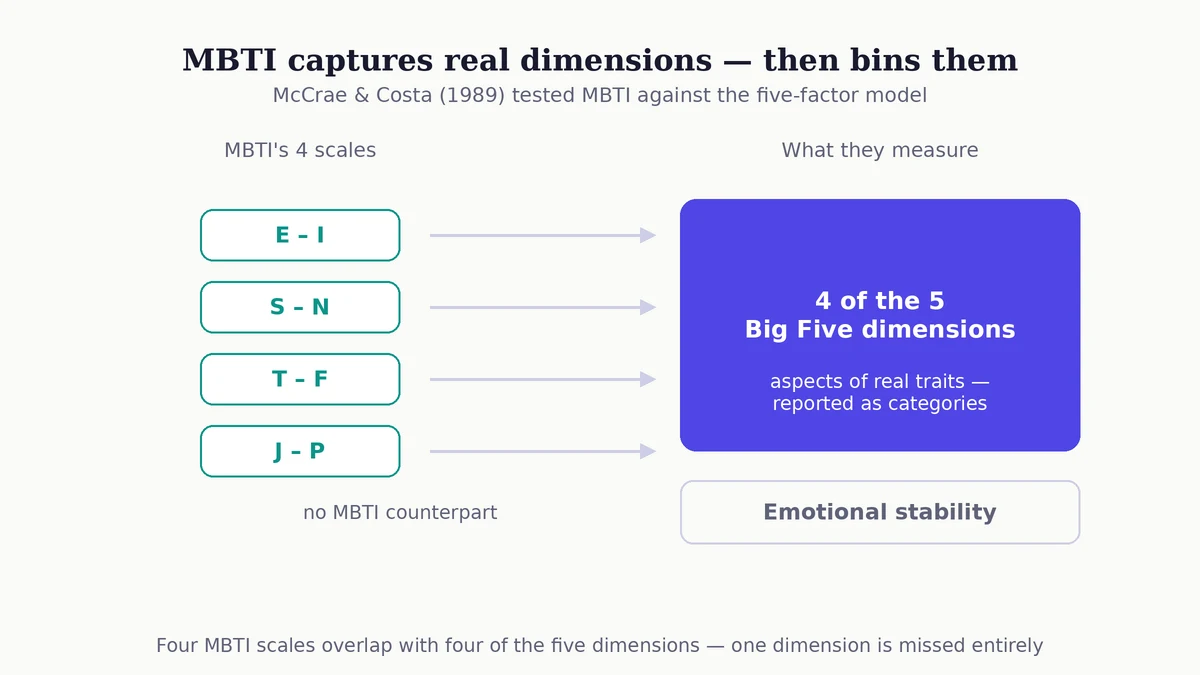
- Tested head-to-head, MBTI’s four scales overlap with four of the five Big Five dimensions — it captures something real, then bins it into types and misses one dimension entirely [2].
- Use MBTI for self-reflection and a shared vocabulary about differences; use the Big Five when you want a research-grade picture of personality. Neither one diagnoses anything.
Table of Contents
What the Big Five Measures
The Big Five — also called the five-factor model — is an empirically derived trait model: researchers studying how personality traits cluster together kept converging on the same five broad dimensions [2]. The five traits, remembered by the acronym OCEAN, are:
- Openness to experience — imagination, curiosity, appetite for novelty
- Conscientiousness — organization, discipline, follow-through
- Extraversion — sociability, assertiveness, energy from others
- Agreeableness — warmth, cooperation, trust
- Neuroticism — tendency toward anxiety, moodiness, and emotional reactivity
Each trait is a spectrum, not a box: you fall somewhere along each one, and nobody is “an extravert” with zero introversion [2]. It’s the most widely used framework in personality psychology, backed by decades of replicated studies — and our full guide walks through each trait in depth: the Big Five personality traits.
What MBTI Measures
The Myers-Briggs Type Indicator grew out of theory rather than data. Inspired by Carl Jung’s theory of psychological types and developed by Katharine Cook Briggs and her daughter Isabel Briggs Myers, the APA Dictionary defines it as “a personality test designed to classify individuals according to their expressed choices between contrasting alternatives in certain categories of traits” [1]. The four categories are:
- Extraversion–Introversion (E/I) — where you direct your energy: outward toward people and action, or inward toward ideas and reflection
- Sensing–Intuition (S/N) — how you take in information: concrete facts and details, or patterns and possibilities
- Thinking–Feeling (T/F) — how you make decisions: impersonal logic, or personal values and impact on people
- Judging–Perceiving (J/P) — how you organize life: structured and planned, or flexible and spontaneous
Your pattern of choices assigns you a type — one of 16 four-letter codes such as INTJ or ESFP [1]. According to the APA, the test is widely used in educational counseling and human resource management “to help improve work and personal relationships, increase productivity, and identify interpersonal communication preferences and skills” [1]. That’s a real, practical footprint — the type language has entered everyday culture.
The Core Difference: Dimensions vs Types
Here is the single most important distinction between the two frameworks: the Big Five measures dimensions, while MBTI assigns types.
Imagine two people who both get the “E” label. One answered 18 out of 20 questions in the extraverted direction — she’s clearly, strongly extraverted. The other answered 11 out of 20 — barely tipping past the midpoint. Both receive the identical label: “E.” The label erases the difference between them. In the Big Five, those two people would simply get different scores on the extraversion scale, and the difference would be visible.
If that second person retakes the test a month later and answers one question differently — 10 out of 20 — her letter flips from E to I. Her personality didn’t change; the cutoff did. Because MBTI forces a continuous range of answers into two boxes, small shifts near the middle can flip a whole letter of your “type.”
When McCrae and Costa tested the MBTI against the five-factor model in 1989, they found “no support for the view that the MBTI measures truly dichotomous preferences or qualitatively distinct types” — instead, the instrument measures “four relatively independent dimensions” [2]. The underlying reality is dimensional; the types are a formatting choice layered on top. Binning continuous scores into categories throws away information — and creates the illusion of sharp boundaries where none exist.
How the Science Compares
The table below puts the comparison side by side.
| Big Five | MBTI | |
|---|---|---|
| Origin | Empirical: derived by researchers studying how traits cluster in real data | Theoretical: inspired by Jung’s theory of psychological types [1] |
| What it measures | Five continuous traits (OCEAN) | Four either-or preferences |
| Output | A score profile — your position on each trait | A four-letter code — one of 16 types |
| Dimensions or types? | Dimensions: everyone has some of each trait | Types: you’re placed in a category on each pair [1] |
| Emotional stability | Measured (neuroticism) | Not covered — MBTI maps onto only four of the five dimensions [2] |
| Scientific standing | The researchers’ standard model, with decades of replicated support [2] | “Little credibility among research psychologists” [1] |
| Stability of results | Scores report degrees, not boxes — there is no cutoff to flip across | Type letters can shift on retesting, especially for scores near the midpoint [2][3] |
| Best for | A precise, research-grade picture of personality; tracking traits over time | Self-reflection, team workshops, a shared vocabulary for differences [1] |
| Not for | — | High-stakes decisions like hiring, or clinical diagnosis [1][3] |
The landmark head-to-head study is McCrae and Costa’s 1989 paper: 267 men and 201 women took both the MBTI and a Big Five inventory [2]. Their honest verdict: MBTI doesn’t measure qualitatively distinct types, but its four scales do “measure aspects of four of the five major dimensions of normal personality” [2]. That’s the balanced truth — MBTI captures real dimensions, then bins them. And one of the five dimensions, emotional stability, has no MBTI counterpart at all.
Reviewing the broader evidence, David Pittenger concluded the MBTI has “much intuitive appeal,” but the data warrant “extreme caution” in using it as a counseling tool, and it “may not yet be able to support the claims its promoters make” [3]. The APA’s assessment is similarly blunt [1]. Popularity and scientific support simply aren’t the same thing here.
What Each Is Good For
MBTI is at its best as a mirror and a conversation starter. Saying “I’m such a J — I plan my holidays in a spreadsheet” gives friends an instant shorthand for a real preference. In team workshops, the four pairs let people say “I process out loud; you need quiet to think” without anyone being wrong. That shared vocabulary, used with a light touch, is genuinely valuable — and the main reason the test has endured.
The Big Five is at its best when you want precision. Because it reports where you fall on each trait, it captures the difference between the 18-out-of-20 extravert and the 11-out-of-20 extravert. Researchers use it because dimensional scores are more reliable and more nuanced than type labels [2].
What neither is good for: decisions about other people’s futures. MBTI type shouldn’t determine hiring, team selection, or relationship compatibility — the evidence doesn’t support those uses [1][3]. Both frameworks are educational and descriptive, not clinical: they never diagnose mental health conditions. If you’re struggling, a qualified professional is the right next step — not a personality test.
Frequently Asked Questions
Is MBTI scientifically valid?
Only in a limited sense. Its four scales do tap into real dimensions of personality — they overlap substantially with four of the Big Five traits [2]. But the type system itself (16 distinct types, sharp either-or boundaries) isn’t supported by the evidence, and the APA Dictionary notes the test “has little credibility among research psychologists” [1]. Treat it as a self-reflection tool, not a scientific measurement.
Why does my MBTI type change when I retake the test?
Each MBTI scale is a continuous range of answers split at a midpoint, so if you score near the middle, tiny changes in your answers can flip a letter. The Big Five avoids this by reporting your actual position on each scale instead of forcing you into a box [2].
Do the Big Five and MBTI measure the same thing?
Partly. When researchers tested both against each other, they found MBTI’s four scales measure aspects of four of the five major Big Five dimensions [2] — so MBTI captures real dimensions of personality, just binned into categories. But the Big Five also measures emotional stability, which MBTI doesn’t cover, and reports degrees rather than types.
Which one should I take?
For a fun starting point for self-reflection or a team discussion, MBTI is fine — just hold the result lightly. For a more accurate, research-grade picture of your personality, choose a well-built Big Five assessment. Our guide to the Big Five personality traits is the place to start.
Keep Exploring
- The Big Five Personality Traits — our full guide to each of the five traits and how they’re measured.
- What Is Personality Psychology? — the foundations of the field these models belong to.
References & Further Reading
- Myers–Briggs Type Indicator — APA Dictionary of Psychology. https://dictionary.apa.org/myers-briggs-type-indicator
- McCrae, R. R., & Costa, P. T., Jr. (1989). Reinterpreting the Myers-Briggs Type Indicator from the perspective of the five-factor model of personality. Journal of Personality, 57(1), 17–40. https://pubmed.ncbi.nlm.nih.gov/2709300/
- Pittenger, D. J. (2005). Cautionary comments regarding the Myers-Briggs Type Indicator. Consulting Psychology Journal: Practice and Research, 57(3), 210–221. http://dx.doi.org/10.1037/1065-9293.57.3.210
1 thought on “Big Five vs MBTI: How Are They Different?”