
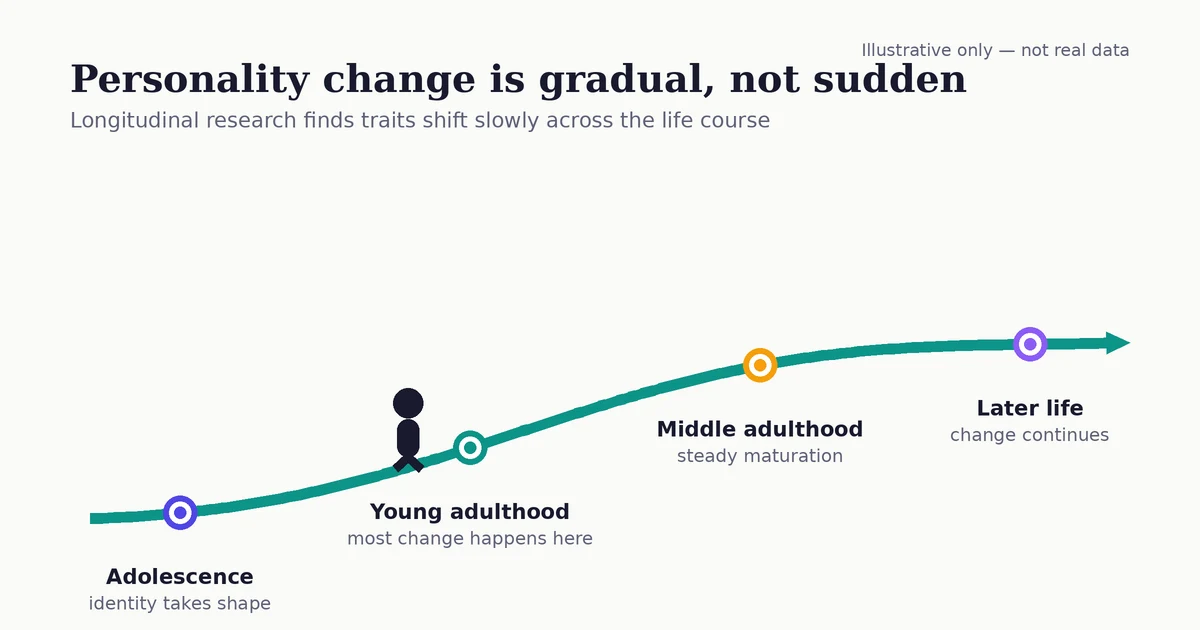
Yes — but slowly, and not in the dramatic way movies suggest. Decades of longitudinal research, which follows the same people for years and measures them repeatedly, shows that personality is both stable and changeable at the same time. That sounds like a contradiction until you learn the distinction researchers draw: your relative position compared to other people stays fairly steady, while your average levels of traits genuinely shift as you age. Grasp that distinction and the whole question clicks into place.
Table of Contents
Two Kinds of “Stability”: What Researchers Actually Measure
When psychologists ask whether personality is stable, they mean two different things — and mixing them up is where most confusion comes from.
Rank-Order Stability: Your Position Relative to Others
Rank-order stability asks: do people keep their relative ranking compared to everyone else? If you’re the most outgoing person in your friend group at 20, are you still among the most outgoing at 40?
The answer is: mostly, yes. The class clown usually doesn’t become the quietest adult in the room. People who are more conscientious than their peers at 25 tend to still be more conscientious than their peers at 45. Your rank in the group is sticky — even as everyone changes.
Mean-Level Change: How the Average Shifts
Mean-level change asks a different question: does the average level of a trait in a group go up or down with age? Here the answer is also yes — and this is where the real change lives.
Take conscientiousness. The whole group may drift upward over the decades: the 45-year-olds are, on average, more organized and reliable than they were at 25. The rank order can stay intact — the most conscientious 25-year-old is still the most conscientious 45-year-old — while everyone has moved up the scale. That’s stability and change happening at once.
| Rank-order stability | Mean-level change | |
|---|---|---|
| Question it answers | Do people keep their relative position vs. others? | Does the average level of a trait rise or fall with age? |
| What research finds | Fairly stable — your rank among peers persists | Real change — group averages shift across the lifespan |
| Everyday example | Still the funniest in your friend group at 40 | The whole group is calmer and more responsible than at 20. |
So “can personality change?” gets two honest answers: compared to others, you stay recognizably you; in absolute terms, you genuinely shift. Both are true.
What the Longest-Running Research Found
The clearest picture comes from meta-analyses — studies that pool dozens of longitudinal studies together. The landmark one is by Roberts, Walton, and Viechtbauer (2006), who combined 92 samples tracking personality across the life course [1]. Their findings:
- People increase in social dominance (a facet of extraversion — think assertiveness and confidence), conscientiousness, and emotional stability, especially in young adulthood, roughly ages 20 to 40.
- Social vitality (a second facet of extraversion — energy and sociability) and openness increase during adolescence but then decrease in old age.
- Agreeableness changed only in old age.
- Of the six trait categories studied, four showed significant change in middle and old age — personality keeps developing long after 30.
- Gender and participant dropout had minimal effects on the results, while longer studies and studies of younger cohorts showed greater change.
Researchers call the young-adulthood pattern the maturity principle: on average, people become more emotionally stable, more socially confident, more agreeable, and more conscientious — shifts that fit the demands of adult life [1][4]. It’s a description of what’s typical, not a prescription for what’s “best.”
A 2026 meta-analysis added an important piece. Haehner and colleagues pooled 362 longitudinal studies covering nearly 400,000 people and asked whether personality variance — how spread out people are — changes with age [2]. It barely does: at the population level, people neither get more different from each other nor more alike across the lifespan. (The only exceptions were more spread in neuroticism during late childhood and early adolescence, ages 5–14, and less spread in extraversion during middle and late adulthood, ages 45–80.) The same paper confirms what earlier meta-analyses found: mean levels and rank orders of traits do change across the lifespan — the change is real, it’s just orderly rather than chaotic [2].
The honest summary of the evidence: personality change is gradual, not dramatic. It unfolds over years and decades. Nothing in these data looks like an overnight transformation.
What Seems to Drive Change
Researchers haven’t fully settled why traits shift, but two threads of evidence stand out. Both deserve careful framing.
Life Roles and Experiences
Notice when the biggest changes happen: young adulthood, ages 20 to 40 — the same stretch of life packed with new roles. First serious jobs, committed partnerships, parenthood, financial responsibility. The leading interpretation in the literature is that these roles pull traits along with them: work rewards reliability, relationships reward patience, responsibility rewards steadiness.
That’s an interpretation, not a proven causal chain — the research shows the timing, and researchers read roles as the most plausible engine. But consider how natural the mechanism feels. Someone chronically disorganized at 22 takes a job running a small team; year after year of deadlines, budgets, and people depending on them, and the reliable habits stop being an act. The role didn’t just use their conscientiousness — it built more of it.
For how these patterns get established in the first place, the developmental backstory matters — but that’s a separate explainer, not this article’s job.
Deliberate Effort: Can You Choose to Change?
This is the question most people actually mean: can I decide to become different? The best-tested answer comes from Hudson and Fraley (2015), who ran two 16-week intensive experiments [3]. People who set explicit goals to increase a Big Five trait — say, extraversion — reported real increases in that trait over the 16 weeks, along with more trait-relevant daily behavior. One tested intervention (training people to form concrete “if-then” plans, like “If a coworker invites me to lunch, I’ll say yes and ask them one question about themselves”) measurably helped; another intervention did nothing.
Take the findings at face value, with the caveats the authors themselves stress: these were self-reported traits over 16 weeks, the shifts were modest, and the authors call the work “a first step,” not a finished science [3]. Deliberate change looks possible — but it looks like practicing new habits until they stick, not flipping a switch.
The Honest Takeaway
Pull it together and the research tells a coherent, unglamorous story:
- You’re not fixed. Mean levels of traits genuinely shift across the lifespan, and deliberate effort can nudge them.
- Change is slow and effortful. Think months and years of consistent behavior, not a weekend workshop.
- Beware anyone promising rapid personality overhauls. Nothing in the longitudinal data looks like that. Big promises are a marketing signal, not a scientific one.
- There’s no finish line to aim for. The maturity principle describes what’s typical with age — it doesn’t define an ideal personality. Different traits are advantages in different lives.
One important distinction: this article is educational. It describes patterns researchers observe in populations. It isn’t therapy advice, and it can’t tell you what to do about your own struggles. If personality-related difficulties are persistently hurting your relationships, work, or well-being, a qualified professional is the right next step — not an article.
Frequently Asked Questions
Does personality keep changing after 30?
Yes. In the Roberts et al. (2006) meta-analysis, four of six trait categories showed significant change in middle and old age [1]. The largest shifts happen in young adulthood (roughly 20 to 40), but development doesn’t stop at 30 — it just slows.
Can I become more extroverted?
Possibly, gradually. In Hudson and Fraley’s (2015) experiments, people who wanted to become more extraverted reported real gains over 16 weeks, especially when they made concrete if-then plans for trait-relevant behavior [3]. Think building habits — accepting more invitations, starting more conversations — not rewiring your nature.
Can therapy change your personality?
That’s a question for a qualified clinician, not something this article can answer. Therapy is designed to relieve distress and change unhelpful patterns; whether and how that shows up in trait measures is a clinical question, and persistent difficulties deserve professional support either way.
Is there an ideal personality I should try to change toward?
No. The maturity principle describes what’s typical as people age, not what’s best. As we explain in our complete guide to personality psychology, there’s no ideal personality — different traits are advantages in different contexts, and the useful question is fit, not rank.
References & Further Reading
- Roberts, B. W., Walton, K. E., & Viechtbauer, W. (2006). Patterns of mean-level change in personality traits across the life course: A meta-analysis of longitudinal studies. Psychological Bulletin, 132(1), 1–25. https://psycnet.apa.org:443/doi/10.1037/0033-2909.132.1.1
- Haehner, P., Buecker, S., Altorfer, M. J., Bocklet, V. V., & Bleidorn, W. (2026). Does the variance of personality traits change across the lifespan? A meta-analytic review of longitudinal studies. Psychological Bulletin, 152(5-6), 544–574. https://psycnet.apa.org:443/doi/10.1037/bul0000523
- Hudson, N. W., & Fraley, R. C. (2015). Volitional personality trait change: Can people choose to change their personality traits? Journal of Personality and Social Psychology, 109(3), 490–507. https://psycnet.apa.org:443/doi/10.1037/pspp0000021
- “Maturity principle” terminology as used in the peer-reviewed personality-development literature (e.g., Journal of Personality). https://onlinelibrary.wiley.com/doi/10.1111/jopy.12640
Keep Exploring
- How personality develops — the backstory: how these patterns form in the first place, from temperament through life experience.
- What is personality psychology? — the trait vocabulary (including the Big Five) behind everything above.