
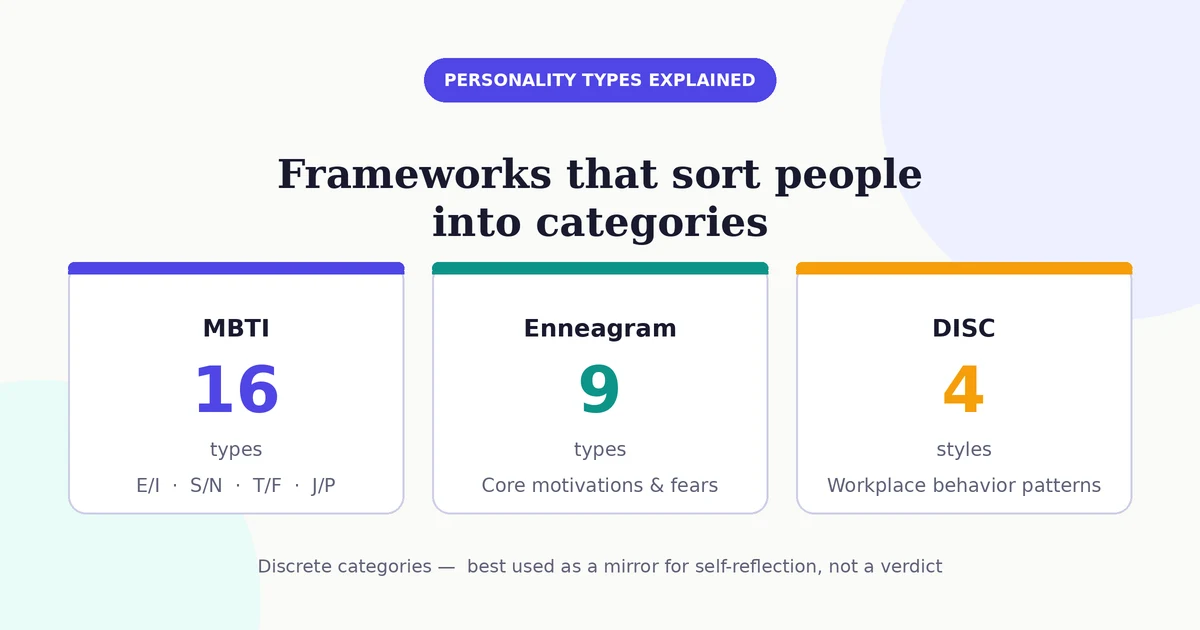
A personality type framework sorts people into discrete categories. Take the MBTI and you come out as one of 16 four-letter types, like INTJ or ESFP. Take the Enneagram and you get one of nine numbered types, each built around a core motivation. These systems are enormously popular — but they’re also controversial among personality researchers, because they chop continuous human traits into neat either/or boxes. This guide explains the major type frameworks accurately and gives you an honest picture of where the science stands.
Table of Contents
What Is a “Personality Type” Framework?
A type framework is built on one idea: people come in kinds. You take a questionnaire, your answers are tallied, and you land in a category — a “type.” The category comes with a description of how people of that type think, feel, and behave.
That makes type frameworks different from trait frameworks, which is worth getting clear on. A trait model places you somewhere along continuous dimensions — for example, how extraverted you are on a scale. A type model draws a line through the middle of that scale and puts you on one side of it. Our guide to personality psychology covers the broader field, and a separate article will compare types and traits in depth.
Type labels can be genuinely useful mirrors: they give you language for patterns you already recognize in yourself. They are not diagnoses. A type result describes tendencies and preferences; it says nothing about mental health, and it should never be used as one.
The MBTI: 16 Types from 4 Dichotomies
The Myers–Briggs Type Indicator (MBTI) is the most famous type framework in the world. It’s a self-report questionnaire that sorts you into one of 16 types by assigning you a preference on each of four dichotomies [1][2].
The Four Dichotomies, Explained
Each dichotomy is a pair of opposite preferences. You get one letter from each, and the four letters together form your type (INTJ, ESFP, and so on) [2]:
- Extraversion (E) vs. Introversion (I) — where you direct your energy. In practice, this often shows up in how you recharge: after a draining day, an extravert-leaning person might feel restored by calling friends, while an introvert-leaning person might prefer a quiet walk alone. Same day, different battery chargers.
- Sensing (S) vs. Intuition (N) — how you take in information. Sensing leans toward concrete details and what’s in front of you; intuition leans toward patterns and possibilities.
- Thinking (T) vs. Feeling (F) — how you make decisions. Imagine giving a friend honest feedback. The thinking-leaning friend weighs logic and fairness: is this accurate? The feeling-leaning friend weighs harmony and impact: how will this land? Both can reach the same decision — they just take different routes. (Feeling here means values-based, not emotional.)
- Judging (J) vs. Perceiving (P) — how you organize your outer life. Judging leans toward plans and settled decisions; perceiving leans toward flexibility and keeping options open. It’s not about being “judgmental” — it’s about preferring closure or openness [2].
Where the MBTI Comes From
The MBTI was created during World War II by Katharine Cook Briggs and her daughter Isabel Briggs Myers, inspired by Swiss psychiatrist Carl Jung’s 1921 book Psychological Types [1][2]. Neither woman was a trained psychologist, but Myers studied test construction and built the instrument to help people find work that fit them [2]. Jung described the first three preference pairs; Briggs and Myers added Judging–Perceiving [2].
What the Research Says About the MBTI
Here’s the honest picture. The APA’s dictionary notes the MBTI has “little credibility among research psychologists,” while being widely used in educational counseling and human resource management to improve work relationships and communication [1]. Its defenders point to that practical usefulness; its critics point to the psychometrics.
The central criticism is about reliability — whether the test gives you the same answer twice. A sizable share of people get a different four-letter type when they retake it: commonly cited figures put same-type agreement around 50% over weeks or months, dropping lower over longer intervals [2]. Part of the problem is structural: the MBTI draws a hard line through the middle of each scale, so two people with nearly identical scores can land in different categories — one just above the line, one just below it [2]. That’s a real weakness if a framework claims to identify your “true” type, and it’s why researchers generally prefer models that report scores as positions on a continuum. (For the full head-to-head, see our comparison of the Big Five and MBTI.)
None of this means the MBTI is useless. As a structured conversation starter — a shared vocabulary for talking about how you and your colleagues differ — it has genuine value. Just treat your four-letter result as a working hypothesis about your preferences, not a fixed identity.
The Enneagram: 9 Types Built Around Motivation
The Enneagram takes a different approach: instead of sorting how you process the world, it tries to describe why you do what you do. It’s a typology of nine interconnected personality types, usually referred to by number, each organized around a characteristic pattern of motivation and fear [5]. A peer-reviewed review describes it as a system of nine character orientations — habitual patterns of perception, emotion, and behavior [4].
The Nine Types at a Glance
Each type pairs a characteristic role with a basic desire — the core motivation the system claims drives that type’s behavior [5]:
- The Reformer (Perfectionist) — driven by a desire for goodness and integrity; fears being bad or corrupt.
- The Helper (Giver) — driven by a desire to feel worthy of love; fears being unlovable.
- The Achiever (Performer) — driven by a desire to feel valuable; fears worthlessness.
- The Individualist (Romantic) — driven by a desire to be uniquely themselves; fears having no identity or significance.
- The Investigator (Observer) — driven by a desire for mastery and understanding; fears helplessness or incompetence.
- The Loyalist — driven by a desire for support and guidance; fears being without it.
- The Enthusiast — driven by a desire to feel satisfied and content; fears feeling trapped or deprived.
- The Challenger (Protector) — driven by a desire for influence and self-sufficiency; fears being controlled or harmed.
- The Peacemaker (Mediator) — driven by a desire for wholeness and peace of mind; fears loss and separation.
A concrete example of how this differs from trait thinking: imagine a colleague who organizes every office birthday party and remembers everyone’s coffee order. A trait model might just call her agreeable. The Enneagram would ask why — and if she’s a Type 2, the answer is that being needed feels like being loved. Same behavior, different engine.
Where the Enneagram Comes From
The modern Enneagram comes from spiritual and self-development traditions rather than academic psychology. Its contemporary form traces largely to Bolivian teacher Oscar Ichazo’s teachings in the 1950s, developed further by Chilean psychiatrist Claudio Naranjo in the 1970s, with older roots in the teachings of G. I. Gurdjieff [5]. It spread through books, workshops, and conferences, and surged again in popular culture from the late 2010s onward [5].
What the Research Says About the Enneagram
Formal psychometric study of the Enneagram has been limited. The most thorough review to date — a 2021 systematic review of 104 independent samples — found mixed evidence of reliability and validity: some factor-analytic work partially aligned with Enneagram theorizing, and Enneagram measures showed sensible relationships with established constructs like the Big Five, but analyses typically found fewer than nine distinct factors, and no study had used clustering techniques to derive the nine types from data [3]. Secondary features of the theory, like “wings” (the neighboring types said to flavor your core type), had little supporting research [3]. On the positive side, several studies found the Enneagram helpful for personal and spiritual growth [3].
The balanced take: the Enneagram is an unusually rich system for self-reflection, and some early research is encouraging, but its nine-type structure is not yet well supported as a scientific model of personality. Use it to ask better questions about yourself — not as a settled map of who you are.
Two Other Type Frameworks Worth Knowing
DISC focuses on observable behavior styles at work rather than inner personality. Originating in William Moulton Marston’s 1928 book Emotions of Normal People and turned into a practical assessment in the 1940s, it sorts workplace behavior into four styles: Dominance (D), Influence (I), Steadiness (S), and Conscientiousness (C) [7]. Its own proponents describe it as a behavioral tool for team communication — for example, recognizing that a high-Steadiness colleague may shut down when rushed, so an urgency-driven high-Dominance colleague can adjust [7]. It’s a commercial workplace instrument, not a research model of personality.
Holland Codes (RIASEC) sort vocational interests into six types — Realistic, Investigative, Artistic, Social, Enterprising, and Conventional — and use your top three to form a code matched against occupation profiles [6]. The U.S. Department of Labor’s O*NET Interest Profiler is built on Holland’s theory, and the underlying system has been tested with wide populations and found consistently reliable, meaningful, and easy to use [6]. Holland Codes aren’t really a personality typology — they’re about person–environment fit for careers — but people often encounter them alongside personality tests.
Type Frameworks Compared
| Framework | Core idea | Categories | Scientific standing |
|---|---|---|---|
| MBTI | Four preference dichotomies (E/I, S/N, T/F, J/P) combine into a type | 16 four-letter types | Enormously popular; widely used in counseling and HR. Little credibility among research psychologists; inconsistent test-retest reliability [1][2] |
| Enneagram | Nine types organized around core motivations and fears | 9 numbered types | Rich self-reflection system with spiritual-development roots. Formal psychometric study is limited; a systematic review found mixed reliability and validity evidence [3][4] |
| DISC | Four observable behavioral styles at work | 4 styles (D, I, S, C) | Commercial workplace tool for communication and teamwork; a behavioral (not personality-research) instrument [7] |
| Holland Codes | Six interest types matched to work environments | 6 types (RIASEC), combined into a 3-letter code | Built on a psychologist’s vocational theory; used by the U.S. Department of Labor’s O*NET; tested and found consistently reliable and meaningful [6] |
Table: the major type frameworks at a glance.
How to Use Type Frameworks Wisely
Type frameworks work best when you treat them as tools for reflection rather than verdicts about identity:
- Use them as a mirror, not a box. If a description resonates, ask what it reveals about your habits — then keep the insight and hold the label lightly. You are not “an INTJ” the way you are right-handed; you’re someone whose answers leaned a certain way on a certain day.
- Look at the underlying scores, not just the letters. Being “barely E” and “strongly E” are very different things, and the binary label hides that. Preferences near the middle are the ones most likely to flip on a retake [2].
- Don’t use them to decide other people’s futures. Type results are too unstable and too coarse for hiring, admissions, or clinical decisions. Team discussion and personal development are their natural home.
- Notice the Barnum effect. Vague, flattering descriptions feel personally true even when they could fit anyone — people often rate the MBTI’s accuracy higher than its scientific credibility warrants [2]. Specific feedback (“I interrupt people in meetings”) beats type-flavored poetry.
- Combine frameworks rather than marrying one. The MBTI sketches how you process things, the Enneagram asks why, and Holland Codes point at where you might thrive. Each answers a different question — none answers all of them.
One final, important note: none of these frameworks diagnose anything. Type labels are educational self-descriptions, not clinical assessments. If you’re struggling with your mental health, a qualified professional — not a personality quiz — is the right next step.
Frequently Asked Questions
Is the MBTI scientifically valid?
As a conversation starter about preferences, it has practical value and is widely used in counseling and workplaces [1]. As a scientific instrument, it has significant problems: research psychologists give it little credibility, and its test-retest reliability is inconsistent — many people get a different type on retaking [1][2].
Which personality type framework is most accurate?
None of the type frameworks functions like a calibrated measuring instrument the way trait models do. For career matching specifically, Holland Codes have the strongest practical track record — they’re backed by the U.S. Department of Labor’s O*NET system and tested as consistently reliable and meaningful [6]. For personality itself, researchers favor dimensional trait models over types; see our Big Five vs. MBTI comparison for why.
Can your personality type change?
Type theories generally say your underlying preferences are stable — so a changed result is more likely measurement wobble than a changed self. Given the MBTI’s documented test-retest instability [2], borderline preferences can easily flip between takes. Treat any single result as a snapshot, not a tattoo.
Should I use personality type tests for hiring?
Not as a decision tool. They’re best used for team development — helping colleagues understand each other’s working styles. Selection decisions should rest on validated methods, not on categories that a third or more of retakers land differently in [2].
References & Further Reading
- Myers–Briggs Type Indicator (MBTI) — APA Dictionary of Psychology. https://dictionary.apa.org/myers-briggs-type-indicator
- Myers–Briggs Type Indicator — Wikipedia. https://en.wikipedia.org/wiki/Myers%E2%80%93Briggs_Type_Indicator
- Hook, J. N., Hall, T. W., Davis, D. E., Van Tongeren, D. R., & Conner, M. (2021). The Enneagram: A systematic review of the literature and directions for future research. Journal of Clinical Psychology, 77(4), 865–883. https://pubmed.ncbi.nlm.nih.gov/33332604/
- Bland, A. M. (2010). The Enneagram: A review of the empirical and transformational literature. Journal of Humanistic Counseling, Education and Development, 49(1), 16–31. https://eric.ed.gov/?id=EJ886344
- Enneagram of Personality — Wikipedia. https://en.wikipedia.org/wiki/Enneagram_of_Personality
- Interest Assessment Help Page — CareerOneStop (U.S. Department of Labor). https://www.careeronestop.org/Toolkit/Careers/interest-assessment-help.aspx
- How DiSC is Different from Other Assessments — Archbright. https://www.archbright.com/blog/how-disc-is-different-from-other-assessments
Keep Exploring
Type frameworks are one window into personality — our guide to personality psychology opens the whole field, and our Big Five vs. MBTI comparison goes deeper on the type-vs-trait debate this article only sketches.
1 thought on “Personality Types Explained: MBTI, Enneagram & More”