
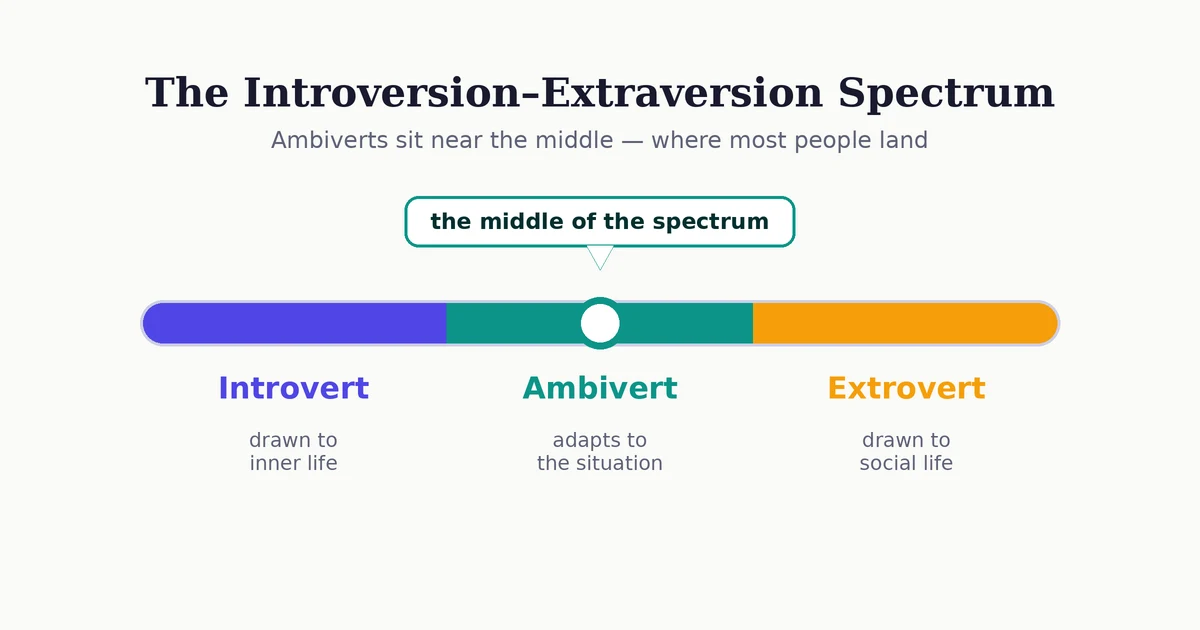
An ambivert is someone who sits near the middle of the introversion–extraversion spectrum — a person with a balance of introvert and extrovert qualities, who adapts their social energy to the situation. If “introvert” has never quite fit you but “extrovert” doesn’t either, you’re probably not confused. You’re likely in the large middle group that personality science says is the normal outcome.
The word itself tells the story: dictionaries define an ambivert as “one whose personality type is intermediate between extrovert and introvert” [1], or “a person who is intermediate between an extrovert and an introvert” [2]. The term dates to the 1920s, built from ambi- (“on both sides”) on the pattern of introvert and extrovert [1].
This guide explains what ambivert really means, why the middle of the spectrum is the most common place to be, and seven concrete signs that describe you.
Table of Contents
The Spectrum: Why the Middle Is the Most Common Place to Be
Here’s the key scientific point behind the whole concept: introversion and extraversion are not boxes you fall into — they are the two ends of one continuous dimension.
In trait psychology, personality traits are measured on continua, not categories. OpenStax’s psychology text describes the Five Factor Model with “each person [having] five traits, each scored on a continuum from high to low” [3], and the Eysencks’ classic theory treats extroversion/introversion as a dimension along which everyone lands somewhere [3]. A continuum has a middle by definition — and that middle is where a great deal of human variation sits. Ambivert is simply the convenient name for it.
That framing matters more than the label. Popular culture loves a clean divide — you’re either the life of the party or the quiet one in the corner. The science says something less dramatic and more useful: most people show a mix of both tendencies, leaning one way or the other depending on the situation. If you want the full picture of the two endpoints themselves, see our guide to introverts vs extroverts.
7 Signs You’re an Ambivert
One honest note before the list: there is no validated “ambivert test” in psychological research. What researchers measure is extraversion as a continuous trait — for example, in the best-known study on the topic, people scoring in the middle of an extraversion scale were the ones researchers called ambiverts [4]. So treat the signs below as recognizable patterns, not a diagnosis. Personality descriptions are educational: they describe tendencies, not clinical categories.
1. You enjoy socializing — and you genuinely enjoy being alone
This is the signature ambivert experience. A Friday night dinner with friends sounds wonderful, and a Saturday spent alone with a book sounds wonderful too — neither feels like settling. You don’t white-knuckle your way through social events the way a strong introvert might, and you don’t get restless alone the way a strong extrovert might. Both modes feel like home.
2. Your social energy depends on the situation and the people
Ask an ambivert whether people drain or recharge them and you’ll get the most ambivert answer possible: “it depends.” A lively evening with close friends feels effortless; the same evening spent making small talk with strangers feels exhausting. The people, the setting, and your mood all change the equation. Your social battery doesn’t follow one fixed rule — it responds to context.
3. You naturally switch between talking and listening
This is the trait researchers have actually documented. In psychologist Adam Grant’s 2013 study of 340 call-center employees, ambiverts — those scoring in the middle of the extraversion measure — achieved greater sales productivity than both extroverts and introverts, and Grant attributed it to a “flexible pattern of talking and listening”: enough assertiveness and enthusiasm to persuade, but enough listening to hear the other person’s interests [4]. In everyday life, you probably recognize this: you speak up when you have something to say, and you’re genuinely comfortable letting someone else hold the floor.
4. You adjust your style to the room
Reserved in an unfamiliar group, animated with people you trust. Quieter at a formal work event, louder at a friend’s barbecue. You dial your sociability up or down without much conscious effort — not as a performance, but because different settings genuinely bring out different sides of you. As psychologist Scott Barry Kaufman put it, ambivert people have “a more flexible mindset, which can be very useful in everyday life” [5].
5. You’re at ease both in crowds and one-on-one
Some people only shine in groups; others only in intimate conversation. Ambiverts tend to be comfortable in both. You can enjoy the buzz of a big gathering and the depth of a long one-on-one conversation — each in its own way. Neither setting feels like foreign territory.
6. You can take the lead or step back, depending on what’s needed
In a group project, you might be the one who presents the idea — and then happily do the quiet follow-up work while someone else takes the spotlight. You don’t need the center of attention, but you can hold it when the situation calls for it. That flexibility is a practical advantage: you fill whatever role the moment is missing.
7. Different people describe you differently
Your quieter friends call you the outgoing one. Your louder friends call you the chill one. If the label changes depending on who’s describing you, that’s a strong hint you’re in the middle — people are comparing you to themselves, and you land on the opposite side of each comparison. When no single label sticks, the middle is usually why.
| # | Sign in brief |
|---|---|
| 1 | Comfortable socializing and comfortable alone |
| 2 | Social energy depends on situation and people |
| 3 | Naturally balances talking and listening |
| 4 | Adjusts style to the room |
| 5 | At ease in crowds and one-on-one |
| 6 | Can lead or step back as needed |
| 7 | Others disagree on whether you’re “quiet” or “outgoing” |
What the Research Actually Says — Honestly
Ambivert is a popular-science term, and honesty requires saying that plainly. It is not a formal category in trait theory the way the Big Five’s extraversion trait is. Most of the scientific evidence concerns extraversion as a continuous dimension — and the ambivert concept rides on that dimension’s middle.
The single strongest peer-reviewed finding attached to the term is Grant’s 2013 study in Psychological Science: 340 outbound-call-center representatives, an inverted-U relationship between extraversion and sales revenue, with the middle scorers outperforming both extremes [4]. It’s a real, replicated-citation study — but it’s also one study, in one occupation, measuring one outcome. It doesn’t prove ambiverts are “better” at everything, and it shouldn’t be stretched into that claim.
What the broader trait literature does firmly support is the spectrum framing itself: personality traits are continuous dimensions [3], which is why a middle zone exists at all. So the most defensible version of the ambivert idea is modest: it’s a useful everyday word for the unremarkable, extremely common fact that most people land somewhere between the extremes of extraversion.
Why the Label Is Useful — and Its Limits
Why it’s useful. The label gives language to the middle majority. Without it, people who don’t fit either stereotype can feel like they’re failing at both — not social enough for the extrovert ideal, not introspective enough for the introvert one. “Ambivert” dissolves a false dichotomy and normalizes being in between. It’s also a practical reminder, as personality psychology teaches, that traits describe patterns and tendencies — not destinies.
Its limits. First, any cutoff is arbitrary. Grant’s “ambiverts” were a score band on an extraversion scale [4] — a useful research definition, not a natural kind with a sharp boundary. Second, a label isn’t an explanation: knowing you’re “an ambivert” doesn’t tell you why you adapt to situations, which is the more interesting question. Third, like all personality labels, it’s descriptive, not clinical — it doesn’t diagnose anything, and reading about traits is no substitute for professional guidance if you’re struggling.
Frequently Asked Questions
Is “ambivert” a real personality type?
The word is real and widely used, and dictionaries define it straightforwardly [1][2]. In scientific trait models, though, it’s not a separate type — it’s the middle range of the extraversion continuum [3]. Think of it as a convenient everyday term rather than a formal scientific category.
Can you be both an introvert and an extrovert?
In trait terms, yes — everyone has some of both tendencies, since introversion and extraversion are opposite ends of one dimension [3]. “Ambivert” is simply the name for having a meaningful amount of each and shifting between them with context.
Is it better to be an ambivert?
No. There’s no hierarchy of goodness among personality traits — each has advantages and disadvantages depending on the situation [5]. The useful question is never which trait is best, but which patterns serve you well in the life you actually live.
Can you change where you sit on the spectrum?
Personality traits are relatively stable patterns, but behavior is flexible: anyone can practice speaking up, listening well, or setting social boundaries regardless of where they land. A label describes your typical pattern — it doesn’t lock it in.
References & Further Reading
- Ambivert — Dictionary.com. https://www.dictionary.com/browse/ambivert
- Ambivert — Collins Dictionary. https://api.collinsdictionary.com/dictionary/english/ambivert?context=english-spanish
- 11.7 Trait Theorists — Psychology 2e (OpenStax). https://openstax.org/books/psychology-2e/pages/11-7-trait-theorists
- Grant, A. M. (2013). Rethinking the extraverted sales ideal: The ambivert advantage. Psychological Science, 24(6), 1024–1030. https://pubmed.ncbi.nlm.nih.gov/23567176/
- Extrovert or Introvert: Most People Are Actually Ambiverts — Scientific American. https://www.scientificamerican.com/article/extrovert-or-introvert-most-people-are-actually-ambiverts/
Keep Exploring
Ambiversion makes most sense against the full picture: compare the two ends of the spectrum in our introvert vs extrovert guide, read about the underlying extraversion trait, or start from the foundations with what personality psychology is.