
Extraversion is one of the five broad personality traits psychologists use to describe how people differ. In simple terms, it captures how outwardly engaged you tend to be: how much you seek out people, activity, and stimulation — and how much energy and positive feeling you bring to the world around you [1].
It is the trait behind a familiar observation. Some people light up in a crowded room; others come alive over a quiet dinner with one close friend. Extraversion does not decide which is better. It describes where you usually fall on that dimension, and why.
Table of Contents
What Extraversion Means in Psychology
Personality researchers describe extraversion as marked by pronounced engagement with the external world. People high in extraversion enjoy being with people, are full of energy, and often experience positive emotions. They tend to be enthusiastic and action-oriented — the kind of people likely to say “Yes!” or “Let’s go!” to an exciting opportunity. In groups, they like to talk, assert themselves, and draw attention to themselves [1].
A key point: extraversion is a dimension, not a label. Personality traits describe the frequency or intensity of a person’s feelings, thoughts, or behaviors relative to other people — so possessing a trait is always a matter of degree. Two people can both count as extraverted, yet one can be noticeably more extraverted than the other [1].
Extraversion is also one of the Big Five: the five broad traits — openness, conscientiousness, extraversion, agreeableness, and neuroticism — that form the most widely used framework in personality research. If you are new to the model, start with our guide to what personality psychology studies.
One clarifying note: introversion is simply the low end of this same extraversion spectrum, not a separate trait.
The Six Facets of Extraversion
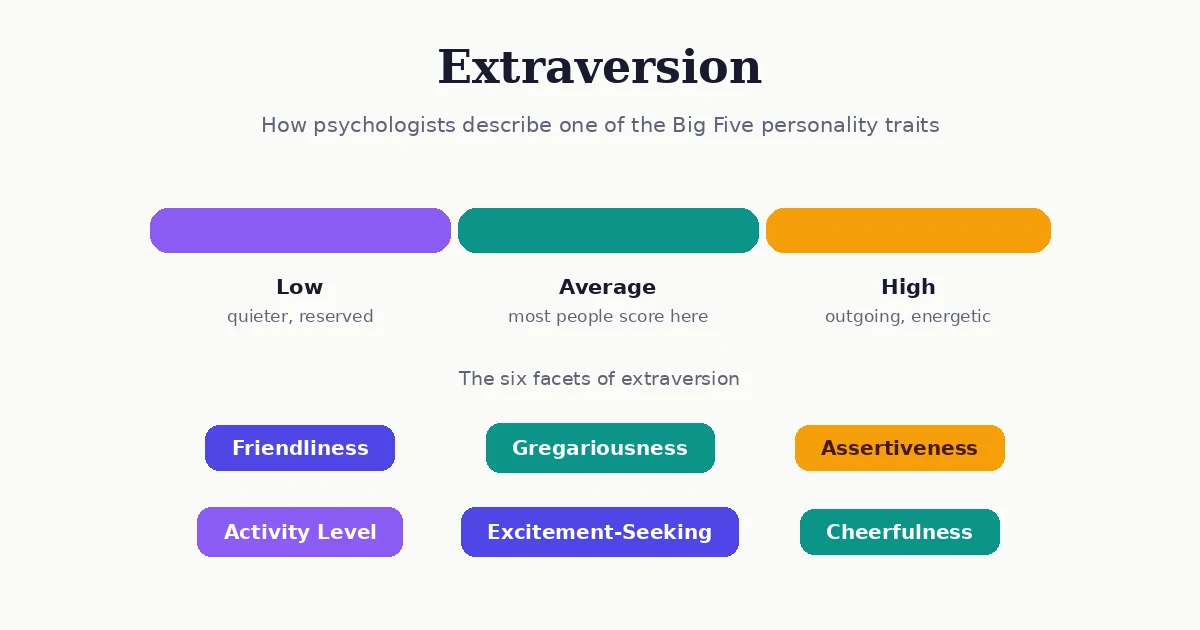
Broad traits are useful summaries, but underneath extraversion sit six narrower facets — specific tendencies researchers can measure separately. The facet framework comes from the NEO Personality Inventory (NEO PI-R), developed by Paul Costa and Robert McCrae, which reports six facets for each Big Five trait [2]. The facet names below follow the IPIP-NEO (with the NEO PI-R name in parentheses where it differs), and the descriptions draw on the public-domain IPIP-NEO facet descriptions written from the personality-measurement literature [1].
| Facet | High scorers tend to… | Low scorers tend to… |
|---|---|---|
| Friendliness (NEO PI-R: Warmth) | Genuinely like others; make friends quickly and form close relationships easily | Not cold or hostile — but don’t reach out; can seem distant or reserved |
| Gregariousness | Find the company of others stimulating; enjoy crowds | Feel overwhelmed by large crowds; need more privacy and time alone |
| Assertiveness | Speak out, take charge, and direct others; tend to lead in groups | Talk less; let others control group activities |
| Activity Level (NEO PI-R: Activity) | Lead fast-paced, busy lives; move and act energetically | Follow a slower, more relaxed and leisurely pace |
| Excitement-Seeking | Crave stimulation and novelty; get bored easily without it; drawn to thrills | Feel overwhelmed by noise and commotion; avoid thrill-seeking |
| Cheerfulness (NEO PI-R: Positive Emotions) | Frequently experience positive feelings — happiness, enthusiasm, optimism | Less prone to energetic high spirits. |
Importantly, the facets can vary independently. A person can be highly sociable but not especially assertive — high on gregariousness, average on assertiveness [3]. That is why two people who both qualify as “extraverted” can look quite different from each other.
A Spectrum, Not Two Types
Every Big Five trait is a continuum, and extraversion is no exception. Questionnaires produce high-to-low scores along a continuum — not membership in a category — and for any given trait, most people fall somewhere near the middle rather than at an extreme [3].
The IPIP-NEO inventory illustrates this with score bands: roughly the lowest 30% of scores count as low, the middle 40% as average, and the highest 30% as high — always relative to people of similar age and sex [1]. An average score means you enjoy time with others and time alone in roughly equal measure. A low score points to someone quiet and reserved who enjoys solitude and keeps socializing to a few close friends [1].
How Researchers Measure Extraversion
Like all personality traits, extraversion cannot be observed directly — it is inferred from patterns of thought, feeling, and behavior. The workhorse method is the self-report questionnaire: people rate how well statements describe them, and the answers are averaged into a score [3].
Two widely used instruments take this approach:
- The NEO PI-R (Costa & McCrae): 240 items answered on a five-point scale, with both self-report and observer-report forms, yielding domain scores plus detailed scores for each of the six facets [2].
- The Big Five Inventory: shorter; respondents agree or disagree with statements such as “Is outgoing, sociable” for extraversion, and an average score is calculated per trait [3].
Scores are interpreted relative to a comparison group — a result tells you where you stand compared with other test-takers, not an absolute amount of the trait [3]. And the usual caveat holds: these measures work best with honest answers about your typical behavior, and they describe tendencies, not destinies.
Extraversion in Everyday Life
Traits are abstract; behavior is where they show up. Two everyday sketches:
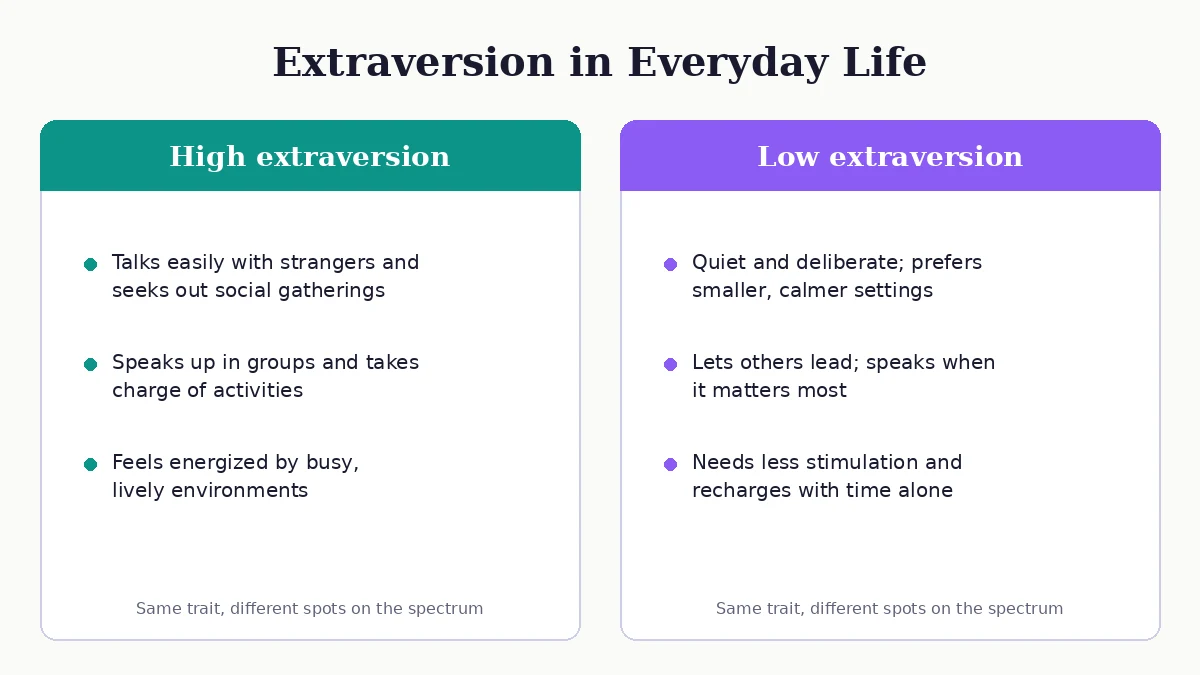
Maya at the office. At the team lunch, Maya joins the biggest table, introduces herself to the new hire, and floats the idea of Friday drinks. When the manager asks for a volunteer to present, her hand goes up first. High gregariousness, high assertiveness, high activity level — the facets combine into someone who visibly engages the external world.
Dan on the weekend. Dan enjoys the party — for a while. He has good conversations and laughs a lot, then slips out early to recharge at home with a book. His cheerfulness is high, but his excitement-seeking is lower and his gregariousness sits near the middle. Same trait, different facet mix, different evening.
The point of both sketches: extraversion is not one single behavior. It is a pattern across situations, built from the facets above [1].
Extraversion and Well-Being
Research finds reliable associations between Big Five trait scores and life outcomes. One notable pattern: extroversion is associated with subjective well-being [3]. This lines up with the cheerfulness facet — people who frequently experience positive emotions tend to report higher well-being.
The usual cautions apply. These are overall patterns across large groups, not guarantees for any individual — and an association is not proof that the trait causes the outcome [3]. Extraversion describes tendencies. What you do with them is still up to you.
Frequently Asked Questions
Is extraversion just being outgoing?
Being outgoing is part of it, but the trait is broader. Extraversion also covers energy level, assertiveness, pace of life, excitement-seeking, and the tendency to experience positive emotions [1][2]. Someone can be talkative yet low on excitement-seeking — “outgoing” alone doesn’t capture the whole picture.
Can a person be extraverted but shy?
Yes. Shyness is mainly about nervousness or self-consciousness in social situations, while extraversion is about how much you engage with the external world. A shy extravert may feel jittery before a party yet still want to go. Researchers explicitly warn against reading low social involvement as shyness or depression — they are different things [1].
Do most people fall in the middle of the spectrum?
Yes. On any Big Five trait, people fall at various points along a continuum, and most of us score somewhere in the middle rather than at the extremes [3].
Can extraversion change over time?
Trait measures tend to be fairly consistent over short periods in adulthood, but they do change across a lifetime [3]. Rank-order differences between people — who is more extraverted than whom — remain relatively stable in adulthood [2].
References & Further Reading
- Johnson, J. A. Descriptions used in the IPIP-NEO narrative report (public domain; based on the personality-measurement literature). https://drj.virtualave.net/IPIP/IPIPNEOdescriptions.html
- Revised NEO Personality Inventory — Wikipedia. https://en.wikipedia.org/wiki/Revised_NEO_Personality_Inventory
- Big 5 Personality Traits — Psychology Today. https://www.psychologytoday.com/us/basics/big-5-personality-traits
Keep Exploring
Start with the foundations: what personality psychology studies. Explore our Big Five personality traits guide.
5 thoughts on “Extraversion: The Big Five Trait Explained”