
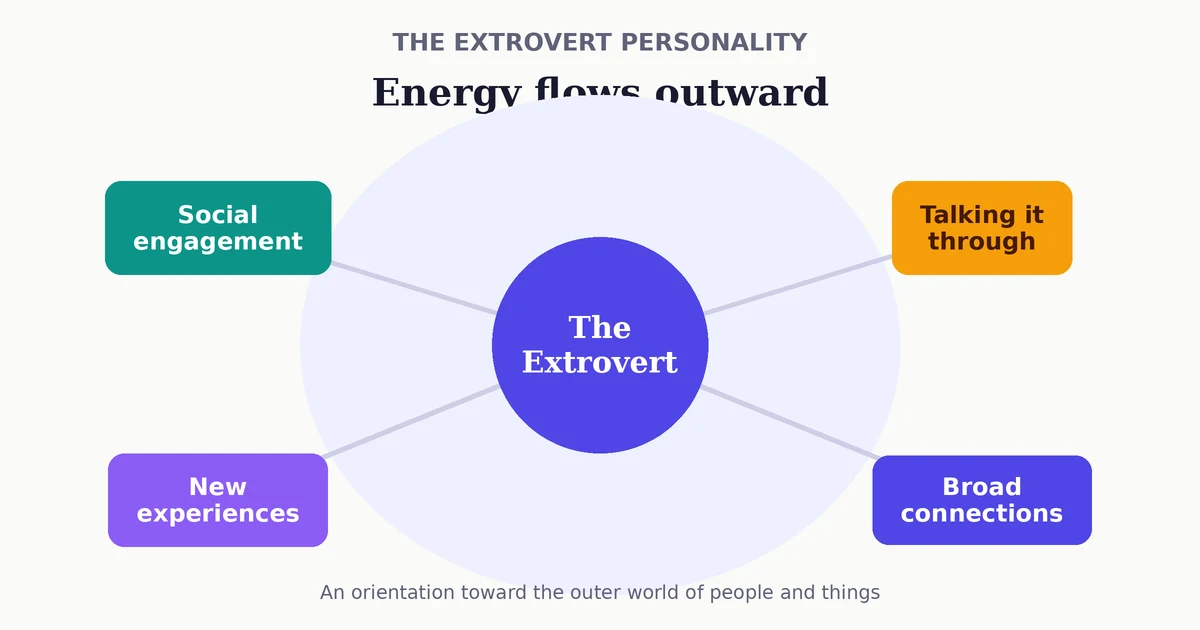
An extrovert is someone whose energy and attention naturally point outward — toward people, activities, conversation, and the buzz of the world around them. Social time doesn’t just entertain them; it genuinely charges them up. Where some people need quiet to recover from a busy day, the extrovert recovers by getting out into it.
The word itself has a precise psychological meaning. The American Psychological Association defines extraversion as “an orientation of one’s interests and energies toward the outer world of people and things rather than the inner world of subjective experience,” and describes extraverts as relatively outgoing, gregarious, sociable, and openly expressive [1]. (Psychology texts usually spell it “extraversion” and “extravert”; popular writing prefers “extroversion” and “extrovert.” Same idea.)
This article is a strengths-framed profile of that orientation: the traits that define it, the everyday signs, the genuine advantages it brings, the misconceptions worth dropping, and practical tips for thriving.
Table of Contents
What Is an Extrovert?
At its core, extroversion is about where your energy goes. The concept was introduced to psychology by Carl Jung in his 1921 book Psychological Types, which framed extraversion as a flow of psychic energy toward the outer world of people and things [2]. Modern personality science kept the core idea and made it measurable: extraversion is one of the five broad dimensions of the Big Five model of personality, alongside openness, conscientiousness, agreeableness, and neuroticism [1].
Three things matter for understanding the extrovert personality:
It’s an orientation, not a performance. Extroversion isn’t about being loud or the life of the party — it’s about where attention and energy naturally lean. Some extroverts are theatrical; others are simply warm, chatty, and happiest in motion around other people.
It exists on a continuum. Extraversion and introversion are ends of a spectrum, and most people fall somewhere in between rather than at an extreme [1]. So “extrovert” here means a person who sits clearly toward the outgoing end — not someone who matches every trait perfectly.
It’s a pattern, not a moment. Like all personality traits, extraversion shows up as a consistent pattern across time and situations, not in any single behavior [1]. A quiet weekend doesn’t disqualify you; a lifetime of seeking out people does define you.
(our guide to personality psychology explains how traits like extraversion fit into the bigger picture of the field.)
The Core Traits of the Extrovert Personality
Energy from social engagement
This is the defining feature. For the extrovert, being around people is energizing rather than draining. A crowded dinner, a team brainstorm, or a long catch-up with friends feels like plugging into a charger. Take Sara, a university student: after a packed day of classes, she’d rather join a group study session than retreat to her room — the company lifts her mood and sharpens her focus.
Talkativeness and thinking out loud
Extroverts tend to be talkative, and many find they think best through conversation. Ideas arrive mid-sentence; talking isn’t just communication, it’s processing. In a team meeting, the extrovert is often the one who says, “Let me think this through with you,” and lands on the answer while explaining it.
Enthusiasm and expressiveness
Enthusiasm is part of the package. Extroverts are typically expressive — feelings show on their faces, in their voices, in their gestures. This upbeat emotional tone is one of the best-documented aspects of the trait: in a large study of over 9,000 adults, extraversion showed medium-to-large associations with positive affect and life satisfaction [3]. That’s an average tendency, not a permanent state — it means their emotional weather runs sunnier overall.
Assertiveness
Extroverts are generally comfortable being visible: volunteering opinions, initiating plans, speaking up in groups. This assertiveness isn’t about dominance — it’s about ease. Being noticed doesn’t feel costly to them, so they step forward where others might hang back.
An appetite for stimulation and activity
Extroverts seek variety, novelty, and action. They’re the ones who say yes to the spontaneous road trip, who get restless with too much routine, who prefer a lively environment over a silent one. This appetite is part of why extroverts often have wide-ranging interests and busy calendars.
Breadth of connections
Extroverts typically maintain wide social circles — many acquaintances, friends from every chapter of life, and a genuine enjoyment of meeting new people. They network naturally, not as a strategy but as a reflex: they’re simply interested in people.
| Trait | What it looks like day to day |
|---|---|
| Social energy | Seeks out company; feels recharged after social time |
| Talkativeness | Thinks out loud; processes ideas through conversation |
| Enthusiasm | Expressive, upbeat, visibly engaged |
| Assertiveness | Speaks up, initiates, comfortable being noticed |
| Appetite for stimulation | Drawn to novelty, variety, and lively environments |
| Broad connections | Wide circle of friends and acquaintances; enjoys meeting people |
Common Signs of an Extrovert Personality
You don’t need a test to recognize the pattern. Extroverts commonly:
- Feel energized — not drained — after spending time with people.
- Strike up conversations with strangers easily (in line, at events, anywhere).
- Prefer group plans over solo ones when given the choice.
- Process thoughts by talking them through rather than thinking silently first.
- Get restless or bored with too much unstructured alone time.
- Keep a wide, varied social circle and genuinely enjoy meeting new people.
- Show their feelings openly — enthusiasm, frustration, and excitement are all visible.
- Volunteer first: for the presentation, the plan, the toast, the introduction.
No one shows all of these all the time. It’s the overall pattern — the outward lean, repeated across weeks and months — that marks the extrovert personality.
Genuine Strengths of the Extrovert Personality
Strengths-framed doesn’t mean inflated. Here’s what the extroverted orientation genuinely delivers.
They build networks fast. Because meeting people is energizing rather than effortful, extroverts accumulate connections quickly — and connections open doors. Jobs, opportunities, and useful introductions often flow through the wide networks extroverts naturally maintain.
They energize groups. Enthusiasm is contagious. In classrooms, workplaces, and friend groups, the extrovert’s visible energy can lift the collective mood and get people moving — not through any technique, but because affect spreads.
They communicate and advocate. The combination of talkativeness and assertiveness makes extroverts natural communicators: they speak up, they ask, they pitch, they persuade. In situations where silence costs — negotiations, interviews, presentations, asking for help — this willingness to be heard is a real advantage.
They tend to emerge as leaders. This one has research behind it. A major meta-analysis of 73 samples by Judge and colleagues found that extraversion was the most consistent Big Five correlate of leadership — across study settings and for both leader emergence (being seen as a leader) and leadership effectiveness [4]. That’s a tendency, not a rule: extroverts are more likely to be picked out as leaders, not automatically the best ones.
They ride a sunnier emotional baseline. As noted above, extraversion is reliably associated with positive affect and life satisfaction in large-sample research [3]. Feeling more positive emotions, more often, is a genuine well-being advantage.
Common Misconceptions About Extroverts
“Extroverts are shallow.”
Breadth is not the opposite of depth. Having many connections doesn’t prevent close ones — plenty of extroverts have deep, decades-long friendships alongside their wide circles.
“Extroverts can’t be alone.”
Preference isn’t inability. Many extroverts enjoy solo time — reading, creating, exercising alone — they just don’t use it the way others do: as their primary way to recharge. An extrovert alone on a quiet Sunday isn’t suffering; they’re simply not gaining energy from it.
“Extroverts are always confident.”
Extraversion is about outward orientation, not self-esteem. An extrovert can feel nervous before a presentation or insecure in a new group — they’ll just tend to work through those feelings outwardly, by talking and engaging, rather than retreating.
“Extroverts are always happy.”
The research link to positive affect describes an average tendency, not a permanent state [3]. Extroverts have bad days, grief, stress, and low moods like everyone else. The difference is in the baseline, not in immunity.
“It’s a box you either fit or don’t.”
Like all traits, extraversion lives on a continuum [1], and behavior flexes with context. Even strongly extroverted people have quieter days and quieter settings. The label describes your center of gravity, not a cage.
Practical Tips for Thriving as an Extrovert
Knowing your orientation lets you design a life that fits it.
Build a social rhythm. Don’t leave people-time to chance. Regular fixtures — a weekly dinner, a running group, collaborative work blocks — keep your energy supplied the way routine exercise keeps a body fit.
Honor your downtime. This is the tip extroverts resist most. High-stimulation stretches still cost something, and deliberate quiet — a walk alone, an hour without input — makes the social time better. Recovery isn’t the opposite of extroversion; it’s maintenance.
Listen on purpose. Your strength is talking; your growth edge is pausing. A simple habit — ask one genuine question and let the answer finish before responding — turns great talkers into great conversationalists.
Think before you speak in high-stakes moments. Thinking out loud is a gift in brainstorming and a risk in conflict. Before the difficult conversation or the important email, give yourself a beat: what do I actually want to say here?
Choose fitting environments. Roles with people, variety, and visibility — teaching, sales, community work, team leadership — tend to reward the extroverted orientation.
Keep a low-stimulation toolkit. For days when life is unavoidably quiet — remote work, solo travel, a slow week — have backups: movement, music, a podcast that feels like company, a short call with a friend. Small doses of stimulation keep the restlessness at bay.
A Profile, Not a Verdict
Two things worth keeping in mind. First, this profile is educational, not clinical: it describes a normal, healthy personality pattern, not a diagnosis of any kind. Reading about traits helps you understand yourself and others; it’s not a substitute for professional guidance if you’re struggling.
Second, this is one orientation on a spectrum, not a life sentence [1]. If you want the fuller picture — how extraversion sits within trait science — see our deep-dive on extraversion. And if you’re curious how the two ends of the spectrum relate to each other, our introvert vs. extrovert comparison covers that separately and in full.
Frequently Asked Questions
Can extroverts enjoy alone time?
Yes. Extroverts can enjoy solitude — reading, hobbies, solo walks — they simply don’t rely on it to recharge the way others might. Preference for social energy isn’t the same as an inability to be alone.
What’s the difference between being an extrovert and just being outgoing?
They’re closely related but not identical. “Outgoing” is everyday language for friendly, sociable behavior. “Extravert” is the psychological term for the underlying orientation — where your energy and attention naturally point [1]. Most outgoing people are extroverts, but the term carries the scientific meaning: a measurable, stable pattern, not just a vibe.
Do extroverts make better leaders?
Not automatically. Research shows extraversion is the most consistent personality correlate of leadership — extroverts are more likely to emerge as leaders and to be rated effective [4]. But “more likely” is a tendency across many people, not a guarantee for any one person. Leadership also draws on judgment, integrity, competence, and care — qualities found everywhere on the spectrum.
Can someone become more extroverted over time?
Personality traits describe your typical patterns, and those patterns are relatively stable — but behavior is more flexible than people assume. You can learn to act more outgoing in situations that call for it (networking, presenting, hosting) without changing who you fundamentally are. Think of it as expanding your range, not swapping your personality.
References & Further Reading
- Extraversion — APA Dictionary of Psychology. https://dictionary.apa.org/extraversion
- Extraversion — Encyclopedia of Personality and Individual Differences (Springer). https://link.springer.com/rwe/10.1007/978-1-4614-6086-2_226
- Duckworth, A. L., Weir, D., Tsukayama, E., & Kwok, D. (2012). Who does well in life? Conscientious adults excel in both objective and subjective success. Frontiers in Psychology, 3, 356. https://www.frontiersin.org/journals/psychology/articles/10.3389/fpsyg.2012.00356/full
- Judge, T. A., Bono, J. E., Ilies, R., & Gerhardt, M. W. (2002). Personality and leadership: A qualitative and quantitative review. Journal of Applied Psychology, 87(4), 765–780. https://psycnet.apa.org:443/doi/10.1037/0021-9010.87.4.765
Keep Exploring
- What Is Personality Psychology? — how traits like extraversion fit into the science of individual differences.
- Extraversion — the trait-dimension deep-dive: how the spectrum is measured and studied.
- Introvert vs. Extrovert — the full comparison, kept separate from this profile.