
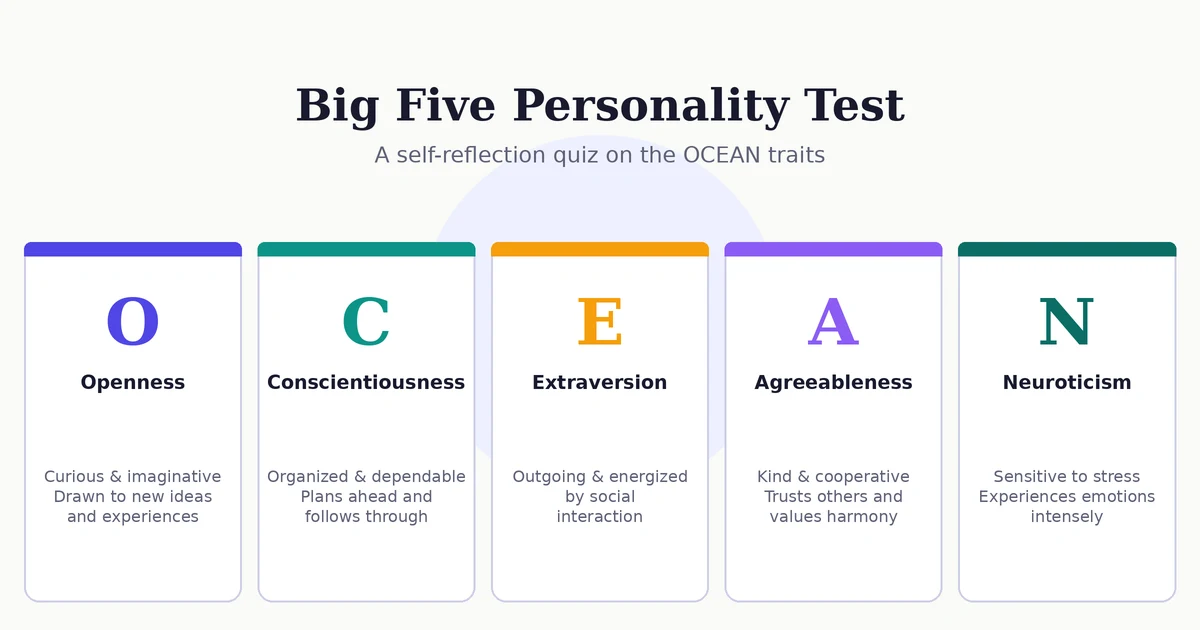
This is a short educational self-report quiz based on the Big Five — the five broad traits psychologists use most often to describe personality: openness, conscientiousness, extraversion, agreeableness, and neuroticism, remembered by the acronym OCEAN. It has 30 statements and takes about five minutes. You score it by hand, so you’ll understand exactly how your results are produced.
Important — please read before starting: This quiz is educational and for self-reflection only. It is NOT a validated psychological instrument and NOT a clinical diagnosis. It cannot diagnose any condition, and no score says anything about your mental health or worth. If you’re struggling with your mood, stress, or daily functioning, please talk to a qualified professional rather than relying on a quiz.
Table of Contents
How to Take It
Answer each statement honestly, based on how you usually are — not how you wish you were, and not based on one unusual week. There are no right or wrong answers, and the quiz only works if you don’t try to game it.
Rate every statement on this 1–5 scale:
- 1 = Strongly disagree
- 2 = Disagree
- 3 = Neutral / sometimes
- 4 = Agree
- 5 = Strongly agree
Write down your answers (or say them out loud — just keep a record). You’ll need them for the scoring section. Aim for your first, instinctive answer rather than overthinking each one.
The 30 Statements
Openness
1. I enjoy trying new foods, music, or activities.
2. I often get lost in imagination or daydreams.
3. I prefer sticking to familiar routines and habits. (R)
4. I like thinking about abstract ideas and “what if” questions.
5. I have a strong interest in art, books, or other forms of creative expression.
6. I rarely go out of my way to have unfamiliar experiences. (R)
Conscientiousness
7. I keep my living space organized and tidy.
8. I make plans and follow through on them.
9. I often leave important tasks until the last minute. (R)
10. I pay close attention to details when I work on something.
11. I make a point of meeting deadlines and keeping promises.
12. I tend to act on impulse without thinking things through. (R)
Extraversion
13. I feel energized after spending time with a group of friends.
14. I enjoy starting conversations with people I’ve just met.
15. I would rather spend a quiet evening alone than go to a busy social gathering. (R)
16. I am usually talkative when I’m with a group.
17. I naturally take the lead when a group needs direction.
18. I need a lot of alone time to recover after social events. (R)
Agreeableness
19. I go out of my way to help others, even when it’s inconvenient for me.
20. I generally trust that most people have good intentions.
21. I often end up in disagreements or conflicts with people around me. (R)
22. I enjoy making people feel included and welcome.
23. I am quick to forgive when someone makes a genuine mistake.
24. In most situations, I look out for myself first. (R)
Neuroticism
25. I often feel tense or on edge without a clear reason.
26. I worry about things that could go wrong in the future.
27. I usually stay calm under pressure. (R)
28. My mood can shift noticeably without an obvious cause.
29. I get upset easily over small setbacks.
30. I rarely feel stressed, even when things get hectic. (R)
How to Score Your Results
Scoring takes about five minutes. You’ll end up with one score between 1 and 5 for each trait.
Step 1 — Reverse-score the items marked (R). For every statement labeled (R), your scored value is 6 minus your response:
- If you answered 1 → scores as 5
- If you answered 2 → scores as 4
- If you answered 3 → stays 3
- If you answered 4 → scores as 2
- If you answered 5 → scores as 1
This is because these statements are worded in the opposite direction of the trait, so agreement has to count “backwards.”
Step 2 — Average the six items for each trait. Add the (possibly reversed) values for that trait’s six items, then divide by 6. Each trait score ranges from 1.0 to 5.0.
| Trait | Items (R = reverse-scored: value = 6 − response) |
|---|---|
| Openness | 1, 2, 3 (R), 4, 5, 6 (R) |
| Conscientiousness | 7, 8, 9 (R), 10, 11, 12 (R) |
| Extraversion | 13, 14, 15 (R), 16, 17, 18 (R) |
| Agreeableness | 19, 20, 21 (R), 22, 23, 24 (R) |
| Neuroticism | 25, 26, 27 (R), 28, 29, 30 (R) |
Step 3 — Read each score using these bands:
- 1.0–2.4 — lower range. You lean away from this trait’s characteristic patterns.
- 2.5–3.4 — middle range. You’re near the center of the spectrum. Most people land here on most traits, and it often reflects flexibility across situations [1][2].
- 3.5–5.0 — higher range. You lean toward this trait’s characteristic patterns.
These are tendencies, not verdicts. A higher score means the pattern shows up in your life more often; it doesn’t define you, predict your future, or rank you against anyone else. And remember the disclaimer above: this is a self-reflection exercise, not a validated instrument. Treat the results as a starting point for thinking, not a professional assessment.
What Your Results Mean
Each Big Five trait is a spectrum, not a box you fall into — people sit somewhere along a continuum for each one [2]. Here is what higher- and lower-range scores tend to look like in everyday life. Neither end is “better”; different traits are advantages in different contexts.
Openness — your appetite for new ideas and experiences
Higher-range scorers tend to be curious, imaginative, and drawn to variety — new ideas, art, travel, and unfamiliar perspectives [1]. You may enjoy deep conversations, creative pursuits, and shaking up routines. A watch-out: constant novelty-seeking can mean unfinished projects or restlessness with routine obligations.
Lower-range scorers tend to prefer the familiar, the practical, and the tried-and-true — routine, tradition, and concrete thinking [1]. You may be grounded, consistent, and good at keeping things running smoothly. A watch-out: unfamiliar ideas or sudden changes can feel unnecessarily disruptive, so it’s worth occasionally checking whether a “new” approach deserves a chance.
Conscientiousness — how you organize your life and follow through
Higher-range scorers tend to be organized, dependable, and disciplined — the people who plan ahead and finish what they start [2]. Your strengths likely include reliability and follow-through. A watch-out: high standards can tip into perfectionism or difficulty relaxing when plans change.
Lower-range scorers tend to be more spontaneous, flexible, and laid-back about structure [1]. You’re probably adaptable and easygoing — strengths in unpredictable environments. A watch-out: important tasks may slip if you don’t build some external structure (reminders, routines) to lean on.
Extraversion — where you get your energy and how you engage socially
Higher-range scorers tend to be outgoing, talkative, and energized by social interaction [2]. You may thrive in groups, speak up easily, and recharge around people. A watch-out: constant social input can mean you rarely slow down — make sure solitude gets a fair hearing too.
Lower-range scorers tend to be quieter and more reserved, recharging through solitude or small-group time [1]. Your strengths may include careful listening and independent thinking. A watch-out: others may misread your quietness as disinterest, so occasionally signaling your engagement goes a long way.
Agreeableness — how you relate to other people
Higher-range scorers tend to be trusting, kind, and cooperative — oriented toward compassion and harmony [1]. People likely experience you as warm and easy to be around. A watch-out: conflict avoidance can mean your own needs get set aside; disagreeing kindly is still disagreeing.
Lower-range scorers tend to be more skeptical, competitive, and self-interested in their interactions [1]. You may be straightforward, independent, and good at making tough calls. A watch-out: directness can read as harshness to more sensitive people — small courtesies cost little and buy a lot.
Neuroticism — how strongly you react to stress and negative emotion
Higher-range scorers tend to experience negative emotions — worry, tension, irritability — more intensely and more easily [2]. This isn’t a flaw: emotional sensitivity also means you notice problems early and care deeply. A watch-out: stress can snowball, so building calming routines (sleep, exercise, talking things through) is genuinely worth the effort.
Lower-range scorers tend to be calm, even-tempered, and resilient under pressure [1]. You’re probably the steady one in a crisis — a real strength. A watch-out: feeling little stress doesn’t always mean there isn’t any; make sure you’re actually addressing problems, not just staying unbothered by them.
Frequently Asked Questions
How accurate is this quiz?
It’s a reasonable self-reflection exercise, not a precise instrument. Psychologists typically measure the Big Five with validated questionnaires such as the Big Five Inventory or the NEO Personality Inventory [1]. A 30-item hand-scored quiz can’t match their reliability. Answer honestly and treat your results as approximate tendencies — useful for reflection, not for decisions about yourself or others.
What if all my scores are in the middle?
That’s normal — most people land near the middle on most traits rather than at an extreme [2]. A middle-range profile usually means you adapt your behavior to the situation rather than leaning hard in one direction. That’s not a boring result; it’s the most common one.
Do these traits change over time?
They’re relatively stable across your lifespan, but not frozen — for example, research reviewed in OpenStax notes that conscientiousness tends to increase through young adulthood into middle age, while neuroticism and extraversion tend to decline slightly with age [2]. If you retake the quiz in a few years and see small shifts, that’s expected, not a sign you did it wrong.
Should I compare my results with someone else’s?
Not to rank each other. The traits describe tendencies, and every combination has strengths — there’s no ideal profile. Comparing can be interesting if it helps you understand someone better (“so that’s why you love brainstorming and I love checklists”), but it’s not a competition and not a basis for judging people.
Keep Exploring
Want the science behind the traits? Read our guide to the Big Five personality traits, or start from the foundations with what personality psychology studies.
References & Further Reading
- Big 5 Personality Traits: The 5-Factor Model of Personality — Simply Psychology. https://www.simplypsychology.org/big-five-personality.html
- 11.7 Trait Theorists — Psychology 2e, OpenStax. https://openstax.org/books/psychology-2e/pages/11-7-trait-theorists
- Personality — Department of Psychology, Penn State. https://psych.la.psu.edu/about-us/research/personality/