
Your personality doesn’t decide your career — but it quietly shapes how you work. Two people can hold the same job title and do it in completely different ways: one thrives on tight deadlines and detailed checklists, the other does their best work exploring open-ended problems. Both can succeed. What differs is fit — how naturally a role’s demands line up with your characteristic patterns of thinking, feeling, and behaving. The APA defines personality as the enduring configuration of characteristics and behavior that makes up a person’s unique adjustment to life [1], and that configuration follows you into the office, the classroom, and every team you’re part of.
This article explains how personality traits show up in work life — in teamwork, communication, leadership, and the environments you prefer — which trait patterns tend to matter for which kinds of roles, and how to use this knowledge practically. One principle runs through everything here: traits inform fit; they never dictate destiny. No trait disqualifies anyone from any career, and there is no scientifically “ideal” personality for a given job.
Table of Contents
How Personality Shows Up at Work
A quick orientation first. Personality researchers most often describe traits using the Big Five: openness (curiosity, imagination), conscientiousness (organization, discipline), extraversion (sociability, energy), agreeableness (cooperation, compassion), and neuroticism (sensitivity to stress — its positive pole is emotional stability). Each is a spectrum, not a box, and each influences work in specific, observable ways. (Our guide to the Big Five personality traits goes deeper into each one.)
Here are the four areas of work life where traits are most visible.
Teamwork styles
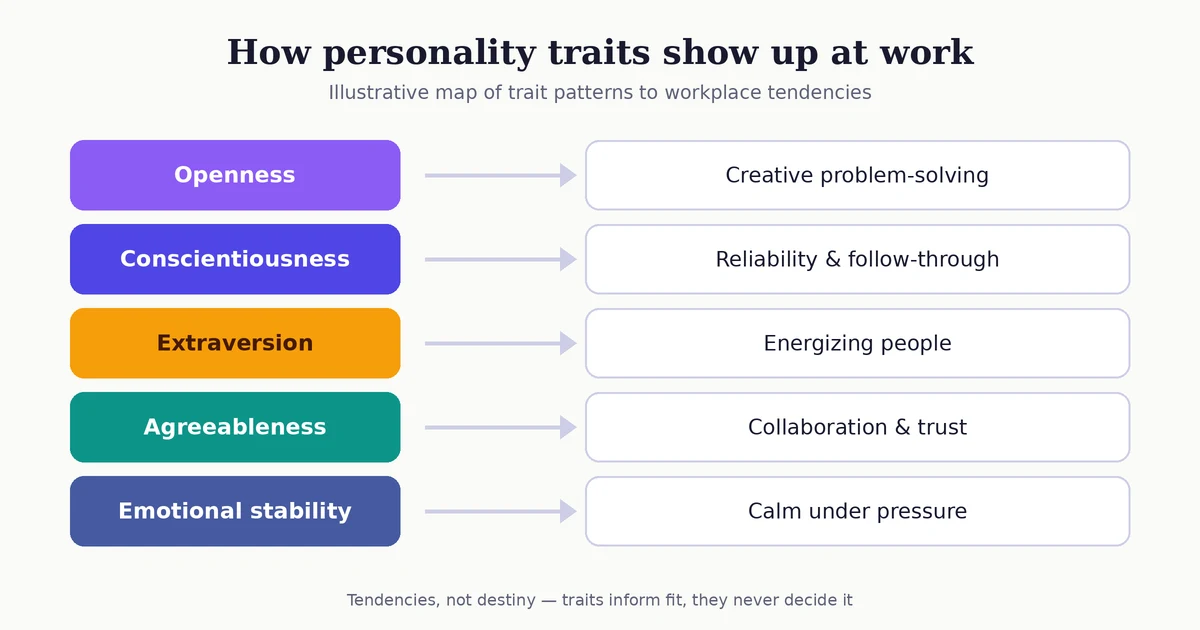
Traits shape the role you naturally drift toward on a team. Highly conscientious people tend to become the organizers — setting timelines, tracking deliverables, and keeping the group accountable. Highly open people tend to become the idea generators, pushing the group toward novel approaches. Agreeable team members often act as the glue, smoothing over disagreements and keeping relationships intact, while extraverts frequently energize the group and drive discussion forward.
Consider a concrete example: a team is assigned an ambiguous, open-ended project with a loose deadline. A highly conscientious member’s first instinct is to create structure — breaking the project into tasks with owners and dates. A highly open member’s first instinct is to explore — questioning the brief, sketching unconventional approaches, and resisting early narrowing. Both instincts are valuable; the best teams usually need both. Friction arises only when teammates mistake a different working style for a lack of commitment.
Communication
Extraversion is the most obvious driver here, but it’s not the only one. Extraverts tend to think out loud, prefer real-time discussion, and are comfortable being heard — which makes them visible in meetings. Less extraverted people often communicate more deliberately: they may contribute less in live discussion but produce sharper written work, having thought things through first. Agreeableness affects how feedback is delivered and received — highly agreeable people may soften critical feedback to preserve harmony, while less agreeable colleagues may deliver it bluntly. Neither is automatically better; the first builds trust, the second brings clarity, and most workplaces need both.
Leadership tendencies
Some people gravitate toward leading, others toward supporting — and traits nudge these inclinations. Research on personality and leadership finds extraversion to be the most consistent trait correlate of leadership, with conscientiousness, openness, and emotional stability also positively related [3]. But these findings describe tendencies and probabilities, not requirements — the correlations are moderate, and effective leaders score anywhere on these traits. Style varies too: an extraverted leader may rally a team with energy and visibility, while a more introverted leader leads through careful preparation, deep listening, and steady one-on-one influence.
Work-environment fit
This is the area people feel most personally. Some thrive in buzzing, unpredictable settings — startups, sales floors, newsrooms — where stimulation is constant. Others do their best work in quiet, structured environments with clear expectations and minimal social demand. Neither preference is a weakness; they’re different operating conditions. A person high in openness may feel stifled by rigid, repetitive processes, while a person high in conscientiousness may feel genuinely uncomfortable in chaotic, plan-free environments. Fit isn’t about prestige — it’s about where your natural patterns meet the work’s actual demands with the least friction.
Trait Patterns and the Roles They Tend to Fit
Decades of research — most famously a meta-analysis of 117 studies — found that conscientiousness relates consistently to job performance across occupational groups and performance measures, while extraversion predicted performance specifically in roles built around social interaction, such as management and sales; openness and extraversion also predicted how well people did in training [2]. In plain language: being organized and dependable helps almost everywhere, being sociable helps most where people are the work, and curiosity helps you learn new roles faster.
The table below maps trait patterns to the workplace tendencies they most often produce — and the friction points to watch for. Read every row as a tendency, not a verdict. People succeed in all kinds of roles regardless of where they fall on these traits.
| Trait pattern | Typical workplace tendencies | Watch-outs |
|---|---|---|
| High conscientiousness | Reliable follow-through, planning, attention to detail, meeting deadlines | May over-perfectionize, struggle to delegate, or resist changing a plan mid-course |
| High openness | Creative problem-solving, comfort with ambiguity, quick learning of new skills | May get bored with routine, chase novelty over finishing, or overwhelm detail-focused colleagues |
| High extraversion | Energizing teams, networking, thinking aloud, comfort with visibility | May dominate discussions, undervalue quiet reflection time, or find solitary work draining |
| High agreeableness | Collaboration, trust-building, supportive feedback, customer care | May avoid necessary conflict, over-accommodate, or struggle to deliver hard feedback |
| High emotional stability | Calm under pressure, steady in crises, resilient after setbacks | May under-prepare for risks others see clearly, or seem unmoved when urgency is warranted |
| Lower on a trait | — | Each trait also brings strengths at its lower end: less extraverted people often listen deeply and focus well alone; less agreeable people negotiate firmly and challenge weak ideas. |
A word on “fit” versus “destiny”: the research links traits to average performance differences across large groups, not to what any individual can or should do. A less extraverted person can absolutely succeed in sales; a less conscientious person can absolutely become a meticulous surgeon — traits describe where you’ll find things easier or harder, and what strategies you’ll need, not what’s possible. Skills, training, motivation, and circumstances matter enormously, and they are all developable.
Using Personality Wisely in Your Career
So how do you turn this from interesting theory into something useful? Three practical moves:
Choose environments that fit, not just job titles. Two roles with the same title can feel like different planets. A “marketing manager” at a fast-moving startup and one at a large, process-driven company demand very different daily patterns. When evaluating a job, ask about the actual texture of the work: How are decisions made? How much is planned versus improvised? How much of the day is collaborative versus solitary? You’re not looking for a perfect match — you’re looking for a place where your strengths get used daily and your friction points are occasional, not constant.
Play to your strengths deliberately. Know which parts of your work light you up and get energized by them — then volunteer for more of those parts. If you’re the person who naturally spots flaws in plans, that’s a strength in quality review and risk assessment, not a personality problem. If you energize rooms, put yourself in roles where that’s the job. Strengths compound when they’re used; they atrophy when they’re sidelined.
Work on friction points, not against your nature. You don’t need to change your personality to succeed at work — but you can build strategies around it. If you’re highly agreeable and struggle with hard feedback, you can learn a structured feedback format rather than trying to become a blunt person. If you’re less conscientious and details slip, you can build checklists and calendar systems rather than trying to become someone who “just remembers.” Personality describes your starting tendencies; skills and systems describe what you do about them.
One honest caveat: this article is educational, not vocational counseling. If you’re making a major career decision and feel stuck, a qualified career counselor can help you weigh personality alongside skills, values, finances, and life circumstances — things no article can do for you.
A Note on Personality Tests in Hiring
You may encounter personality questionnaires when applying for jobs — some employers use them as part of their selection process. This is normal practice in many industries, and these tools are designed to estimate work-relevant tendencies, not to judge your worth or diagnose anything.
A few things worth knowing. First, legitimate employment assessments should be validated — meaning there is evidence they measure what they claim and relate to actual job performance — and job-relevant, meaning they assess characteristics that genuinely matter for the role [4]. The Society for Industrial and Organizational Psychology takes the position that validated employment tests are a fair, merit-based practice, while also noting it is best practice not to use any single test as the sole deciding factor in hiring [4]. Second, tests built for development (helping employees grow) are not automatically appropriate for selection (deciding who gets hired) — the two purposes have different standards. And third, if you’re asked to take one, the most useful approach is also the simplest: answer honestly about your typical behavior. Trying to guess the “right” answers usually backfires, and a role that requires you to fake your way in is a role you’d likely find miserable anyway.
Frequently Asked Questions
Should you choose a career based on your personality?
Personality is one useful input among many — alongside your skills, interests, values, and practical constraints. Use it to understand how you’d likely experience a role (its daily texture, social demands, and structure) rather than as a list of permitted and forbidden careers. No validated personality framework assigns you a destiny.
Do employers really use personality tests when hiring?
Some do, particularly larger organizations with structured hiring processes. When they do, professional standards call for the tests to be validated and job-relevant, and not the only factor in the decision [4]. Smaller employers more often rely on interviews and work samples.
Can introverts be good leaders?
Yes. Research finds extraversion is the most consistent trait correlate of leadership, but the relationship is moderate — not a requirement [3]. Introverted leaders often lead through preparation, deep listening, and calm steadiness, which many teams value highly. What matters most is leadership behavior, which can be learned.
Can you develop traits to fit a job better?
Traits are relatively stable, but the behaviors they influence are absolutely trainable. You may never become a naturally spontaneous person, but you can learn to run an effective brainstorming session. Focus on building skills and systems around your friction points rather than trying to rebuild your personality.
Does being organized really matter that much at work?
The evidence says yes, broadly: conscientiousness — being dependable, planful, and persistent — is the Big Five trait most consistently linked to job performance across occupations, in a meta-analysis combining 117 studies [2]. It’s not the only thing that matters, but reliability is rarely a bad investment.
Keep Exploring
Our guide to the Big Five personality traits goes deeper into each trait. For the science behind the Big Five itself, start with what personality psychology studies.
References & Further Reading
- Personality — APA Dictionary of Psychology. https://dictionary.apa.org/personality
- Barrick, M. R., & Mount, M. K. (1991). The Big Five personality dimensions and job performance: A meta-analysis. Personnel Psychology, 44(1), 1–26. https://onlinelibrary.wiley.com/doi/10.1111/j.1744-6570.1991.tb00688.x
- Judge, T. A., Bono, J. E., Ilies, R., & Gerhardt, M. W. (2002). Personality and leadership: A qualitative and quantitative review. Journal of Applied Psychology, 87(4), 765–780. https://psycnet.apa.org/doi/10.1037/0021-9010.87.4.765
- Society for Industrial and Organizational Psychology (2025). Title VII and Job-Relevant Employment Practices (SIOP Statements). https://www.siop.org/wp-content/uploads/2025/05/Title-VII-and-Job-Relevant-Employment-Practices.pdf