
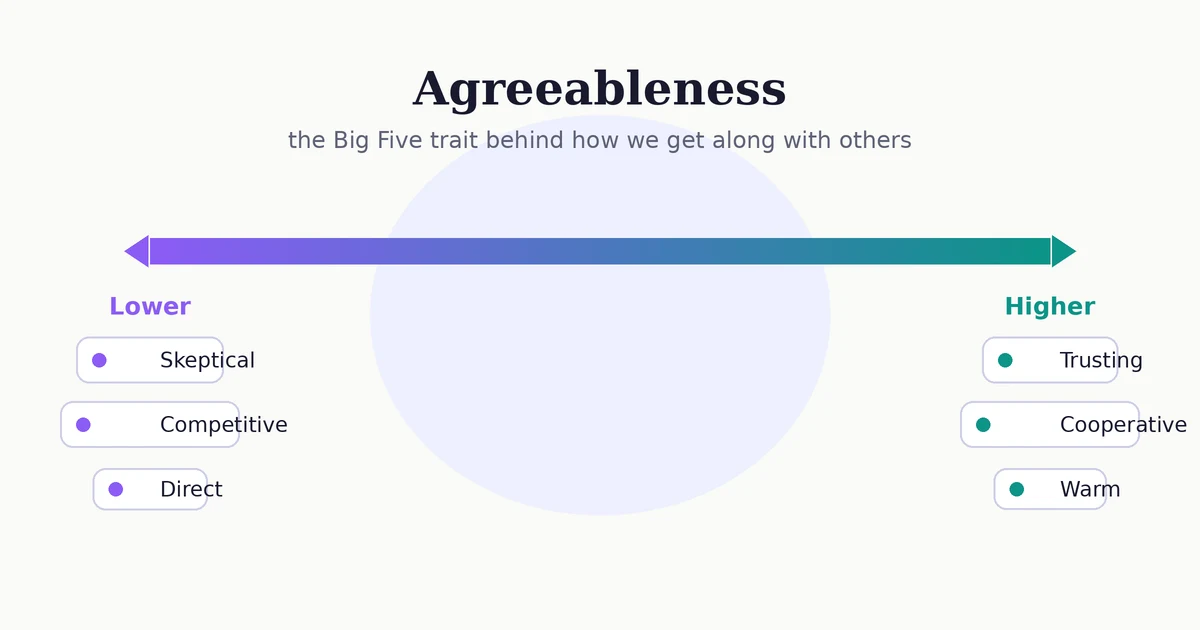
Agreeableness is the personality trait behind how warmly and cooperatively we deal with other people. If you’ve ever wondered why one friend instinctively gives everyone the benefit of the doubt while another questions motives first and negotiates hard — you’ve been observing differences in agreeableness.
In psychology, agreeableness is one of the Big Five personality traits. The American Psychological Association defines it as “the tendency to act in a cooperative, unselfish manner,” one end of an agreeableness–disagreeableness dimension [1]; a widely used psychology textbook describes it as the tendency to be pleasant, cooperative, trustworthy, and good-natured [2].
One clarification before we go further. Agreeableness is not a measure of how good a person is. High agreeableness isn’t moral superiority, and low agreeableness isn’t a character flaw. It’s a description of tendencies — how someone typically relates to others — and both ends of the spectrum have genuine strengths and genuine costs. We’ll keep that neutral framing throughout.
Table of Contents
What Agreeableness Means in Psychology
The Big Five — openness, conscientiousness, extraversion, agreeableness, and neuroticism, remembered as OCEAN — is the most widely used framework in modern personality psychology, and each trait is a spectrum, not a box: everyone falls somewhere along each dimension, usually near the middle rather than at an extreme [2].
Within that framework, agreeableness is the trait “primarily concerned with helping and building positive relationships with others,” according to a 2022 synthesis of 142 meta-analyses covering over 1.9 million participants — the most comprehensive quantitative review of agreeableness research to date [4]. Its core components: the motivation to maintain positive relationships, the ability to empathize with others’ perspectives, and the tendency to cooperate and coordinate goals with others [4].
So agreeableness isn’t just “niceness.” It’s an orientation toward others — trust over suspicion, cooperation over competition, harmony over conflict. And because it’s a spectrum, the question is always how much, never which type.
The Six Facets of Agreeableness
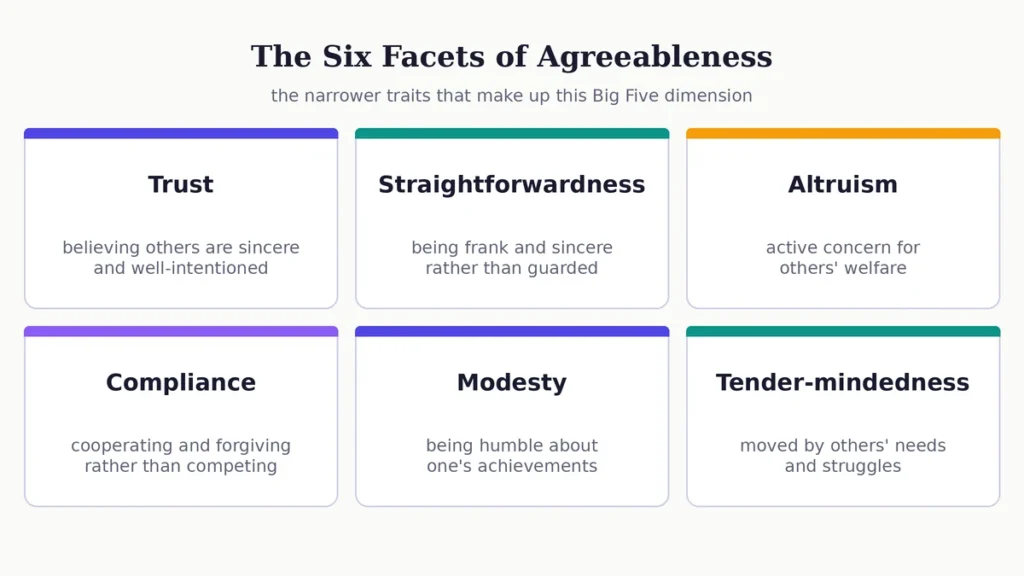
The widely used NEO-PI-R inventory breaks each Big Five trait into six narrower facets — and for agreeableness those are trust, straightforwardness, altruism, compliance, modesty, and tender-mindedness [3]. The facets explain why two similarly agreeable people can seem different: one may be high on trust but low on compliance, another the reverse.
- Trust — believing others are sincere and well-intentioned, versus being skeptical of people’s motives.
- Straightforwardness — expressing yourself frankly and sincerely, versus staying guarded or strategic about what you reveal.
- Altruism — actively caring about others’ welfare and helping, versus focusing primarily on your own interests.
- Compliance — cooperating and forgiving in conflicts, versus competing, standing your ground, and not hesitating to express anger.
- Modesty — playing down your own achievements, versus being confident and open about them.
- Tender-mindedness — being moved by others’ needs and struggles, versus taking a harder-headed, reason-first approach.
Signs of High Agreeableness
People who score high on agreeableness share a recognizable pattern across the facets. Researchers describe the prototypical agreeable person as sympathetic, considerate, truthful, and supportive [4]. In daily life, that tends to look like:
- Giving people the benefit of the doubt — assuming good intentions until proven otherwise (the trust facet at work).
- Volunteering help before being asked — noticing a colleague is overwhelmed and stepping in, or checking on a friend who’s gone quiet (altruism).
- Yielding in disagreements to restore harmony — apologizing first after an argument, or compromising quickly so everyone can move on (compliance).
- Forgiving relatively easily — meta-analytic evidence links agreeableness strongly to forgivingness [4].
- Deflecting praise — crediting the team, changing the subject when complimented (modesty).
- Being visibly moved by others’ problems — tearing up at a friend’s bad news, or feeling genuinely upset by someone else’s hardship (tender-mindedness).
Research backs up the conflict piece in particular: across studies, agreeableness is associated with cooperative conflict resolution — integrating goals with the other person and reaching compromise — rather than dominating them [4].
Signs of Lower Agreeableness
Scoring lower on agreeableness means tending toward the opposite patterns, and this deserves a neutral description: these are orientations, not offenses. Researchers describe the prototypical person at this end as critical, skeptical, and competitive [4]. In practice:
- Questioning motives first — wondering what someone really wants, rather than assuming sincerity (lower trust).
- Competing rather than cooperating — treating negotiations, games, and even discussions as something to win (lower compliance).
- Being direct, even blunt — saying the uncomfortable thing plainly instead of softening it.
- Standing firm in conflict — not backing down to keep the peace, and being comfortable with disagreement.
- Staying unmoved by emotional appeals — deciding based on logic and evidence rather than sympathy (lower tender-mindedness).
- Promoting your own interests openly — advocating for yourself without embarrassment (lower modesty).
OpenStax notes that people low on this trait “tend to be described as rude and uncooperative” [2] — exactly the kind of moral coloring this article pushes back against. Skeptical, competitive, and direct are legitimate ways to operate, and in many situations they’re the most effective ones.
Agreeableness in Everyday Life
In a disagreement. Two roommates argue about late-night noise. The highly agreeable one apologizes quickly and proposes a compromise — quiet hours that work for both. The lower-agreeableness one holds their position and negotiates firmly until the terms feel fair. Research supports this pattern: agreeable people lean toward compromise and goal integration, not domination [4]. Neither approach is universally better — one preserves the relationship faster, the other protects individual interests more reliably.
Giving feedback. On a team project, an agreeable member softens criticism: “This draft is really strong — one small thing we might tweak…” A lower-agreeableness member delivers it straight: “This section doesn’t work; here’s why.” The first keeps morale high; the second surfaces problems faster. Teams often need both.
When asked for a favor. A friend calls, exhausted, asking you to cover their shift tomorrow. High altruism makes the “yes” almost automatic; lower agreeableness prompts a calculation of the cost. These small decisions accumulate — meta-analytic evidence links agreeableness to higher relationship satisfaction, including marital satisfaction [4].
| Situation | Tends to be higher in agreeableness | Tends to be lower in agreeableness |
|---|---|---|
| A disagreement | Compromises early to restore harmony | Holds position; negotiates firmly |
| Giving feedback | Softens criticism, protects feelings | Delivers it directly, prioritizes accuracy |
| Asked for a favor | Says yes quickly (altruism) | Weighs the cost before agreeing |
| Someone apologizes | Forgives readily | Takes longer to let it go |
Table: how agreeableness typically shows up in everyday situations.
Why Neither End Is “Better”
It’s tempting to read all this and conclude agreeableness is simply a virtue — kinder, more cooperative, more forgiving. The research genuinely leans that way: in the 2022 review, agreeableness pointed in a desirable direction for 93% of the 275 variables studied, and it was linked to happiness and quality of life [4]. But “mostly beneficial” isn’t “always better,” and both ends carry trade-offs.
The costs of high agreeableness. The review identifies a theme of “lower results emphasis”: highly agreeable people can be more lenient — for example, in judging others’ performance — and less focused on hard outcomes [4]. In practice, this can mean difficulty saying no or avoiding useful conflict. Harmony has a price.
The strengths of lower agreeableness. Skepticism, competitiveness, and directness have real value. Critical thinkers, tough negotiators, and people willing to deliver uncomfortable truths often score lower on agreeableness — and organizations need them. One study summarized in OpenStax found that men who scored lower on agreeableness earned more than their more agreeable peers, likely because they negotiated harder and advocated for themselves more forcefully [2].
The honest conclusion: agreeableness is a tool, not a grade. The useful question isn’t whether you’re “too” agreeable or “not enough” — it’s whether your tendencies serve you in the situations you actually face.
Does Agreeableness Change Over Time?
Like the other Big Five traits, agreeableness is relatively stable across the lifespan, though it shifts slightly with age [2]. Longitudinal research finds it tends to increase as people get older, peaking between roughly 50 and 70 [2] — a gradual drift toward becoming more trusting, patient, and cooperative, even as your rank among your peers stays fairly consistent.
Frequently Asked Questions
Is agreeableness the same as being “nice”?
Not exactly. Niceness is behavior — something you can choose in a given moment. Agreeableness is the underlying tendency that makes kind, cooperative behavior feel natural and automatic. A person low in agreeableness can still act politely when it matters, and a highly agreeable person can still say no when something is important to them.
Is low agreeableness a bad thing?
No. It’s a neutral trait, not a flaw. Lower agreeableness brings skepticism, competitiveness, and directness — qualities that serve people well in negotiation, critical analysis, and advocacy [2][4]. What matters is fit between your tendencies and your context.
How is agreeableness measured?
Through self-report questionnaires. The best-known is the NEO-PI-R, a 240-item inventory that measures all five Big Five domains, each broken into six facets — including trust, straightforwardness, altruism, compliance, modesty, and tender-mindedness for agreeableness [3].
Can agreeableness change?
Gradually. Traits are relatively stable, but agreeableness tends to increase with age, peaking between about 50 and 70 [2]. Deliberate effort — practicing perspective-taking, for example — can shift habits even if it doesn’t rewrite the underlying tendency overnight.
Keep Exploring
Agreeableness is one of five major dimensions — see our overview of the Big Five personality traits for the full picture. And if you’re new to the field, our guide on what personality psychology is explains how psychologists study patterns like these.
References & Further Reading
- Agreeableness — APA Dictionary of Psychology. https://dictionary.apa.org/agreeableness
- 11.7 Trait Theorists — Psychology | OpenStax. https://openstax.org/books/psychology/pages/11-7-trait-theorists
- Frontiers in Genetics (2024). Personality and COMT gene: molecular-genetic and epigenetic associations with NEO-PI-R personality domains and facets in monozygotic twins. https://www.frontiersin.org/journals/genetics/articles/10.3389/fgene.2024.1455872/full
- Wilmot, M. P., & Ones, D. S. (2022). Agreeableness and Its Consequences: A Quantitative Review of Meta-Analytic Findings. Personality and Social Psychology Review. https://doi.org/10.1177/10888683211073007
1 thought on “Agreeableness: Meaning, Signs & Examples”