
An introvert personality describes someone who is oriented toward their inner world — their thoughts, feelings, and ideas — rather than toward the outer world of people and things. Introverts tend to be quiet, reserved, and deliberate; they prefer lower-stimulation environments, enjoy spending time alone, and feel their energy restored by solitude rather than by social interaction [1].
This is one of the most misunderstood ideas in psychology. Being introverted is not shyness, it is not antisocial behavior, and it is not a flaw to fix. It is a normal personality trait — one end of a broad continuum that everyone sits somewhere on. This guide describes the introvert personality as it is actually lived: the common traits and signs, the genuine strengths it brings, the myths worth dropping, and practical ways to thrive as an introvert.
Table of Contents
What Is the Introvert Personality?
The American Psychological Association defines introversion as an “orientation toward the internal private world of one’s self and one’s inner thoughts and feelings, rather than toward the outer world of people and things” [1]. It is a broad personality trait: the APA notes that introverts tend to be relatively withdrawn, retiring, reserved, and quiet — and that introversion, like extraversion, “exists on a continuum of attitudes and behaviors” [1]. Nobody is 100% introvert or 100% extrovert; these are directions on a spectrum, not boxes.
The idea itself has a long history. The concept of introversion originated with Carl Jung, the Swiss psychiatrist who first used it in his study of personality types [1]. Later trait models, including the Big Five (where introversion sits at the lower end of the extraversion dimension), turned it into one of the most widely studied ideas in personality psychology [2].
If you are new to the field, our guide to personality psychology explains how traits like this are studied — but all you need to follow this article is the core idea: an introvert’s default setting is How Introversion Works: The Energy Cycle
How Introversion Works: The Energy Cycle
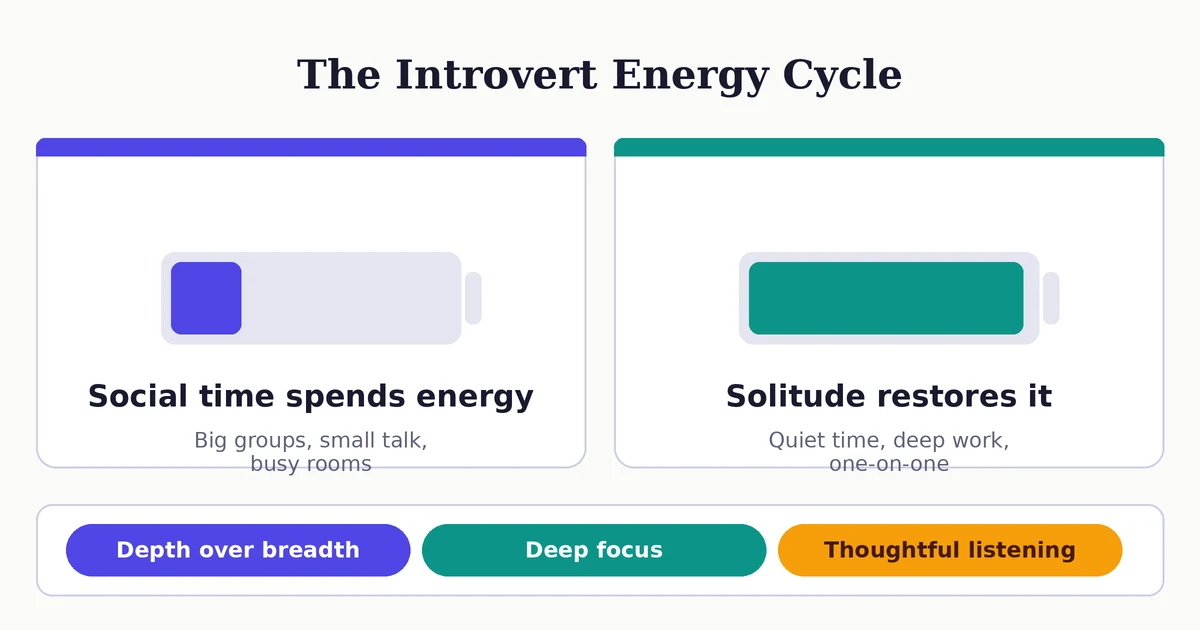
The simplest way to understand introversion is through energy. For an introvert, social interaction spends energy, while solitude restores it.
Imagine two coworkers at the office holiday party. Maya spends two hours making small talk with dozens of people, then comes home buzzing and ready for more. Daniel enjoys the party too — he genuinely likes his colleagues — but by 9 p.m. he is mentally spent and needs a quiet drive home and an early night. Daniel is not antisocial; his social battery simply drains faster, and it recharges in low-stimulation settings.
This is the key pattern to notice: it is about stimulation preference, not dislike of people. Introverts often prefer quieter environments, smaller groups, and meaningful one-on-one conversation over loud, high-energy social scenes [1]. After a full day of meetings or a busy weekend, an introvert does not need cheering up — they need downtime. A quiet Saturday morning alone is not avoidance; it is recovery.
Another everyday example: when a group chat explodes with weekend plans, the introvert in the group might prefer a calm coffee with one close friend over a packed group dinner. Both are social. One is simply less stimulating.
A note on what this section is (and isn’t)
This is educational content about a personality trait, not a diagnosis of anything. Introversion is a normal variation in how people are wired — describing a preference, not a condition. Reading about personality traits is not a substitute for professional advice, and if you are struggling with persistent distress or difficulty functioning, a qualified professional is the right next step.
Common Traits and Signs of an Introvert
Introversion shows up as a cluster of tendencies, not a single behavior. Here are the most common signs, described the way introverts themselves usually recognize them:
- You recharge alone. After social events — even fun ones — you need time by yourself to feel like yourself again. A book, a walk, a quiet room: solitude restores you.
- You prefer small groups or one-on-one time. Deep conversation with one person feels nourishing; a loud party with strangers feels draining. You choose depth over breadth in your social life.
- You think before you speak. You tend to reflect first and respond second. In meetings, you may be the person who speaks last — and says the thing everyone remembers.
- You are an observant listener. You notice details others miss: the tone of a voice, the thing left unsaid. People often tell you, “You’re easy to talk to.”
- You prefer to work independently. The APA’s definition specifically notes that introverts tend to prefer working independently [1]. Solo projects, deep focus blocks, and control over your environment suit you.
- You guard your inner world. Introverts tend to be relatively reserved and deliberate, and may hold back expressive enthusiasm even when they feel it [1]. Your privacy is precious, and you reveal yourself slowly.
- You need recovery time. After high-stimulation stretches — a conference, a family gathering, a week of back-to-back meetings — you need a buffer of quiet before you are ready for more.
- You dislike small talk. Not because you dislike people, but because you prefer conversations that go somewhere. You would rather talk about one real thing than ten shallow ones.
You do not need every sign to be introverted — remember the continuum [1]. But if most of these sound like you, you are probably sitting on the introverted side of it.
Strengths of the Introvert Personality
Introversion is often framed as the absence of something — of confidence, of sociability, of energy. Looked at honestly, it is a profile with real strengths:
Deep focus. Preferring to work independently and favoring quiet environments means introverts often sustain concentration well. Long, uninterrupted work — writing, coding, research, craft, analysis — is a natural fit.
Thoughtful listening. Because introverts tend to be reserved and deliberate, they listen more than they broadcast [1]. In friendships, teams, and relationships, being genuinely heard is rare — and introverts are often the people who provide it.
Calm under pressure. A preference for low stimulation is an advantage when things get chaotic. Introverts tend to stay measured, think before reacting, and keep a steady presence while others are overwhelmed.
Careful decision-making. The habit of thinking before speaking extends to decisions. Introverts tend to consider an issue thoroughly before committing, which makes them reliable in roles where a hasty call is costly.
Depth in relationships. Introverts may have smaller social circles, but those bonds tend to run deep. Choosing a few close connections over a wide network is not a limitation — it is a different, equally valid way of relating.
Preparation. Many introverts prepare thoroughly — for meetings, conversations, presentations — because they prefer not to improvise. That preparation often reads as competence.
None of this means extroverts lack these qualities. It means the introvert’s strengths are genuine and structural: they come from the same source as the traits themselves.
Common Misconceptions
Some of the most persistent myths about introverts come from reading the quiet surface and guessing wrong about what’s underneath. If you want the side-by-side view, compare introverts and extroverts.
| What people assume | What’s actually true |
|---|---|
| Introverts are shy | Shyness is fear of social judgment; introversion is a preference for lower stimulation. Many introverts are socially confident and warm — they just need less of it. |
| Introverts are antisocial | Introverts are not against people; they prefer fewer people, deeper connection, and quieter settings. Disliking a loud party is not disliking people. |
| Introverts are unfriendly or rude | Being reserved or quiet in expression is not coldness [1]. Introverts are often deeply loyal and attentive once you know them. |
| Introverts can’t be leaders | Leadership draws on vision, listening, preparation, and calm judgment — all classic introvert strengths. Introverts lead differently: by thinking deeply and empowering others, not by being the loudest voice. |
| Introversion is social anxiety | Introversion is a preference, not a fear. Social anxiety involves persistent fear or distress about social judgment — and it is a distinct, diagnosable condition. Introverts without anxiety simply prefer calm over chaos. |
Table: common misconceptions about introverts, and the reality behind each.
If social situations cause you persistent fear, dread, or difficulty functioning, that is worth discussing with a mental health professional — it may be social anxiety rather than How to Thrive as an Introvert
How to Thrive as an Introvert
Introversion is not something to overcome. It is something to design your life around. A few practical ideas:
- Schedule recovery time deliberately. Put downtime on your calendar the way you would a meeting. After a busy week, protect a quiet morning or an evening alone — treat it as maintenance, not laziness.
- Choose depth over breadth. You do not need a huge social circle. Invest in a few close relationships; a dinner with one good friend beats a dozen shallow obligations.
- Communicate your needs plainly. “I need an hour to recharge, then I’m all yours” is honest, not rude. Most people respect it when you say it directly.
- Prepare for high-energy events. Know your exits, plan breaks, drive yourself so you can leave when you need to. Arriving with a plan makes big events far more enjoyable.
- Design your environment. A quiet workspace, noise-canceling headphones, and control over your surroundings are not luxuries for introverts — they are tools that protect your focus.
- Lead with your strengths. Volunteer for the deep work, the careful analysis, the one-on-one mentoring. You do not have to play the extrovert’s game to be valuable.
- Stop apologizing for your wiring. You do not owe anyone an explanation for preferring a quiet evening in. Introversion is a normal, healthy personality trait — own it.
Frequently Asked Questions
What’s the difference between being an introvert and being shy?
Introversion is a preference for lower-stimulation environments and inner-directed attention; shyness is fear or discomfort about social judgment. You can be introverted and socially confident, or extroverted and shy — they are different dimensions.
Is introversion the same as social anxiety?
No. Introversion is a personality trait — a preference. Social anxiety is a clinical condition defined by persistent fear or distress around social evaluation. An introvert without anxiety enjoys people on their own terms; someone with social anxiety suffers in situations they may wish they could enjoy.
Can introverts be good leaders?
Yes. Leadership relies on vision, listening, preparation, calm decision-making, and the ability to develop others — qualities introverts often have in abundance. The stereotype that leaders must be loud and commanding confuses style with effectiveness.
Can an introvert become more outgoing?
Your basic position on the introversion–extraversion continuum is a relatively stable trait, but behavior is flexible. Introverts can learn social skills, speak up in meetings, and enjoy parties — they will just need recovery time afterward. The goal is not to change your wiring, but to expand your range.
References & Further Reading
- Introversion — APA Dictionary of Psychology. https://dictionary.apa.org/introversion
- Personality — Department of Psychology, Penn State. https://psych.la.psu.edu/about-us/research/personality/