
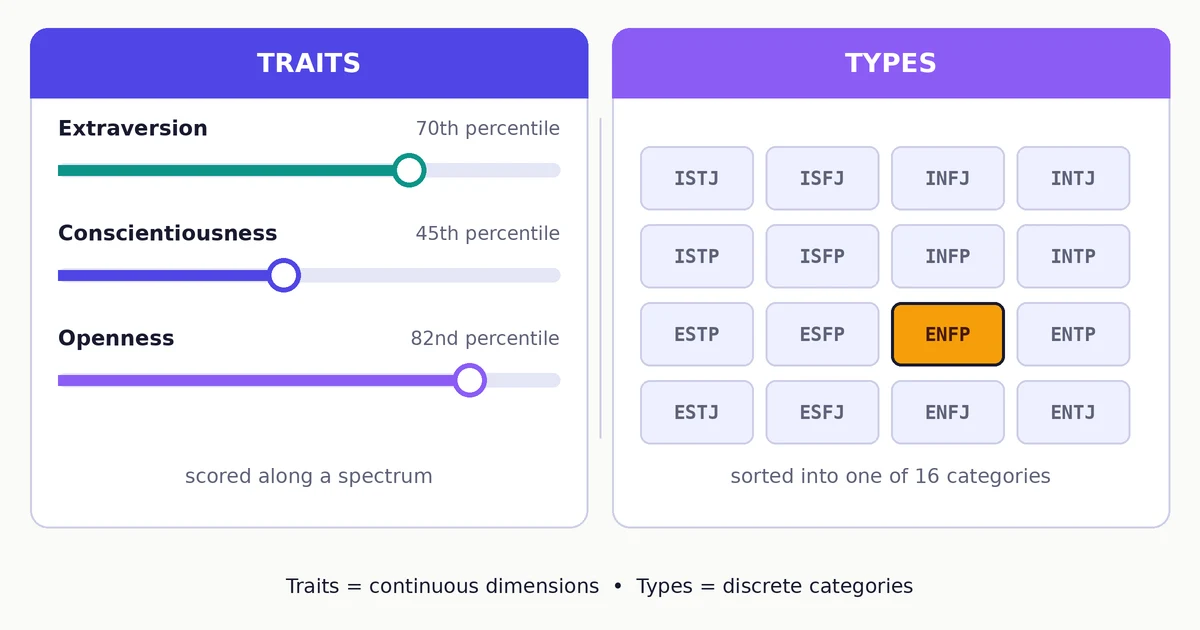
The difference is simple: traits describe you as a point on a sliding scale, while types sort you into a box. A trait framework says you score at the 70th percentile on extraversion — a degree of something everyone has. A type framework says you are an “ENFP” — a category you belong to.
Both approaches try to describe personality, but they rest on different assumptions about how personality works. Traits assume human variation is mostly continuous: people differ by how much of something they have. Types assume variation clusters into kinds: people belong to distinct groups. Understanding this one distinction clears up most of the confusion — and the debate — around frameworks like the Big Five and the MBTI.
Table of Contents
Traits in 30 Seconds
Trait models, led by the Big Five (openness, conscientiousness, extraversion, agreeableness, and neuroticism — OCEAN), describe personality as five broad dimensions. Everyone has some of each trait; when measured, some people rate higher and others rate lower, and scores are typically compared against a large sample of test takers to show where you stand relative to others [1].
So a trait result isn’t a label — it’s a profile: moderately extraverted, highly conscientious, about average on openness. Research finds that people fall at various points along a continuum for each trait, with most of us landing somewhere in the middle rather than at the extremes [1]. (For the full picture, see our guide to personality traits.)
Types in 30 Seconds
Type systems sort people into a fixed set of categories. The best-known is the Myers-Briggs Type Indicator (MBTI): four pairs of opposites — Extraversion or Introversion, Sensing or Intuition, Thinking or Feeling, Judging or Perceiving — combine into 16 four-letter types such as INTJ or ENFP. It was created by Katharine Cook Briggs and her daughter Isabel Briggs Myers, building on Carl Jung’s 1921 theory of psychological types, and it is widely used for self-understanding, communication, team building, and career guidance [2]. Another popular example is the Enneagram, which sorts people into nine types.
A type result is a single, memorable identity: you don’t get five numbers, you get a name. (For the full picture, see our overview of personality type systems.)
The Core Difference: Degrees vs. Boxes
Consider a concrete example. Amara completes a Big Five questionnaire and scores at the 70th percentile on extraversion. That tells her something precise and comparative: she is more outgoing than roughly 70 out of 100 people, moderately high but not extreme. There is room to say “somewhat extraverted” — the number captures the degree [1].
Now imagine Amara takes a type-based test instead and receives the label ENFP. Her actual position on the extraversion–introversion scale might be just barely past the midpoint — yet the letter “E” erases that nuance entirely. Someone at the 51st percentile and someone at the 99th percentile get the same letter, and someone at the 49th gets the opposite one. A tiny shift in answers can flip a letter, which is exactly why researchers raise concerns about the reliability of assigned types [1].
This is the heart of the difference:
- Traits preserve nuance. They measure how much, so near-misses and middle-ground results stay visible.
- Types force a decision. They measure which side, so borderline cases get sorted anyway — and the border is arbitrary.
Traits vs. Types: Side-by-Side Comparison
| Dimension of comparison | Traits | Types |
|---|---|---|
| Core idea | Personality varies along continuous dimensions | Personality clusters into distinct categories |
| What a result looks like | A profile of scores (e.g., percentiles) across dimensions | A single category or code (e.g., ENFP, Type 4) |
| Example statement | “You’re moderately high in extraversion” | “You’re an extravert” |
| Measurement | Questionnaires scoring each dimension, compared to population norms [1] | Questionnaires with cutoffs that assign you a side on each pair [2] |
| Research standing | The five-factor model dominates among personality psychologists; widely used in research and linked to life outcomes [1] | Hugely popular outside academia, but researchers raise concerns about the reliability of assigned types and the validity of the framework [1][3] |
| Strengths | Precise, nuanced, research-tested, stable scores | Memorable, intuitive, great conversation starters and team language [2] |
| Limitations | Numbers can feel abstract; scores need context to interpret | Boxes hide nuance; borderline cases get sorted arbitrarily; can encourage identity lock-in (“I’m just like this”) |
| Best for | Research, tracking change, decisions that need precision | Self-reflection, group discussions, accessible first step into personality |
Why Psychology’s Research Mainstream Favors Traits
This isn’t a popularity contest — it’s about what survives scientific testing. Among personality researchers, the five-factor model dominates; type frameworks like the MBTI and the Enneagram are popular mainly outside academic psychology, where many experts take issue with them on scientific grounds [1].
Two findings explain the gap:
Types don’t behave like types in the data. When McCrae and Costa analyzed the MBTI against the five-factor model in a peer-reviewed study, they found no support for the idea that it measures truly dichotomous preferences or qualitatively distinct types — instead, the instrument measures four relatively independent dimensions [4]. In other words, the MBTI collects trait-like data and then throws away the nuance by cutting each dimension in half.
The “true type” theory falters on basic scientific criteria. Stein and Swan (2019) examined the Jungian-based theory behind the MBTI — the claim that people have a “true type” defined across four dichotomies — and concluded it lacks agreement with known facts and data, lacks testability, and contains internal contradictions [3].
Trait models aren’t perfect — researchers still debate how many dimensions personality really has [1]. But traits won the mainstream because their claims are testable and have held up.
(For the full picture, see our guide to personality psychology.)
When Type Frameworks Are Still Useful
A framework can be scientifically shaky and still useful in the right context. Type systems thrive because they give people something trait profiles often don’t — a shared, human language. Saying “I’m an introvert” in a team meeting lands instantly; saying “I score at the 30th percentile on extraversion” does not.
Used well, type frameworks are good for:
- Self-reflection. Answering questions about your preferences forces useful introspection, whatever the label says.
- Team and relationship conversations. Types give groups a neutral vocabulary for saying “we work differently” without blame [2].
- Accessible starting points. For many people, a four-letter code is the doorway that leads to deeper, more serious personality science.
The key is proportion: use types as conversation starters, not as verdicts. Don’t hire by type, don’t diagnose by type, and don’t let a label decide who you’re allowed to become.
The Practical Takeaway: Different Questions, Different Answers
Traits answer “how much?”; types answer “which kind?” When you need precision — tracking change, understanding strengths, consequential decisions — trait dimensions are the stronger tool. When you need quick, shareable language for talking about differences, types do the job fine.
And here’s the view many psychologists land on: types are best understood as rough shorthands over underlying trait continua. The same peer-reviewed work that found no support for distinct MBTI types also found that the MBTI’s four indices measure aspects of four of the Big Five’s five major dimensions [4]. The types aren’t nonsense — they’re blurry photographs of real trait dimensions. Know the difference between the photo and the landscape, and you can use both without being misled by either.
A brief educational note: personality frameworks describe patterns and tendencies, not medical conditions. They can aid self-understanding, but they don’t diagnose anything — and no quiz result is a substitute for professional guidance if you’re struggling.
Frequently Asked Questions
Which is more accurate for describing personality — traits or types?
Traits, by the standards of psychological science. Trait models measure you on continua, keep borderline nuance visible, and have far stronger evidence for reliability and validity [1]. Types are more memorable but less precise — accuracy and memorability are different virtues.
Are personality types just simplified traits?
Largely, yes. Research on the MBTI found that it measures underlying dimensions rather than truly distinct types, and that its scales map onto aspects of the Big Five’s dimensions [4]. A type is roughly what you get when you draw lines through continuous trait scores.
Can I use both?
Absolutely — use a trait-based assessment when you want an honest, detailed picture, and type language when you want a quick way to talk about differences with others. Problems only start when a type label is treated as a scientific verdict.
My type letters change when I retake the test. Is something wrong with me?
No — that’s a property of the instrument, not of you. If you sit near the middle of a dimension, tiny differences in your answers can flip a letter, because the system forces everyone onto one side of a line [1][4]. A trait score would simply show you hovering near the middle, which is exactly where most people are [1].
Should I put my personality type in my bio or use it for hiring decisions?
A bio is harmless fun; a hiring decision is not. Type frameworks lack the reliability and validity evidence that high-stakes decisions require [1][3].
References & Further Reading
- Big 5 Personality Traits — Psychology Today. https://www.psychologytoday.com/us/basics/big-5-personality-traits
- Myers-Briggs Type Indicator (MBTI) — Simply Psychology. https://www.simplypsychology.org/the-myers-briggs-type-indicator.html
- Stein, R., & Swan, A. B. (2019). Evaluating the validity of Myers-Briggs Type Indicator theory: A teaching tool and window into intuitive psychology. Social and Personality Psychology Compass, 13, e12434. https://compass.onlinelibrary.wiley.com/doi/10.1111/spc3.12434
- McCrae, R. R., & Costa, P. T. (1989). Reinterpreting the Myers-Briggs Type Indicator from the perspective of the five-factor model of personality. Journal of Personality, 57(1), 17–40. https://pubmed.ncbi.nlm.nih.gov/2709300/
Keep Exploring
This article compared two ways of describing personality — now go deeper on each side: our guide to personality traits unpacks the trait approach in full, our overview of personality type systems covers the MBTI, the Enneagram, and more, and our guide to personality psychology places both in the bigger picture of the field.