
A personality trait is an enduring pattern in how a person typically thinks, feels, and behaves. It’s the reason your friend is always early, your coworker chats easily with strangers, and your sibling replays every criticism for days. Psychologists define personality itself as built from “long-standing traits and patterns that propel individuals to consistently think, feel, and behave in specific ways” — and the key word is consistency: one generous act doesn’t make someone generous, but a lifetime of them does [2].
This guide explains what traits are, how they differ from passing moods, and walks through 15 common personality traits with concrete, everyday examples — so words like “ambitious,” “patient,” and “curious” have real meaning behind them.
Table of Contents
What Is a Personality Trait?
A personality trait is a relatively stable, characteristic tendency — an internal pattern inferred from what a person repeatedly does, thinks, and feels. The American Psychological Association’s definition of personality describes it as an “enduring configuration” of characteristics and behavior, including major traits [1]; Penn State’s psychology department similarly describes personality as “relatively stable patterns of thought, emotion, and behavior” that define a person’s distinctive way of experiencing the world [4].
What makes something a trait rather than just a quality someone showed once? A psychology textbook puts the test plainly: “The particular quality or trait must be part of an enduring behavior pattern, so that it is a consistent or predictable quality” [2]. Three features follow from that:
- Enduring — it shows up over time, not once.
- Consistent across situations — it appears in different contexts, at home, at work, and with friends.
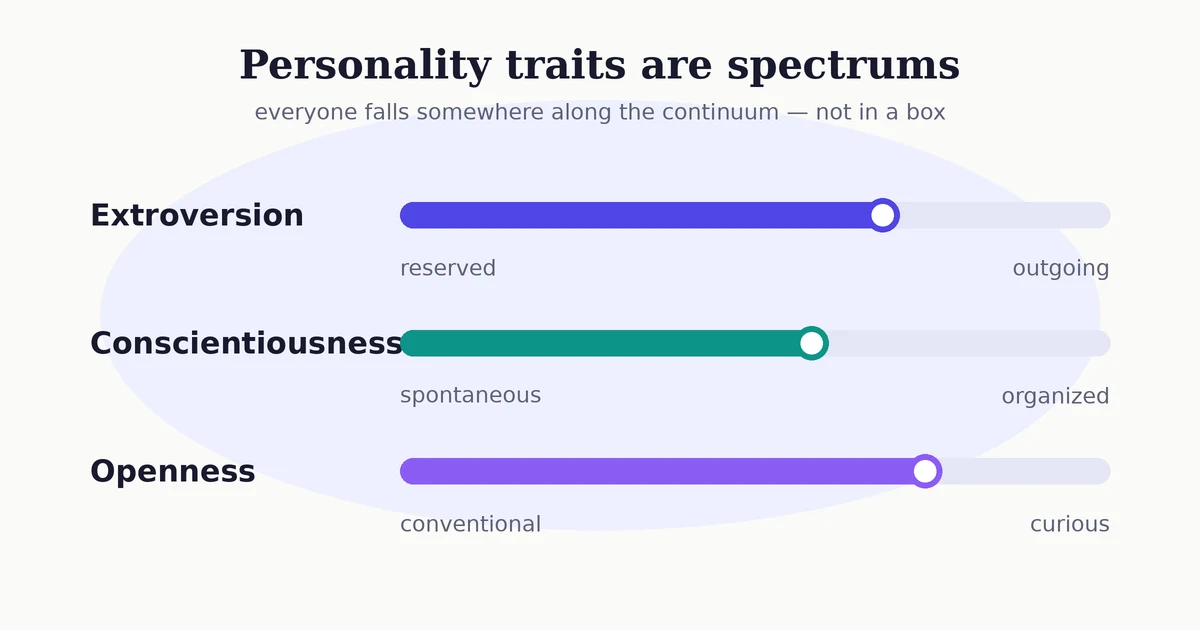
- A matter of degree — people don’t simply “have” or “lack” a trait; they fall somewhere along a continuum of it.
Your friend isn’t “a patient person” because she stayed calm once in traffic — she’s patient because she stays calm in traffic, with difficult customers, while teaching her kids, and when the internet cuts out. The pattern is the trait.
Traits vs. States and Moods
A trait is the long-term tendency. A state or mood is the temporary experience. Feeling anxious the night before a job interview is a state; being an anxious person — someone who worries often, across many situations — is a trait. From the definition above, the distinction is straightforward: traits are the enduring, consistent pattern; states are what you’re experiencing right now [2].
It’s an easy mix-up: “she’s so angry” after one bad afternoon describes a mood; “she has a quick temper” — said after watching someone flare up again and again — describes a trait. Traits describe where someone usually lands; states describe where they are in this moment.
15 Common Personality Traits, With Examples
Below is a practical tour of the traits people actually talk about — each with a one-line meaning and a concrete example. This isn’t a scientific inventory (that comes next); it’s the working vocabulary of personality. Every trait is a spectrum, so read each example as “somewhere along this continuum.”
| Trait | What it means | A real-life example |
|---|---|---|
| Extroversion | Draws energy from social interaction; tends to be outgoing and talkative | Volunteers to give the demo, chats with strangers, and leaves a party feeling recharged |
| Conscientiousness | Organized, reliable, and planful; follows through on commitments | Submits the report a day early and keeps a tidy, well-planned calendar |
| Openness to experience | Curious about new ideas, art, and experiences; comfortable with novelty | Signs up for a pottery class and a language app in the same month — just to see what they’re like |
| Agreeableness | Warm, cooperative, and considerate; values harmony | Smooths over disagreements, shares credit, and asks how everyone’s weekend went |
| Emotional sensitivity (psychologists call this neuroticism) | Tends to experience negative emotions — worry, sadness, irritation — more often and intensely | Replays a minor critical comment from a colleague for three days straight |
| Honesty | Truthful, sincere, and principled; does the right thing even when unseen | Reports a billing error in her own favor to a client, though nobody would have noticed |
| Ambition | Strongly driven to achieve goals and advance | Sets a promotion target, lists the skills it requires, and starts building them this week |
| Patience | Tolerates delays, frustration, and difficulty calmly | Teaches a child the same math concept three times without a hint of snapping |
| Curiosity | Has a strong desire to learn, explore, and understand | Spends evenings down research rabbit holes about how bridges are built — just for fun |
| Empathy | Senses and shares other people’s feelings | Notices a friend has gone quiet at dinner and gently asks what’s on their mind |
| Assertiveness | Expresses needs and opinions confidently, without aggression | Asks for a raise with clear reasons and a calm tone, instead of hoping to be noticed |
| Optimism | Expects good outcomes; treats setbacks as temporary | Treats a rejected proposal as useful feedback, not a verdict on her ability |
| Generosity | Freely gives time, attention, or resources to others | Volunteers Saturday mornings at the food bank — and shows up every week |
| Resilience | Recovers from setbacks and keeps moving forward | Starts applying for new roles the week after a layoff |
| Loyalty | Stands by people, groups, and commitments over time | Defends a friend’s reputation in a conversation they’re not part of |
A note on the list: some of these (extroversion, conscientiousness, openness, agreeableness, emotional sensitivity) are among the most studied traits in psychology and appear in the major scientific models. Others — honesty, ambition, patience, curiosity — are everyday trait words that don’t belong to one model but describe real, observable patterns. Both kinds are useful; the key is that each describes an enduring tendency, not a one-off behavior.
The Big Five: The Scientific Framework
When psychologists want a rigorous, research-tested way to describe traits, they most often reach for the Big Five, also called the five-factor model. It’s “one of the most well-known and influential models of personality,” proposing that personality can be defined by five broad dimensions: openness to experience, conscientiousness, extraversion, agreeableness, and neuroticism [4]. Psychology Today describes the Big Five as the framework personality researchers “widely use,” noting each trait reflects a key part of how a person thinks, feels, and behaves [3].
What gives the Big Five its scientific standing:
- Each trait has facets. A relatively extroverted person might be highly sociable but not especially assertive — the Big Five measures the broad trait and the narrower facets beneath it [3].
- Scores are spectrums. Questionnaires give high-to-low scores on each trait, so someone can be more conscientious and less agreeable than average while scoring mid-range on the rest [3].
- They’re fairly stable in adulthood. Big Five traits “remain fairly stable during adulthood,” though researchers note they can change over the course of a lifetime — and there’s reason to believe deliberate change is possible [3].
- It isn’t the only model. A six-factor model called HEXACO adds honesty-humility to the original five [3] — which is one reason honesty appears as its own entry in the list above.
The Big Five is part of the trait-theory family of personality theories — one of the major approaches we overview in our complete guide to personality psychology. We’ll publish a dedicated deep-dive on the Big Five soon (this section will link to it).
How Traits Are Described: Spectrums, Not Boxes
The most common mistake people make with traits is treating them as categories — you’re either an extrovert or an introvert, either organized or chaotic. Research points the other way: for any given trait, “people fall at various points along a continuum rather than fitting neatly into categories,” and most of us land somewhere in the middle [3].
This is why trait language works best with degrees: “she’s quite conscientious,” “he’s somewhat introverted,” “they’re moderately open to new experiences.”
A practical rule: if a trait label helps you understand someone’s usual pattern, it’s doing its job. If it starts to feel like a box someone can’t escape — a fixed verdict rather than a tendency — it’s being misused.
Frequently Asked Questions
What’s the difference between personality and a personality trait?
Personality is the whole package — the full, organized pattern of how someone thinks, feels, and behaves. A trait is one enduring thread within that pattern. Our guide to what personality is covers the construct itself; this article covers its building blocks.
Can personality traits change?
They’re fairly consistent over short periods in adulthood, but they do change over the course of a lifetime — and there’s reason to believe deliberate personality change is possible [3]. Traits are tendencies, not life sentences.
Are personality traits inherited or learned?
Both. Personality traits are “thought to be rooted in genetic and environmental factors, and they develop and evolve throughout an individual’s lifespan” [4]. Genes set tendencies; experience, culture, and choices shape how those tendencies play out.
What’s the difference between personality traits and personality types?
Traits describe where you fall on continuous spectrums that everyone shares in some degree. Types sort people into discrete categories. For any given trait, people actually fall at various points along a continuum rather than fitting neatly into boxes [3]. (We’ll publish a dedicated traits-vs-types comparison soon.)
How are personality traits measured?
Mostly through questionnaires. Big Five measures, for example, ask how much you agree that statements like “Is curious about many different things” or “Is outgoing, sociable” describe you, then calculate an average high-to-low score for each trait [3]. They work best with honest answers about your typical behavior — and they estimate tendencies, not destinies.
References & Further Reading
- Personality — APA Dictionary of Psychology. https://dictionary.apa.org/personality
- What Is Personality? — Psychology, OpenStax/H5P Edition via Maricopa Community Colleges. https://open.maricopa.edu/psy101brown/chapter/what-is-personality/
- Big 5 Personality Traits — Psychology Today. https://www.psychologytoday.com/us/basics/big-5-personality-traits
- Personality — Department of Psychology, Penn State. https://psych.la.psu.edu/about-us/research/personality/
Keep Exploring
- Personality psychology: the complete guide — the field that studies traits: its theories, how traits are measured, and what they predict.
- What is personality? — the construct itself: what personality means as a whole, beyond any single trait.
Educational note: this article is for understanding and self-reflection. Describing traits is not diagnosing anything — if you’re concerned about your mental health, a qualified professional is the right next step.
3 thoughts on “Personality Traits: Meaning, List & Examples”