
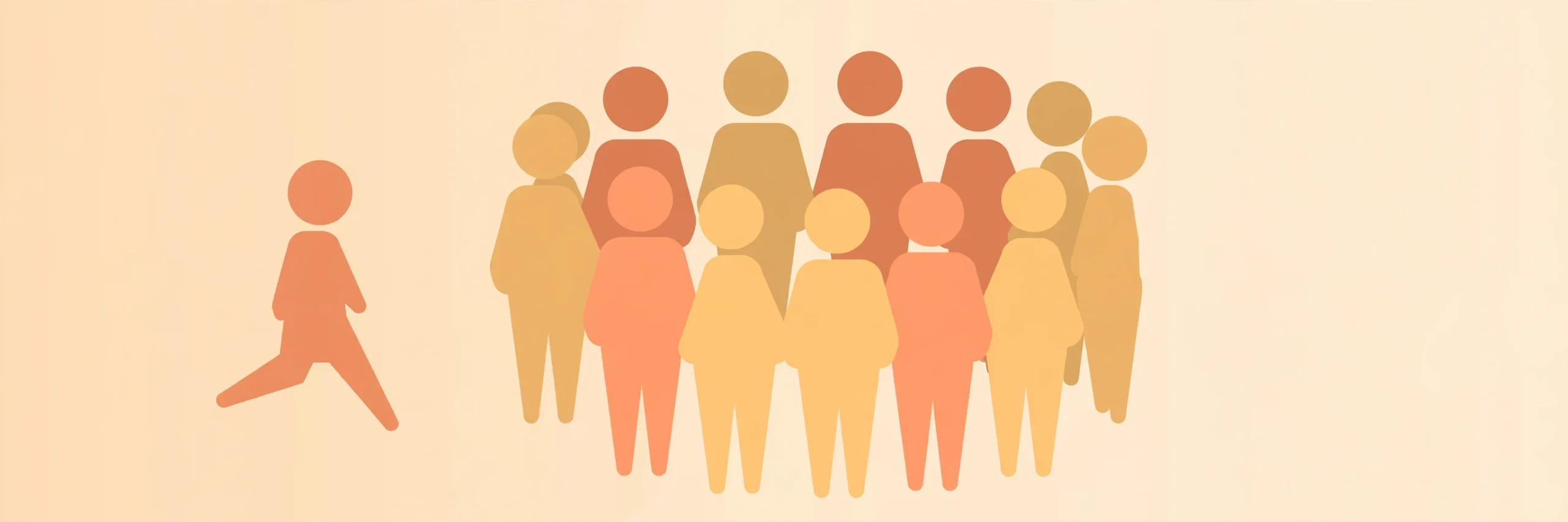
The bystander effect is the tendency for an individual to be less likely to help in an emergency when other people are present than when alone. It was studied by social psychologists John Darley and Bibb Latané, beginning with experiments published in 1968. This entry gives only the definition and the basic finding; the fuller discussion of helping, its causes, and its exceptions belongs to the site’s article on prosocial behaviour, linked from the planned-links file once that article is live.
What it looks like
The pattern is counterintuitive: more witnesses can mean less help. A person who collapses on a busy street may wait longer for assistance than someone who collapses where only one passer-by is present. A student being harassed in a crowded corridor may find that nobody steps in, not because nobody cares, but because each onlooker assumes someone else will act, or is unsure whether action is even needed.
Why it happens
Two explanations are usually given. The first is diffusion of responsibility: when several people witness an event, the responsibility to act feels shared, so each person feels less personally obliged than they would alone. The second is social ambiguity: in an unclear situation, people look to others for cues, and if everyone else appears calm, each person reads that calm as evidence that nothing serious is happening. A third factor is evaluation apprehension: people worry about misreading the situation and embarrassing themselves by intervening unnecessarily. Darley and Latané’s experiments showed the basic pattern in controlled settings, where participants who believed others were present were slower to report an apparent emergency than participants who believed they were alone.
An everyday example
In an office, an email thread reports a problem with a shared printer. Everyone on the thread sees it, and nobody replies, each assuming a colleague will handle it. If the same problem had been sent to one person alone, that person would almost certainly have acted. The same hesitation scales up to emergencies, where uncertainty and an audience together make action feel riskier than inaction. The printer is trivial, but the mechanism is the same: shared awareness diluted individual responsibility, and the task went undone.