
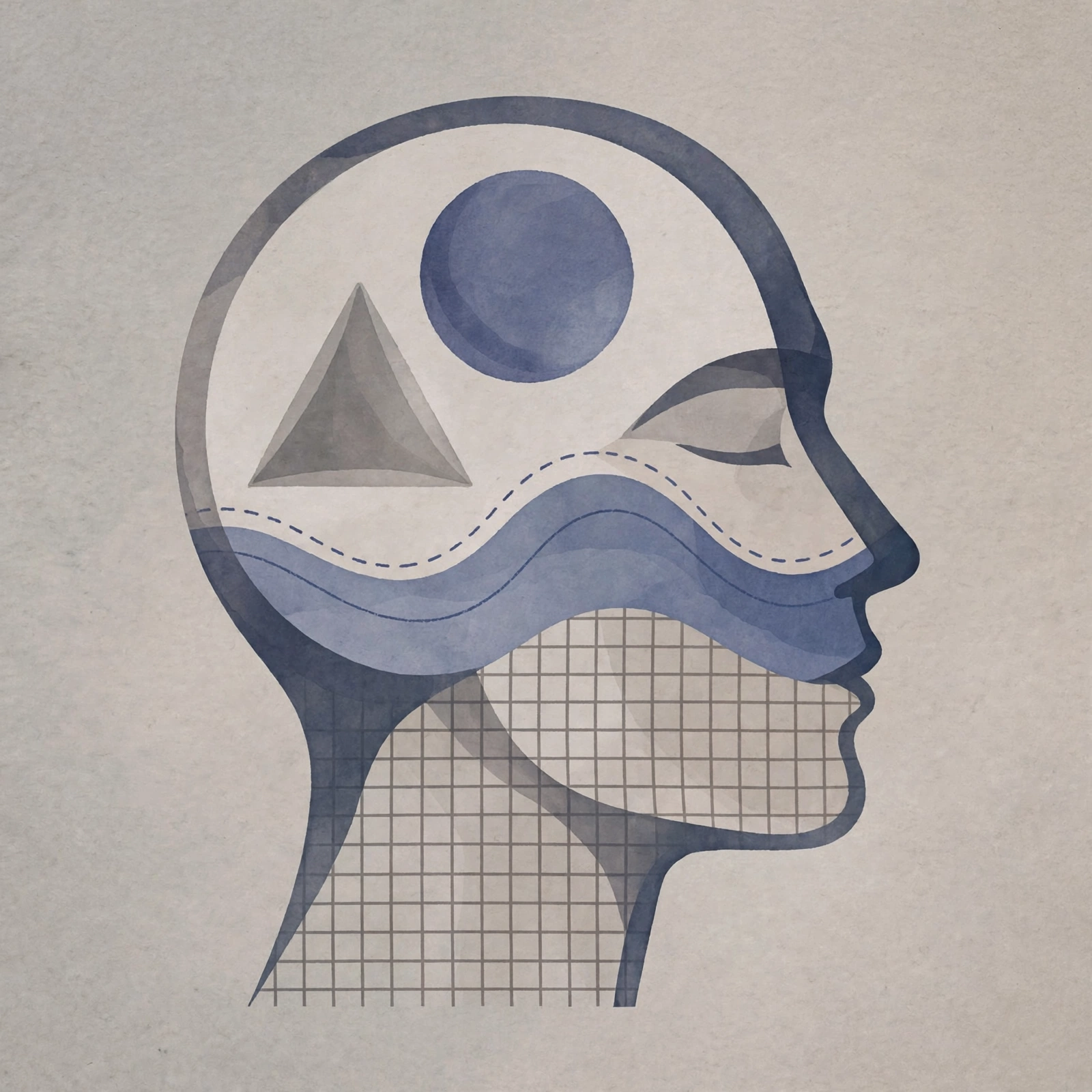
Cognitive psychology is the study of how the mind works — how we take in information through our senses, pay attention to some of it and ignore the rest, store it as memory, use language to think and communicate, and solve problems and make decisions. It asks a question that sounds simple and turns out to be very hard: what happens between the moment the world reaches us and the moment we act on it? The field’s answer is that the mind is not a passive recorder. It selects, organizes, interprets, and sometimes distorts what it takes in — and understanding those processes explains a great deal about everyday human experience, from why we forget names to why two people can watch the same event and remember it differently.
This article explains the core ideas of cognitive psychology in plain language. It describes patterns found across many people in many studies, not rules for any one person. It cannot diagnose you or anyone else, and it cannot predict how a particular person will think or remember in a particular situation. It can help you understand how the mind generally works — including its limits and its shortcuts.
The Cognitive Revolution: Psychology Gets Its Mind Back
For much of the first half of the twentieth century, psychology was dominated by behaviorism, a school of thought that treated the mind as a black box. Behaviorists studied what could be observed and measured — stimuli and responses — and argued that talking about inner mental processes was unscientific. This approach produced real knowledge about learning, but it left the most interesting questions untouched: how do people understand language, remember the past, or solve a new problem?
By the late 1950s, the cracks were showing. In 1959, the linguist Noam Chomsky published a critical review of B. F. Skinner’s account of language, arguing that behaviorist principles could not explain how children learn the complex rules of grammar (Chomsky, 1959). In the same period, George Miller (1956) published one of the most famous papers in psychology, showing that short-term memory has a strict limit — about seven items, plus or minus two — which suggested that the mind has a measurable internal structure worth studying in its own right. Around the same time, the new science of computers gave psychologists a powerful metaphor: the mind could be understood as an information-processing system, taking in input, transforming it, storing it, and producing output. How children learn to think is part of developmental psychology, the field that studies growth and change across the lifespan.
The field got its name in 1967, when Ulric Neisser published Cognitive Psychology, a book that pulled the scattered research together into a single discipline (Neisser, 1967). From there the field grew rapidly, mapping the stages of memory, the filters of attention, the rules of perception, and the strategies of problem-solving. Today it is one of the largest areas of the discipline, and its findings shape everything from classroom design to how eyewitness testimony is treated in court.
Perception: Making Sense of the World
Perception is the process by which the brain turns sensory input into a meaningful picture of the world — and it is far more active than it feels. The eyes take in light, but the brain decides what counts as an object, what is in the foreground, and what something means. The Gestalt psychologists showed that the brain organizes what it sees according to simple principles: things that are close together are grouped together, similar things are seen as belonging together, and the mind fills in gaps to complete a shape. These principles still describe how perception works: they explain why we see a whole face in a few lines, or a single melody in a sequence of notes.
Perception is also shaped from the top down, by what we already know and expect. The same ambiguous image can look like a duck or a rabbit depending on what you have just been thinking about, and a word can sound different depending on the sentence around it. Expectations are useful — they let the brain interpret incomplete information quickly — but they also mean that perception is not a faithful recording. The site’s guide to confirmation bias describes a related pattern: we tend to notice and remember information that fits what we already believe, which is one reason two people can look at the same evidence and reach opposite conclusions.
Illusions are also a research tool: an illusion is not a failure of the system but a clue about how it works. When the brain misjudges the size of two identical lines, or sees motion where nothing moves, it reveals the shortcuts and assumptions the visual system normally relies on. Understanding those shortcuts is useful far beyond the laboratory — it matters for design, for safety, and for knowing when to trust what you see.
Attention: The Mind’s Spotlight
Attention is the mind’s way of dealing with a basic problem: far more information arrives than the mind can process. Attention is the selection — choosing what to focus on and what to let pass. Donald Broadbent (1958) proposed one of the first models of this selection, a “filter” model in which incoming information is held briefly and only some of it is allowed through for deeper processing. Later work refined the idea, but the core insight has held up: attention is limited, and what gets through depends on both the properties of the information and the goals of the person.
One of the clearest demonstrations of selective attention is the cocktail party effect. In experiments by Colin Cherry (1953), people listening to two different messages — one in each ear — could follow one conversation closely while barely registering the other, yet still notice when their own name appeared in the ignored message. Attention is selective, but it is not a sealed door: important information can break through.
Attention also has a famous blind spot. In a study by Daniel Simons and Christopher Chabris (1999), people asked to count basketball passes in a video often failed to notice a person in a gorilla suit walking through the scene — a phenomenon called inattentional blindness. When attention is fully occupied, even obvious things can go unseen. The same limitation shows up in divided attention: doing two demanding things at once, like driving while using a phone, reliably makes both worse — the mind’s capacity is shared, not duplicated.
Memory: Encoding, Storage, and Retrieval
Memory is the mind’s record-keeping system, usually described in three stages: encoding (getting information in), storage (keeping it), and retrieval (getting it back out). Each stage can fail in its own way, which is why forgetting is not a single problem but several. Miller’s (1956) finding about the seven-item limit applies to short-term memory, the brief holding system that keeps information active for seconds. But the mind also has a working memory — a system for holding and manipulating information while you use it — which Alan Baddeley and Graham Hitch (1974) described as having separate components for sounds, images, and a central controller that coordinates them.
Long-term memory, by contrast, is vast and durable, and it comes in different kinds. Some memories are conscious and reportable, like the facts you learned at school or the events of your own life. Others operate without awareness, like the skill of riding a bicycle or the way a familiar word comes to mind more easily after you have recently seen it — a phenomenon called priming. Baddeley (2012), reviewing nearly forty years of research on working memory, concluded that the model has held up well but continues to be refined, with new components added as the evidence has accumulated.
Memory is also reconstructive rather than reproductive. Remembering is not like replaying a recording; it is more like rebuilding a scene from fragments, guided by what you know and expect. That is why memories can be confident and wrong at the same time, and why the same event can be remembered differently by different people. The details of how memory fails — and how it can mislead — are covered in the cluster’s articles on how memory works and why we forget.
Language and Thought
Language is one of the mind’s most remarkable achievements, and cognitive psychology treats it as a mental system with its own rules. Speaking and understanding a sentence requires far more than knowing words: the brain has to parse grammar in real time, work out what a speaker means rather than only what they literally said, and keep track of the conversation so far. Children master this system without formal teaching, which is one reason language has been so central to debates about what is built into the mind and what is learned from experience.
The relationship between language and thought is one of the field’s oldest questions. Does the language you speak shape the way you think? Researchers broadly agree on a modest version of the idea: language makes some distinctions easier to notice and talk about, and it gives us tools for reasoning — counting, categorizing, and planning — that would be harder without words. But the stronger claim, that language determines thought and limits what a person can conceive, has not held up. People can think about things they have no words for, and speakers of different languages solve the same problems in similar ways.
Language also connects cognitive psychology to the rest of the discipline: how we describe feelings affects how we experience them, how we frame a problem affects how we try to solve it, and how we talk shapes what we remember. Language is not only a way of expressing thought — it is one of the tools thought is made of.
Thinking and Problem-Solving
Thinking is the mind’s workbench: reasoning, judging, deciding, and solving problems. Cognitive psychologists distinguish between different modes of thinking — the fast, automatic judgments we make without effort, and the slow, deliberate reasoning we use when a problem is hard or unfamiliar. Much of everyday thinking runs on the fast track, which is efficient but prone to predictable errors. The site’s guide to cognitive biases covers those errors in detail: the shortcuts, or heuristics, that usually help and sometimes mislead.
Problem-solving has its own psychology. Researchers describe it as moving through stages: understanding the problem, coming up with possible approaches, trying one, and checking whether it worked. Two findings recur. The first is insight — the sudden “aha” moment when a problem’s structure becomes clear, often after a period of stepping away from it. The second is the way old habits can block new solutions: a mental set, formed by past success, can make it hard to see a simpler approach, and functional fixedness can make it hard to see an object used in an unfamiliar way. Both show that thinking is not only about ability — it is about flexibility, and about being able to let go of a strategy that used to work.
Thinking is also where the field’s limits show most clearly: people are capable of careful, logical reasoning, and they also regularly make judgments that contradict their own stated beliefs. The field’s job is to explain when each mode takes over and why.
How Cognitive Psychologists Study the Mind
Because mental processes cannot be observed directly, cognitive psychologists study them indirectly, and the methods they use are part of what makes the field distinctive. The core method is the experiment: change one thing under controlled conditions and measure what happens to speed or accuracy. If people are slower to respond when a task requires switching between two rules, that slowing tells researchers something about how attention and control work — even though nobody can see the switching itself.
A second method is cognitive neuroscience, which links mental processes to the brain. Brain imaging shows which regions are active during a task, and studies of people with brain injuries show what is lost when a region is damaged. Together with experiments, they let researchers test whether a proposed mental process has a plausible physical basis.
A third method is the computer model: building a program that performs a task the way the mind seems to, and checking whether it makes the same mistakes. Models are useful because they force vague ideas to become precise — a theory that cannot be turned into a working model usually has a gap in it. The quality of any of these methods depends on measurement, and the site’s guide to psychology tests explains the standards researchers use: validity, whether a test measures what it claims to, and reliability, whether it gives similar results on repeated use.
Where Cognitive Psychology Shows Up in Everyday Life
Cognitive psychology is a basic science, but its findings reach into everyday life in several directions. Education is one of the clearest: teaching methods that fit how memory and attention actually work — presenting material in manageable amounts, revisiting it over time, and testing understanding rather than only re-reading — are grounded in cognitive research.
The legal system is another. Because memory is reconstructive, eyewitness testimony is less reliable than it feels, and courts increasingly take account of what memory research shows about how confidence and accuracy can come apart. Design is a third: interfaces, road signs, and warning systems work best when they fit the limits of attention and perception rather than fighting them.
Clinical work is a fourth. Cognitive-behavioral therapy, one of the most widely used talking therapies, draws directly on cognitive models: it works with the idea that how a person interprets events shapes how they feel and act, and that changing those interpretations can change the outcome. The link shows how a laboratory finding can end up changing how people are helped.
Key Takeaways
- Cognitive psychology studies the mind’s information processing: perception, attention, memory, language, thinking, and problem-solving.
- The field began with the cognitive revolution of the 1950s and 1960s, when researchers showed that inner mental processes could be studied scientifically — Miller (1956) on memory limits, Chomsky (1959) on language, and Neisser (1967) naming the discipline.
- Perception is active, not passive: the brain organizes input using Gestalt principles and top-down expectations, which is why the same scene can be seen differently by different people.
- Attention is a limited resource: Broadbent’s filter model, Cherry’s cocktail party effect, and Simons and Chabris’s inattentional blindness all show that what we notice — and miss — depends on where attention is directed.
- Memory has stages (encoding, storage, retrieval) and systems (short-term, working, and long-term memory), and remembering is reconstructive — the mind rebuilds the past rather than replaying it.
- The field’s methods — experiments, brain imaging, and computer models — let researchers test ideas about processes nobody can observe directly, and its findings inform education, law, design, and therapy.
References
- Baddeley, A. (2012). Working memory: Theories, models, and controversies. Annual Review of Psychology, 63, 1–29. https://doi.org/10.1146/annurev-psych-120710-100422
- Baddeley, A. D., & Hitch, G. (1974). Working memory. In G. H. Bower (Ed.), The Psychology of Learning and Motivation (Vol. 8, pp. 47–89). Academic Press. https://doi.org/10.1016/S0079-7421(08)60452-1
- Broadbent, D. E. (1958). Perception and Communication. Pergamon Press.
- Cherry, E. C. (1953). Some experiments on the recognition of speech, with one and with two ears. The Journal of the Acoustical Society of America, 25(5), 975–979. https://doi.org/10.1121/1.1907229
- Chomsky, N. (1959). Review of Verbal Behavior by B. F. Skinner. Language, 35(1), 26–58. https://doi.org/10.2307/411334
- Miller, G. A. (1956). The magical number seven, plus or minus two: Some limits on our capacity for processing information. Psychological Review, 63(2), 81–97. https://doi.org/10.1037/h0043158
- Neisser, U. (1967). Cognitive Psychology. Appleton-Century-Crofts.
- Simons, D. J., & Chabris, C. F. (1999). Gorillas in our midst: Sustained inattentional blindness for dynamic events. Perception, 28(9), 1059–1074. https://doi.org/10.1068/p281059
Keep Exploring
- Cognitive Biases: How Your Mind Takes Shortcuts
- Confirmation Bias: Why We See What We Already Believe
- Priming: How Earlier Cues Shape Later Responses
- Psychology Tests Explained: Types and Limits
What is cognitive psychology?
Cognitive psychology is the study of mental processes — perception, attention, memory, language, thinking, and problem-solving. It asks how the mind takes in information, stores it, and uses it to understand the world and act on it.
How is cognitive psychology different from behaviorism?
Behaviorism studied only observable behavior and treated the mind as a black box. Cognitive psychology studies the mental processes in between — the perceiving, remembering, and thinking that connect what happens to us with what we do.
What are the main processes cognitive psychology studies?
The core processes are perception, attention, memory, language, and thinking (including reasoning, decision-making, and problem-solving). Most research focuses on one of these, but they overlap — attention shapes what gets into memory, and memory shapes what we perceive.
How do cognitive psychologists study the mind if they cannot see it?
Indirectly, through experiments that measure speed and accuracy under controlled conditions, brain imaging that links mental tasks to brain activity, studies of people with brain injuries, and computer models that test whether a theory can reproduce what the mind does.
What is cognitive psychology used for?
Its findings inform education (how teaching fits memory and attention), the legal system (how reliable eyewitness memory is), design (interfaces and signs that fit the mind’s limits), and therapy — cognitive-behavioral therapy draws directly on cognitive models of how interpretation shapes feeling and action.