
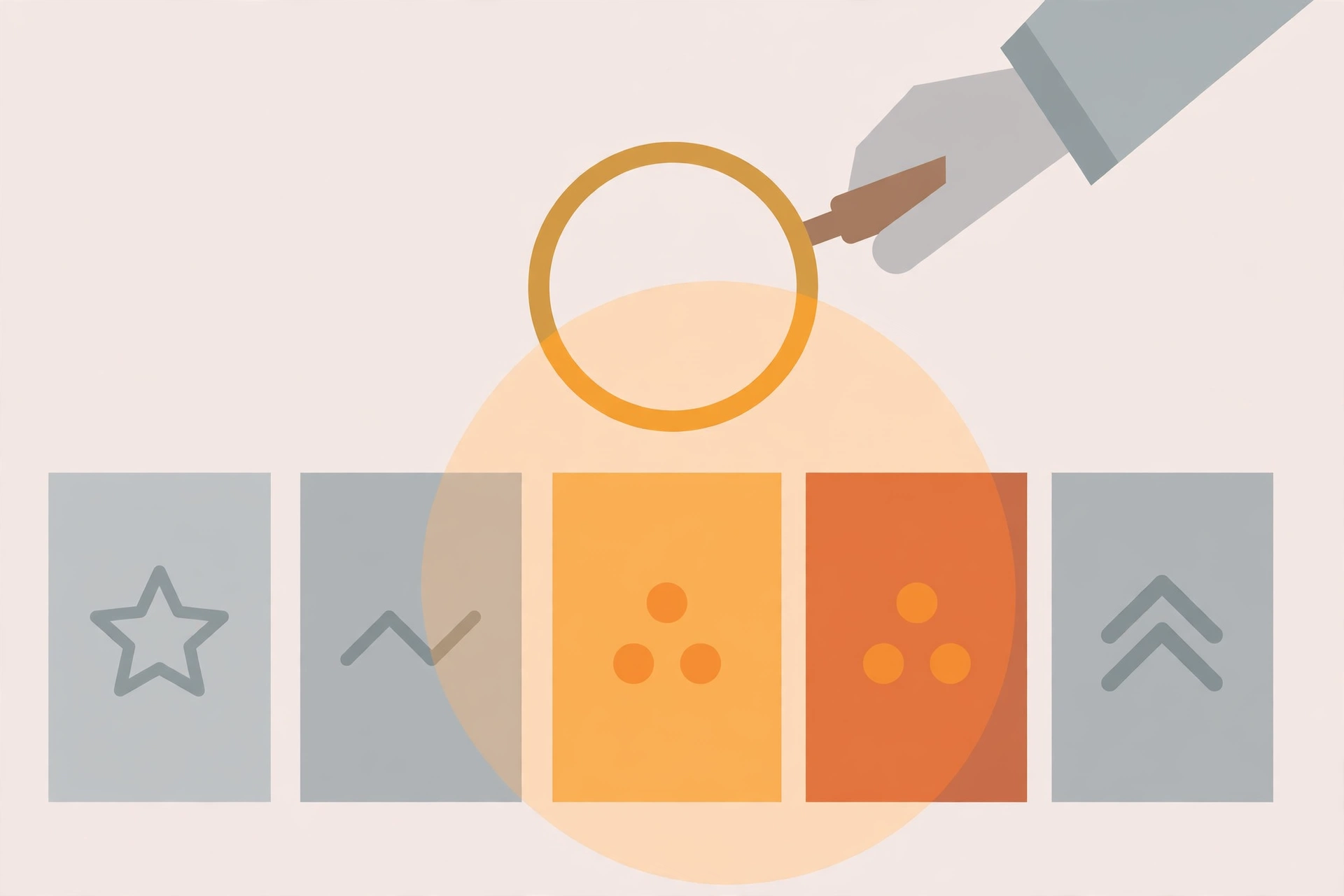
Confirmation bias is the tendency to search for, interpret, and remember information in a way that confirms what you already believe — while giving less weight to evidence that contradicts it. It shows up everywhere: the news sources you choose, the feedback you remember after a performance review, the way you judge whether a new policy at work is succeeding. It is not dishonesty and it is not stupidity. It is a predictable pattern in how minds handle evidence.
This article is educational, not clinical. It explains what confirmation bias is, the classic experiments that revealed it, how it appears in everyday life, and practical ways to reduce its grip. It will not diagnose your thinking — everyone shows this bias, including the researchers who study it. Confirmation bias is one of the cognitive biases that shape everyday judgment.
Table of Contents
What Is Confirmation Bias?
Psychologist Raymond Nickerson’s landmark review defined the phenomenon in its many guises: people preferentially seek evidence that supports their hypotheses, interpret ambiguous evidence as supporting them, and remember supporting evidence better than contradicting evidence (Nickerson, 1998). Note the three stages — seeking, interpreting, remembering. Confirmation bias can enter at any of them, which is why it is so hard to catch: even if you gather balanced evidence, you may still interpret or remember it one-sidedly. The same one-sided attention also explains why bad news sticks longer — negativity bias.
It is worth distinguishing confirmation bias from a related but different behaviour: testing a hypothesis by looking at cases where it should hold. Klayman and Ha showed that this “positive test strategy” is often a sensible way to gather information, not necessarily a bias — the bias appears when positive results are treated as proof while negative results are explained away (Klayman & Ha, 1987). The difference matters: the problem is not looking for support, it is refusing to be moved by contradiction.
The Classic Experiment: The 2-4-6 Task
The most famous demonstration comes from Peter Wason in 1960. Participants were told that the sequence 2-4-6 follows a rule, and were asked to discover it by proposing their own sequences and being told whether each followed the rule. Most people quickly formed a hypothesis — for example, “even numbers increasing by two” — and then tested it only with sequences that fit, such as 8-10-12 or 20-22-24. They almost never tried sequences that would disprove their guess, such as 1-2-3 or 5-4-3. The actual rule was simply “numbers in ascending order,” and very few participants found it (Wason, 1960).
The lesson is not that people are bad at logic. It is that the mind’s default strategy is to confirm rather than to falsify. Testing only what fits feels like progress — every “yes” seems to strengthen the hypothesis — while the decisive test, the one that could prove you wrong, is the one you avoid.
How It Works in Real Life
Confirmation bias scales from laboratory tasks to consequential decisions:
News and politics. People choose outlets and feeds that match their views, and then interpret ambiguous events as further proof. Two people can watch the same debate and both leave more convinced they were right — a pattern Charles Lord and colleagues demonstrated experimentally: when people with opposing views on capital punishment were given the same mixed evidence, each side rated the evidence supporting its own position as stronger, and both sides became more polarised (Lord, Ross, & Lepper, 1979).
Health and everyday decisions. Someone convinced a supplement works will notice every good day and explain away every bad one. Someone convinced a diet failed will remember every craving and forget the weeks it held. The evidence feels overwhelming because the filtering happened before the conclusion was reached.
Work and hiring. An interviewer who forms a good first impression in the first minutes will notice answers that confirm it and discount answers that do not — the same selective attention that shapes performance reviews and investment decisions. The same selective reading of evidence shows up when people judge their own skill — the pattern behind the Dunning–Kruger effect.
Relationships. In arguments, partners often collect evidence for their own version of events while discounting the other’s — which is why the same disagreement can feel completely different to each person involved.
Why Smart People Show It Too
Confirmation bias is not a failure of intelligence. It comes from the fast, automatic mode of thinking Daniel Kahneman called System 1, which jumps to conclusions from limited evidence and then defends them (Kahneman, 2011). Experts show it in their own domains: doctors, judges, and scientists have all been observed favouring evidence that fits their initial hypothesis. Training changes which hypotheses you hold, not whether you defend them.
Motivation plays a role as well. Beliefs are tied to identity, community, and past decisions. Abandoning a belief can feel like admitting wasted effort or betraying your group, so the mind protects it — quietly, by filtering what counts as evidence.
How to Counter It
No technique eliminates confirmation bias, but several reliably weaken it:
- Ask what would change your mind — before you decide. Write it down. If nothing could, you are defending a belief, not testing one.
- Consider the opposite. Spend two minutes arguing the other side as strongly as you can. This single habit measurably reduces one-sided reasoning.
- Seek disconfirmation deliberately. When researching a decision, search for the strongest case against it, not the weakest. Ask: “What would kill this idea fastest?”
- Separate the source from the claim. Judge evidence by its quality, not by whether it comes from “your side.”
- Track your predictions. Writing down what you expected, then checking what actually happened, is the only reliable mirror — memory alone will rewrite the record in your favour.
Common Misconceptions
“Confirmation bias means lying to yourself.” No — it usually operates without awareness. People genuinely experience the filtered evidence as the full picture.
“It only affects politics.” Politics makes it visible, but the same pattern shapes health choices, hiring, investing, and relationships.
“Balanced information fixes it.” Not on its own. Lord’s experiment gave both sides the same balanced evidence, and both became more extreme — because interpretation, not just exposure, was biased.
Key Takeaways
- Confirmation bias is the tendency to seek, interpret, and remember evidence that confirms existing beliefs, while discounting contradiction.
- Wason’s 2-4-6 task showed people test hypotheses by seeking confirmation, not disconfirmation — and miss the real rule as a result.
- Biased assimilation means the same mixed evidence can polarise opposing sides.
- Looking for supporting evidence is not always a bias; the bias is refusing to be moved by contradiction (Klayman & Ha, 1987).
- Experts show it too — it comes from fast, automatic thinking, not low intelligence.
- Practical antidotes: pre-commit to disconfirming evidence, consider the opposite, seek the strongest case against, and track your predictions.
References
- Kahneman, D. (2011). Thinking, fast and slow. Farrar, Straus and Giroux. (Book; no DOI.)
- Klayman, J., & Ha, Y.-W. (1987). Confirmation, disconfirmation, and information in
hypothesis testing. Psychological Review, 94(2), 211–228. https://doi.org/10.1037/0033-295X.94.2.211
- Lord, C. G., Ross, L., & Lepper, M. R. (1979). Biased assimilation and attitude
polarization: The effects of prior theories on subsequently considered evidence. Journal of Personality and Social Psychology, 37(11), 2098–2109. https://doi.org/10.1037/0022-3514.37.11.2098
- Nickerson, R. S. (1998). Confirmation bias: A ubiquitous phenomenon in many guises.
Review of General Psychology, 2(2), 175–220. https://doi.org/10.1037/1089-2680.2.2.175
- Wason, P. C. (1960). On the failure to eliminate hypotheses in a conceptual task.
Quarterly Journal of Experimental Psychology, 12(3), 129–140. https://doi.org/10.1080/17470216008416717
Keep Exploring
What is confirmation bias in simple terms?
It is the tendency to notice, seek out, and remember information that supports what you already believe, while giving less weight to information that contradicts it.
What is the 2-4-6 task?
A 1960 experiment by Peter Wason in which participants had to discover the rule behind 2-4-6. Most tested only sequences fitting their guess and missed the real rule — simply ascending numbers — because they never tried to disprove themselves.
Is confirmation bias the same as being close-minded?
Not exactly. It usually operates without awareness: people genuinely experience filtered evidence as the full picture. Deliberate close-mindedness is a choice; confirmation bias is a pattern in how evidence is processed.
Can confirmation bias be overcome?
It cannot be eliminated, but it can be weakened: ask what would change your mind before deciding, consider the opposite view, seek the strongest case against your position, and track your predictions against outcomes.
Does balanced information fix confirmation bias?
Not on its own. In Lord’s 1979 experiment, both sides received the same balanced evidence and both became more polarised — because interpretation, not just exposure, was biased.