
Disagreements don’t predict whether a relationship lasts — research consistently finds it’s not how often couples fight, but how. Couples who start conversations gently, notice corrosive patterns early, and repair mid-conflict tend to do well. Couples whose arguments fill with contempt, defensiveness, and withdrawal fare worse. Here’s what the science of conflict actually shows.
If you’re reading this in the middle of a rough patch, a steadying fact first: every couple fights, including the happy ones. The question researchers have spent decades answering isn’t “do you argue?” but “what happens inside your arguments?” What they found is genuinely hopeful — the patterns that predict trouble are learnable skills, not personality verdicts. This article walks through what decades of watching couples argue actually revealed: how conflict is studied, the four patterns that erode relationships, what repair looks like in practice, and how to tell when conflict is signaling something bigger.
Conflict is one thread in a larger fabric — the psychology of relationships maps the whole landscape, from attraction to lasting love.
Table of Contents
Why Conflict Is Normal — the Pattern Is the Signal
Two people sharing a life will disagree. They want different things at different times, read the same situation differently, and carry different sensitivities into the same conversation. Conflict is what happens when two real inner worlds collide — it’s a feature of closeness, not a bug.
What researchers measure, though, is not whether couples fight but the pattern their fights take over time. In a landmark longitudinal study, psychologist John Gottman and physiologist Robert Levenson observed 73 married couples discussing their disagreements, then followed them for years. Using a balance theory of marriage, they divided couples into “regulated” ones — who kept their conflict discussions in emotional balance — and “nonregulated” ones. Compared with regulated couples, the nonregulated ones showed more negative emotional expression and less positive expression, more stubbornness and withdrawal, greater defensiveness, and a greater risk of marital dissolution [1].
One bad fight means almost nothing; patterns across months and years are the signal. That’s a kinder way of reading your own relationship, and it’s the more accurate one.
How Researchers Actually Study Fights
The findings in this article come from an unusual kind of science: watching couples argue on purpose. In Gottman’s laboratory work, couples were filmed discussing a real, ongoing disagreement while sensors tracked their physiology — heart rate, stress responses — and trained observers coded the interaction moment by moment: facial expressions, tone of voice, who withdrew, who escalated. Researchers then followed the same couples for years to see which relationships flourished and which struggled [2].
This design is the strength of the work and its limit. Its strength: it measures what people actually do under stress, not what they report about themselves afterward. Its limit: the early studies focused on married couples in US university research settings, and findings describe those samples best. Later work has extended to other couple types — including research on same-sex couples — but generalizing to every cultural context deserves care [3]. Throughout this article, treat every finding as a probabilistic pattern — something that tends to happen, not a verdict on your relationship.
In a heated argument, each partner may also fall into confirmation bias — noticing mainly the moments that fit the story they already hold about the other.
The Four Horsemen: Patterns to Notice, Not Labels
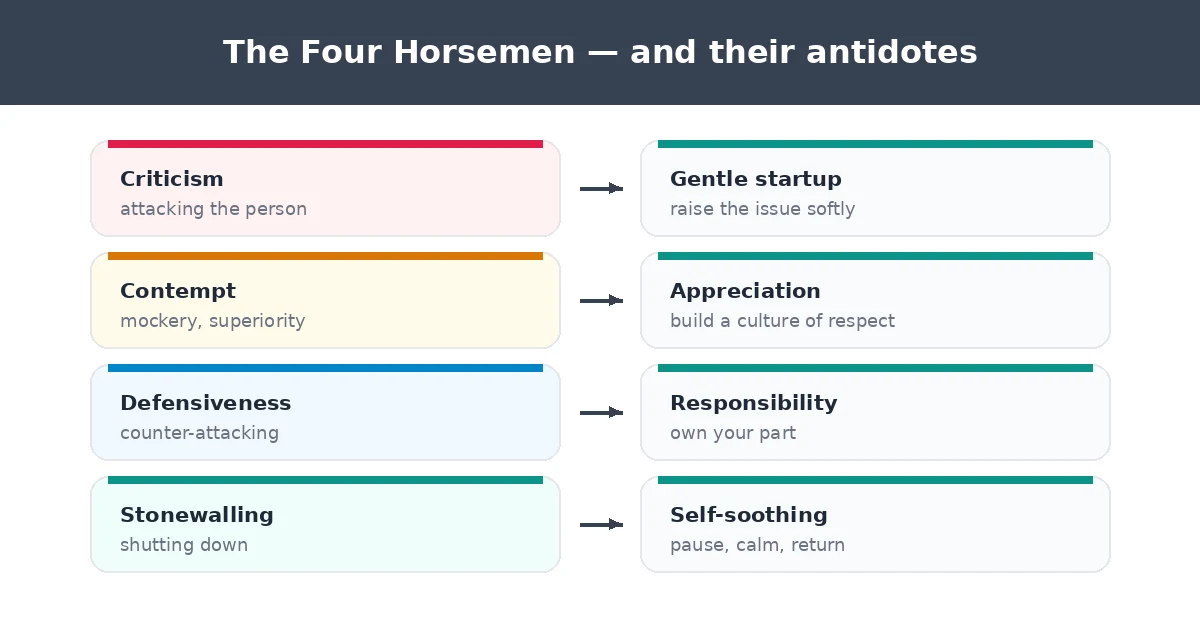
From this observational work emerged one of relationship science’s most replicated frameworks: four communication patterns that consistently appeared in couples heading toward dissolution. Gottman named them the Four Horsemen. They form a rough cascade — criticism feeds contempt, contempt feeds defensiveness, defensiveness feeds stonewalling — and a structural model of the process received preliminary support in the research [1].
Two framing notes before the details, because they matter more than the framework itself. First: these are patterns to notice, never labels for a partner. Calling your partner “contemptuous” or diagnosing them with “a horseman” is itself a form of criticism — the framework is a mirror for your own behavior and a shared vocabulary for couples, not ammunition. Second: this is educational information about patterns studied in research, not a diagnosis of anyone’s relationship. Occasional appearances of these patterns are human; it’s their chronic, unrepaired presence that the research flags.
Criticism: attacking the person, not the problem
Criticism is different from a complaint. A complaint addresses a specific situation; criticism attacks the person’s character. The Gottman Institute’s own materials illustrate the difference with a running-late scenario:
- Complaint: “I was scared when you were running late and didn’t call me. I thought we had agreed that we would do that for each other.”
- Criticism: “You never think about how your behavior is affecting other people. I don’t believe you are that forgetful, you’re just selfish. You never think of others! You never think of me!” [4]
The giveaways: “you always” and “you never,” and sentences about who your partner is rather than what happened. When criticism becomes pervasive, the Institute notes, it paves the way for the far deadlier horsemen to follow — it makes the other person feel assaulted and rejected, and the cycle escalates [4].
The antidote: a gentle startup. Raise the issue with “I” statements about your own feelings and a specific request, without blame. “I feel overwhelmed when the chores pile up — can we figure this out together?” keeps the conversation on the problem; “you never help” puts the person on trial. What the research finds is that how a conversation starts strongly shapes how it ends — a harsh opening of criticism or sarcasm tends to trigger defensiveness and escalation, while a gentle one keeps the door open [5].
Contempt: the most corrosive pattern
Contempt goes beyond criticism. Where criticism attacks character, contempt assumes a position of moral superiority: disrespect, mockery, sarcasm used as a weapon, name-calling, eye-rolling, scoffing. The message isn’t “I’m angry about what you did” — it’s “you are beneath me.” The Gottman Institute’s example captures the tone: “You’re ‘tired?’ Cry me a river… Could you be any more pathetic?” [4]
Of the four patterns, contempt consistently emerges as the most damaging. The Gottman Institute describes it as the most corrosive of the Four Horsemen and, in its clinical materials, a leading predictor of divorce [4]; in the primary research, expressions of contempt and disgust were among the strongest predictors of later separation [1]. These are group-level, probabilistic patterns — not verdicts on any individual relationship. Contempt is typically fueled by long-simmering negative thoughts about the partner — it rarely arrives first; it’s where unaddressed resentment goes to live.
The antidote: build a culture of appreciation. Deliberately notice and voice what your partner does right, and name resentments before they ferment into superiority. This isn’t forced positivity — it’s the daily practice of respect that makes contempt psychologically impossible to sustain [4].
Defensiveness: the escalator
Defensiveness is usually a response to criticism, and it’s nearly universal when a relationship is struggling. It takes several familiar forms: making excuses, playing the innocent victim, counter-attacking (“well, what about when you did this?”), or reversing blame. The Gottman Institute’s example: asked why a promised call wasn’t made, the defensive partner replies, “I was just too darn busy today… Why didn’t you just do it?” — then adds a counter-charge [4].
The problem is that defensiveness, while understandable when you feel attacked, almost never works. It tells your partner their concerns aren’t being taken seriously, it accepts no responsibility, and it escalates the conflict — because defensiveness is really a way of blaming your partner, and it leaves no room for healthy conflict management [4].
The antidote: take responsibility, even for a small part. “You’re right that I was late — that’s on me” does more to end a fight than any defense. Closely related is accepting influence: treating your partner’s perspective as legitimate input into decisions rather than something to defeat. Research on couples found that partners who accept influence — who genuinely let the other person’s views shape outcomes — have happier, more satisfying relationships; the Institute frames it as an equal-opportunity principle, one of the hallmarks of successful relationships being a pattern of respectful influence going back and forth [3].
Stonewalling: shutting down
Stonewalling is the listener withdrawing from the interaction entirely — shutting down, going silent, turning away, acting busy, disappearing mid-conflict. It usually arrives as a response to contempt, after the negativity of the first three patterns becomes overwhelming enough that withdrawal feels like the only option [4].
Here’s the crucial context: stonewalling is driven by physiological flooding. The person isn’t calmly choosing silence — their nervous system is so activated that they may not be in a state where rational discussion is possible [4]. What feels like self-protection reads to the other partner as rejection, which is why stonewalling is so painful on the receiving end.
The antidote: a structured break, not a shutdown. If you’re flooded, name it and ask for a pause: “I’m feeling too angry to keep talking about this. Can we please take a break and come back to it in a bit?” Then take about 20 minutes to do something alone that genuinely soothes you — a walk, reading, anything that calms your body — and return to the conversation [4]. The difference between stonewalling and a healthy break is the return.
Repair: What Actually Separates Couples Who Last
Here’s the finding that reframes everything: every couple has ruptures. What distinguished couples in Gottman’s research wasn’t the absence of conflict — it was the presence of repair. A repair attempt is any statement or action meant to diffuse negativity and keep conflict from escalating out of control: “Can we start over?”, “I’m sorry — that came out wrong”, “I need a break”, a touch on the arm, a moment of shared humor [7]. Gottman called repair attempts the “secret weapon” of emotionally intelligent couples, and his research found that the success or failure of a couple’s repair attempts is one of the primary factors in whether a relationship flourishes or flounders [7]. Repair attempts handle the moment; forgiveness is the longer process that can follow a deeper hurt.
Two things make repair attempts work. First, they’re made at all — someone puts on the brakes mid-conflict instead of accelerating. Second, and just as important, they’re accepted. The same repair attempt that lands in a warm relationship falls flat in a distressed one, because in distressed relationships even neutral gestures get read negatively. In couples headed for trouble, repair attempts are absent or consistently rejected; in couples who stay together, they’re woven into the conflict itself [7].
This is also where repair meets trust. Every accepted repair is a small deposit: it tells your partner that even when things get heated, you’ll come back and make it right. How trust is built and repaired explores that mechanism in depth — trust and repair reinforce each other over time.
One more layer worth naming: conflict also runs on attachment patterns. If your fights follow a recurring script — one person pursuing closeness while the other withdraws for space — that’s a different dynamic with its own logic, and our guide to how attachment styles interact covers it in detail. This article covers general conflict mechanics; the two lenses complement each other.
What Healthy Disagreement Looks Like
Pulling the research together, healthy conflict has a recognizable shape:
Start gently. Begin with how you feel and what you need, not with blame. The opening minutes of a conflict conversation strongly influence where it ends up — a harsh startup of criticism or sarcasm tends to produce defensiveness and escalation regardless of the topic, while a gentle startup keeps problem-solving possible [5].
Take breaks properly. Flooding is physiological, not a character flaw. Name it, ask for a timed pause, genuinely calm your body for about 20 minutes, and come back. A break with a committed return is a skill; disappearing without one is stonewalling [4].
Accept influence. Treat your partner as someone whose perspective counts — find the part of what they’re saying you can agree with, even if it’s small. Research consistently links this habit to happier relationships, and the paradox the Gottman Institute notes is real: the more willing you are to share power, the more genuinely influential you become in the relationship [3].
Stop trying to “win” the unsolvable ones. Gottman’s research found that roughly two-thirds — about 69% — of couple problems are perpetual: rooted in lasting differences in personality, values, or lifestyle that won’t resolve, like one partner being a saver and the other a spender, or one needing more social time than the other. These don’t get solved; they get managed through ongoing, respectful dialogue [6]. Confusing a perpetual problem for a solvable one — and trying to win it — is one of the most common sources of grinding, years-long conflict.
Keep the emotional balance positive. In Gottman’s observations, stable couples maintained at least five positive interactions for every negative one during conflict — moments of affection, humor, interest, validation. This is an observed pattern in the research, not a magic formula to perform [2]. The point isn’t to avoid negativity; it’s that a relationship with enough warmth can absorb a fight without the fight becoming evidence that the relationship is failing.
The day-to-day habits underneath all of this matter too — how couples communicate outside of conflict is the soil that disagreements grow in.
When Conflict Is a Warning Sign
This article has been deliberately non-alarmist, and that stance holds: the patterns above are skills to practice, and practicing them changes trajectories. But honesty requires naming when conflict is signaling something bigger.
Pay attention if contempt and disrespect are the default rather than the exception — if one partner is routinely treated as beneath the other, mocked, or dehumanized, and appreciation feels impossible to rebuild. Pay attention if conflict involves intimidation, control, threats, or any form of harm, or if you feel afraid of your partner. Those situations are not communication problems to skill your way out of, and no article can assess them.
A qualified professional — a couples therapist for relationship patterns, or an individual counselor — is the right next step when conflict feels stuck, cruel, or frightening. If there’s any threat to your safety, seek help promptly through local support services rather than waiting for the relationship to improve on its own.
The throughline of the research is worth holding onto: it’s not the presence of conflict that predicts trouble, but the absence of the things that make conflict safe — gentleness at the start, repair in the middle, and a return to each other at the end.
Key Takeaways
- Conflict itself isn’t the predictor — the pattern is. Longitudinal research distinguishes couples by how their disagreements unfold, not by how often they happen [1].
- The Four Horsemen are patterns to notice, not labels for a partner: criticism (attacking character), contempt (mockery and superiority), defensiveness (deflecting responsibility), and stonewalling (shutting down) [4].
- Each pattern has a documented antidote: gentle startup for criticism, a culture of appreciation for contempt, taking responsibility for defensiveness, and structured, genuinely calming breaks for stonewalling [3][4][5].
- Repair attempts are the real difference-maker. Small mid-conflict gestures to de-escalate — and a partner willing to accept them — are among the strongest factors in whether relationships flourish [7].
- About two-thirds of couple problems are perpetual, rooted in lasting differences. The goal with those is respectful dialogue, not victory [6].
- When conflict involves persistent contempt, intimidation, control, or fear, that’s beyond communication skills — a qualified professional is the right next step.
Is fighting normal in a relationship?
Yes. Every couple disagrees, including happy ones — conflict is what happens when two real inner worlds share a life. Research finds it’s not whether couples fight but how: couples who start gently, keep contempt out of the conversation, and repair mid-conflict do well, while couples whose fights chronically fill with contempt, defensiveness, and withdrawal fare worse [1]. A single bad fight means very little; patterns over time are the signal.
What are Gottman’s Four Horsemen?
They’re four communication patterns — criticism, contempt, defensiveness, and stonewalling — that relationship researcher John Gottman’s observational studies consistently found in couples heading toward dissolution [1][4]. Criticism attacks the person’s character rather than the problem; contempt communicates mockery and moral superiority; defensiveness deflects all responsibility; stonewalling is complete withdrawal. Each has a documented antidote, and they’re patterns to notice and change, never labels to pin on a partner.
What’s the difference between criticism and a complaint?
A complaint is about a specific situation; criticism is about the person. “I was scared when you were running late and didn’t call” is a complaint. “You never think about how your behavior affects other people — you’re just selfish” is criticism: it puts your partner’s character on trial instead of addressing what happened [4]. The Gottman Institute’s recommended shift is the gentle startup — raising the issue with “I” statements about your feelings and a specific request, without blame.
How do healthy couples argue differently?
Research points to a consistent shape: they start gently instead of with blame, they make and accept repair attempts mid-conflict (a “can we start over?”, an apology, a touch), they take real breaks when physiologically flooded and come back, and they accept each other’s influence on decisions [3][4][5][7]. They also recognize that roughly two-thirds of their disagreements are perpetual differences to manage with dialogue, not problems to win [6].
When is conflict a bad sign?
Conflict is a warning sign when contempt and disrespect are the default rather than the exception — when one partner is routinely mocked or treated as lesser — or when conflict involves intimidation, control, threats, or fear [4]. Those situations go beyond communication skills. This article is educational, not a diagnosis of any relationship; if conflict feels stuck, cruel, or frightening, a qualified therapist or counselor is the right next step.
References
- Gottman, J. M., & Levenson, R. W. (1992). Marital processes predictive of later dissolution: Behavior, physiology, and health. Journal of Personality and Social Psychology, 63(2), 221–233. https://doi.org/10.1037/0022-3514.63.2.221
- Gottman, J. M. (1994). Why Marriages Succeed or Fail: And How You Can Make Yours Last. New York: Simon & Schuster.
- The Gottman Institute. Accepting Influence: Find Ways to Say “Yes”. https://www.gottman.com/blog/accepting-influence-find-ways-to-say-yes/
- The Gottman Institute. The Four Horsemen: Recognizing Criticism, Contempt, Defensiveness, and Stonewalling. https://gottman.com/blog/the-four-horsemen-recognizing-criticism-contempt-defensiveness-and-stonewalling
- Gottman, J. M., & Silver, N. (1999). The Seven Principles for Making Marriage Work. New York: Crown.
- The Gottman Institute. Marriage Minute: Don’t Solve Problems (on perpetual vs. solvable problems). https://info.gottman.com/marriage-minute836-dont-solve-problems
- The Gottman Institute. Marriage Minute: De-escalate the Argument (on repair attempts). https://info.gottman.com/marriage-minute802-de-escalate-the-argument
Keep Exploring
- The Psychology of Relationships — the pillar guide: the full landscape of relationship psychology, from attraction to lasting love.
- How Different Attachment Styles Interact — when conflict runs on attachment patterns: the pursue–withdraw dynamic and what matters more than the pairing.
- Communication in Relationships — the everyday communication habits that set the stage for how conflict unfolds.
- Trust in Relationships: How It’s Built and Repaired — how repair during conflict and trust rebuild each other over time.