
Research distinguishes couples less by whether they disagree than by how they talk: the balance of positive to negative moments in everyday interaction, whether partners notice and “turn toward” each other’s bids for connection, and whether repair attempts get through. These are observed patterns — not personality traits, and not therapy assignments.
The strongest evidence on couple communication comes from a simple method: researchers watched couples talk. In laboratory studies, partners were filmed during everyday conversations and disagreements while researchers coded moment after moment of what each person said and did — warmth, humor, criticism, withdrawal — and then followed the couples for years to see which relationships lasted (Gottman & Levenson, 1992). What follows is what that observational work, and the structured-listening research that grew out of it, actually found.
Table of Contents
What “Good Communication” Means in Research
In research, good communication is not a personality trait or a self-report (“we communicate well”). It is a set of observable patterns — things independent observers can see and count in how partners talk to each other, especially in ordinary moments, not just during crises.
Gottman and Levenson’s (1992) landmark study illustrates the approach. They recorded couples’ physiological responses and coded their behavior during a conflict discussion, then checked years later which marriages had dissolved. What distinguished the couples whose relationships survived was the relative balance of positive versus negative affect during those interactions — the emotional tone of the exchange, moment by moment, rather than the topic being discussed or whether the couple argued at all. Couples can argue often and still be stable; the deciding factor is how the argument — and the thousand small interactions around it — unfolds.
This matters because it shifts the goal away from “never fight” toward something learnable: the patterns of everyday talk. Three of those patterns have the strongest research backing, and they structure the rest of this article.
Turning Toward vs Turning Away: Bids for Connection
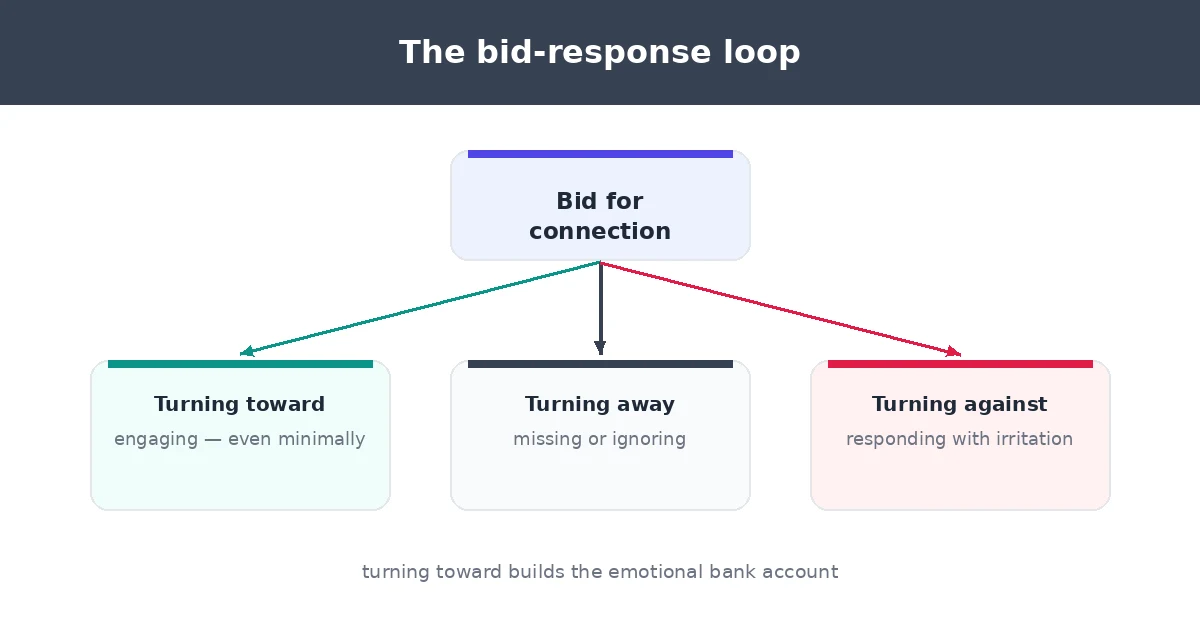
Psychologist John Gottman describes much of daily couple life as a stream of small “bids for connection” — any attempt, large or small, to get a partner’s attention, affection, or engagement. A bid can be a question (“How was your day?”), a comment (“Look at that sunset”), a sigh, a touch on the arm, or a shared laugh at something on a screen. The content is often trivial; the underlying message is connect with me for a moment (Gottman & Silver, 1999). These small moments are also one of the main everyday routes to emotional intimacy.
Partners respond to bids in three ways, and the distinction is one of the most replicated patterns in relationship research:
- Turning toward — acknowledging the bid: looking up, answering, laughing, asking a follow-up question.
- Turning away — missing or ignoring it: staying on the phone, changing the subject, giving no response. Usually this is distraction, not hostility.
- Turning against — responding with irritation: “Can’t you see I’m busy?”
The Gottman Institute reports that in observational studies, couples who stayed married turned toward each other’s bids about 86% of the time, while couples who later divorced did so only about 33% of the time (The Gottman Institute, n.d.). Each turned-toward bid is a small deposit in what Gottman calls the “emotional bank account” — a reservoir of goodwill the relationship draws on when harder conversations arrive.
The practical reading is modest, not moralistic. Nobody turns toward every bid; the pattern is about the habitual response. And the misses are usually obliviousness — a phone, a deadline, fatigue — rather than rejection. Noticing the bid is most of the skill. This is also where communication overlaps with trust: consistently responding to bids is one of the main ways partners learn that the other is reliably there — a link explored in depth in our article on how trust forms and breaks in relationships.
Couples in long-distance relationships face the same bids for connection, except the bids arrive through screens rather than shared rooms.
The Positive-to-Negative Balance
The second well-supported pattern is the overall emotional balance of a couple’s interactions. Across observational studies, stable couples show substantially more positive than negative moments during their exchanges — warmth, humor, interest, affection, and validation on one side; criticism, contempt, defensiveness, and withdrawal on the other (Gottman & Levenson, 1992).
A note on numbers: you may have seen this summarized as a precise “magic ratio.” Treat any exact figure as an oversimplification. What the research actually shows is a pattern — relationships in which positive interactions clearly and consistently outweigh negative ones tend to be the stable, satisfying ones — not a formula where a couple can tally their week and compute a score. The balance is a description of an emotional climate, not a diagnostic test.
What does the positive side look like in practice? It is rarely grand. Observers code things like: genuine interest in what a partner is saying, affectionate touch, humor that lands, expressions of appreciation, and — during disagreements — moments of de-escalation rather than escalation. On the negative side, the destructive patterns have their own well-documented profile, covered in our companion article on conflict in relationships, which describes the four communication patterns researchers flag as most corrosive.
The key insight is that the positive moments do real work: they keep the emotional bank account funded, which is what allows a couple to have hard conversations without the relationship itself feeling threatened. Communication skills sit on top of that foundation — which brings us to the third pattern.
Repair Attempts: What They Are and Why They Matter
A repair attempt is any statement or action that tries to prevent negativity from escalating out of control during an interaction — a bit of humor in a tense moment, a softened tone, an apology, a direct “I need to calm down for a minute,” or simply reaching for a partner’s hand mid-argument (Gottman & Levenson, 1992).
Gottman’s research program identified repair attempts as a pivotal concept: disagreements happen in every relationship, and what separates stable couples is not the absence of negativity but whether repair attempts succeed. In stable couples, a partner’s attempt to de-escalate tends to land — the other partner recognizes it and the temperature drops. In distressed couples, repair attempts often fail or go unnoticed, and the negativity keeps climbing.
This reframes what “good communication” means during a disagreement. It is not about delivering a perfectly worded argument; it is about whether either partner can hit the brakes, and whether the other lets them. A repair attempt that works can be as simple as: “Wait — I’m getting loud, and I don’t want to be. Can we slow down?” The skill has two halves: making the attempt, and receiving it generously rather than treating it as surrender.
Structured Listening: The Speaker-Listener Technique
The first four sections describe patterns researchers observed. This section describes a method researchers tested: the speaker-listener technique, developed by Howard Markman and colleagues and taught as part of the PREP relationship-education program at the University of Denver (Markman, Stanley, & Blumberg, 2010).
The technique is deliberately simple. One partner holds “the floor” (sometimes a literal object, like a pen) and speaks in short segments, using “I” statements. The other partner listens without interrupting, then paraphrases what they heard — “What I hear you saying is…” — until the speaker confirms they were understood. Then the floor changes hands. The rules are designed so that the listener’s only job is understanding, not rebutting, which slows the escalation that derails most difficult conversations.
What does the evidence say? The technique is a studied method rather than a proven cure. Relationship-education programs that teach structured communication have been evaluated in longitudinal research, but the broader evidence base for communication-skills training is more modest than the field’s enthusiasm for it. In a widely cited review, Burleson and Denton (1997) concluded that the impact of communication skills on marital satisfaction “has been assumed much more frequently than it has been shown” — a caution worth keeping in mind whenever a technique is presented as a relationship fix.
The honest summary: structured listening is a reasonable, research-informed way to make hard conversations safer — it slows things down, forces genuine paraphrasing, and guarantees both partners get heard. What it cannot do is supply the goodwill the conversation needs, which is why the patterns above (bids, balance, repair) come first. Think of it as scaffolding: useful while the emotional bank account is being rebuilt, not a substitute for it.
What Communication Can’t Fix
A closing honesty note, because the research literature supports it: communication skills operate on top of a relationship’s emotional foundation, and they cannot substitute for it. No technique resolves a pattern of contempt on its own, bridges a genuine mismatch in values or life goals, or makes an unsafe dynamic safe. When the underlying emotional climate is depleted — when bids are routinely missed and repair attempts routinely fail — better phrasing is rearranging deck chairs.
This is not pessimism; it is what the observational studies imply. The couples who communicate “well” in the lab are, to a large extent, couples whose emotional bank accounts are already full — their skills and their goodwill reinforce each other. Skills can help rebuild the account, but they work slowly and only when both partners are willing to turn toward the process.
If disagreements themselves are the pain point, the deeper dive is our article on conflict in relationships, which covers the destructive patterns to watch for and what the research says about navigating them. And if the question underneath is whether you can count on your partner at all, start with how trust works in relationships. For the bigger picture of how relationships function, see the psychology of relationships pillar.
This article describes research findings for education and self-reflection. It is not therapy, clinical advice, or a substitute for professional support. For couples who decide they need structured help, couples therapy is the option most consider next.
Key Takeaways
- In research, good communication means observable patterns — not self-reports or personality traits — coded from how couples actually talk.
- Partners constantly make small “bids for connection”; habitually turning toward them (vs away or against) is one of the strongest observed predictors of stability.
- Stable couples show substantially more positive than negative moments in their interactions — a climate pattern, not a “magic ratio” to calculate.
- Repair attempts (humor, softening, pausing, apologizing) matter less for their eloquence than for whether they land and de-escalate.
- The speaker-listener technique is a studied way to slow difficult conversations down — useful scaffolding, with modest evidence, not a guaranteed fix.
- Communication skills sit on top of the relationship’s emotional foundation; they can’t substitute for goodwill, shared values, or safety.
What does healthy communication look like, according to research?
Researchers describe it as a pattern, not a personality trait: partners who consistently notice and respond to each other’s small bids for connection, whose everyday interactions contain clearly more warmth and humor than criticism and withdrawal, and who can de-escalate disagreements through successful repair attempts. It is measured by observing couples, not by asking them to rate themselves (Gottman & Levenson, 1992).
What is a “bid for connection”?
A term from John Gottman’s research for any attempt — big or small — to get a partner’s attention, affection, or engagement: a question, a comment, a sigh, a touch, a shared joke. Partners respond by turning toward (engaging), turning away (missing or ignoring), or turning against (responding with irritation). Couples who stayed married turned toward bids about 86% of the time in observational studies, versus about 33% among couples who divorced (The Gottman Institute, n.d.; Gottman & Silver, 1999).
Do communication exercises actually work?
They are studied, and the evidence is modest. Structured methods like the speaker-listener technique (Markman, Stanley, & Blumberg, 2010) give couples a workable format for difficult conversations — short turns, paraphrasing, no interruptions. But a widely cited review cautioned that the impact of communication-skills training on marital satisfaction has been assumed more often than it has been shown (Burleson & Denton, 1997). Treat exercises as useful scaffolding, not as fixes for deeper problems.
What’s the biggest communication mistake couples make?
Framed by the research rather than by advice columns, two patterns stand out. The first is habitually missing bids for connection — not out of malice, but through distraction — which slowly drains the relationship’s goodwill. The second is letting negativity escalate without repair: failed or absent repair attempts are what allow an ordinary disagreement to become a corrosive one (Gottman & Levenson, 1992).
References
- Gottman, J. M., & Levenson, R. W. (1992). Marital processes predictive of later dissolution: Behavior, physiology, and health. Journal of Personality and Social Psychology, 63(2), 221–233. https://doi.org/10.1037/0022-3514.63.2.221
- Gottman, J. M., & Silver, N. (1999). The Seven Principles for Making Marriage Work. New York: Crown.
- Markman, H., Stanley, S., & Blumberg, S. L. (2010). Fighting for Your Marriage (3rd ed.). San Francisco: Jossey-Bass.
- Burleson, B. R., & Denton, W. H. (1997). The relationship between communication skill and marital satisfaction: Some moderating effects. Journal of Marriage and the Family, 59, 884–902. https://doi.org/10.2307/353790
- The Gottman Institute. (n.d.). The secret ingredient to a thriving relationship: Turning towards each other. https://www.gottman.com/blog/turning-towards-each-other-for-a-thriving-relationship/
Keep Exploring
- The Psychology of Relationships — the cluster pillar: how relationships form, function, and change, with the full map of this series.
- Trust in Relationships: How It Forms and Breaks — the mechanism underneath communication: how responsiveness builds (or erodes) the expectation that a partner will be there.
- Conflict in Relationships: Why Couples Fight and How to Fight Better — the companion piece on disagreements: the four communication patterns research flags as most corrosive, and what helps.