
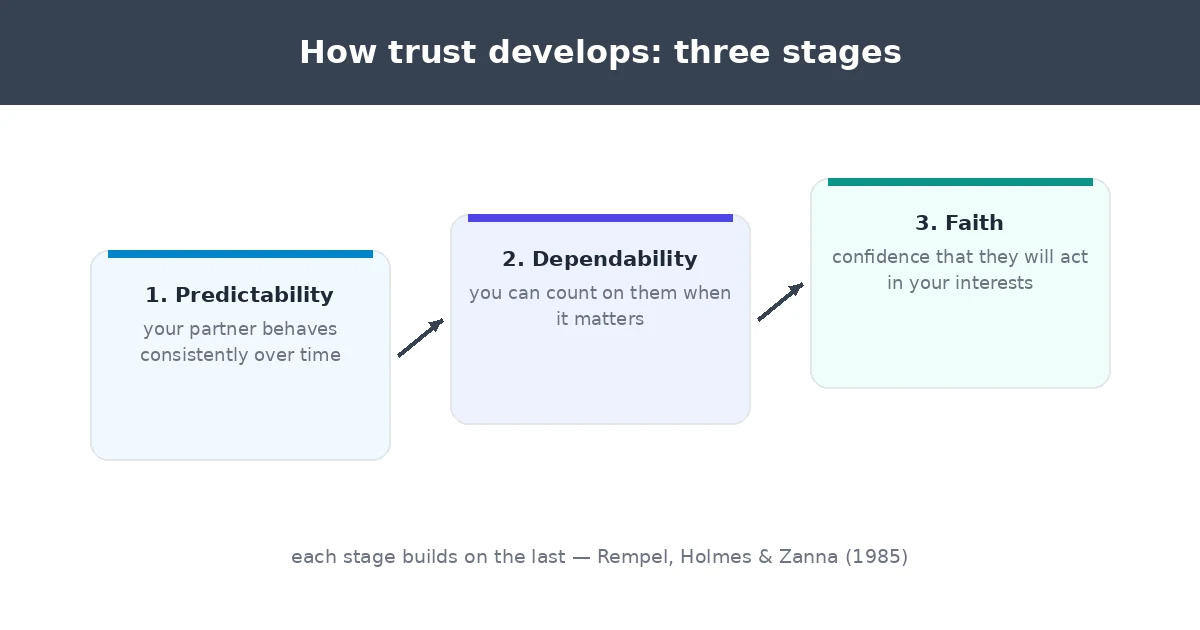
Trust is the expectation that your partner will act in your best interests — especially when it counts. Psychologists Rempel, Holmes, and Zanna (1985) describe it as built in stages: predictability (consistent behavior), dependability (reliability when tested), and finally faith — confidence in a partner’s goodwill that holds even in uncertainty [1].
That expectation isn’t blind optimism. It’s a psychological mechanism: trust is the conclusion your mind draws from accumulated evidence about how someone treats you. And because it’s built from evidence, it can be damaged by counter-evidence — and, sometimes, rebuilt through new evidence gathered slowly over time. This article explains how researchers understand that mechanism: what trust is, how it grows, why it matters so much, how it breaks, and what repair honestly looks like.
Table of Contents
What Is Trust in a Relationship?
In close-relationships research, trust is often defined as confidence in a partner’s motives — a belief that they will act in your interests even when doing so costs them something [1]. It is distinct from liking or love: you can love someone and still not trust them, and you can trust someone (a colleague, a neighbor) without loving them. Love is about how you feel; trust is about what you expect.
Rempel and colleagues proposed that trust develops through three components, roughly in sequence [1]:
- Predictability — your partner behaves in consistent, foreseeable ways. You can anticipate what they’ll do because past behavior gives you a reliable pattern. The partner who always texts when running late is predictable; the one whose reactions you can never guess is not.
- Dependability — trust deepens when a partner proves reliable in situations that actually test them. Keeping small promises builds predictability; showing up when you’re ill, stressed, or in trouble builds dependability.
- Faith — the deepest layer. This is confidence in a partner’s goodwill that extends beyond the evidence — trusting them in new situations, or when you can’t verify what happened. In Rempel’s research, it was feelings of faith, more than the earlier stages, that were closely tied to love and happiness in the relationship [1].
Underneath these stages sit attributions: when your partner does something kind, do you read it as driven by genuine care (intrinsic motives) or by self-interest (extrinsic motives)? Rempel and colleagues found that perceiving intrinsic motives in a partner was itself a dimension of trust — the story you tell about why they act matters as much as what they do [1].
How Is Trust Built?
Trust is rarely built in grand gestures. It accumulates through small, repeated acts of responsiveness — noticing what the other person needs and responding to it, consistently, over time.
The intimacy model of Reis and Shaver (1988) captures the engine of this process. Intimacy grows through an interpersonal loop: one person reveals something personally meaningful (a worry, a hope, a vulnerability), and the other responds with understanding, validation, and care [3]. When that loop runs successfully again and again, the discloser learns a lesson that becomes trust: when I am vulnerable with this person, I am safe. That loop is also how emotional intimacy develops.
Think of it in ordinary scenes. You mention offhand that a work presentation is making you anxious; your partner remembers and asks how it went that evening. A friend tells you something they haven’t told anyone; you keep it. A partner promises to call at eight and does. None of these moments is dramatic. But each one is evidence, and trust is the sum of the evidence.
Two ingredients matter most:
- Responsiveness — actually attending to what the other person communicates, rather than deflecting or minimizing. Research on responsiveness treats it as one of the central organizing processes of closeness [3].
- Consistency over time — one caring response doesn’t build trust; a pattern does. Predictability is the first stage precisely because trust needs repetition to grow.
Note that building trust requires risk: you can’t learn that someone is dependable without first depending on them. Trust and vulnerability are a loop — vulnerability provides the test, and a caring response provides the evidence.
Why Does Trust Matter So Much?
Trust matters because connection itself matters. Baumeister and Leary’s (1995) influential review argued that the need to form and maintain close relationships is a fundamental human motivation — that people form bonds readily, resist their dissolution, and suffer when attachments are missing [2]. Trust is what makes those bonds feel safe enough to rely on.
Within relationships, trust does quiet, practical work. When you trust your partner, you spend less energy on vigilance — checking, second-guessing, bracing for disappointment — and more on the relationship itself. Rempel and colleagues’ finding that faith in a partner’s motives is tied to love and happiness suggests trust isn’t just a nice feature of good relationships; it’s part of what makes them feel good [1].
This also explains why betrayal hurts the way it does. If trust were just a preference, breaking it would be a disappointment. Because it is woven into a fundamental need, breaking it can feel like the ground shifting.
How Does Trust Break?
Trust breaks when evidence arrives that contradicts the expectation — what psychologists sometimes frame as an expectancy violation. You believed your partner would act in your interests; something happens that suggests otherwise. The event itself matters, but so does its meaning: a forgotten anniversary and a discovered lie both break an expectation, but they break different expectations in different ways.
Holmes and Rempel (1989) argued that trust is tested most revealingly in what they called diagnostic situations — moments when a partner’s self-interest and your interests point in different directions, so their choice reveals their motives [5]. Everyday life is full of them:
- Your partner is offered a career opportunity that would uproot your life. Do they consider your side, or decide alone?
- You share something painful in confidence. Does it stay between you?
- A friend asks your partner about you. What version of the story do they tell?
In these moments, the attribution engine runs in reverse: instead of accumulating evidence for trust, you accumulate evidence against it — or evidence that a partner’s motives were more self-serving than you assumed [1].
A crucial honesty note: trust can also erode without any single betrayal. Slow drift — distracted attention, promises that quietly stop being kept, responsiveness that fades into habit — can undermine predictability and dependability just as surely as one dramatic violation. The mechanism is the same; only the timeline differs.
The common relationship red flags are worth learning: noticing this drift early matters, so you can spot the signs that trust is starting to erode.
Can Broken Trust Be Repaired?
This is the question that brings most readers here, and it deserves an honest answer: sometimes, slowly, and never guaranteed. Forgiveness is a separate decision from rebuilding trust, with its own research behind it: see forgiveness in relationships.
When the rupture involves cheating, our article on the psychology of infidelity looks at what research finds about why it happens.
Repair is best understood as rebuilding through the same mechanism that built trust in the first place — responsiveness and consistency, but now under much harder conditions. Research on trust points to the elements that give repair its best chance:
- Genuine acknowledgment — the person who broke trust recognizing what happened and its impact, rather than minimizing or deflecting. Without this, new evidence can’t accumulate, because the violation itself is still being disputed.
- Changed behavior, sustained over time — trust after betrayal can’t be rebuilt with words alone. The partner who shared a confidence now checks before sharing anything — not once, but repeatedly, until a new pattern exists. Consistency is what converts a promise into evidence.
- Attunement to the hurt — Gottman’s (2011) work on trust centers on emotional attunement: a couple’s ability to fully process difficult emotional events together rather than around each other [4]. In repair, this means the hurt partner’s pain is met with patience rather than defensiveness — again and again.
What repair is not: a procedure with a timeline. No research supports a fixed schedule for rebuilding trust, and anyone promising one is selling something the evidence doesn’t contain. Some relationships recover; some recover partially, with trust that is real but more cautious than before; some don’t recover. The outcome depends on the severity of the violation, the history that preceded it, both partners’ willingness, and factors no one fully controls.
A note on what this article is: this is educational information about how trust works, not therapy and not a verdict on your relationship. If betrayal has left you with persistent distress, anxiety, or difficulty functioning, a qualified mental health professional — not an article — is the right next step. When repair is not possible, the question changes to deciding whether to leave a relationship.
Key takeaways
- Trust is the expectation that a partner will act in your interests, built in stages: predictability → dependability → faith [1].
- It grows through small, repeated acts of responsiveness — vulnerability met with care, consistently over time [3].
- Trust matters because close connection is a fundamental human need; trust is what makes bonds feel safe to rely on [1][2].
- Trust breaks through expectancy violations and is tested in diagnostic situations, where a partner’s choice reveals their motives [5].
- Repair is possible but never guaranteed: acknowledgment, sustained changed behavior, and attunement give it its best chance — on no fixed timeline.
- Trust operates in friendships and family too, not only romance.
Trust Beyond Romance
Everything above applies beyond romantic partnerships. Friendships run on the same mechanism: the friend who keeps confidences, shows up when it matters, and tells you hard truths kindly is building the same predictability, dependability, and faith — in a different register.
Family relationships add a wrinkle: the evidence base is much longer, which can make trust either deeply rooted or deeply damaged. A sibling relationship carries decades of diagnostic situations. The mechanism doesn’t change, but the weight of accumulated evidence — for or against — is heavier.
The practical implication is encouraging: trust is a general relationship skill, not a romantic one. Practicing responsiveness and consistency in any close relationship builds the same capacity everywhere.
How is trust built in a relationship?
Gradually, through repeated responsiveness. Research describes trust developing in stages — first predictability (consistent behavior), then dependability (reliability when tested), then faith (confidence in a partner’s goodwill) [1]. The engine is an interpersonal loop: one person shows vulnerability, the other responds with care, and each successful cycle becomes evidence [3]. There is no shortcut around repetition.
Can trust be rebuilt after it’s broken?
Sometimes — slowly, and never guaranteed. Repair works through the same mechanism as building: genuine acknowledgment of what happened, changed behavior sustained over time, and emotional attunement to the hurt partner [4]. No research supports a fixed timeline, and some violations or histories make recovery unlikely. If the distress is persistent, professional support is the appropriate step.
What destroys trust the most?
Evidence that a partner’s motives are self-serving rather than caring — particularly in diagnostic situations where their interests and yours conflict [5]. Betrayals like deception or broken confidences are the sharpest violations, but slow erosion — fading responsiveness, quietly unkept promises — can undermine trust just as thoroughly over time.
Is trust the same as love?
No. Love is about how you feel toward someone; trust is about what you expect from them [1]. You can love someone you don’t fully trust, and trust someone you don’t love. That said, in Rempel and colleagues’ research, the deepest layer of trust — faith in a partner’s motives — was closely tied to love and happiness in the relationship [1]. They are distinct, but they tend to travel together.
References
- Rempel, J. K., Holmes, J. G., & Zanna, M. P. (1985). Trust in close relationships. Journal of Personality and Social Psychology, 49(1), 95–112. https://doi.org/10.1037/0022-3514.49.1.95
- Baumeister, R. F., & Leary, M. R. (1995). The need to belong: Desire for interpersonal attachments as a fundamental human motivation. Psychological Bulletin, 117(3), 497–529. https://doi.org/10.1037/0033-2909.117.3.497
- Reis, H. T., & Shaver, P. (1988). Intimacy as an interpersonal process. In S. Duck (Ed.), Handbook of personal relationships (pp. 367–389). Wiley.
- Gottman, J. M. (2011). The science of trust: Emotional attunement for couples. W. W. Norton & Company.
- Holmes, J. G., & Rempel, J. K. (1989). Trust in close relationships. In C. Hendrick (Ed.), Close relationships: Review of personality and social psychology (Vol. 10, pp. 187–220). Sage.
Keep Exploring
- The Psychology of Relationships — the pillar: what relationship research says actually holds partnerships together, including trust as a core finding.
- Secure Attachment: Signs, Development & Earned Security — how trust sits at the heart of the secure attachment pattern, and how security can develop later in life.
- Communication in Relationships — trust is built in conversation: how everyday responsiveness shows up in the way partners talk.
- Conflict in Relationships — disagreements are where trust gets tested: how couples handle rupture and repair.