
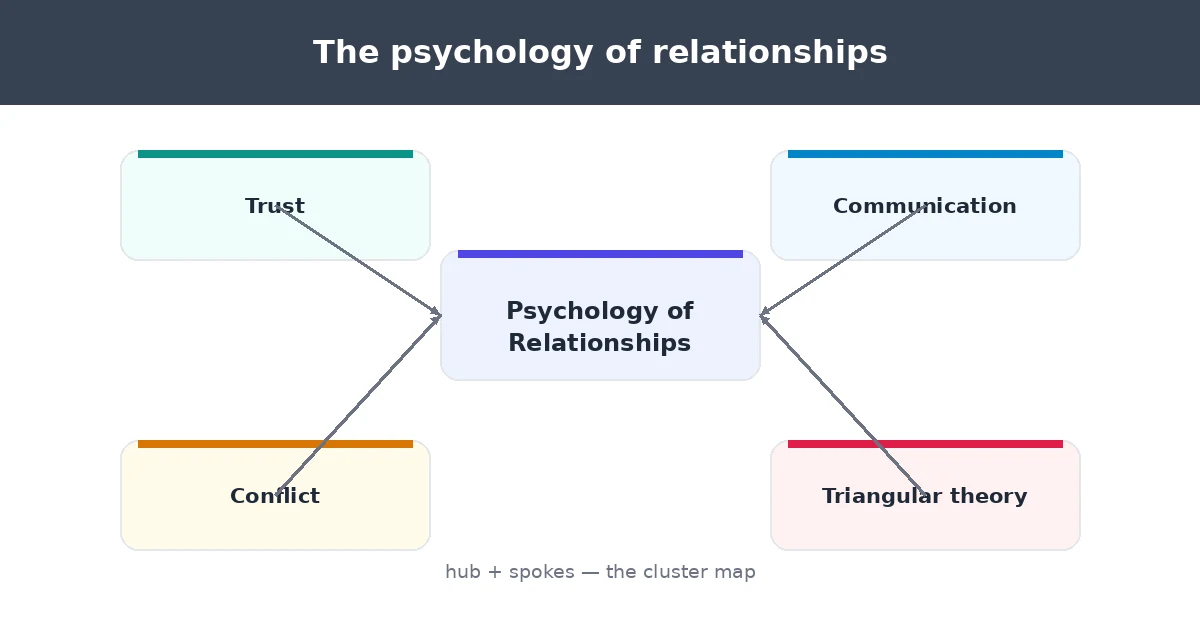
Relationship psychology is the scientific study of how close relationships form, stay satisfying, and sometimes end. Across decades of research, a short list of findings keeps recurring: responsiveness and trust, the quality of everyday communication, how couples repair after conflict, and commitment — what people have invested in the bond and what keeps them choosing it.
That convergence is worth pausing on. Thousands of studies, carried out in labs, living rooms, and long-running surveys, keep circling the same few themes. This article maps the field: what relationship psychologists actually study, the major frameworks they use, what the evidence keeps finding, and where the research is honest about its limits. It is the hub of this cluster — each theme below gets its own deep-dive article, linked along the way.
Table of Contents
What Does Relationship Psychology Study?
Relationship psychology — often called the psychology of close relationships — asks a deceptively simple question: how do human bonds work? Researchers typically organize the work around three stages of a relationship’s life.
Formation. Why do we connect with some people and not others? This is the territory of attraction: proximity and familiarity, similarity, physical attraction, and the early conversations that turn strangers into partners or friends. Formation research studies how bonds begin, across romantic partnerships, friendships, and family ties.
Maintenance. Once a relationship exists, what keeps it satisfying? Most modern research lives here. Psychologists study how partners communicate day to day, how they handle disagreements, how trust builds or erodes, and how commitment deepens. Maintenance research is where the field’s most practical findings come from — and where this cluster concentrates.
Dissolution. Why do relationships end? Researchers study the trajectories of relationships that break up or divorce: what distinguishes, on average, bonds that survive from those that don’t. This is predictive work in the statistical sense — identifying patterns that tend to precede endings, not prophecies about any individual couple (more on what “predicts” means in the limits section below).
One more framing point, because it shapes everything in this cluster: humans appear deeply built for connection. Baumeister and Leary’s influential review of the literature argued that the need to form and maintain stable, caring relationships is a fundamental human motivation — not a luxury, and not limited to romance [4]. That is why relationship psychology studies friendships, family bonds, and romantic partnerships together: the underlying need is the same, even when the relationships look different.
The Main Frameworks, Briefly
No single theory explains relationships. Instead, researchers work with a handful of frameworks, each capturing something different. Think of them as lenses: switching lenses changes what you notice.
Attachment in adult relationships
Attachment theory began with the bond between infants and caregivers, but in the late 1980s researchers showed the same attachment system operating between adult romantic partners. Hazan and Shaver’s landmark 1987 paper translated the infant attachment styles — secure, avoidant, and anxious — into the language of adult love, finding that the three patterns appeared in roughly the same proportions in adulthood and predicted how people experienced romantic relationships [3].
That move launched one of the most productive research programs in relationship science. Attachment has its own dedicated guides on this site:
- What attachment is — the bond, the attachment figure, safe haven and secure base
- The four attachment styles compared — secure, anxious, avoidant, and disorganized, side by side
The pillar’s takeaway: attachment theory explains how people tend to handle closeness — their expectations of others and their patterns under stress. The other frameworks in this section explain what happens between people.
Sternberg’s triangular theory of love
Robert Sternberg’s 1986 triangular theory proposes that love has three components: intimacy (closeness, connectedness, bondedness), passion (romance, attraction, physical drives), and decision/commitment (the short-term decision to love someone and the long-term commitment to maintain it) [1]. Different combinations of the three describe different kinds of love — from liking (intimacy alone) to infatuation (passion alone) to consummate love (all three together).
The theory’s real contribution is vocabulary: it gives researchers — and the rest of us — a way to say precisely what kind of love a relationship involves, and to track how the mix shifts over time. The full framework, including all eight types and its honest limits, has its own article: Sternberg’s triangular theory of love.
Social exchange and the investment model
Social exchange approaches treat relationships as ongoing tallies of rewards and costs: people feel satisfied when what they get compares well with what they expect and with what they could get elsewhere. Caryl Rusbult’s investment model (1980) refined this by explaining a puzzle the simple tally couldn’t — why people sometimes stay in unsatisfying relationships. The answer: commitment depends not only on satisfaction, but also on the investments people have poured in (time, shared friends, a home, a history) and the quality of their alternatives [5]. Large investments and poor alternatives can keep people committed even when satisfaction is low — an insight that explains far more than the tally alone.
Observing couples: the Gottman approach
While other traditions relied on questionnaires, John Gottman and colleagues took a different path: they filmed couples interacting, coded moment-by-moment behaviors and physiological responses, and followed the couples for years. In a landmark 1992 study, Gottman and Levenson found that the patterns visible in a brief laboratory interaction — how much negative affect surfaced, whether defensiveness or withdrawal appeared — were associated with whether couples later separated or divorced [2]. The method’s power is its objectivity: it studies what couples do, not what they say they do. The conflict deep-dive walks through this research in full: conflict in relationships.
What the Evidence Keeps Finding
Frameworks organize thinking; findings are what they produce. Across the frameworks, the same four themes keep surfacing. Each gets its own article in this cluster — here is the useful-summary version.
Responsiveness and trust
The closest thing relationship research has to a master variable is responsiveness: the sense that a partner notices your needs, understands them, and responds with care. When responsiveness is consistent, trust grows — the expectation that the other person will act in your interests. Trust itself builds in stages, from predictability (“I can count on them”) to dependability (“they care about my welfare”) to faith (“I am confident in them even under uncertainty”) — a progression documented by Rempel, Holmes, and Zanna in the 1980s and still central to how psychologists think about trust [6].
This is a mechanism, not a moral: trust is built through small, repeated experiences of responsiveness, and damaged when those expectations are violated. The full mechanism — how trust is built, broken, and repaired — is the subject of trust in relationships.
How couples communicate
What separates satisfying couples from distressed ones is less whether they disagree than how they talk — including during ordinary moments. Observational research consistently finds that happier couples show a higher balance of positive to negative moments in interaction, “turn toward” each other’s small bids for connection (a comment, a glance, a sigh that invites engagement), and make repair attempts when conversations go sideways — small gestures that de-escalate tension before it hardens.
The practical upshot is about patterns, not perfection: every couple has bad days. What matters is the ratio over time and whether repair keeps working. For the patterns themselves — bids, repair attempts, structured listening — see communication in relationships.
Repair after conflict
Disagreement is normal; the pattern of disagreement is the signal. Gottman’s observational work identified four negative interaction patterns — criticism, contempt, defensiveness, and withdrawal — that tend to appear more in couples whose relationships later deteriorate [2]. Equally important is what healthy couples do instead: they start difficult conversations gently, take breaks when physiology runs hot, and — critically — their repair attempts succeed. A couple where one partner’s “okay, let’s reset” reliably lands is in a different place than one where it reliably doesn’t.
None of this is a diagnostic checklist for your own relationship — these are population-level patterns observed by researchers, and no article can diagnose an individual couple. If persistent distress makes outside perspective appropriate, a qualified professional is the right next step. For the full descriptive picture, see conflict in relationships.
Commitment and investment
Finally, relationships endure when people are committed to maintaining them — and commitment, as Rusbult’s model showed, is not the same as satisfaction [5]. Satisfaction fluctuates with daily life; commitment is the steadier force, held in place by satisfaction, by the investments already made, and by the perceived quality of alternatives. This is why “are we happy right now?” and “will we last?” can have different answers: commitment is what bridges the gap between them.
Where the Research Is Thin
A pillar should be honest about the field’s limits. Three caveats matter for everything above.
Who gets studied. Much of the foundational research — especially the longitudinal couple studies — was conducted with Western, mostly married, mostly heterosexual samples. That doesn’t invalidate the findings, but it limits how far they generalize. Cultures differ in how relationships form, what commitment means, and how love is expressed; samples of friendships, unmarried partners, and non-Western couples are growing but still underrepresented.
Correlation is not causation. Most relationship research is correlational: it finds that X and Y move together, not that X causes Y. When a study finds that responsive partners have more satisfying relationships, it cannot fully rule out that satisfying relationships make people more responsive — or that some third factor drives both. Longitudinal designs help, but the field’s claims are probabilistic associations, not proven recipes.
What “predicts” means. When researchers say a pattern “predicts” divorce or satisfaction, they mean it shifts the odds across a group — not that it determines any individual outcome. A pattern can be a genuine statistical predictor and still be wrong about many specific couples. Read every finding on this site in that spirit: as information about tendencies, not verdicts.
How to Use This Cluster
This article is the map; the spokes are the territory. Use it like this:
- Start with the frameworks if you want the big picture of how psychologists think: Sternberg’s triangular theory of love for what love is made of, and the attachment guides — what attachment is, the four attachment styles — for how people handle closeness.
- Go to the mechanisms for what the evidence finds: trust in relationships (how trust is built and repaired), communication in relationships (the patterns that distinguish satisfying couples), and conflict in relationships (Gottman’s observational research and healthy disagreement).
- Read the limits section above before drawing conclusions about your own relationships — then treat everything as education, not diagnosis.
- Explore jealousy in relationships — when it’s a normal alarm and when it becomes control.
- Read why people cheat — the motives researchers find and how couples recover.
- Explore online dating — how profiles, matching, and first impressions shape modern romance.
- Explore long-distance relationships — what helps couples stay connected across the miles.
- Discover what people want in a partner — how mate preferences show up in the research.
A note on what this article is (and isn’t)
This is educational content about relationship science, not clinical advice. Research describes patterns across groups of people; it cannot diagnose your relationship, and no article can substitute for a qualified professional if you are experiencing persistent distress. If conflict in your relationship ever involves fear, control, or harm, a professional — or a local support service — is the right next step, not a reading list.
Key Takeaways
- Relationship psychology studies how close relationships form, are maintained, and end — across romantic, family, and friendship bonds.
- The field works with several frameworks: attachment (how people handle closeness), Sternberg’s triangle (what love is made of), the investment model (what sustains commitment), and observational couple research (what partners actually do).
- The evidence converges on four themes: responsiveness and trust, everyday communication quality, repair after conflict, and commitment.
- Disagreement itself is normal; research distinguishes couples by the pattern of their disagreements, not by whether they fight.
- Findings are probabilistic and come mostly from Western samples — treat them as tendencies across groups, not verdicts on individuals.
What does relationship psychology study?
Relationship psychology studies how close relationships form, stay satisfying, and end. Researchers investigate attraction and relationship formation, the maintenance of satisfaction (communication, trust, conflict, commitment), and dissolution — across romantic partnerships, friendships, and family bonds.
What matters most in relationships, according to research?
No single factor dominates, but the evidence converges on four: consistent responsiveness that builds trust, a healthy balance of positive to negative moments in everyday communication, effective repair after conflict, and commitment sustained by satisfaction, investment, and alternatives. These themes recur across frameworks from attachment research to observational couple studies.
Can research predict which relationships will last?
Only probabilistically. Studies can identify patterns that shift the odds across groups — for example, Gottman’s observational work found that negative interaction patterns were associated with later separation [2] — but no finding determines any individual couple’s outcome. Treat predictions as information about tendencies, never as verdicts.
Is relationship psychology only about romantic relationships?
No. Romantic partnerships dominate the research — especially the longitudinal couple studies — but the field’s core ideas apply to friendships and family bonds too. The underlying motivation, the need to form and maintain stable caring relationships, is not limited to romance [4], and the attachment system operates across all close bonds.
References
- Sternberg, R. J. (1986). A triangular theory of love. Psychological Review, 93(2), 119–135. https://doi.org/10.1037/0033-295X.93.2.119
- Gottman, J. M., & Levenson, R. W. (1992). Marital processes predictive of later dissolution: Behavior, physiology, and health. Journal of Personality and Social Psychology, 63(2), 221–233. https://doi.org/10.1037/0022-3514.63.2.221
- Hazan, C., & Shaver, P. (1987). Romantic love conceptualized as an attachment process. Journal of Personality and Social Psychology, 52(3), 511–524. https://doi.org/10.1037/0022-3514.52.3.511
- Baumeister, R. F., & Leary, M. R. (1995). The need to belong: Desire for interpersonal attachments as a fundamental human motivation. Psychological Bulletin, 117(3), 497–529. https://doi.org/10.1037/0033-2909.117.3.497
- Rusbult, C. E. (1980). Commitment and satisfaction in romantic associations: A test of the investment model. Journal of Experimental Social Psychology, 16(2), 172–186.
- Rempel, J. K., Holmes, J. G., & Zanna, M. P. (1985). Trust in close relationships. Journal of Personality and Social Psychology, 49(1), 95–112. https://doi.org/10.1037/0022-3514.49.1.95
- Attachment — APA Dictionary of Psychology. https://dictionary.apa.org/attachment
Keep Exploring
- Trust in Relationships — how trust is built in stages, how betrayal damages it, and what repair looks like in the research.
- Communication in Relationships — bids for connection, repair attempts, and the interaction patterns that distinguish satisfying couples.
- Conflict in Relationships — Gottman’s observational research, the four negative patterns, and what healthy disagreement looks like.
- Sternberg’s Triangular Theory of Love — intimacy, passion, and commitment, the eight types of love, and the theory’s honest limits.
- What Is Attachment? — the bond itself: the attachment figure, safe haven, and secure base across the lifespan.
- Attachment Styles Compared — the four patterns (secure, anxious, avoidant, disorganized) side by side.