
Attachment is the deep emotional bond between a child and their caregiver — and, later in life, between adults in close relationships. The American Psychological Association defines it as the emotional bond between an infant and a parent figure or caregiver, developed as a step toward feeling secure, and shown by calmness in the caregiver’s presence; it also covers the tendency to form such bonds with others in infancy and to seek emotionally supportive relationships in adulthood [1].
The key word is bond — but not just any bond. An attachment bond has a specific job: security. When a toddler trips and runs crying to her father, when a teenager calls his mother after a bad day, when an adult reaches for their partner’s hand in a hospital waiting room — the same system is at work. The person turns to someone specific for comfort and protection, calms down, and then gets back to life.
This guide explains what attachment actually is: the bond itself, the key concepts psychologists use to describe it, how it differs from the theory of attachment, and why it matters far beyond childhood. (For the full scientific framework behind these ideas, see our guide to attachment theory.)
Table of Contents
The Scientific Definition of Attachment
Psychologists describe attachment in remarkably consistent terms. The APA’s definition points to three essentials: it is an emotional bond (not just a habit or a practical arrangement), it forms with a specific person (a parent figure, a caregiver — later, a partner or close friend), and its purpose is felt security [1].
Notice what attachment is not in this definition. It is not the same as liking someone, depending on someone financially, or spending a lot of time together. A child can spend all day at nursery and still be attached to the parent they run to at pickup. What makes a relationship an attachment relationship is the security function: this is the person you turn to when you are frightened, hurt, or overwhelmed.
An open psychology textbook puts the evolutionary logic plainly: attachment theory starts from the observation that infants go to extraordinary lengths to stay close to caregivers — crying, clinging, following — and argues these behaviors are adaptive responses that keep a vulnerable child safe [3].
Key Concepts: The Attachment System
Psychologists describe attachment as a behavioral system — a built-in set of tendencies that switches on when we feel threatened and quiets down when we feel safe. Four concepts describe how it works.
The attachment figure
An attachment figure is the specific person toward whom attachment behavior is directed — the one whose presence calms you [3]. For an infant, this is usually a parent. For adults, it is often a romantic partner, but it can also be a close friend, a sibling, or a parent. The defining feature is not the role but the function: this is the person you want when you are distressed.
Proximity seeking
Proximity seeking is the drive to stay physically or emotionally close to the attachment figure. In babies it looks like crying, reaching, clinging, and following. In adults it looks subtler: calling, texting, wanting to be in the same room, feeling unsettled when a partner is distant during a crisis. The behaviors change with age; the goal — closeness to the person who makes you feel safe — does not [1][3].
Safe haven
The attachment figure serves as a safe haven: the place you return to for comfort when something goes wrong. The toddler who falls, runs to her father, cries in his arms, and settles is using him as a safe haven. So is the adult who has a terrible day and needs to talk it through with someone trusted before they can think straight. The safe haven is what makes the bond an attachment bond rather than just a close relationship.
Secure base
The same person also serves as a secure base: the platform from which you explore the world. Watch a securely attached toddler at a playground — she wanders off to investigate, glances back to check her parent is still there, and ventures further. The parent’s availability enables exploration rather than preventing it. Adults work the same way: people take bigger risks — a new job, a difficult conversation, a creative project — when they know someone has their back.
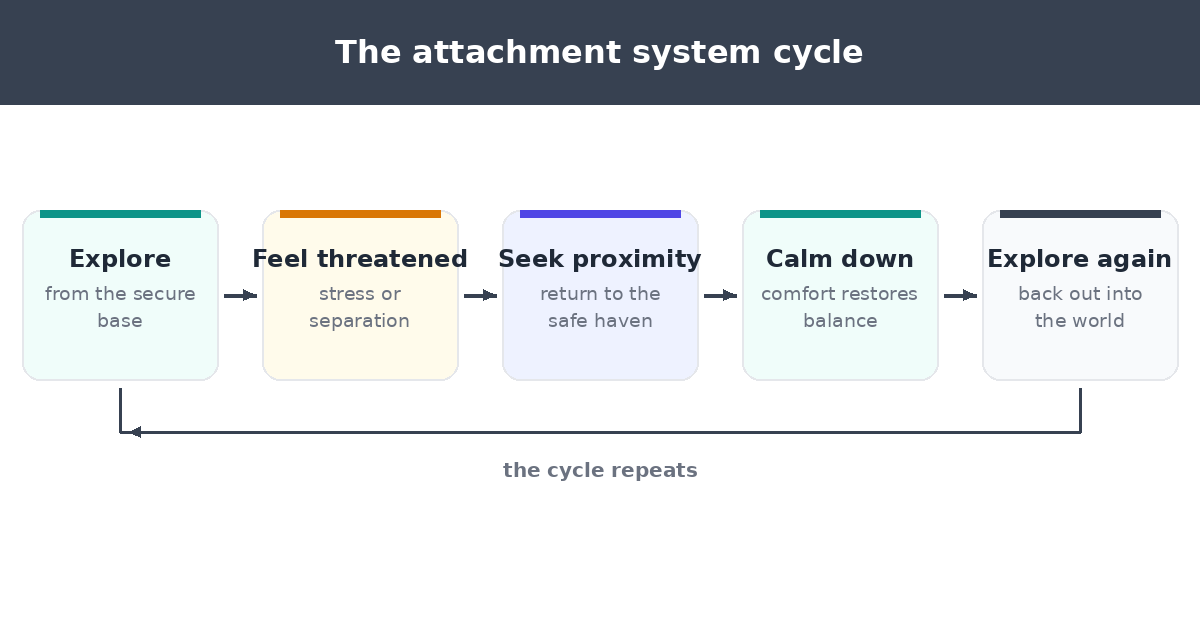
These two functions form a cycle: explore from the secure base → feel threatened → return to the safe haven → calm down → explore again. Psychologists consider this cycle the signature of a working attachment system.
Attachment vs. Attachment Theory: Don’t Confuse Them
This distinction matters, and mixing the two up causes endless confusion:
| Attachment | Attachment theory | |
|---|---|---|
| What it is | The bond itself — the emotional tie and the behaviors around it | The scientific framework that explains the bond |
| Question it answers | “What is this bond, and how does it work?” | “Why does the bond form, and what shapes it?” |
| Key content | Attachment figure, proximity seeking, safe haven, secure base | Bowlby’s evolutionary account, Ainsworth’s research, internal working models, the four styles |
| Analogy | The weather | Meteorology |
You can observe attachment without knowing the theory — every parent who has comforted a crying child has seen it. The theory, developed by John Bowlby and expanded by Mary Ainsworth and others, is the explanation of why the bond exists and how it shapes development [2]. This article is about the bond; our attachment theory guide covers the framework.
Attachment Is Not Just for Babies
Bowlby argued that attachment is not a childhood phase that ends — it characterizes human beings across the whole lifespan [3]. The APA’s definition agrees: alongside the infant–caregiver bond, attachment covers “the tendency in adulthood to seek emotionally supportive social relationships” [1].
What changes is the cast, not the play. The behaviors mature — a 30-year-old does not cling to her partner’s leg at the airport — but the underlying system still runs: threat activates the need for closeness, the attachment figure’s responsiveness restores calm, and felt security frees you to engage with life. Researchers who extended the theory to adult romantic relationships in the 1980s found the same patterns of security and insecurity showing up between partners [3].
This is also why attachment is not the same as childhood dependence in the casual sense. Needing comfort when you are distressed is not immaturity; in this framework, it is a normal feature of being human at every age.
Can You Be Attached to More Than One Person?
Yes. Children typically form attachment relationships with more than one caregiver — both parents, a grandparent, a regular caregiver — and adults maintain several attachment bonds at once (a partner, a best friend, a parent) [3]. Researchers often describe a loose hierarchy: most people have a primary figure they turn to first, but the system is not limited to one person.
This corrects a common misunderstanding of Bowlby’s early writing, which emphasized a single primary figure. Later research showed the picture is more flexible: what matters is having at least one reliably responsive attachment figure, not exactly one [3].
A note on what this article is (and isn’t)
This is educational content about a normal feature of human development, not a clinical assessment. Attachment describes tendencies in how people relate — it does not diagnose anyone, and attachment patterns are not fixed labels. If you are experiencing persistent distress in your relationships, a qualified mental health professional is the right next step.
Frequently Asked Questions
Is attachment the same as love?
Not exactly. Love is a broader, fuzzier word — it covers affection, attraction, care, and commitment in many forms. Attachment is a specific kind of emotional bond defined by its security function: the person you turn to for comfort and protection when distressed. You can love someone without being attached to them in this technical sense (a beloved mentor, a admired public figure), and attachment bonds always involve the safe-haven/secure-base dynamic that casual "love" may not.
Is attachment only about mothers?
No. Bowlby's early writing focused heavily on the mother–child bond, reflecting both his clinical observations and the era's assumptions. Modern research studies attachment across many caregivers — fathers, grandparents, adoptive parents, and other consistent caregivers — and finds the same security dynamics at work [3]. What matters is responsive caregiving, not the caregiver's gender or biological relationship.
Does everyone form attachments?
Attachment is considered a normal, universal feature of human development — children form attachment bonds even in difficult circumstances, though the quality of the bond varies with caregiving experiences [2][3]. The differences researchers study are not between "attached" and "unattached" people but between different patterns of attachment — secure and insecure — which our guide to the four attachment styles compares in detail.
What is the difference between attachment and attachment theory?
Attachment is the bond — the emotional tie, the proximity seeking, the safe haven and secure base. Attachment theory is the scientific explanation of that bond: why it evolved, how it develops, and how it shapes relationships across life. Think of it as the difference between the weather and meteorology.
Keep Exploring
- Attachment Theory Explained — the full scientific framework: Bowlby, Ainsworth, the Strange Situation, and how the theory grew to cover adult relationships.
- Attachment Styles — the four patterns of attachment (secure, anxious, avoidant, disorganized) compared side by side.
References
- Attachment — APA Dictionary of Psychology. https://dictionary.apa.org/attachment (opened and verified)
- Attachment theory — APA Dictionary of Psychology. https://dictionary.apa.org/attachment-theory (opened and verified)
- Attachment — Culture and Psychology (open textbook), OpenStax via Maricopa Community Colleges. https://open.maricopa.edu/culturepsychology/chapter/attachment/ (opened and verified)