
Conscientiousness is the personality trait of being responsible, careful, and diligent — the tendency to be organized, self-disciplined, and driven to do a task well. A highly conscientious person plans ahead, keeps commitments, and follows through; someone lower in conscientiousness is more spontaneous, flexible, and relaxed about structure [1][2].
Conscientiousness is one of the five broad traits of the Big Five model of personality, alongside openness, extraversion, agreeableness, and neuroticism. If you’re new to that model, our guide to the Big Five personality traits explains the full framework — and our introduction to personality psychology covers how traits like this one are studied. This article is a deep dive into just one of those five traits: what conscientiousness is, its facets, what it looks like at high and low levels, and why researchers consider it one of the most consequential traits there is.
Table of Contents
What Is Conscientiousness?
Psychologists describe conscientiousness as individual differences in the tendency to be hardworking, orderly, responsible to others, self-controlled, and rule-abiding [1]. It shows up in characteristic behaviors: being neat, systematic, careful, thorough, and deliberate — tending to think carefully before acting [2].
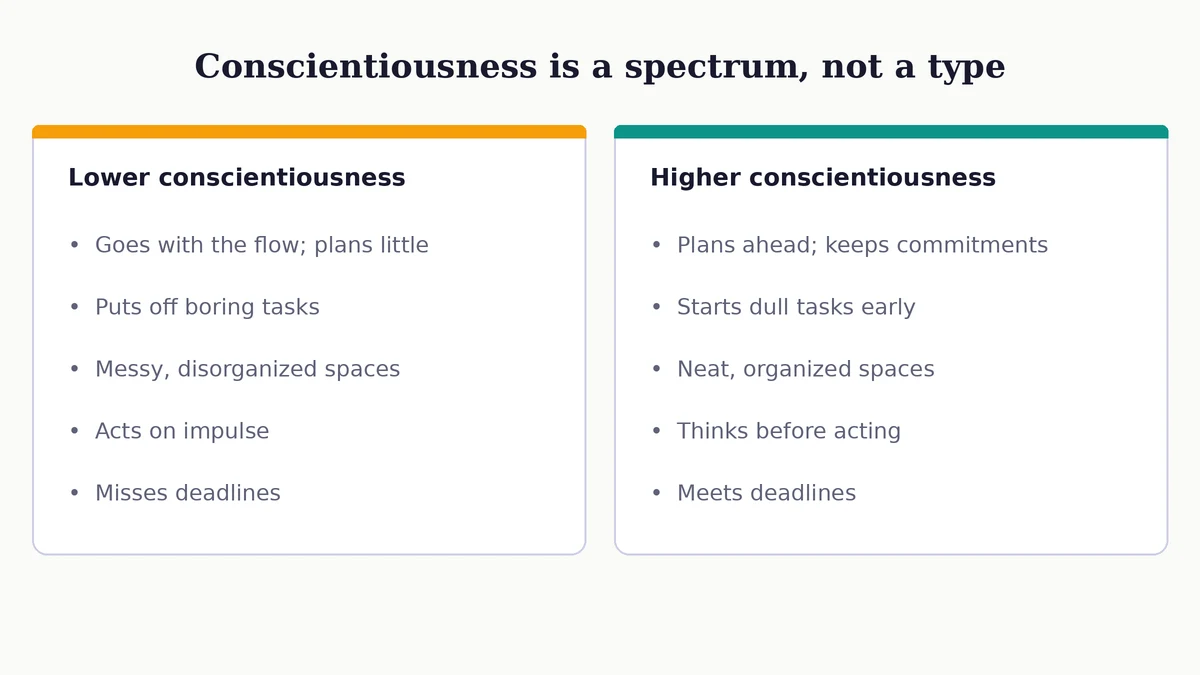
Like every personality trait, conscientiousness is a spectrum, not a box. You don’t “have it or not”; you fall somewhere along a continuous dimension, and most people sit somewhere near the middle [2]. A person high in conscientiousness consistently does things like plan, organize, and follow through across situations — not just once, but as a recognizable pattern.
It’s also worth separating conscientiousness from a few things it gets confused with. It isn’t perfectionism (perfectionism is narrower and can be maladaptive). It isn’t morality — though dutifulness touches ethics, the trait itself is about goal-directed organization, not goodness. And it isn’t a measure of intelligence, though conscientious habits can help people make full use of their abilities.
The Six Facets of Conscientiousness
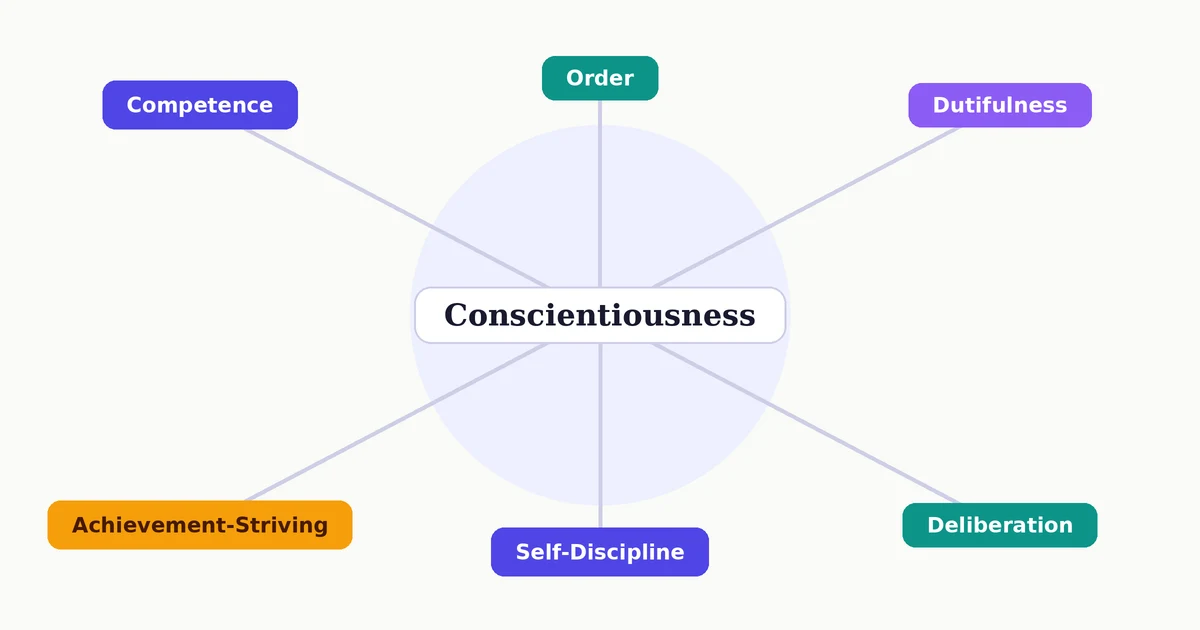
Researchers often break broad traits into narrower facets — smaller, more specific patterns that sit underneath the broad trait. In the NEO framework (Costa & McCrae), conscientiousness has six facets: competence, order, dutifulness, achievement-striving, self-discipline, and deliberation [3].
| Facet | What it looks like in practice |
|---|---|
| Competence | Confidence in your ability to handle what life throws at you — the sense that you can figure things out |
| Order | Keeping your environment and plans organized — tidiness, lists, routines |
| Dutifulness | Taking obligations seriously — doing what you promised because it matters to you and others |
| Achievement-striving | Setting challenging goals and working hard toward them — ambition with follow-through |
| Self-discipline | Persisting at difficult or boring tasks until they’re done — starting, not just planning |
| Deliberation | Thinking before acting — pausing to weigh consequences rather than going with the first impulse |
Table: the six facets of conscientiousness in the NEO framework (Costa & McCrae, 1992) [3].
This facet structure matters because two people can both be “high in conscientiousness” in very different ways. One might express it mostly through orderliness — the person with the color-coded calendar and a spotless desk. Another might express it through achievement-striving and self-discipline — the person who grinds through a hard project at night but whose desk is chaos. The broad trait is the family resemblance; the facets are the individual faces.
Signs of High Conscientiousness
High conscientiousness doesn’t look like one personality stereotype — it shows up in habits:
- You plan ahead. Meetings go in the calendar; trips get itineraries; big projects get broken into steps before they start.
- You keep commitments. If you say you’ll do something, people can count on it happening — not because you never forget, but because you build systems (reminders, lists) so you don’t.
- Your spaces are organized. Planners, to-do lists, neatly arranged desks and shelves — the physical traces of an orderly mind [2].
- You start boring tasks anyway. Self-discipline means the report gets written before the deadline, not after the adrenaline of the last night.
- You pause before acting. Deliberation looks like checking the numbers twice, sleeping on a big decision, or asking “what could go wrong?” before committing.
These are tendencies, not rules. A highly conscientious person can still have a junk drawer and a forgotten birthday — traits describe patterns, not perfection.
Signs of Low Conscientiousness
Lower conscientiousness is the other end of the same spectrum, and it’s not a moral failing — it’s a pattern with its own trade-offs:
- Spontaneity over planning. Less use of calendars and lists; more improvising and going with the flow.
- Procrastination. Low conscientiousness is strongly associated with putting things off [2] — starting at the last minute, or after.
- Disorganization. Cluttered desks, scattered belongings, systems that exist mostly in the head.
- Impulsiveness. Acting on the first idea rather than deliberating — sometimes fun, sometimes costly.
- Missed commitments. Not from malice; follow-through is just harder to sustain without structure.
The upside of this end of the spectrum deserves saying plainly: lower conscientiousness often comes with flexibility, spontaneity, and an easier relationship with uncertainty. The person who improvises the road trip is not the person who built the spreadsheet — both can be wonderful. Problems arise mainly when the pattern consistently clashes with the demands of the person’s goals, not from the trait itself.
Conscientiousness in Everyday Life
Abstract definitions are only half the story. Here’s what the trait looks like in three concrete settings:
At work. Maya, a project coordinator high in conscientiousness, arrives with an agenda for every meeting, updates the shared task board without being asked, and delivers the quarterly report two days early — because she started it the week it was assigned. Her conscientiousness shows in the dutifulness (keeping the team on track) and deliberation (flagging risks before they become problems) facets. Researchers note that conscientious employees tend to be more reliable and harder working, with lower rates of absenteeism and counterproductive work behaviors [2].
Studying. Sam, a college student, treats exam season like a campaign: a study schedule six weeks out, practice questions on Tuesdays, flashcards on the bus. This is self-discipline and achievement-striving in action. Conscientiousness consistently predicts academic performance [1] — not because conscientious students are smarter, but because steady effort compounds.
Daily life. Ahmed pays bills on autopilot the day they arrive, meal-plans on Sundays, and has a plumber’s number saved before the sink leaks. That’s orderliness and competence at work — small, boring systems that prevent large, expensive problems.
Why Conscientiousness Matters
Among personality traits, conscientiousness punches above its weight. A large-scale review of more than a century of research describes it as the most potent noncognitive predictor of occupational performance, with meta-analytic evidence linking it to work performance, academic performance, physical health and mortality, marital stability, and subjective well-being [1]. “Noncognitive” here doesn’t mean unimportant — it means these are strengths of character and habit rather than raw mental ability.
The health connection is particularly striking. Conscientious people are more likely to follow the boring rules that keep bodies healthy — regular check-ups, exercise, moderate drinking, not smoking — because conscientiousness includes a strong respect for norms and obligations, including the ones that protect health [2].
But perspective matters: conscientiousness is a real, consistent predictor of life outcomes, not a guarantee of them. Traits describe tendencies; they don’t write destinies.
Is More Conscientiousness Always Better?
Not exactly. Taken to an extreme, high conscientiousness can shade into workaholism, rigid perfectionism, or compulsive behavior [2] — the person who can’t leave the office, re-checks the lock five times, or follows rules so closely they miss better solutions. Research even finds downsides in specific situations: being overly deliberate can slow urgent decisions, and high conscientiousness can amplify the pain of setbacks like unemployment [2].
Psychologists increasingly see traits this way: no trait is inherently positive or negative. Its value depends on the situation, your goals, and what you’re willing to trade for it. The useful question is never “how high can I get my score?” — it’s “does my pattern serve the life I’m trying to build?”
Frequently Asked Questions
What’s the difference between conscientiousness and perfectionism?
Conscientiousness is a broad trait covering organization, discipline, and goal-directed effort. Perfectionism is narrower: demanding flawless results, often with harsh self-criticism. You can be highly conscientious — reliable, organized, hard-working — without being a perfectionist.
Can conscientiousness change?
Traits are relatively stable, but they do shift. Studies suggest conscientiousness tends to increase from late adolescence through middle age — people often become more organized and disciplined as they take on adult responsibilities like work and family [1][2]. Change is gradual, not overnight, and it usually follows sustained changes in roles and routines rather than sheer willpower.
How is conscientiousness measured?
Mostly through self-report questionnaires, where people rate statements about their typical habits (“I keep my belongings organized”). Peer ratings and observer reports are also used. Conscientiousness measures show good reliability, and both self-reports and observer ratings predict real-life outcomes like academic success [2].
Is low conscientiousness bad?
It’s not a character flaw — it’s a trait position with trade-offs. People low in conscientiousness can be more spontaneous, flexible, and creative. It becomes a problem mainly when it consistently undermines someone’s own goals, such as repeated procrastination hurting a career they care about.
References & Further Reading
- Wilmot, M. P., & Ones, D. S. (2019). A century of research on conscientiousness at work. Proceedings of the National Academy of Sciences, 116(46), 23004–23010. https://pmc.ncbi.nlm.nih.gov/articles/PMC6859351/
- Conscientiousness — Wikipedia. http://en.wikipedia.org/wiki/Conscientiousness
- NEO PI-R facet structure (Costa & McCrae, 1992), as described in: Educational orientation, NEO PI-R personality traits, and plans for graduate school. College Student Journal. https://www.thefreelibrary.com/Educational+orientation%2C+NEO+PI-R+personality+traits%2C+and+plans+for…-a0112720423
Keep Exploring
Conscientiousness is just one piece of the personality puzzle: meet all five traits in our Big Five guide, or start from the foundations with what personality psychology studies.
1 thought on “Conscientiousness: Meaning, Signs & Examples”