
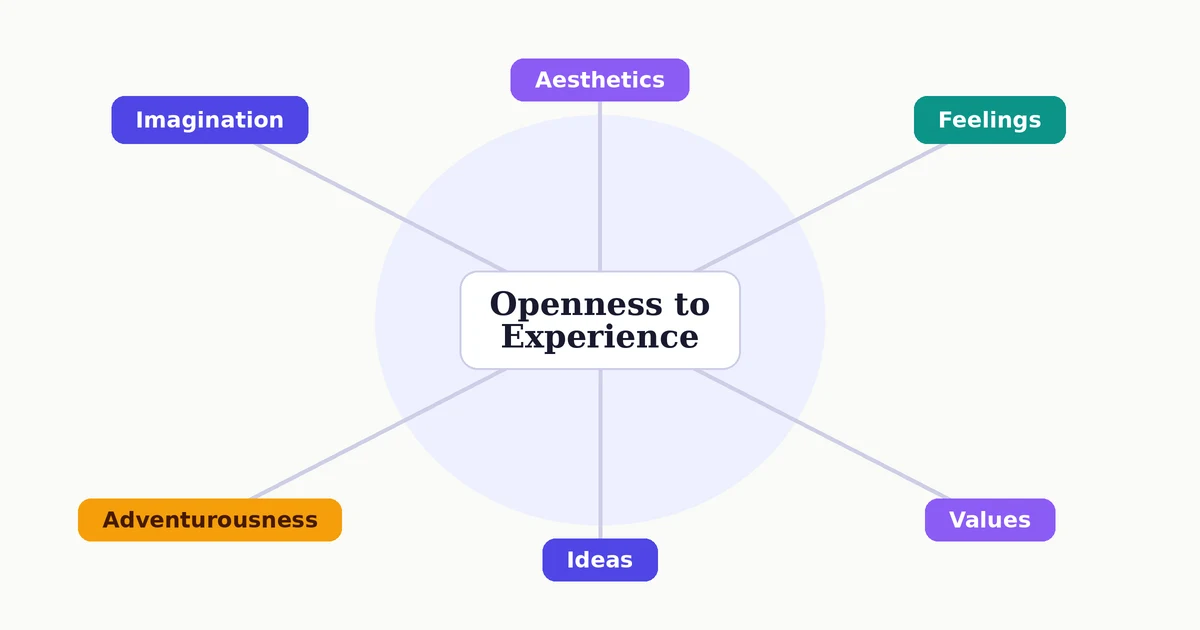
Openness to experience — usually shortened to just openness — is the personality trait that describes how receptive you are to new ideas, new experiences, and new ways of seeing the world. People high in openness tend to be curious, imaginative, and drawn to novelty: they want to try the unfamiliar restaurant, explore the unusual idea, and notice the beauty in things others walk past. People low in openness tend to prefer the familiar, the practical, and the tried-and-tested [1].
Openness is one of the five broad dimensions in the five-factor model of personality — alongside conscientiousness, extraversion, agreeableness, and neuroticism. Like every personality trait, it sits on a spectrum: you fall somewhere along it, usually closer to the middle than to either extreme [1]. This article goes deep on openness specifically: what it means, the facets that make it up, the signs of high and low openness, and what it all looks like in real life.
Table of Contents
What Openness to Experience Means
Psychologists describe openness as being characterized by imagination, feelings, actions, and ideas — and people who score high on it tend to be curious with a wide range of interests [1]. In everyday language, openness is about the breadth and richness of your mental life: exploring the world outward (new places, activities, ideas) and exploring the mind inward (imagination, emotional nuance, reflection on how things could be different).
This is worth clarifying: openness is not about being sociable or talkative. A quiet bookworm can be very high in openness, and a life-of-the-party extrovert can be relatively low. Openness is about engagement with novelty and complexity — not with people.
The Six Facets of Openness
Personality researcher Robert McCrae showed that openness isn’t one simple thing — it’s a broad dimension made up of six narrower facets that tend to cluster together: fantasy, aesthetics, feelings, actions, ideas, and values [2]. Each facet captures a different flavor of openness:
| Facet | What it captures |
|---|---|
| Fantasy | A vivid inner life — daydreaming, imagining possibilities, thinking in images and stories |
| Aesthetics | Sensitivity to art, music, design, and beauty in general |
| Feelings | Paying attention to your own emotions and treating them as meaningful information |
| Actions | Preferring variety and novelty over routine — trying new things |
| Ideas | Intellectual curiosity — enjoying abstract thinking and complex problems |
| Values | Willingness to examine, question, and update your own beliefs and assumptions |
You don’t have to be high on every facet at once. Someone might score high on Ideas (loves debating philosophy) but average on Actions (still eats lunch at the same café). The overall trait describes your general tendency across these areas [2].
Signs You’re High in Openness
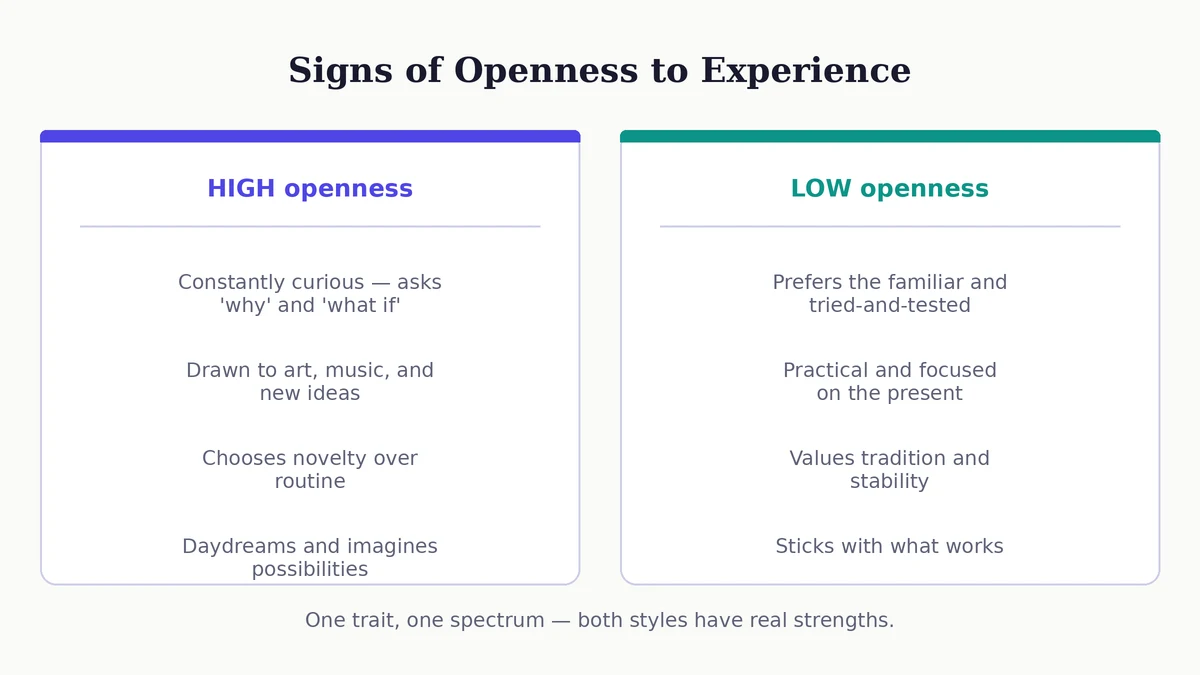
Nobody checks every box, but a person high in openness will usually recognize several of these:
- You’re constantly curious. You ask why and what if — about people, systems, and ideas.
- You have a wide range of interests rather than one narrow focus [1].
- You choose novelty over routine. A new cuisine, a new route, a new hobby all sound appealing.
- You have a vivid imagination — you daydream, visualize possibilities, or get absorbed in stories.
- You’re drawn to art, music, and beauty, or to ideas that stretch your thinking [2].
- You enjoy re-examining your own beliefs when you encounter a perspective you hadn’t considered.
- It also shows up in behavior: research has found that people high in both openness and extraversion are more likely to take part in adventure and risky sports, drawn by their curious and excitement-seeking nature [1].
Signs You’re Low in Openness
Scoring low on openness doesn’t mean anything is wrong with you — it means your pattern runs toward stability and the concrete:
- You prefer the familiar. Routines, traditions, and known quantities feel right.
- You’re practical and focused on the present rather than on hypotheticals.
- You trust experience over experimentation — if something works, you stick with it.
- You value stability and continuity in how you live, work, and relate to others.
- Your interests run deep rather than wide — you’d rather master something than sample everything.
Low openness has genuine strengths — reliability, focus, and follow-through. No profile is an ideal; the useful question is always fit, not rank.
Openness in Everyday Life
Abstract traits are easier to grasp through concrete moments. Here’s how openness plays out in ordinary life:
Choosing where to eat. Four friends are picking a restaurant. One is already googling an Ethiopian place that just opened — that’s high openness in action. Another votes for the Italian spot they’ve loved for five years, where they know exactly what they’ll order. That’s low openness — not stubbornness, just a preference for the reliable over the unknown. Both are legitimate ways to spend a Friday evening.
A free Saturday. A high-openness person signs up for a pottery workshop on a whim, curious about what shaping clay feels like. A low-openness person spends the same Saturday perfecting a recipe they’ve cooked for years — deepening something that already works rather than sampling something new. Neither Saturday is wasted.
At a team meeting. When a project hits a wall, the high-openness colleague is the one who suggests the unconventional fix — what if we rebuilt it completely differently? The low-openness colleague is the one who points out the practical risks and asks what evidence supports the change. Innovation needs both: someone has to generate the wild idea, and someone has to make sure it survives contact with reality.
Openness and Creativity
Openness is the personality trait most consistently tied to creativity. In a meta-analysis that quantitatively reviewed decades of research — comparing scientists with nonscientists, more creative with less creative scientists, and artists with nonartists — creative people were generally more open to new experiences, and openness showed one of the largest effect sizes of any personality dimension measured [3].
That finding makes intuitive sense: generating something new requires engaging with unfamiliar ideas, images, and possibilities — exactly what openness describes. But honesty matters here. The link is a correlation, not a guarantee. High openness doesn’t make you creative, and plenty of creative people sit near the middle of the spectrum.
It’s also worth separating openness from intelligence. Although the two get conflated in everyday conversation, McCrae’s research found that openness is only weakly and inconsistently related to psychometric measures of intelligence — the fifth basic dimension of personality is better understood as openness than as intellect [2]. They’re different dimensions of how minds differ.
Common Misconceptions
“High openness means being smarter.” It doesn’t. Openness is only weakly related to measured intelligence — they’re largely separate things [2].
“Low openness means you’re closed-minded.” As an insult, no. As a technical description, someone low in openness prefers the familiar and conventional — but that’s a stable preference pattern, not a moral failing, and it comes with real advantages like steadiness and practicality.
“Open people are unconventional about everything.” Not necessarily. Facets can differ within one person — someone might be intellectually adventurous but perfectly traditional in their daily routines [2].
Frequently Asked Questions
Is openness to experience the same as being creative?
No. Research shows the two are related — creative people tend to score higher on openness [3] — but they aren’t the same thing. Openness describes receptivity to new ideas and experiences; creativity is what you do with them.
Can you become more open?
Personality traits are relatively stable over a lifetime, though they can shift slightly over time [1]. Deliberately trying new experiences — an unfamiliar cuisine, an unfamiliar book, a conversation with someone who sees things differently — exercises the openness you already have, whatever its level.
Is it better to be high in openness?
There’s no ideal personality profile. High openness brings curiosity and imagination; lower openness brings stability and focus. Different traits are advantages in different contexts — what matters is the fit between your traits and your life.
How is openness measured?
Through validated self-report questionnaires based on trait models like the Big Five — the same tools personality researchers use to measure all five dimensions [1]. These describe tendencies, not diagnoses: reading about a trait is educational, not a substitute for professional assessment.
References & Further Reading
- Trait Theorists — OpenStax, Psychology (Section 11.7). https://openstax.org/books/psychology/pages/11-7-trait-theorists
- McCrae, R. R. (1992). Openness to Experience as a Basic Dimension of Personality. ERIC ED351630. https://eric.ed.gov/?id=ED351630
- Feist, G. J. (1998). A Meta-Analysis of Personality in Scientific and Artistic Creativity. Personality and Social Psychology Review. https://journals.sagepub.com/doi/10.1207/s15327957pspr0204_5
Keep Exploring
Openness is one piece of a larger picture — our guide to what personality psychology is explains the field that studies these traits, and our Big Five overview maps how openness fits alongside the other four dimensions.
1 thought on “Openness to Experience: Meaning, Signs & Examples”