
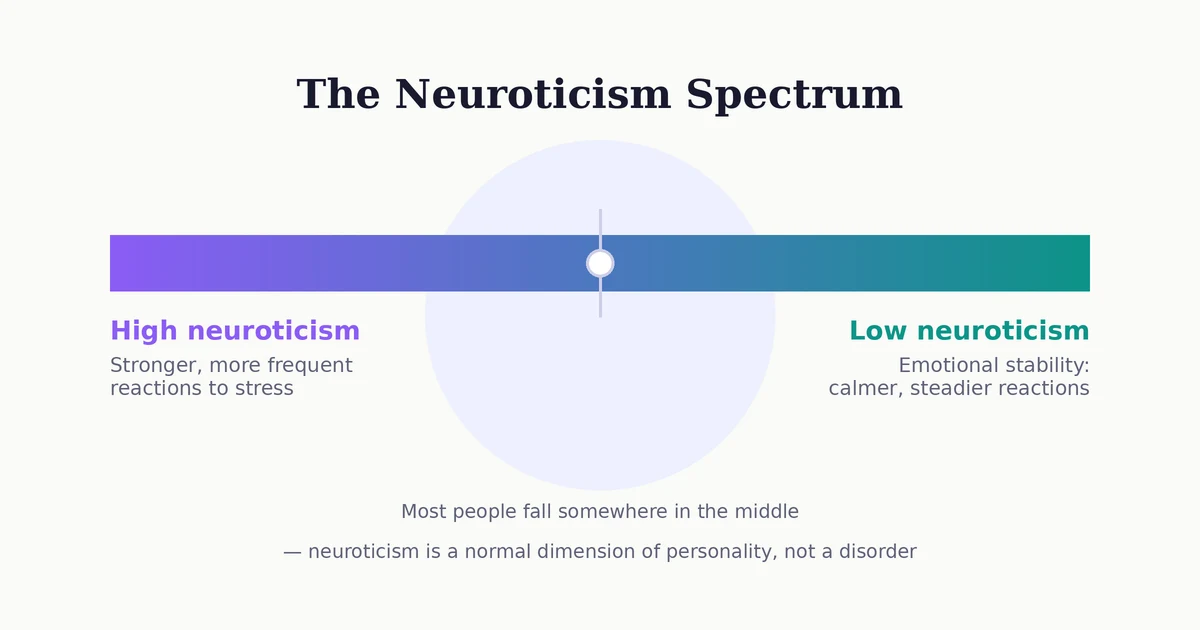
Neuroticism is the personality trait that describes how strongly a person reacts to life’s challenges with negative emotions — worry, sadness, frustration, self-consciousness, or irritability. Someone high in neuroticism tends to respond to threat, frustration, or loss with frequent, intense emotional reactions; someone low in neuroticism responds to the same situations more calmly and evenly [1].
Here is the most important thing to understand first: high neuroticism does not mean someone is “neurotic” in the everyday sense. It is one of the Big Five personality traits, a dimension of normal personality variation — measured in the general population, not a diagnosis of any kind. Psychologists who study these traits stress that they are “intended to measure normal personality” and “are not clinical measures” [3].
Table of Contents
What Does Neuroticism Mean in Psychology?
In research, neuroticism refers to individual differences in negative emotional response to threat, frustration, or loss [1]. It captures a tendency: when things go wrong — or merely look like they might — how quickly and how strongly do your emotions flare, and how long do they take to settle?
Because of this core, researchers often call the same dimension “negative emotionality” — a less loaded name that captures exactly what the trait measures: how readily a person experiences unpleasant emotions [1]. Its opposite end has a name too: emotional stability. When someone scores low on neuroticism, they are not cold or unfeeling — they simply experience negative emotions less often and less intensely, and recover from stress more smoothly. Low neuroticism means being calm and even-tempered rather than moody or easily rattled [2].
A few things neuroticism is not:
- Not a disorder. It is a normally distributed trait — most people fall somewhere in the middle, with fewer people at the extremes [2][3].
- Not a verdict. A trait score describes tendencies, the way you usually react, not a fixed destiny or a judgment of character. Like all traits, it interacts with situations, habits, and coping skills.
- Not the absence of positive feelings. Being low in neuroticism means fewer negative emotions, but positive emotions like enthusiasm and excitement are mainly linked to other traits, such as extraversion.
The Name Is Misleading — And Researchers Know It
The word neuroticism is widely seen as an unfortunate label. It sounds clinical, even insulting, and it drags along old-fashioned associations with “being neurotic.” Modern personality science uses the term in a purely descriptive way: it measures where someone sits on the normal spectrum of emotional reactivity [1][3].
So when a personality test says you scored high in neuroticism, what it actually means is: “compared with other people, you tend to experience worry, frustration, and low moods more readily.” It says nothing about whether you are healthy, capable, or resilient. High and low scorers alike build full, successful lives — they just steer through stress differently.
The Six Facets of Neuroticism
Neuroticism is a broad trait, but it is not one single thing. Personality inventories break it into narrower facets — distinct flavors of emotional reactivity that tend to travel together but can differ from person to person [1]. The six facets identified in the leading Big Five instrument (the NEO Personality Inventory) are:
- Anxiety — a readiness to feel nervous, tense, or fearful, including worry about what might go wrong.
- Angry hostility — a tendency to feel frustration and anger, especially when blocked or treated unfairly.
- Depression-proneness — a tendency toward sad, discouraged, low-energy moods and a sense of hopelessness.
- Self-consciousness — sensitivity to what others think; feeling awkward, shy, or easily embarrassed in social situations.
- Impulsiveness — difficulty resisting urges and cravings; acting on feelings before thinking through consequences.
- Vulnerability to stress — feeling overwhelmed or unable to cope when demands pile up; a low threshold for pressure.
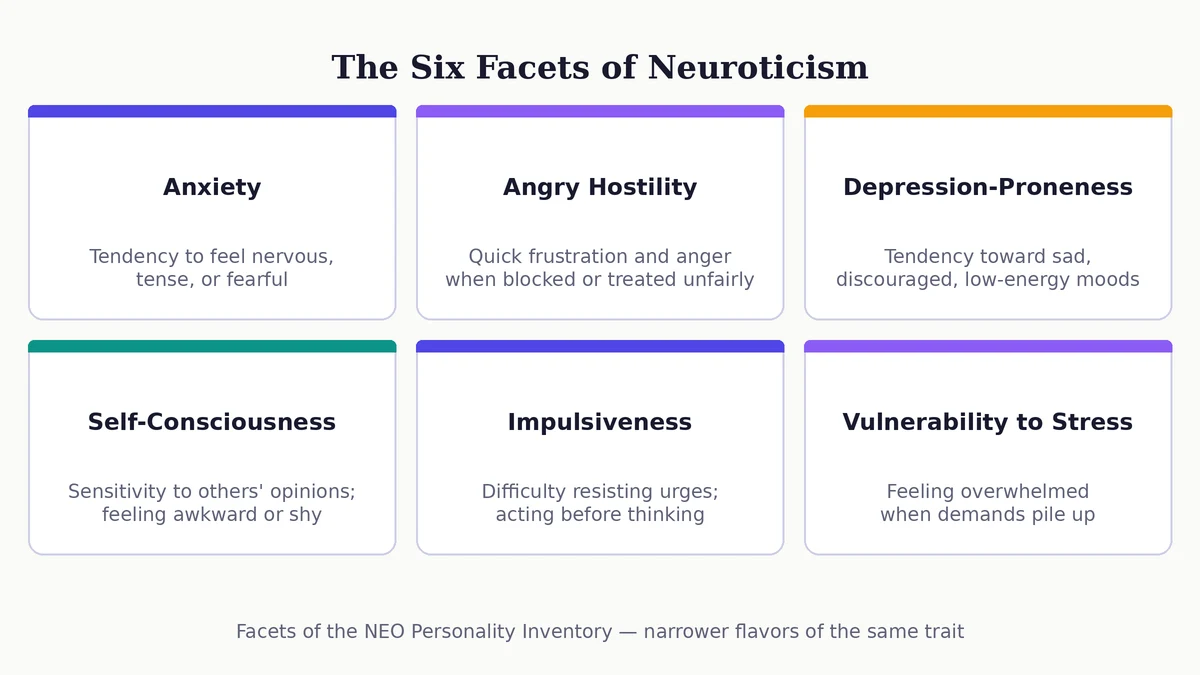
Two people can share the same overall neuroticism score with very different profiles: one might be high mainly on anxiety and self-consciousness (worrying about what others think), while another is high mainly on angry hostility and impulsiveness (snapping under frustration). The facet view is a useful reminder that labels like “high neuroticism” always hide real variety.
Signs of High Neuroticism vs. Emotional Stability
The trait is a spectrum, and everyday life shows it clearly. Here is how the two ends typically differ:
| High neuroticism | Low neuroticism (emotional stability) |
|---|---|
| Worries frequently about things that might go wrong | Stays calm when plans change or uncertainty appears |
| Takes criticism personally and replays it for hours | Takes feedback at face value and moves on |
| Experiences mood swings and strong emotional reactions | Moods stay steady even on difficult days |
| Feels tense or on edge in unfamiliar situations | Feels relaxed and secure in unfamiliar situations |
| Gets frustrated quickly when blocked or delayed | Shrugs off minor frustrations and delays |
| Feels overwhelmed when several demands pile up | Handles pressure without feeling swamped |
Remember that most people are not at either extreme — they sit somewhere in the middle and recognize themselves in both columns depending on the day [2].
Everyday Examples
Example 1: The delayed message. Two colleagues, Sara and Dan, each send an important proposal to their manager and get no reply for a day. Sara — high in neuroticism, particularly the anxiety and self-consciousness facets — spends the evening rereading the email, convinced she made a mistake and that her manager is displeased. Dan — low in neuroticism — assumes the manager is simply busy and thinks about it only when the reply arrives. Same situation, same lack of information, very different inner experiences.
Example 2: The cancelled plan. A friend cancels dinner at the last minute. Someone high in neuroticism may feel a rush of hurt and suspicion — are they avoiding me? Did I do something wrong? — alongside frustration at the wasted evening. Someone low in neuroticism is more likely to feel mild disappointment, reorder the evening, and move on. Neither reaction is “correct”; they are different default settings for processing the same event.
Example 3: The stressful week. During a week of deadlines, traffic jams, and a sick child, a person high in vulnerability to stress feels each new demand as proof that everything is falling apart and struggles to prioritize. A person high in emotional stability feels the same pressure but treats each problem as separate and solvable. Research describes exactly this pattern: for people high in neuroticism, negative emotional responses to challenges are frequent — and often out of proportion to what triggered them [1].
Does Neuroticism Change Over Time?
Like all Big Five traits, neuroticism is relatively stable — your rank among your peers tends to stay roughly similar over the years [1]. But “relatively stable” is not “fixed.” Longitudinal research finds that average neuroticism scores peak in late adolescence and decline moderately through adulthood — people, on average, become somewhat calmer and more emotionally stable as they age [1].
Life experience, relationships, work, and deliberate effort (such as learning coping skills or therapy for specific difficulties) can all shift how the trait shows up in daily life. A trait describes your starting point and your tendencies, not a ceiling.
Why Do Researchers Study Neuroticism?
Among personality traits, neuroticism gets the most research attention — and for a reason. Studies consistently find it associated with how people cope with stress and with a wide range of well-being outcomes, which makes it one of the most studied individual-difference variables in psychology [1]. Researchers want to understand why some people react so much more strongly to the same challenges, because that mechanism touches everything from daily happiness to long-term health.
One important caution from the research itself: some questionnaire items used to measure neuroticism overlap with the symptoms of anxiety and depression, so scientists are careful to distinguish the personality trait from mental health conditions when interpreting results [1]. That distinction is worth keeping in mind for readers, too — which brings us to the most important section of this article.
Personality Traits Are Not Diagnoses
This article is educational. It describes patterns of normal personality variation — the ways people differ from one another in emotional reactivity. It does not diagnose anything, and a high neuroticism score is not a diagnosis of anxiety, depression, or any other condition [3].
Personality psychology and clinical psychology are different fields with different aims: the first studies how people vary; the second assesses and treats psychological distress. Reading about traits can build self-understanding, but it is not a substitute for professional advice. If worry, low mood, or stress are seriously affecting your life, a qualified mental health professional is the right next step — not an article.
Frequently Asked Questions
Is neuroticism a mental illness?
No. Neuroticism is a normal personality trait found at varying levels across the general population. It is measured with personality questionnaires, which researchers describe as “not clinical measures of personality” [3]. Mental health conditions are diagnosed by professionals using clinical criteria — a very different process from scoring high on a trait.
What is the opposite of neuroticism?
Emotional stability — the low end of the same trait. Emotionally stable people tend to be calm, even-tempered, and resilient under pressure, experiencing negative emotions less often and less intensely [2].
Why do researchers also call it “negative emotionality”?
Because “neuroticism” is a misleading name that sounds clinical. “Negative emotionality” describes exactly what the trait measures — individual differences in how readily people experience negative emotions in response to threat, frustration, or loss [1] — without the stigma.
Can someone be high in neuroticism and still be happy and successful?
Absolutely. Neuroticism describes emotional reactivity, not life outcomes. Many people high in neuroticism build happy, successful lives — and the same sensitivity that makes stress hit harder can also make them careful, thorough, and attuned to problems before they grow.
Is neuroticism the same as being anxious?
Not quite. Anxiety is one facet of neuroticism, but the trait is broader — it also covers anger, sadness-proneness, self-consciousness, impulsiveness, and vulnerability to stress [1]. And unlike an anxiety disorder, neuroticism is a stable personality dimension, not a clinical condition.
Keep Exploring
New to the field? Start with What Is Personality Psychology? The Complete Guide and our overview of the Big Five personality traits to see how neuroticism fits into the bigger picture.
References & Further Reading
- Lahey, B. B. (2009). Public health significance of neuroticism. American Psychologist, 64(4), 241–256. https://pmc.ncbi.nlm.nih.gov/articles/PMC2792076/
- Personality — Chapter 4 (OpenStax-based psychology textbook, Open Oregon). http://openoregon.pressbooks.pub/app/uploads/sites/277/2022/06/Chapter-4-Personality.pdf
- Oswald, F. (interview, APA Speaking of Psychology). “Can a personality test determine if you’re a good fit for a job?” https://www.apa.org/research/action/speaking-of-psychology/personality-tests