
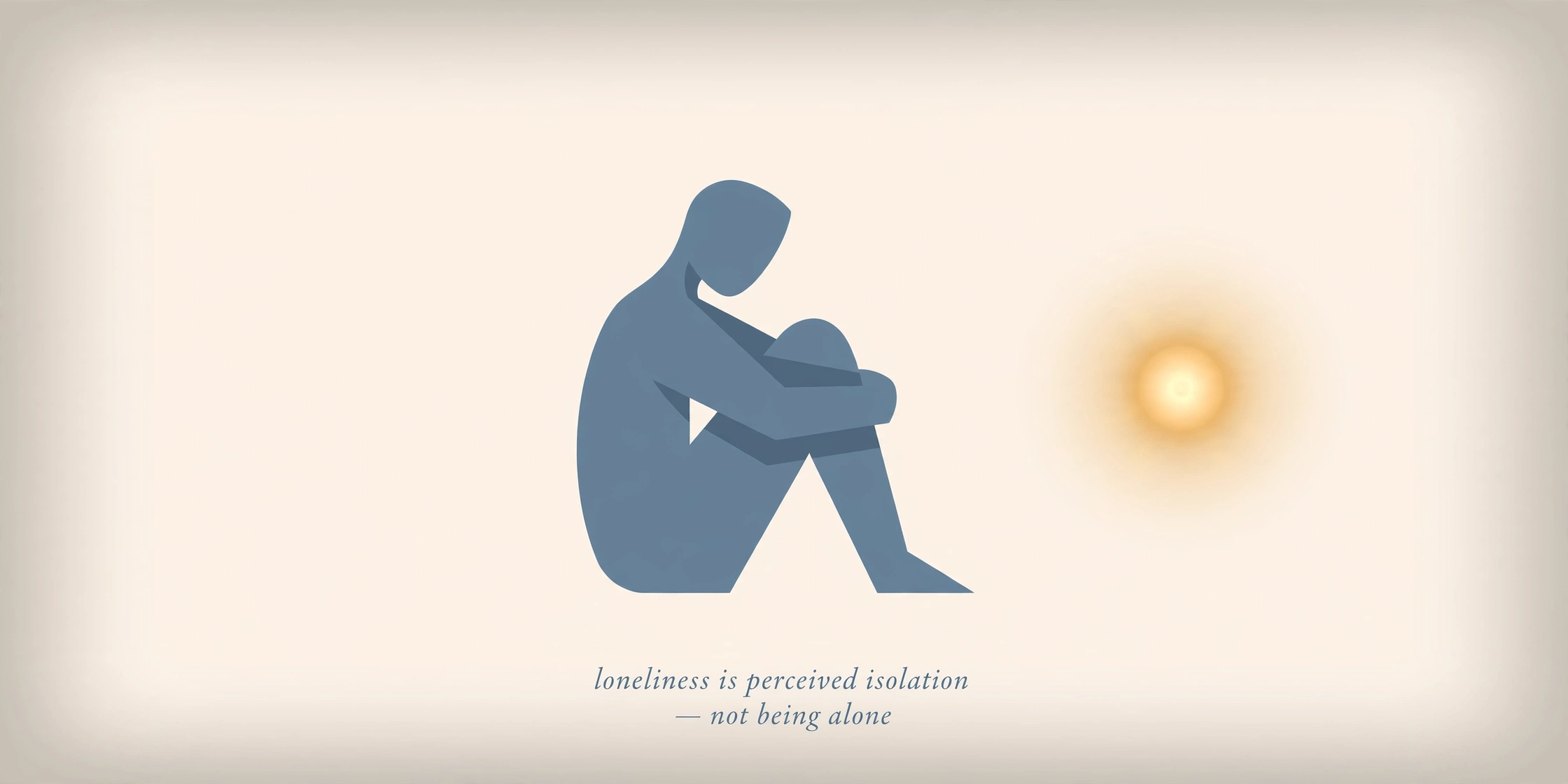
Loneliness is one of the most misunderstood human experiences. It is not the same as being alone — you can feel profoundly lonely in a crowded room, and perfectly content on a solitary walk. Psychologists define loneliness as perceived social isolation: the distressing gap between the connection you want and the connection you feel you have. It is a signal, not a verdict on your worth.
This article is educational. It explains what research finds about what loneliness is, why it happens, what it is associated with, and what seems to ease it. It is not a diagnostic tool and not clinical advice.
Table of Contents
What Loneliness Actually Is
The key distinction in the research is between objective isolation and perceived isolation. Objective isolation is a countable fact: how many people you see, how often you go out. Perceived isolation is a feeling: whether the connection in your life feels like enough. Loneliness lives in the second category. That is why two people with identical social calendars can feel entirely different — and why simply “getting out more” doesn’t automatically fix it.
Neuroscientist John Cacioppo, who spent decades studying loneliness, argued that it works like hunger or thirst: an aversive internal signal that motivates us to repair something we need (Cacioppo & Patrick, 2008). Hunger doesn’t mean you’re broken; it means you need food. Loneliness, in this view, doesn’t mean you’re unlikeable; it means your social needs aren’t being met. That reframe matters, because shame is one of loneliness’s most paralyzing companions — and it is unwarranted.
Why Loneliness Happens
Because loneliness is about the gap between wanted and actual connection, it can arise in many circumstances — not only the obvious ones. Common triggers include life transitions: moving to a new city, starting a demanding job, becoming a parent, retiring, or losing someone close. Each of these disrupts the structures that used to supply everyday contact, a pattern our article on The Psychology of Friendship explores in depth.
Crucially, loneliness can also happen inside relationships. A marriage, a busy friend group, or a full family life can still leave someone feeling unseen if the connection lacks warmth, mutual understanding, or emotional honesty. This is why advice that focuses only on meeting more people misses the point: loneliness is about the quality of perceived connection, not the headcount.
None of this makes loneliness a personal failing. Circumstances, transitions, and mismatches between needs and environment drive it far more than character does. Loneliness also sharpens negativity bias — neutral social signals start to read as rejection.
What Loneliness Is Associated With
Researchers take loneliness seriously in part because social connection is consistently associated with health. The most cited evidence comes from a meta-analysis of 148 studies with over 300,000 participants, which found that people with stronger social relationships had a 50% greater likelihood of survival than those with weaker ones — an association the authors described as comparable in magnitude to well-established mortality risk factors (Holt-Lunstad, Smith, & Layton, 2010).
Two careful notes about that finding. First, it concerns social relationships broadly, not loneliness specifically — it is evidence about the importance of connection, not proof that loneliness itself causes illness. Second, like most research in this area, it is observational: it shows a strong, consistent association, not a proven causal chain. Psychology is honest about the limits here. What the evidence supports is that humans are deeply social creatures and that the state of our connections tracks closely with our health — not that any individual’s loneliness dooms them.
What Seems to Help
There are no guaranteed cures for loneliness, and anyone selling one should be treated with skepticism. What research associates with relief is less dramatic: rebuilding the conditions for genuine connection.
A 2023 systematic review of adult friendship research found that time spent socializing with friends predicted wellbeing over time, and that deliberate efforts to maintain friendships helped explain the link (Pezirkianidis et al., 2023). The implication is practical rather than clinical: regular, meaningful contact with people you trust is associated with feeling better — not because socializing is medicine, but because it directly addresses the gap loneliness signals.
Small, sustainable steps fit the evidence better than grand overhauls: reconnecting with one existing relationship, joining a recurring activity built around a genuine interest, or simply making contact more regular. The goal is not to maximize social time but to close the gap between the connection you want and the connection you have — which is, by definition, personal.
When to Seek Professional Support
Loneliness itself is not a disorder, but it can travel with conditions that deserve professional attention, such as depression and anxiety. Consider talking to a mental health professional if loneliness feels persistent and overwhelming, if it comes with hopelessness, worthlessness, or a loss of interest in things you used to enjoy, or if it is seriously affecting your sleep, appetite, work, or daily functioning. Reaching out is a reasonable response to a real signal — it is what support exists for.
Key Takeaways
- Loneliness is perceived social isolation — the gap between the connection you want and the connection you feel you have — not the same as being alone (Cacioppo & Patrick, 2008).
- It functions like a signal (hunger, thirst), motivating reconnection; it is not evidence of personal failing.
- It can arise from life transitions and disrupted routines, and it can occur inside relationships — what matters is perceived connection, not headcount.
- Stronger social relationships are associated with substantially better survival odds across 148 studies (50% greater likelihood) — an association comparable to established risk factors, but observational, not proof of causation (Holt-Lunstad et al., 2010).
- What research associates with relief: rebuilding conditions for genuine connection — regular, meaningful contact and deliberate friendship maintenance (Pezirkianidis et al., 2023). No guaranteed cures.
- If loneliness is persistent, overwhelming, or impairs daily life — especially alongside hopelessness or loss of interest — professional support is appropriate.
References
- Cacioppo, J. T., & Patrick, W. (2008). Loneliness: Human nature and the need for social connection. New York: W. W. Norton.
- Holt-Lunstad, J., Smith, T. B., & Layton, J. B. (2010). Social relationships and mortality risk: A meta-analytic review. PLoS Medicine, 7(7), e1000316. https://doi.org/10.1371/journal.pmed.1000316
- Pezirkianidis, C., Galanaki, E., Raftopoulou, G., Moraitou, D., & Stalikas, A. (2023). Adult friendship and wellbeing: A systematic review with practical implications. Frontiers in Psychology, 14. https://doi.org/10.3389/fpsyg.2023.1059057
Keep Exploring
- The Psychology of Relationships — the pillar overview: how relationship science understands bonds, connection, and loss.
- The Psychology of Friendship — how friendships form, why adult friendship gets harder, and what keeps friendships alive.
What’s the difference between loneliness and being alone?
Being alone is an objective state; loneliness is a subjective feeling. Psychologists define loneliness as perceived social isolation — the distressing gap between the connection you want and what you feel you have (Cacioppo & Patrick, 2008). You can be alone without being lonely, and lonely without being alone.
Can you feel lonely even when you’re in a relationship or around people?
Yes. Because loneliness tracks perceived connection rather than headcount, it can occur in marriages, families, and busy social lives when the connection lacks warmth, mutual understanding, or emotional honesty. This is why simply meeting more people doesn’t reliably resolve it.
Is loneliness bad for your health?
The honest answer: social connection is strongly associated with health, but the evidence is observational. A meta-analysis of 148 studies found people with stronger social relationships had a 50% greater likelihood of survival — comparable to established risk factors — but this concerns social relationships broadly and shows association, not proven causation (Holt-Lunstad et al., 2010). It is a reason to take connection seriously, not a reason to panic.
What actually helps with loneliness?
No guaranteed cures exist. What research associates with relief is rebuilding conditions for genuine connection: regular, meaningful contact with people you trust and deliberate maintenance of existing friendships (Pezirkianidis et al., 2023). Small, sustainable steps — reconnecting with one person, joining a recurring activity around a real interest — fit the evidence better than dramatic overhauls.
When should I talk to a professional about loneliness?
If it feels persistent and overwhelming, if it comes with hopelessness, worthlessness, or loss of interest in things you used to enjoy, or if it is seriously affecting sleep, appetite, work, or daily functioning. Loneliness itself isn’t a disorder, but it can accompany depression and anxiety, which deserve professional care.