
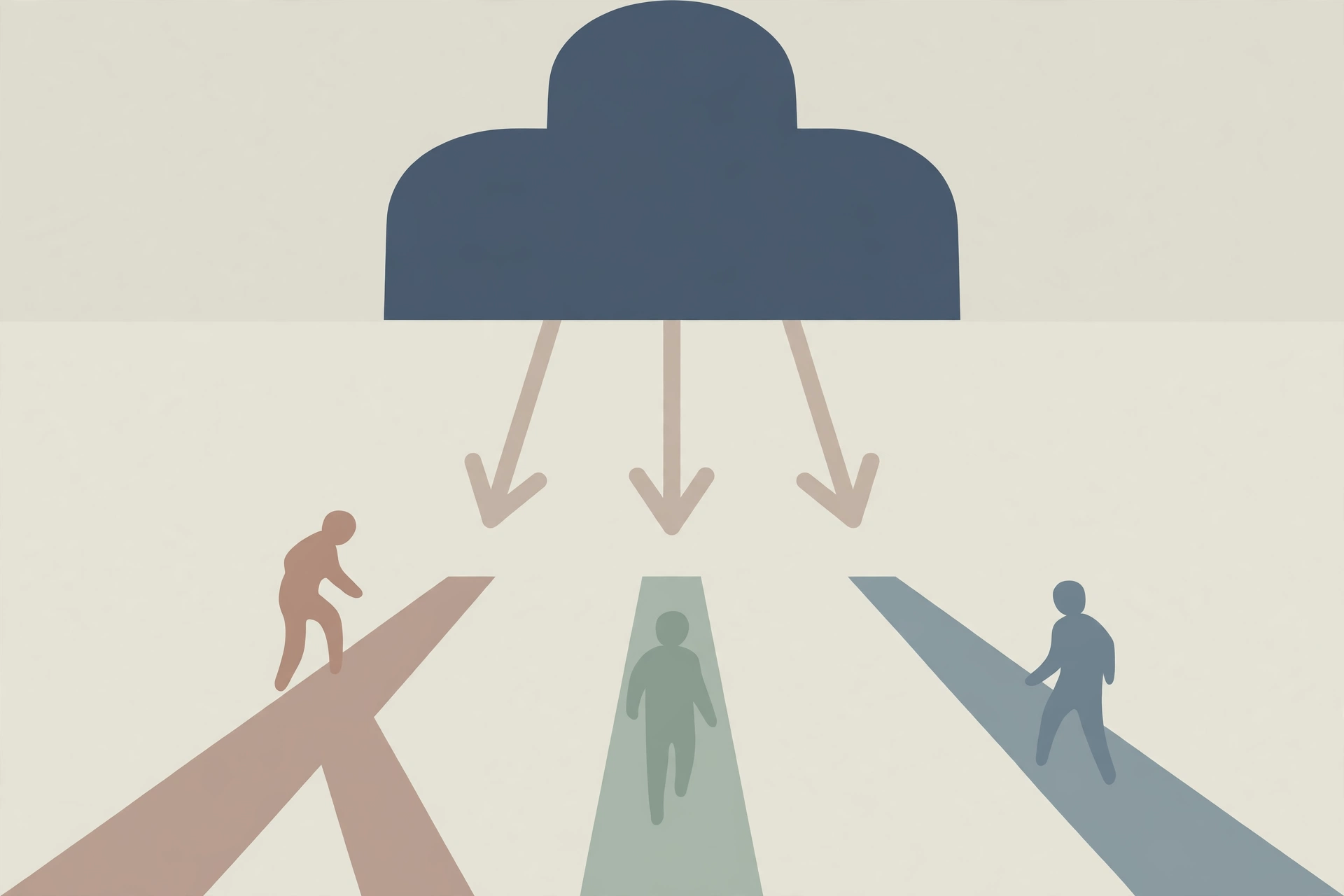
Obedience to authority is following orders from someone perceived as an authority figure. Stanley Milgram’s experiments in the 1960s made it the most famous topic in social psychology: ordinary adults, told by a researcher in a lab coat to deliver electric shocks to another person, mostly kept going even as the other person screamed, pleaded, and then fell silent. The study was designed after the trial of Adolf Eichmann, when Milgram wanted to test whether ordinary people would obey destructive orders — and the answer, disturbingly, was that many would.
This article is educational and historical. It describes Milgram’s studies, what they showed, and why they could not be run today. It is not a guide to influencing or controlling anyone, and it offers no instructions for replicating the procedure.
Table of Contents
What Obedience Means
Obedience differs from conformity and compliance. Conformity is aligning with a group; compliance is agreeing to a request from a peer; obedience is following orders from an authority — someone whose role, expertise, or institutional position gives their instructions weight. The distinction matters because authority changes the psychology: people obeying an authority often feel they are not acting on their own responsibility. Milgram called this the agentic state — the person sees themselves as an agent carrying out another’s wishes rather than as an autonomous actor, and responsibility shifts upward to the authority.
Authority itself comes in forms. Legitimate authority rests on a recognized role (a teacher, an officer, a supervisor). Expert authority rests on knowledge (a doctor’s orders in a hospital). And institutional authority rests on the setting: a laboratory, a uniform, or an official-looking procedure can make an instruction feel authorized even when no law requires it. Milgram’s experiment stacked all three — a Yale researcher, a scientific setting, and a formal procedure — and that stacking was part of the point.
Milgram’s Experiments
Milgram (1963) recruited ordinary adults through a newspaper advertisement for a study of memory and learning. The participant drew lots (rigged) and was assigned the role of “teacher”; a confederate played the “learner,” who was strapped into a chair in another room. The teacher’s job was to read word pairs and deliver an electric shock for each wrong answer, increasing the voltage one step at a time, from 15 volts up to 450 volts, labeled up to “XXX.” The learner was not actually shocked — the responses, protests, and eventual silence were prerecorded — but the teacher believed the shocks were real.
The headline result: 26 of 40 participants (65%) continued to the maximum 450 volts, despite the learner’s protests and despite obvious distress of their own — sweating, trembling, nervous laughter. Almost all participants at some point questioned or protested, and the experimenter responded with standardized prompts, ending with “You have no other choice, you must go on.” Obedience was not enthusiastic: participants obeyed while visibly troubled, which is precisely what made the result unsettling. They did not enjoy harming the learner; they did it while believing it was wrong.
Why People Obeyed
Milgram’s own explanation centered on the agentic shift: once a person accepts an authority’s definition of the situation, their own conscience is partly suspended and attention narrows to doing the job well. Several features of the setup reinforced this. The experiment began with small, harmless steps, and each step made the next one easier to justify — a gradual escalation that never presented a single dramatic decision to stop. The learner was in another room, so the harm was heard rather than seen. And the authority took responsibility, explicitly assuring participants that he would accept the consequences.
Later analyses add other factors. Participants had volunteered for a scientific study at a prestigious university and felt a commitment to see it through. The shocks were framed as part of a legitimate scientific purpose, which made continuing feel like serving knowledge rather than harming a person. And the situation offered no clear exit script: there was no obvious moment to refuse, and refusing meant directly defying an authority face to face. None of this excuses the behavior; it explains the mechanism, which is the point of studying it.
Variations That Changed Obedience
Milgram ran many variations, and their results are as informative as the headline figure. When the learner was in the same room, obedience fell; when the teacher had to physically hold the learner’s hand on a shock plate, it fell further — proximity to the victim made the harm harder to ignore. When the experimenter gave orders by telephone instead of in person, obedience fell sharply. When two experimenters disagreed with each other, obedience collapsed to nearly zero — conflicting authority broke the spell. And when the study moved from Yale to a run-down office building, obedience fell, showing that institutional prestige itself was part of the pressure.
The most hopeful variation involved peers. When two confederate “teachers” refused to continue, real participants almost always refused too. Just as a single dissenter breaks conformity, a single disobedient peer breaks obedience. The pattern is consistent across both literatures: unanimous authority is powerful, but it is fragile, and visible dissent gives others permission to act on their own judgment.
The Ethics Debate
Milgram’s studies became a landmark in research ethics for good reason. Participants were deceived about the study’s purpose and the reality of the shocks, and many experienced severe stress — some had seizures, though no lasting harm was documented in follow-ups. Milgram argued that his debriefing, in which participants learned the truth and met the unharmed learner, restored their well-being, and that most participants later said they were glad to have taken part. Critics replied that consent given for a memory study was not consent to be placed in a situation of moral crisis, and that debriefing cannot undo distress already suffered.
The debate reshaped the field. Modern ethical standards — informed consent, the right to withdraw without penalty, minimal deception, and institutional review — would not permit Milgram’s original design. That is why the experiments are taught as history: they revealed something important about obedience, and they also showed why psychology needed rules to protect the very people it studies. The ethical cost is part of the finding, not a footnote to it.
Obedience Today
Obedience has not disappeared; it has changed form. Modern workplaces, hospitals, and militaries all depend on obedience, and all have learned to build in safeguards: checklists that authorize anyone to stop a procedure, second opinions, and explicit protections for whistleblowers. Research on authority has shifted to ethical designs — studying obedience in role-play, in surveys, and in low-stakes settings — and to the conditions that help people disobey: clear exit routes, dissenting peers, and training that names the pressure before it arrives.
The practical lesson is not that authority is evil or that obedience is always wrong. Legitimate authority coordinates hospitals, aircraft, and disaster responses. The lesson is that obedience is a situational force with known levers — gradual escalation, distance from consequences, prestige of the institution, and the absence of dissent — and that recognizing those levers is the first defense against them. When a situation makes it hard to stop, that difficulty is itself a warning sign. The contrast is instructive: while harmful obedience follows orders that injure others, prosocial behavior follows directions that help them.
Key Takeaways
- Obedience is following orders from a perceived authority, distinct from conformity to a group or compliance with a peer’s request.
- In Milgram (1963), 26 of 40 participants (65%) continued to the maximum shock level, despite protests and their own visible distress.
- Milgram’s explanation was the agentic shift: obeying participants saw themselves as agents of the authority, with responsibility shifted upward.
- Variations showed obedience falling with victim proximity, remote authority, reduced institutional prestige, and conflicting or dissenting peers.
- The studies reshaped research ethics: deception and distress of that kind are now prohibited by modern standards.
- Obedience remains essential in legitimate institutions; its risks are managed by safeguards like stop-rules, dissent, and explicit exit routes.
References
- Milgram, S. (1963). Behavioral study of obedience. The Journal of Abnormal and Social Psychology, 67(4), 371–378. https://doi.org/10.1037/h0040525
- Milgram, S. (1974). Obedience to Authority: An Experimental View. Harper & Row.
Keep Exploring
- Social Psychology: How Other People Shape Mind and Behavior
- The Psychology of Emotions: What Feelings Are and Why They Matter
- Behavioral Psychology: How Learning Shapes Behavior
- Cognitive Biases: How Your Mind Takes Shortcuts
What is obedience to authority?
Following orders from someone perceived as an authority figure — through their role, expertise, or institutional position — rather than from peers or a group.
What did Milgram’s experiments find?
In Milgram (1963), 26 of 40 ordinary adults (65%) continued delivering what they believed were increasingly severe electric shocks to a stranger, up to the maximum level, when ordered to by an experimenter.
Why did participants obey if they were distressed?
Milgram argued they entered an agentic state, seeing themselves as agents of the authority with responsibility shifted upward, reinforced by gradual escalation and distance from the victim.
What reduced obedience in Milgram’s variations?
Victim proximity, remote authority, lower institutional prestige, conflicting authorities, and — most powerfully — a peer who refused to continue.
Could Milgram’s experiments be run today?
No. Modern ethical standards — informed consent, the right to withdraw, and limits on deception and distress — would not permit the original design, which is why it is taught as history.