
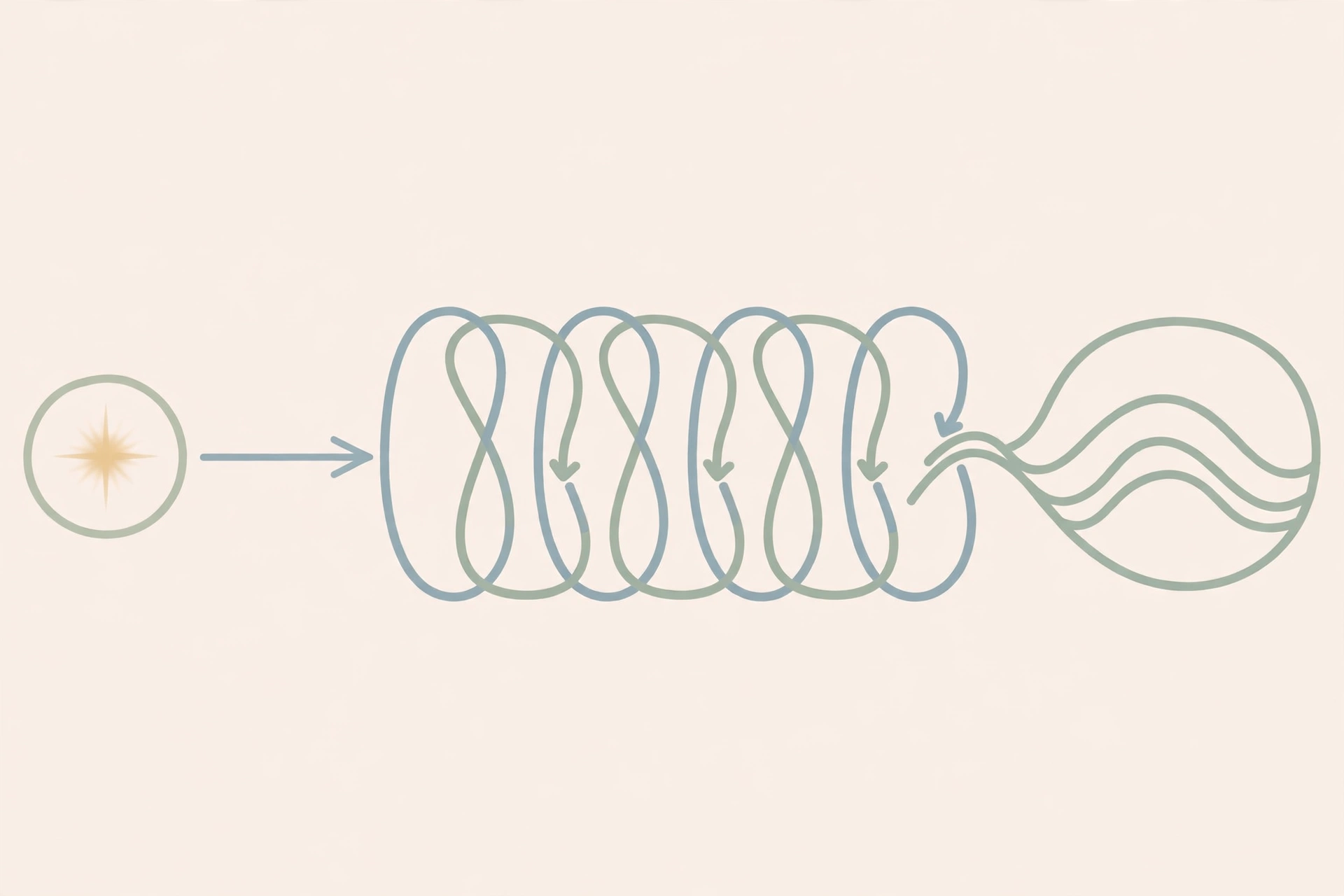
Behavioral psychology is the study of how behavior is learned — how experience, consequences, and the environment shape what people (and animals) do. Where other approaches start with thoughts, feelings, or personality traits, behaviorists start with something observable: a stimulus, a response, and what happens next. If a behavior is followed by a reward, it tends to recur; if it is followed by punishment or nothing at all, it tends to fade. That simple loop explains a surprising amount of everyday life, from why a habit sticks to why a phobia persists.
This article is educational, not clinical. It explains the core ideas of behavioral psychology, the classic studies behind them, and where the approach reaches its limits. It is not therapy and not a treatment guide: if a behavior is causing serious distress, that is a matter for a qualified professional, not for a self-help summary of conditioning principles.
Table of Contents
What Is Behavioral Psychology?
Behavioral psychology, often just called behaviorism, treats psychology as the science of observable behavior. Its founding statement came from John B. Watson, who argued in 1913 that psychology should study what organisms do rather than what they supposedly experience inside, because only behavior can be observed and measured reliably (Watson, 1913). That was a deliberate break from the introspection-based psychology of the time, and it set the field’s agenda for decades: find the laws that connect environmental events to behavior, and test them in controlled experiments.
The approach rests on two kinds of learning. In classical conditioning, an organism learns that one stimulus predicts another — Pavlov’s dogs learned that a bell predicted food, and began salivating to the bell alone. In operant conditioning, an organism learns from consequences — behaviors that produce rewards are strengthened, behaviors that produce unpleasant outcomes are weakened. Together, these two processes cover most of what behaviorists mean by learning: behavior changes because experience changes what a stimulus signals or what a response leads to.
Classical Conditioning in Brief
Classical conditioning starts with a reflex: an unconditioned stimulus that naturally produces a response, like food producing salivation. If a neutral stimulus (a bell) is repeatedly paired with the food, the bell alone eventually produces the response. The bell has become a conditioned stimulus, and the salivation a conditioned response (Pavlov, 1927).
The details matter. Conditioning is strongest when the bell reliably predicts the food, not when the two merely occur together. And conditioned responses can be extinguished: if the bell keeps sounding without food, the salivation gradually fades. They can also generalise — a dog conditioned to one tone may respond to similar tones — and be discriminated, responding to one tone but not another, if only one is ever followed by food. These principles show up far beyond the laboratory: a song linked to a bad breakup can trigger sadness years later, and the same pairing logic underlies some treatments for phobias, where feared stimuli are gradually paired with calm rather than threat.
Operant Conditioning in Brief
Operant conditioning, developed most fully by B. F. Skinner, concerns voluntary behavior and its consequences (Skinner, 1938). Four consequences shape behavior: positive reinforcement (adding something pleasant, like praise), negative reinforcement (removing something unpleasant, like turning off an alarm), positive punishment (adding something unpleasant), and negative punishment (removing something pleasant, like taking away a privilege). The names are a common source of confusion: “positive” and “negative” here mean adding and removing, not good and bad, and “punishment” always means something that weakens a behavior.
Two findings from this research are especially practical. First, reinforcement schedules matter: behaviors rewarded every time are learned fast but extinguish fast when rewards stop, while behaviors rewarded unpredictably — like checking a phone for messages — are remarkably persistent. Second, timing matters: a consequence that follows behavior immediately shapes it far more effectively than a delayed one. That is why feedback close to the behavior, whether praise or correction, carries more weight than a review weeks later.
What Behaviorism Explains Well
Behaviorism’s strength is its precision about observable change. It predicts when a behavior will strengthen, weaken, or persist, and those predictions have held up across species and settings. Its principles power practical tools that are still in use: habit-building strategies that rely on cues and rewards, classroom and workplace feedback systems, and applied behavior analysis, which uses reinforcement systematically to teach skills and reduce harmful behaviors (Cooper et al., 2020). When the goal is to change a specific, measurable behavior, the behavioral toolkit is often the most direct one available.
Where Behaviorism Falls Short
The approach’s limits are equally clear, and modern psychology treats them as settled rather than controversial. First, behaviorism deliberately ignores mental processes — memory, expectation, understanding — and those turn out to matter: people learn from observation without direct reinforcement, as Albert Bandura showed, and they form mental maps of their environment that pure stimulus–response accounts struggle to explain (Bandura, 1977). Second, biology constrains learning: not every association is equally easy to form, which is why taste aversions form after a single bad meal while other pairings take many trials. Third, language and thought let humans learn from instruction and reasoning in ways that conditioning alone cannot capture. Behavioral psychology is therefore best read as one lens on learning, not a complete theory of mind — a point the cognitive tradition developed in detail.
Behaviorism Today
Behaviorism did not disappear when cognitive psychology rose; it merged into the mainstream. Modern learning science combines conditioning principles with cognitive ideas: reinforcement still explains habit persistence, while attention, memory, and expectation explain why the same reward motivates one person and bores another. Therapies such as exposure treatment for phobias, and practical methods for building or breaking habits, still rest on conditioning logic. The field’s lasting contribution is a discipline: define the behavior, observe what precedes and follows it, and change the contingencies if you want to change the behavior.
Key Takeaways
- Behavioral psychology studies learned behavior: how stimuli, responses, and consequences shape what organisms do.
- Classical conditioning is learning by association — one stimulus comes to predict another (Pavlov, 1927).
- Operant conditioning is learning by consequences — reinforcement strengthens behavior, punishment weakens it (Skinner, 1938).
- Reinforcement schedules and timing strongly affect how fast behavior is learned and how long it persists.
- Observational learning and biological constraints show why conditioning alone is not a complete theory of mind (Bandura, 1977).
- The approach remains practically useful for habits, feedback, skill teaching, and exposure-based treatments.
References
- Bandura, A. (1977). Social Learning Theory. Prentice Hall.
- Cooper, J. O., Heron, T. E., & Heward, W. L. (2020). Applied Behavior Analysis (3rd ed.). Pearson.
- Pavlov, I. P. (1927). Conditioned Reflexes. Oxford University Press.
- Skinner, B. F. (1938). The Behavior of Organisms. Appleton-Century.
- Watson, J. B. (1913). Psychology as the behaviorist views it. Psychological Review, 20(2), 158–177. https://doi.org/10.1037/h0074428
Keep Exploring
- What Is Personality Psychology?
- Theories of Personality
- Cognitive Biases: How Your Mind Takes Shortcuts
- How Personality Develops
What is behavioral psychology in simple terms?
It is the study of how behavior is learned through experience — mainly through association (classical conditioning) and consequences (operant conditioning) — rather than through thoughts or traits alone.
Who founded behavioral psychology?
John B. Watson set out its program in 1913, arguing psychology should study observable behavior; Ivan Pavlov and B. F. Skinner supplied its two core learning processes.
What is the difference between classical and operant conditioning?
Classical conditioning links two stimuli (a bell predicts food); operant conditioning links a behavior to its consequence (a reward strengthens the behavior that produced it).
Is behaviorism still used today?
Yes. Its principles underlie habit strategies, feedback systems, applied behavior analysis, and exposure treatments, usually combined with cognitive ideas about attention and memory.
Does behaviorism ignore thoughts and feelings?
Classical behaviorism deliberately set them aside to focus on observables. Modern psychology accepts that mental processes matter, which is why behaviorism is now one lens on learning rather than a complete theory of mind.