
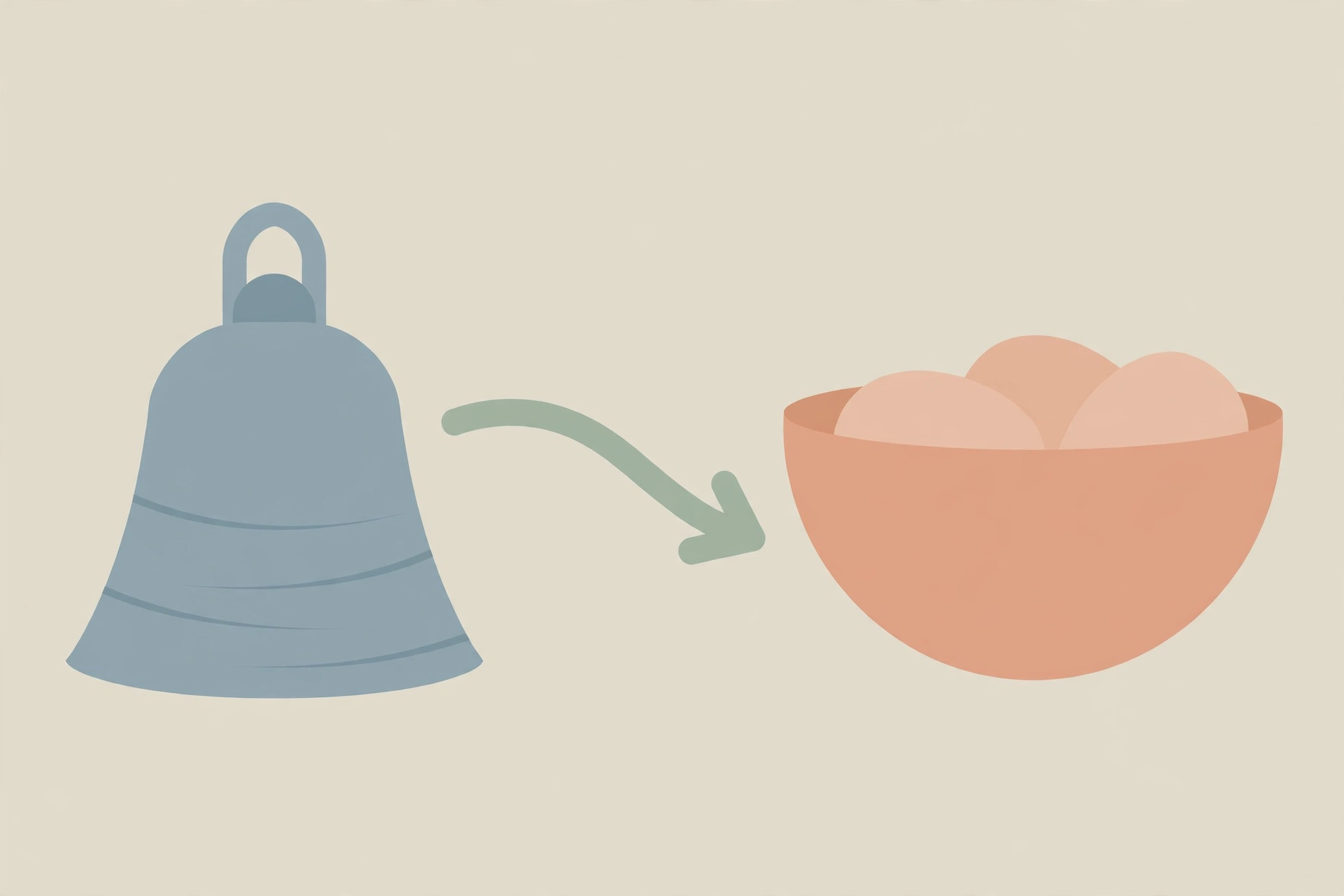
Classical conditioning is learning by association: when two stimuli repeatedly occur together, the mind learns that one predicts the other, and begins responding to the first as if it were the second. It is why a song can bring back a summer, why a dental waiting room can raise your heart rate before anything happens, and why a phone notification can trigger a flicker of anticipation. The response is not chosen — it is learned, automatically, through pairing.
This article is educational, not clinical. It explains the classic experiments, the principles that govern them, and where the ideas show up in everyday life. It describes historical studies, including one that would not pass modern ethical standards, and notes that plainly where relevant.
Table of Contents
Pavlov’s Dogs: The Original Experiment
The story begins with Ivan Pavlov, a Russian physiologist studying digestion in dogs. He noticed that his dogs began salivating not only when food arrived, but when they heard the footsteps of the assistant who brought it, or saw the bowl. Salivation to food is a reflex — an unconditioned response to an unconditioned stimulus. Pavlov’s insight was to test whether a neutral stimulus could be trained to produce the same response (Pavlov, 1927).
In the classic procedure, a neutral stimulus such as a bell is sounded just before food is presented. After repeated pairings, the bell alone produces salivation. The bell has become a conditioned stimulus and the salivation a conditioned response. Three details turned out to matter enormously. First, order matters: the bell must come before the food, not after. Second, prediction matters more than mere pairing: conditioning is strongest when the bell reliably signals that food is coming (Rescorla, 1988). Third, the response is genuinely learned — dogs with no pairing history do not salivate to the bell.
The Little Albert Study — and Its Ethical Problem
The most famous human demonstration came from John B. Watson and Rosalie Rayner in 1920. They conditioned an infant, known as “Little Albert,” to fear a white rat by pairing the rat with a loud, frightening noise. Albert, who had initially shown no fear of the rat, began crying at its sight alone, and the fear generalised to other furry objects (Watson & Rayner, 1920).
The study is still taught because it showed that emotional responses could be conditioned in humans, not just reflexes in animals. It is also taught as an ethical warning: the researchers created a fear in a child and did not undo it, something no modern ethics board would permit. Later research has also questioned how clean the original results were. The lesson stands in both directions — conditioning is powerful, and studying it in people requires care that the early work lacked.
Extinction, Generalization, and Discrimination
Three principles govern what happens after conditioning. Extinction: if the conditioned stimulus keeps appearing without the unconditioned stimulus — bell without food — the conditioned response gradually fades. This is not forgetting in the simple sense; the association is suppressed, which is why an extinguished response can return later (spontaneous recovery) if the stimulus reappears after a break. Generalization: responses spread to stimuli similar to the conditioned one — a dog conditioned to one tone may respond to nearby tones, and a person afraid of one dog may flinch at others. Discrimination: when only one stimulus is ever followed by the unconditioned stimulus, the organism learns to respond to that one and not to similar ones.
Together these principles explain a great deal of everyday emotional life. A restaurant where you once had a bad meal can put you off before you sit down (generalization); a feared situation faced repeatedly without harm loses its grip (extinction); and the ability to tell a genuinely risky situation from a merely similar one is discrimination at work.
Classical Conditioning in Everyday Life
The laboratory pattern shows up constantly outside it. Advertising pairs products with attractive images, music, or celebrities so that the good feeling transfers to the product. Phobias often begin with a single pairing — a bad experience with a dog, a turbulent flight — and then generalise. Taste aversions form after a single pairing of a food with illness, and can last for years. And the same logic, run in reverse, underlies exposure treatments: a feared stimulus presented repeatedly without harm gradually loses its power, which is extinction deliberately applied.
It is worth distinguishing this from operant conditioning, where behavior changes because of its consequences rather than because two stimuli were paired. In practice the two usually work together — a student may both associate exams with anxiety (classical) and avoid studying because avoidance reduces that anxiety (operant) — but the mechanisms are different, and naming them separately keeps the explanation honest.
Key Takeaways
- Classical conditioning is learning by association: a neutral stimulus comes to predict a meaningful one and triggers the same response.
- Pavlov’s dogs showed the basic procedure: bell paired with food eventually produces salivation to the bell alone (Pavlov, 1927).
- Conditioning depends on prediction, not just pairing — the signal must reliably foretell what follows (Rescorla, 1988).
- The Little Albert study showed emotional conditioning in a human child, and stands as an ethical caution (Watson & Rayner, 1920).
- Extinction weakens a conditioned response when the pairing stops; generalization spreads it to similar stimuli; discrimination narrows it to one.
- Everyday examples include advertising, phobias, taste aversions, and exposure-based treatments.
References
- Pavlov, I. P. (1927). Conditioned Reflexes. Oxford University Press.
- Rescorla, R. A. (1988). Pavlovian conditioning: It’s not what you think it is. American Psychologist, 43(3), 151–160. https://doi.org/10.1037/0003-066X.43.3.151
- Watson, J. B., & Rayner, R. (1920). Conditioned emotional reactions. Journal of Experimental Psychology, 3(1), 1–14. https://doi.org/10.1037/h0069608
Keep Exploring
- Behavioral Psychology: How Learning Shapes Behavior
- What Is Personality Psychology?
- Theories of Personality
- Cognitive Biases: How Your Mind Takes Shortcuts
What is classical conditioning in simple terms?
It is learning by association: when a neutral stimulus (like a bell) repeatedly comes just before something meaningful (like food), the neutral stimulus alone starts to trigger the same response.
Who discovered classical conditioning?
Ivan Pavlov, a Russian physiologist studying digestion in dogs, who noticed his dogs salivating to signals that predicted food and turned the observation into a systematic research program.
What is the difference between classical and operant conditioning?
Classical conditioning pairs two stimuli so one predicts the other; operant conditioning changes behavior through consequences — rewards strengthen a behavior, punishments weaken it.
What is extinction in classical conditioning?
When the conditioned stimulus keeps appearing without the unconditioned stimulus, the conditioned response gradually fades. The association can return later (spontaneous recovery), so extinction is suppression, not erasure.
Can classical conditioning explain phobias?
Partly. A phobia can begin with a single frightening pairing and then generalise to similar situations. Exposure treatment works by reversing the process — presenting the feared stimulus repeatedly without harm so the response extinguishes.