
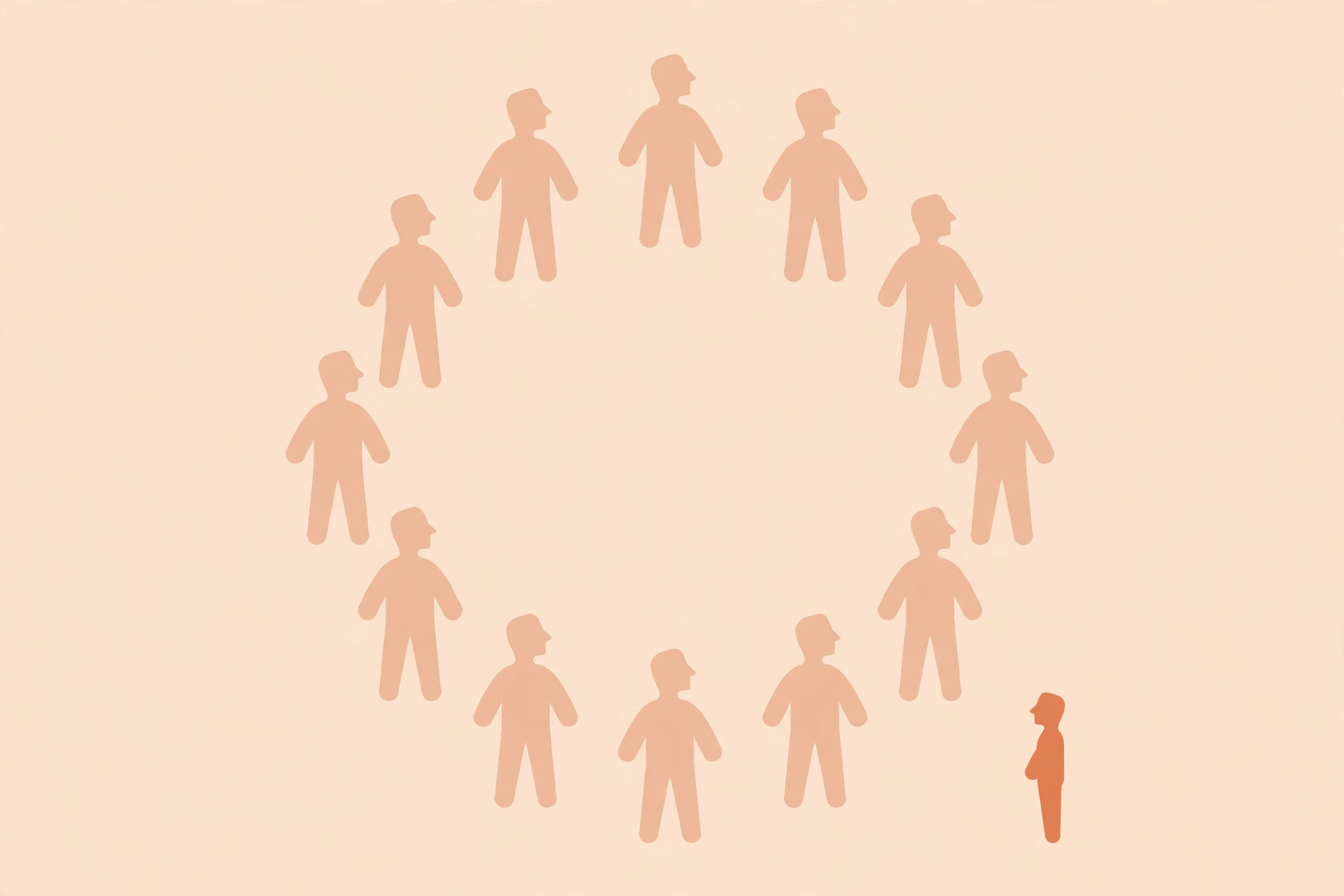
Groupthink is what happens when a group’s desire for agreement overrides its desire to make a good decision. Irving Janis coined the term in 1972 after studying American foreign-policy disasters: groups of intelligent, experienced officials made decisions — the Bay of Pigs invasion, the escalation in Vietnam — that, in hindsight, look obviously flawed. His explanation was not that the officials were foolish, but that the group dynamics around them suppressed doubt, filtered out warnings, and rewarded agreement until a bad plan felt like consensus.
This article is educational, not clinical. It describes groupthink research and how groups can avoid it. It is not advice about any specific organization’s decisions.
Table of Contents
What Groupthink Means
Groupthink is a mode of thinking that members of a cohesive group engage in when their striving for unanimity overrides their motivation to realistically appraise alternative courses of action. The key word is unanimity: the group does not merely agree, it pressures itself into agreement. Dissent starts to feel like disloyalty, and members censor their own doubts before anyone else has to. The result is a decision that looks unanimous but was never genuinely tested.
Groupthink differs from ordinary agreement and from healthy consensus. A healthy group can agree after vigorous debate; a groupthinking group agrees by avoiding debate. It also differs from conformity in a specific way: conformity, as Asch studied it, is an individual yielding to a group’s stated position, while groupthink is a group-level process in which the group itself stops generating alternatives. The individual feels the pressure, but the failure belongs to the group’s process, not to any single member’s weakness.
Janis and the Historical Cases
Janis (1972) built the theory from case studies of American foreign-policy decisions. The Bay of Pigs invasion of 1961 was his central example: President Kennedy’s advisors approved a plan to land Cuban exiles at the Bay of Pigs, despite intelligence suggesting it would fail, and the invasion collapsed within days. Janis argued that the advisory group was cohesive, insulated from outside opinion, led by a leader who favored the plan, and under stress — conditions that produced the symptoms he catalogued. The escalation of the Vietnam War provided a second case, where successive administrations continued a failing policy while dissenting information was discounted.
Janis contrasted these failures with a success: the Cuban Missile Crisis of 1962, where the same president’s advisors used different procedures — open debate, outside experts, and subgroups working independently — and reached a negotiated outcome. The contrast is the theory’s practical core: the same people, under different group procedures, made a catastrophically bad decision in one case and a careful one in the other. The difference was process, not personnel.
The Symptoms of Groupthink
Janis identified eight symptoms, grouped into three types. The first type is overestimation of the group: an illusion of invulnerability (“we cannot fail”) and an unquestioned belief in the group’s inherent morality (“we are good people, so our actions are good”). The second type is closed-mindedness: collective rationalization, in which warnings are explained away, and stereotyping of out-groups as weak, evil, or stupid, which makes their warnings easy to dismiss.
The third type is pressure toward uniformity, and it is the most directly damaging. Self-censorship keeps members from voicing doubts; the illusion of unanimity follows, because silence is read as agreement; direct pressure is applied to anyone who does dissent, with questions about their loyalty; and mindguards emerge — members who shield the group from dissenting information, deciding on their own what the group should not hear. When several symptoms appear together, the group can march toward a decision that no member privately fully supports.
Why Smart Groups Fail
Groupthink is counterintuitive because it strikes groups that seem best equipped to decide well: cohesive, experienced, confident teams. Cohesiveness is the trap — the more members value the group, the more they protect its harmony, and the more dissent feels like betrayal. Insulation compounds it: when a group stops hearing outside views, its internal consensus becomes its only reality check. Directive leadership compounds it further: when a leader states a preference early, discussion shifts from evaluating options to justifying the leader’s choice.
Stress and time pressure complete the picture. Under deadline pressure, groups satisfice — they accept the first adequate plan rather than searching for the best one — and dissent, which takes time, becomes an unaffordable luxury. These conditions are common in exactly the settings where decisions matter most: cabinets, corporate boards, and crisis teams. Groupthink theory’s warning is that the groups most confident in their judgment are often those least exposed to challenge. Loyalty to the group can deepen this effect, since members may treat defending the group as part of their social identity.
Groupthink vs. Healthy Consensus
Not every unanimous decision is groupthink, and not every disagreement is healthy. The distinction is procedural: did the group genuinely consider alternatives, hear dissent, and test its assumptions? A group that debates vigorously and then agrees has reached consensus; a group that agrees by skipping debate has groupthinked. The outward result — everyone nodding — looks identical, which is why groupthink is hard to spot from inside.
Research since Janis has qualified the theory. Laboratory studies find the symptoms less consistently than the case studies suggest, and some scholars argue that cohesiveness alone does not produce defective decisions — it must combine with insulation, directive leadership, and stress. The theory’s value survives the qualifications: even if the full syndrome is rarer than Janis implied, each symptom — self-censorship, rationalization, stereotyping of critics — is a documented failure mode, and groups that watch for them decide better.
How Groups Avoid Groupthink
Janis’s own remedies remain the standard advice. Assign a devil’s advocate, or better, rotate the role so dissent is a job rather than a rebellion. Have the leader withhold their preference until discussion is underway, so members form independent views first. Split the group into subgroups to evaluate the same problem independently, then compare conclusions. Bring in outside experts and critics, and hold a “second-chance” meeting after a tentative decision, explicitly inviting remaining doubts.
Modern organizations add structural versions of the same ideas: anonymous pre-meeting input, so junior members commit to views before seniors speak; red teams tasked with attacking the plan; and premortems, in which the group imagines the plan has failed and works backward to find why. The common thread is making dissent safe and structured. Groups do not avoid groupthink by hiring smarter people; they avoid it by designing procedures that make disagreement normal, expected, and rewarded.
Key Takeaways
- Groupthink, coined by Janis (1972), is when a group’s desire for unanimity overrides realistic appraisal of alternatives.
- Janis built the theory from cases like the Bay of Pigs invasion and the Vietnam escalation, contrasted with the better-handled Cuban Missile Crisis.
- Its eight symptoms include illusion of invulnerability, belief in the group’s morality, rationalization, stereotyping of out-groups, self-censorship, illusion of unanimity, pressure on dissenters, and mindguards.
- Cohesive, insulated groups with directive leaders under stress are most vulnerable — the groups that seem best equipped are often most at risk.
- Later research qualifies the theory: cohesiveness alone is not enough; it must combine with insulation, leadership style, and stress.
- Remedies make dissent structural: devil’s advocates, leader neutrality, subgroups, outside experts, second-chance meetings, red teams, and premortems.
References
- Janis, I. L. (1972). Victims of Groupthink: A Psychological Study of Foreign-Policy Decisions and Fiascoes. Houghton Mifflin.
Keep Exploring
- Social Psychology: How Other People Shape Mind and Behavior
- The Psychology of Emotions: What Feelings Are and Why They Matter
- Cognitive Biases: How Your Mind Takes Shortcuts
- Behavioral Psychology: How Learning Shapes Behavior
What is groupthink?
A group decision-making failure, named by Janis (1972), in which the desire for unanimity overrides realistic appraisal of alternatives, so dissent is suppressed and a flawed plan feels like consensus.
What is an example of groupthink?
The 1961 Bay of Pigs invasion: Kennedy’s advisors approved a plan despite intelligence suggesting failure, in a cohesive, insulated group under stress — Janis’s central case study.
What are the symptoms of groupthink?
Illusion of invulnerability, belief in the group’s morality, rationalization of warnings, stereotyping of out-groups, self-censorship, illusion of unanimity, pressure on dissenters, and mindguards who filter information.
Is every unanimous decision groupthink?
No. The distinction is procedural: consensus reached after genuine debate and testing of alternatives is healthy; agreement reached by avoiding debate is groupthink.
How can groups prevent groupthink?
Make dissent structural: assign devil’s advocates, have leaders withhold preferences early, split into independent subgroups, invite outside experts, hold second-chance meetings, and use red teams or premortems.