
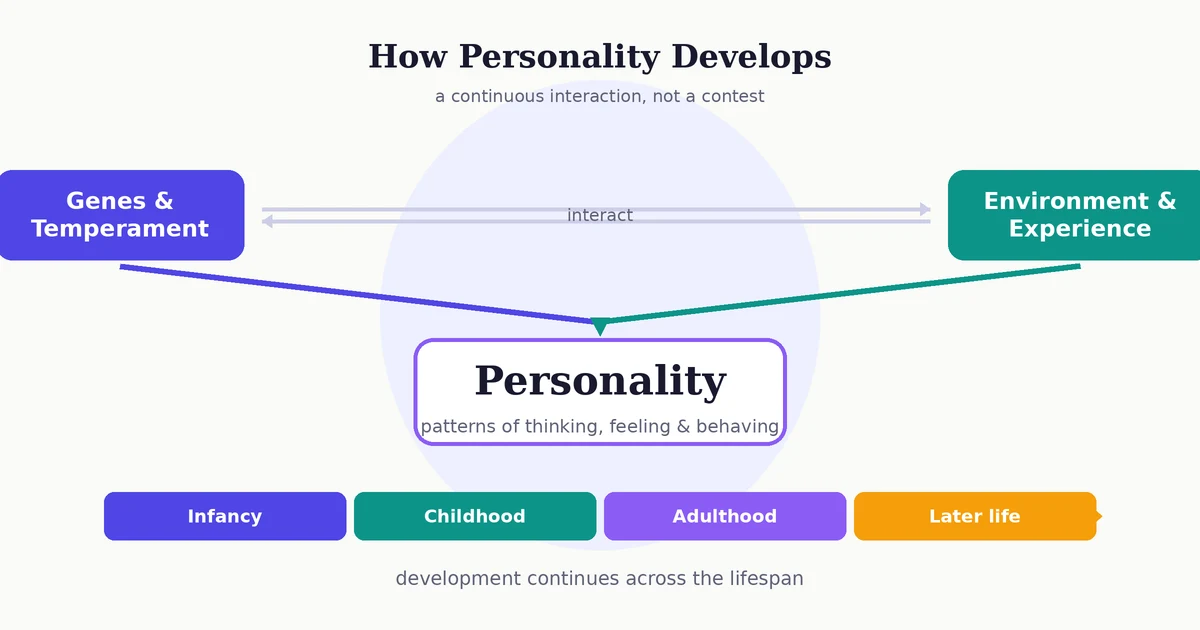
Your personality was not decided at birth — and it was not stamped onto you by your upbringing, either. It developed from a lifelong conversation between the two: the biological starting point you inherited (your genes and temperament) and everything you have experienced since (your family, relationships, culture, and the choices and accidents of life). This article explains that origins story — how nature and nurture work together, why childhood matters so much, and how personality keeps developing long after childhood ends.
Table of Contents
The Short Answer: It’s an Interaction, Not a Contest
“Nature versus nurture” sounds like a contest with a winner. Modern developmental psychology treats it as a partnership instead. As one lifespan-development textbook puts it, personality is “the result of the continuous interplay between this initial biological disposition and experience” [3]. Genes give you a starting temperament; experience sculpts what grows from it; and the two keep influencing each other — your temperament shapes the experiences you seek out, and those experiences shape how your temperament gets expressed.
Documenting this development — how personalities form, stabilize, and change across a lifetime — is one of the core questions of personality psychology. What follows is the dedicated deep-dive.
Nature: Genes and Temperament
What genes actually contribute
It is tempting to ask “what percentage of personality is genetic?” Researchers answer that question with a concept called heritability — a statistic that describes how much of the variation in a trait across people in a study can be attributed to genetic differences. Two cautions matter enormously. First, heritability is a population statistic, not a personal one: it never means “50% of your personality comes from your parents’ genes.” Second, a high heritability does not mean a trait is fixed or unchangeable — it only describes what drives differences between people in the environment studied.
With those cautions in place, the evidence for genetic influence is substantial. One of the largest analyses ever conducted — a meta-analysis of virtually all published twin studies of human traits between 1958 and 2012, covering nearly 18,000 traits and over 14.5 million twin pairs — found that across all traits, the reported heritability averaged 49% [2]. Personality traits fit squarely into this picture: identical twins, who share all their genes, resemble each other in personality more than fraternal twins do, even when raised in different homes — and the twin data are consistent with most of that family resemblance coming from genetic rather than shared-environment influence [2].
The honest bottom line: genes matter a lot, but they don’t write a script. They set starting tendencies — and then life gets a say.
Temperament: your biological starting point
Before personality, there is temperament: biologically influenced characteristics of infants — including mood, activity level, and emotional reactivity — that are noticeable soon after birth [3]. Some newborns are calm and adaptable; others are reactive and intense. Temperament is not simply “fixed at birth,” though: even at birth, a newborn’s neurophysiology has already been shaped by the prenatal environment and the birth process [3].
A landmark study of temperament, the New York Longitudinal Study begun in 1956, followed 141 children and identified three common temperament profiles [3]:
| Temperament profile | What it looks like | Share of children |
|---|---|---|
| Easy child | Adapts quickly to routines and new situations, usually calm and in a positive mood | ~40% |
| Slow-to-warm-up child | Low activity level, adjusts slowly to new situations, often negative in mood | ~15% |
| Difficult (feisty) child | Reacts negatively to new situations, trouble adapting, cries frequently | ~10% |
Here’s a concrete example of how temperament becomes personality. A newborn with high reactivity may grow into an impulsive toddler — but as the brain’s capacity for self-control matures, that same child may channel their intensity into persistence and drive instead. As the textbook notes, “a newborn who cries frequently does not necessarily have a grumpy personality; over time, with sufficient parental support and an increased sense of security, the child might be less likely to experience and express distress” [3].
The crucial point: temperament is the raw material, but personality — the consistent pattern of thinking, feeling, and behaving — is what emerges as temperament interacts with experience over time [3].
Nurture: Childhood and Experience
Parenting styles — and why the word “cause” is tricky
Developmental psychologist Diana Baumrind identified four parenting styles, still widely taught today [4]:
- Authoritative — reasonable demands and consistent limits, plus warmth, affection, and listening. Rules come with explanations, and parents are flexible when the situation warrants it. Children raised this way tend to develop high self-esteem and social skills.
- Authoritarian — high value on conformity and obedience: strict, closely monitoring, expressing little warmth. This style is associated with anxious, withdrawn, unhappy children — though importantly, its effects vary by culture, and it can be as beneficial as the authoritative style in some ethnic groups.
- Permissive — few demands, rarely uses punishment, very nurturing — more friend than parent. Children raised permissively tend to lack self-discipline and score lower in school, though they often report higher self-esteem and better social skills.
- Uninvolved (neglectful) — indifferent and unresponsive to the child’s needs, making few demands. Children in this style are at the highest risk of poor outcomes, including emotional withdrawal, poor school performance, and substance abuse.
A vivid illustration: consider bedtime rules on a family vacation. An authoritative parent might relax the rules for a nighttime swim and explain why it’s a special occasion. An authoritarian parent would keep the rules exactly as set — rules are rules. A permissive parent might have no bedtime rules at all [4].
Now the honesty clause. These findings come mostly from correlational research: researchers observe that a parenting style and certain child outcomes tend to appear together. That does not prove the parenting caused the outcome — children also influence their parents, and families share genes that shape both. No responsible psychologist uses this research to blame parents for how a child turns out. Parenting is an important influence, not a destiny.
The relationship runs both ways
One of the most important findings in developmental psychology is that influence flows in both directions. Child temperament shapes parenting, too: easy, adaptable infants tend to elicit warm, responsive parenting, while demanding, irritable, hard-to-soothe children can evoke irritation or withdrawal in their parents [4]. Over time, parents of more difficult children may become more punitive and less patient — not because they are bad parents, but because parenting is genuinely hard [3].
This is where the concept of goodness-of-fit comes in: a child’s long-term adjustment depends less on the temperament itself than on how well the caregiver’s demands and expectations fit that temperament [3]. An active, curious child does well with parents who support exploration — but may struggle in a rigid household. What matters most is not which temperament a child has, but how the adults around them respond to it.
Early experiences beyond parenting
Parenting is only one part of the environment — and the environment starts working before birth. The prenatal environment and birth process already shape a newborn’s neurophysiology [3], and environmental factors such as exposure to alcohol or other teratogens during pregnancy can have lifelong effects on development [4].
After birth, the quality of a child’s early attachment and experiences of early adversity can have marked effects on their developing nervous system [3]. Later come peers, school, culture, friendships, mentors, and the ordinary accidents and choices of a life. All of these are part of “nurture” — a far bigger category than parenting alone.
Personality Across the Lifespan: Stable but Not Static
Here’s where the story gets really interesting. People’s personalities are relatively stable — if you’re more outgoing than average at 30, you’ll probably still be more outgoing than average at 50. But the average levels of traits shift across the lifespan in predictable ways.
The strongest evidence comes from a meta-analysis of 92 longitudinal studies by Roberts, Walton, and Viechtbauer (2006), published in Psychological Bulletin [1]. Their findings:
| Life stage | Typical pattern of trait change |
|---|---|
| Adolescence | Social vitality (energy, liveliness) and openness increase |
| Young adulthood (ages 20–40) | The largest changes: social dominance (assertiveness), conscientiousness, and emotional stability all increase |
| Middle and old age | Social vitality and openness decrease; agreeableness shifts mainly in old age |
Researchers call this overall trend the maturity principle: with age, people tend to become more socially dominant, more conscientious, and more emotionally stable — in other words, more capable of handling adult life’s demands [1][3]. Independent reviews converge on the same picture: neuroticism and openness tend to decrease with age while conscientiousness increases [3].
This is about origins and the natural developmental arc, not a self-help claim. The question of whether — and how — people can deliberately change their personality is a separate topic we’ll cover in a future article.
These findings also connect to the Big Five traits — conscientiousness, emotional stability (low neuroticism), and the extraversion facets above are all Big Five dimensions, and they are the ones that move most.
What This Means for You
- You are not your temperament, and neither is anyone else. Temperament is a starting point; personality is what grows from it through experience. Judging a “difficult” child — or a difficult adult — by their raw reactions misses the whole story.
- Fit matters more than labels. For parents, teachers, and managers alike, the question isn’t “what type is this person?” but “how do I work well with how they are?” Goodness-of-fit applies at every age.
- Influence is not destiny. Parenting, early experiences, and genes all shape personality — none of them single-handedly determine it. That cuts both ways: no one is doomed by a rough start, and no one is excused by one.
- Development doesn’t stop at 25. Personality keeps maturing through young adulthood and beyond. The person you are becoming is still under construction — which is true for everyone around you, too.
Frequently Asked Questions
Are we born with our personality?
No — we’re born with temperament, the biologically influenced tendencies (mood, activity level, reactivity) noticeable soon after birth [3]. Personality is what develops as that temperament interacts with experience over years and decades. So nature provides the starting point, but the finished pattern is co-authored by life.
How much of personality is genetic?
Substantial, but “how much” is the wrong question to ask about any individual. Twin research shows personality traits have considerable genetic influence — one massive meta-analysis of nearly 18,000 human traits found average reported heritability of about 49% across all traits studied [2]. But heritability describes variation between people in a population, not a recipe for any one person, and it says nothing about whether a trait can change.
Do parents determine their child’s personality?
No. Parenting styles are associated with different patterns of child adjustment [4], but the research is largely correlational, children shape their parents right back, and culture changes which styles work best [4]. Parents are a major influence — not a blueprint, and not a verdict.
Does personality keep developing after childhood?
Yes. Traits are relatively stable in rank order, but average trait levels shift across the lifespan: the largest changes happen in young adulthood (ages 20–40), when people tend to become more assertive, conscientious, and emotionally stable, and change continues into old age [1].
Why do siblings raised in the same home turn out so different?
Because “the same home” isn’t the same experience. Siblings have different temperaments, different birth-order positions, different peers, and different relationships with each parent — and twin research finds that growing up in the same family (the “shared environment”) explains surprisingly little of siblings’ personality differences, with genetic differences and each child’s unique experiences doing most of the work [2][3].
References & Further Reading
- Roberts, B. W., Walton, K. E., & Viechtbauer, W. (2006). Patterns of mean-level change in personality traits across the life course: A meta-analysis of longitudinal studies. Psychological Bulletin, 132(1), 1–25. https://psycnet.apa.org:443/doi/10.1037/0033-2909.132.1.1
- Polderman, T. J. C., Benyamin, B., de Leeuw, C. A., Sullivan, P. F., van Bochoven, A., Visscher, P. M., & Posthuma, D. (2015). Meta-analysis of the heritability of human traits based on fifty years of twin studies. Nature Genetics, 47(7), 702–709. https://pubmed.ncbi.nlm.nih.gov/25985137/?dopt=Abstract
- Lifespan Human Development: A Topical Approach (Baylor University open textbook), Chapter 19.2 — Temperament & Personality. https://openbooks.library.baylor.edu/lifespanhumandevelopment/chapter/chapter-19-2-temperament-personality/
- OpenStax, Psychology 2e, Section 9.3 — Stages of Development. https://openstax.org/books/psychology-2e/pages/9-3-stages-of-development
Keep Exploring
- What Is Personality Psychology? The Complete Guide — the foundations: theories, traits, and how researchers study personality
- What Is Personality? — personality vs. temperament vs. character, explained
- Personality Traits — the Big Five traits that develop and shift across the lifespan
1 thought on “How Personality Develops: Nature, Nurture & Childhood”