
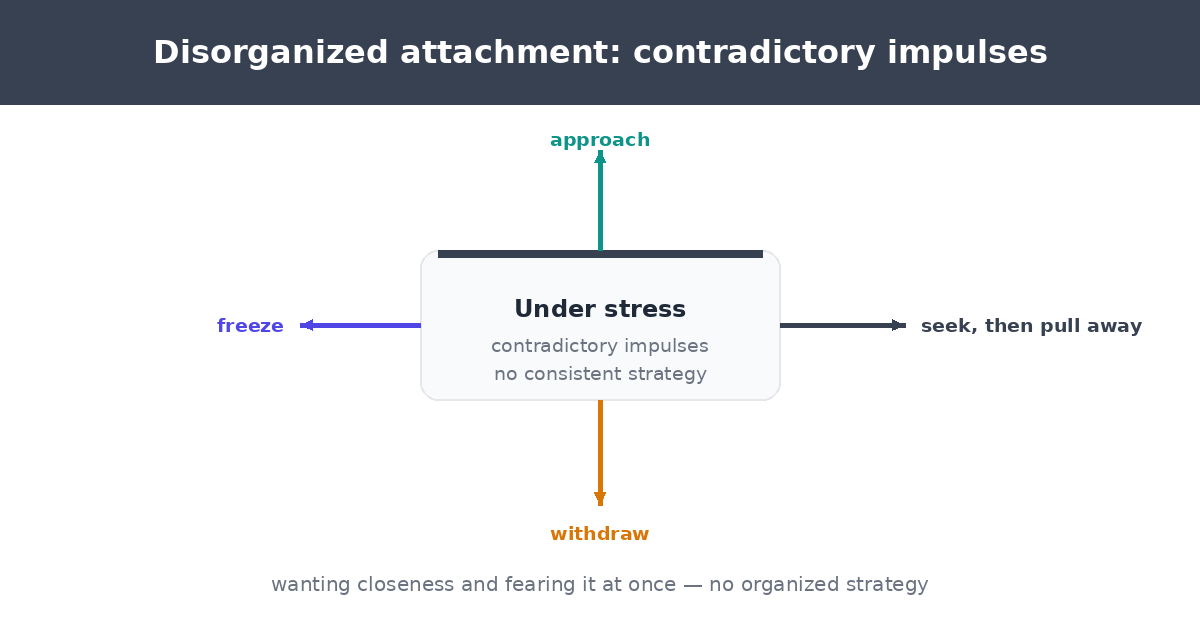
Disorganized attachment is the pattern without a consistent strategy. Where secure, anxious, and avoidant patterns are organized ways of handling the need for closeness — trust it, amplify it, or mute it — disorganized attachment describes what happens when no strategy reliably works: contradictory impulses, freezing, or confusion, especially under stress. In the adult literature, this region of the map is often called fearful-avoidant: high attachment anxiety and high avoidance — wanting closeness while fearing it [1][4].
If the other patterns are answers to the question “how do I handle needing people?”, the disorganized pattern is what it looks like when the question itself feels unanswerable.
Two things to hold from the start, because this topic deserves unusual care. First, this article describes observed tendencies studied in research — it is educational content, not a diagnosis of you or anyone else, and not a verdict on anyone’s childhood. Second, nothing here is a treatment guide; it offers understanding, not promises. With that framing in place: what researchers have found.
(For the full side-by-side picture, see our attachment styles guide.)
Table of Contents
How Researchers Identified This Pattern
The pattern was identified by Mary Main and Solomon in work beginning in 1986, with full coding procedures published in 1990. Watching Strange Situation reunions, they noticed infants who didn’t fit the three organized patterns: children who approached the caregiver while looking away, froze or stilled in place, showed fear on reunion, or displayed contradictory sequences with no coherent strategy [1].
The key insight was the proposed mechanism. Main and Hesse called it “fear without solution”: the child is thought to experience the caregiver as simultaneously the safe haven and a source of fear — frightening behavior, or a caregiver who is themselves frightened and unpredictable. An infant in that bind cannot do what the organized patterns do: there is no consistent move that resolves both “go to safety” and “flee from danger” when safety and danger are the same person [1].
In adulthood, researchers map this region as fearful-avoidance — the combination of wanting closeness (high anxiety) with fearing it (high avoidance) [4]. The adult picture is less about the specific infant behaviors and more about the underlying conflict they expressed: the attachment system pulling in two directions at once.
The Signs of Disorganized Attachment
Because there is no single strategy, the signs are contradictions rather than a consistent style — tendencies that tend to appear under relational stress:
- Wanting closeness, then pulling away from it. Reaching out and withdrawing in quick succession — seeking contact, then canceling, freezing, or shutting down once contact arrives. The push-pull isn’t a tactic; it’s the conflict made visible.
- Freezing or “going blank” under relational stress. Moments of stilling, dissociation-like blankness, or sudden emotional shutdown when a relationship feels intense — the adult echo of the freezing Main and Solomon coded in infants [1].
- Difficulty trusting even demonstrably safe people. A partner, friend, or therapist behaves reliably for months, yet the expectation of hurt doesn’t update easily. Trust isn’t refused so much as it never quite lands.
- Intense, hard-to-predict emotional reactions. Responses that surprise even the person having them — disproportionate fear, anger, or shutdown in situations others experience as manageable. The system is responding to old alarms, not current evidence.
- Chaotic relationship patterns. Relationships that swing between extremes — idealization and devaluation, intense closeness and abrupt distance — without the person quite understanding why the pattern repeats.
Read these as descriptions of a conflict, not as character flaws. Every one of them made a kind of sense as a response to an environment where closeness and fear arrived together.
A concrete picture — offered carefully, as illustration only: Sam’s partner is kind, patient, and consistent. After a warm weekend together, Sam feels an inexplicable dread on Sunday night, picks a fight over something trivial Monday morning, then feels ashamed and clingy Monday night. Nothing in the weekend explains the arc. The trigger was closeness itself; the system response was the old conflict, replayed.
Why It Develops: The Roots (Association, Not Verdict)
The developmental literature associates disorganized attachment with caregiving environments where the child experienced the caregiver as frightening, or as frightened and unpredictable — what researchers describe as frightening or frightened caregiving. The proposed mechanism is the one above: when the safe haven is also a source of fear, no organized strategy resolves the bind [1].
This is where the care matters most, so let’s be explicit:
- This is an association, not a diagnostic marker. Disorganized attachment is found at higher rates in high-risk caregiving environments — but it is not evidence that abuse occurred, and it must never be read that way. Many pathways lead here, and the pattern describes an observed interaction history, not a verdict on any parent or any childhood.
- “Frightening” covers a wide range. A caregiver doesn’t have to be abusive to be frightening to an infant: untreated trauma responses, severe depression, dissociation, or chronic unpredictability can all create the bind. The research describes frightening or frightened caregiving deliberately.
- Probabilistic, not deterministic. These caregiving patterns raise the odds; they don’t fix outcomes. Temperament, later relationships, and individual variation all matter enormously — and later experiences continue to revise working models across life.
How It Plays Out in Relationships
In adult relationships, the core conflict — approach and avoidance firing together — tends to show up as instability rather than a stable style:
- The push-pull dynamic. Periods of intense closeness followed by sudden withdrawal or conflict, often without an identifiable cause. Partners describe feeling confused: “everything was fine, and then it wasn’t.”
- Testing that never quite resolves. Seeking reassurance in ways that reassurance can’t satisfy — because the fear isn’t about the partner’s current behavior, it’s the older alarm sounding underneath.
- Difficulty with the good times. Paradoxically, the hardest moments can be the safe ones: when a relationship is going well, the unfamiliarity of safety itself can trigger the system. Calm feels suspicious when chaos was the early teacher.
- Relationships as the arena, not the cause. Partners often assume they’re doing something wrong. Usually they aren’t — they’re encountering a pattern that predates them and operates partly outside awareness.
None of this is inevitable for anyone who recognizes themselves here. Patterns describe tendencies under stress, not scripts — and understanding the mechanism is, for many people, the first time the pattern starts to make sense rather than feeling like a personal failing.
Understanding the Pattern: What Helps (Without Promises)
This section is deliberately not called “healing” or “recovery,” because those words promise what no article can deliver. What research and clinical observation suggest is more modest and more honest: understanding.
1. Name the conflict, not just the behavior. The most useful reframe: “I’m not broken — my system learned that closeness and fear arrive together.” Seeing push-pull as a learned conflict rather than a character flaw changes the relationship to the pattern itself.
2. Notice the sequence in real time. The highest-leverage skill, as with the other patterns: catching the moment — the dread after closeness, the urge to pick a fight or disappear — before acting on it. The pause is where choice lives, even if the feeling doesn’t immediately change.
3. Let safe experiences accumulate slowly. Working models revise through repeated experience, not insight alone. Consistent, non-dramatic relationships — friendships, partnerships, mentoring bonds — provide the slow evidence the system needs. There is no shortcut on offer here, and anyone selling one should be disbelieved.
4. Consider professional support — as exploration, not treatment-by-article. A good therapist can help make sense of these patterns in a way no article can. This is one option among several, not a prescription and not a treatment recommendation; what matters is finding support that fits, at your own pace. If reading about this pattern brings up distress, that distress deserves care from a qualified professional, not from a webpage.
What this section does not contain is deliberate: no techniques promising to “resolve” the pattern, no timelines, no implication that understanding alone fixes it. The honest version is that this pattern is the hardest to describe simply because it formed where simplicity wasn’t available — and that understanding it is a beginning, not a cure.
A note on what this article is (and isn’t)
This is educational content about a relationship pattern studied in research — not a diagnosis of you or anyone else, and not a comment on anyone’s childhood or parenting. Attachment patterns describe tendencies, and this one, more than the others, deserves to be held lightly: as a lens for understanding, never as a label. If relationship distress is persistent or overwhelming, a qualified mental health professional is the right next step.
Frequently Asked Questions
Is disorganized attachment a disorder?
No. It is a pattern described in developmental and personality research — not a clinical diagnosis. It describes observed tendencies (contradictory impulses around closeness, difficulty trusting, intense reactions under relational stress). That said, because this pattern is associated with more difficult early environments, anyone experiencing significant distress deserves professional support — not because of a label, but because the distress itself matters.
Does disorganized attachment mean I was abused?
No — and this needs to be unambiguous. Disorganized attachment is found at higher rates in high-risk caregiving environments, but it is not a diagnostic marker of abuse, and it cannot be read backward as evidence about any specific childhood. The research describes frightening or frightened caregiving — which covers a wide range of situations, many of them far from abuse. Never let this pattern be used as a verdict on your past.
What’s the difference between “disorganized” and “fearful-avoidant”?
They point to the same region from different traditions. “Disorganized” comes from the developmental literature (Main & Solomon’s infant observations); “fearful-avoidant” comes from Bartholomew and Horowitz’s adult four-category model (negative model of self and other — wanting closeness while fearing it) [4]. Researchers use them in overlapping ways; the adult literature leans toward “fearful-avoidant,” the developmental literature toward “disorganized.”
Can patterns like this change?
Attachment research finds patterns are malleable across life — new relationship experiences can revise working models over time. Our upcoming guide on whether attachment styles can change reviews the evidence honestly, including its limits. No article can promise transformation; what the evidence supports is that change is possible, usually slow, and usually relational — it happens between people, not by force of will.
Keep Exploring
- Attachment Styles — all four patterns compared side by side.
- Attachment Theory Explained — the full framework: Bowlby, Ainsworth, Main and Solomon, and adult attachment research.
- Secure Attachment — the dedicated profile: signs, development, and earned security — the direction growth points.
References
- Attachment Disorganization in Infancy: A Developmental Precursor to Maladaptive Social Information Processing at Age Eight — Zajac, Bookhout, Hubbard, Carlson, & Dozier (2020), Child Development (peer-reviewed, via PMC; summarizes Main & Solomon, 1990 identification procedures: contradictory behaviors, freezing, fear at reunion). https://pmc.ncbi.nlm.nih.gov/articles/PMC6395572/ (opened and verified)
- Attachment style — APA Dictionary of Psychology (describes adult attachment styles). https://dictionary.apa.org/attachment-style (opened and verified)
- Attachment in Young Adulthood — Lifespan Human Development: A Topical Approach (open textbook), Baylor University (adult attachment styles). https://openbooks.library.baylor.edu/lifespanhumandevelopment/chapter/chapter-17-2-attachment-in-adulthood/ (opened and verified)
- What Do Self-Report Measures of Attachment Assess? — P. R. Shaver (chapter; Bartholomew & Horowitz, 1991 four-category model including fearful-avoidance; Brennan, Clark, & Shaver, 1998 dimensions). https://adultattachment.faculty.ucdavis.edu/wp-content/uploads/sites/66/2015/09/Shaver_2004_What-Do-Self-Report-Measures-of-Attachment-Assess.pdf (opened and verified)
- Attachment — Culture and Psychology (open textbook), OpenStax via Maricopa Community Colleges (Ainsworth; Strange Situation; attachment across the lifespan). https://open.maricopa.edu/culturepsychology/chapter/attachment/ (opened and verified)