
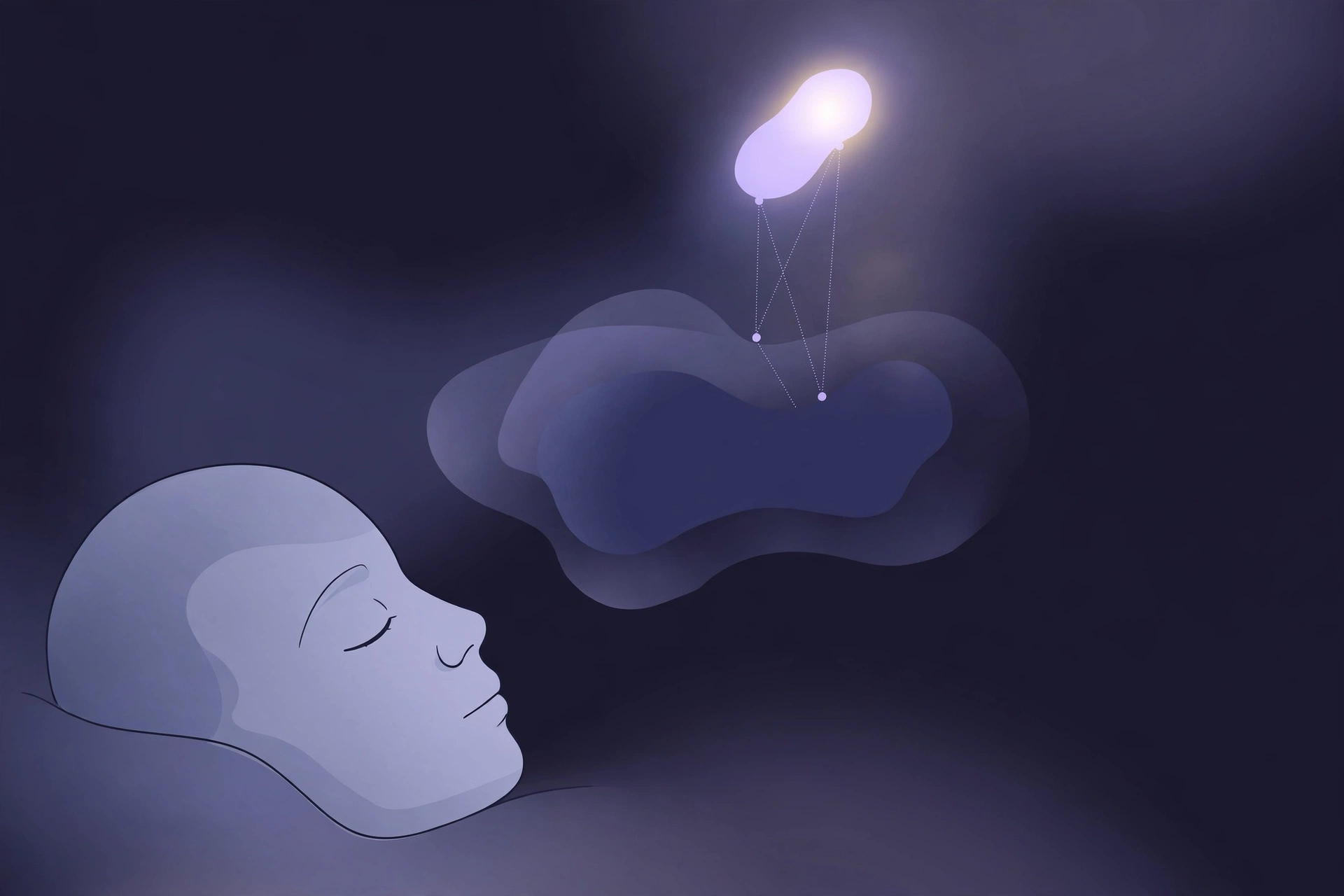
The Interpretation of Dreams (1900) is Sigmund Freud’s argument that dreams are not random noise but meaningful, disguised fulfilments of wishes — and that by decoding them, we can reach parts of the mind that waking thought keeps out of sight. Freud called dreams the “royal road” to the unconscious, and he regarded this book as the most significant work of his life. It was published in November 1899 by Franz Deuticke in Leipzig and Vienna, in a first printing of just 600 copies, with the title page dated 1900; it sold so slowly that a second edition was not needed until 1909.
This summary explains the book’s key ideas in the site’s own words: the wish-fulfilment thesis, the difference between manifest and latent content, the four mechanisms of dream-work, and the famous Irma dream Freud used to prove his method. It also says plainly where Freud’s claims hold up and where modern dream research disagrees. Dream interpretation is an educational topic here, not a clinical tool: dreams cannot diagnose anything, and no dream dictionary can tell you what your dreams mean.
What the Book Argues
Before Freud, a dream was usually treated as either a message from the gods or the meaningless static of a resting brain. Freud proposed a third option: a dream is a meaningful mental act with a hidden logic, and its meaning can be recovered systematically. The sleeping mind, he argued, is not switching off; it is doing a job with a purpose — expressing wishes that waking life will not allow, in a disguise that lets them slip past an inner censor.
The book is organized as a single argument in seven chapters, not a collection of dream stories. It opens by surveying everything written about dreams before him, then sets out his method, works through it on one dream in full, and finally builds a general theory of dreaming from the results. Many of the dreams Freud analyses are his own, drawn from the self-analysis he began after his father’s death — the book is, among other things, the record of Freud analysing himself. The first English translation, by A. A. Brill, appeared in 1913.
Freud’s ambition was larger than dreams. He believed that if dreams could be shown to follow rules, then the same rules would explain symptoms, slips of the tongue, and jokes — all the places where hidden wishes leak into ordinary life. That is why the book became the foundation of psychoanalysis rather than a curiosity about sleep, and why it also introduces ideas that would run through all of Freud’s later work, including repression, the unconscious, and the Oedipus complex.
Wish Fulfilment: The Central Thesis
The book’s central claim is strikingly simple: every dream is the fulfilment of a wish. Freud put it in a single formula: “The dream is the (disguised) fulfilment of a (suppressed or repressed) wish” (Freud, 1900, Standard Edition, Vol. 4, pp. 160–164). The wish supplies the motive force; the disguise is the work required to get it past the part of the mind that would refuse it. Remove either element and, for Freud, you no longer have a dream.
The claim is easiest to see in children’s dreams, where the wish is barely disguised at all — a child who was refused strawberries dreams of eating them. Adult dreams are harder because the wishes are harder to admit: wishes about people we are supposed to love, ambitions we are supposed to have outgrown, or resentments we will not own. The dream does not remove the wish; it dresses it up so that sleep can continue undisturbed.
That raises the obvious objection: what about nightmares and anxious dreams? Freud’s answer was that a dream fulfilling a forbidden wish will feel unpleasant precisely because the wish is forbidden. The disguise can fail, or the wish itself can be frightening, and then the dreamer wakes in distress. The unpleasant feeling does not disprove the wish, in Freud’s view — it shows the wish meeting resistance.
Freud also argued that many latent wishes trace back to childhood — wishes never outgrown, reappearing in adult form. It is here that the Oedipus complex first appears: the child’s wishes towards its parents, which Freud treated as the prototype of the repressed wishes that later return in dreams.
Manifest Content and Latent Content
To make his theory workable, Freud drew a distinction that is still the book’s most useful idea: the difference between manifest content and latent content. The manifest content is the dream as you remember it — the images, events, and story you can recount on waking. The latent content is the hidden train of thought and wish lying behind it: the real meaning, expressed in disguise.
Interpretation, in Freud’s method, is the work of moving from the manifest surface to the latent meaning underneath. Crucially, it is not done with a symbol dictionary. Freud insisted that a dream element means what the dreamer’s own associations connect it to — the personal thoughts and memories each element calls up — not what a fixed list of symbols says it means. Two people can dream of the same image for entirely different reasons.
This is why the book’s method is free association: the dreamer says whatever comes to mind about each element of the dream, and the associations gradually reveal the latent thoughts. The interesting object, Freud argued, is neither the remembered dream nor the hidden wish alone, but the act of translating between them. He called that act dream-work, and understanding it is the key to the whole book.
Dream-Work: How the Disguise Is Made
Dream-work is Freud’s name for the mental processes that transform hidden wishes into the dream you remember. He described four mechanisms. They are the most portable part of the book: even readers who reject wish fulfilment outright often find these four devices describe how people handle anything that cannot be said straight.
Condensation
Condensation packs several trains of thought into a single image. One figure in a dream can stand for several people at once; one object can carry several meanings. A dream figure who looks like a colleague, speaks like a parent, and wears a friend’s coat is, for Freud, three latent thoughts compressed into one manifest image. Condensation is why dreams feel so dense and overcrowded: a short dream can carry a large amount of hidden material.
Displacement
Displacement shifts emotional emphasis from what matters to something trivial. The feeling that belongs to an important thought is transferred onto a minor detail, so the dream seems to be about something unimportant while the real subject stays hidden. A dreamer furious with a spouse may dream of being mildly annoyed by a stranger; the anger is real, but its target has been moved. Freud considered displacement one of the main reasons dreams look meaningless: the dream’s emotional centre is not where it appears to be.
Representability
Representability — Freud’s “considerations of representability” — is the problem of turning abstract thoughts into pictures. Wishes and ideas are not images, so the dreaming mind must translate them into something that can be seen: a relationship becomes a journey, a conflict becomes a struggle with an object, a forbidden idea becomes a visual symbol. The dream thinks in pictures because pictures are the only language sleep allows.
Secondary revision
Secondary revision is the mind imposing order on the result. Raw dream material is disjointed and contradictory, so a final process tidies it into something resembling a story, filling gaps and smoothing contradictions. This is why a dream can feel almost coherent on waking even though its parts do not fit together. For Freud, the neat story is the last layer of disguise: it makes the dream feel like an event rather than a construction.
The Irma Dream: One Dream Taken Apart
Freud proves his method on a single dream, and the choice is deliberate: it is his own. On the night of 23–24 July 1895, while on holiday at the Hôtel Bellevue near Vienna, Freud dreamt of a patient he called Irma. In the dream he meets Irma at a large gathering, reproaches her for not yet accepting his “solution”, and is alarmed when she complains of pains in her throat, stomach, and abdomen. He examines her mouth and finds white patches and strange scabby structures; colleagues are summoned, and the cause is finally traced to an injection — given by another doctor, Otto — containing trimethylamine, delivered with a syringe that had probably not been clean.
Freud called this his “specimen dream” and devoted the book’s entire second chapter to taking it apart element by element, following his own associations for each part. The reading he arrives at is, in his own terms, almost embarrassingly plain: from beginning to end, the dream is an acquittal. Irma is not better, and it is not Freud’s fault — it is hers, for refusing his solution and being the wrong sort of patient, and Otto’s, for the dirty needle. The dream’s instigating wish, Freud concluded, was to be cleared of blame for the incomplete success of Irma’s treatment — and it also gave him his revenge on Otto by making Otto responsible.
Freud regarded the dream as so significant that, writing to his friend Wilhelm Fliess on 12 June 1900, he joked that a marble tablet ought one day to be fixed to the house where he dreamt it, reading: “In this house, on 24 July 1895, the secret of dreams was revealed to Dr. Sigm. Freud.” The point was not that one dream had been solved. It was that Freud believed he now had the key to all of them — a single method that could be applied to any dream, by anyone, with the same result.
What the Book Gets Right — and What It Gets Wrong
More than a century later, Freud’s book is still read, but its central claims are contested, and modern dream research has moved in a different direction. The honest picture has three parts: what survives, what does not, and what remains open.
What survives is the book’s basic observation that dreams are not random. Modern research agrees that dreaming is a real, structured mental activity, not noise: dreams draw on waking concerns, memories, and emotions, and their content is lawful enough to study. Freud himself predicted that “deeper research will one day trace the path further and discover an organic basis for the mental event” — a line modern reviewers still quote, because brain research has done exactly that, even though it has not confirmed his theory (Nir & Tononi, 2010).
What does not survive is the wish-fulfilment theory as a general account of dreaming. The main rival account is the activation–synthesis model, associated with J. Allan Hobson, which treats dreams as the brain’s attempt to weave the random signals of REM sleep into a story. On that view, the strangeness of dreams comes from the brain working with noisy input, not from a censor disguising forbidden wishes. Hobson later developed this into a theory of dreaming as a protoconscious state, in which the brain builds a model of the world while disconnected from it (Hobson, 2009). Neither account has settled the question, but wish fulfilment is no longer the default explanation among dream researchers.
Modern neuroscience has also corrected one of Freud’s background assumptions: dreaming and REM sleep are not the same thing. Nir and Tononi’s (2010) review of the evidence shows that dreaming can occur without REM sleep and REM sleep can occur without dreaming, and that dream-like experience is tied to forebrain mechanisms rather than to the brainstem generators of REM sleep. Dreams, on their account, are closely related to imagination — brain activity flowing in a “top-down” manner, generating a world of experience while disconnected from the environment. That picture keeps Freud’s insight that dreams are meaningful mental acts, but it drops the censor, the disguise, and the hidden wish.
Three limits follow for the reader. First, there is no reliable way to decode a particular dream: free association can produce interesting material, but it cannot verify that a given interpretation is correct, because there is no independent check. Second, dream symbols have no fixed meanings — a dictionary that says one image always means one thing is not Freud’s method and not supported by research. Third, dreams are not a diagnostic instrument: they cannot reveal a disorder, predict the future, or substitute for professional help. If a dream leaves you distressed, or if sleep itself is a problem, that is a matter for a clinician, not a dream book.
None of this makes the book worthless. As intellectual history it is unmatched: it founded psychoanalysis, gave psychology the unconscious and repression in their modern form, and changed how Western culture thinks about the mind. As a theory of dreams it is best read as a bold, wrong-in-detail attempt to take dreams seriously — it asked the right question (why do dreams have the shape they do?) even though its answer has not survived.
Who Should Read It
This summary is enough for most readers. It gives you the book’s argument, its method, and its standing today without the long middle chapters, which work through dozens of dreams in detail and are slow going for a general reader.
Read the book itself if you are a psychology student, if you want to understand psychoanalysis from its source, or if you are interested in Freud as a writer — the Irma chapter, in particular, is a remarkable piece of self-examination. A modern edition with an introduction is the best starting point, since it puts Freud’s claims in their historical context. Skip it if you want practical help with sleep or your own dreams: for that, a modern book on sleep science will serve you better than Freud.
Key Takeaways
- Freud’s central claim is that every dream is the disguised fulfilment of a (suppressed or repressed) wish, and that decoding the disguise reveals the unconscious.
- Manifest content is the dream as remembered; latent content is the hidden wish and train of thought behind it. Interpretation moves from the first to the second through the dreamer’s own associations, not a symbol dictionary.
- Dream-work makes the disguise through four mechanisms: condensation, displacement, representability, and secondary revision.
- The Irma dream (23–24 July 1895) is Freud’s worked proof: he reads it as a wish to be cleared of blame for a patient’s incomplete recovery.
- Modern research keeps Freud’s insight that dreams are structured and meaningful, but rejects wish fulfilment as the general explanation, and shows dreaming and REM sleep are not the same thing (Nir & Tononi, 2010; Hobson, 2009).
- Dreams are not a diagnostic tool and dream symbols have no fixed meanings; interpretation is educational, not clinical.
References
- Freud, S. (1900). The Interpretation of Dreams (Die Traumdeutung). Leipzig and Vienna: Franz Deuticke. (First English translation by A. A. Brill, 1913; reprinted in The Standard Edition of the Complete Psychological Works of Sigmund Freud, Vols. 4–5. London: Hogarth Press.)
- Hobson, J. A. (2009). REM sleep and dreaming: Towards a theory of protoconsciousness. Nature Reviews Neuroscience, 10(11), 803–813. https://doi.org/10.1038/nrn2716
- Jones, E. (1953). Sigmund Freud: Life and Work: Vol. 1, The Young Freud, 1856–1900. London: Hogarth Press.
- Nir, Y., & Tononi, G. (2010). Dreaming and the brain: From phenomenology to neurophysiology. Trends in Cognitive Sciences, 14(2), 88–100. https://doi.org/10.1016/j.tics.2009.12.001
Keep Exploring
- Major Theories of Personality: From Freud to the Big Five — Freud’s ideas in context: the psychodynamic family of personality theories, what each explains best, and the honest appraisal of each.
- What Is Personality? Definition & Key Concepts — the foundations: how personality is defined scientifically, and the key concepts the rest of the site builds on.
What is The Interpretation of Dreams about?
Sigmund Freud’s 1900 book argues that dreams are meaningful, disguised fulfilments of wishes, and that by decoding them we can reach the unconscious — the part of the mind that waking thought keeps out of sight. It is the founding book of psychoanalysis.
What does Freud mean when he says dreams fulfil wishes?
He means that every dream expresses a wish, usually one the dreamer will not admit while awake, disguised so that it can slip past an inner censor. The wish can be an ordinary one, as in children’s dreams, or a forbidden one, which is why some dreams are frightening rather than pleasant.
What are manifest and latent content?
Manifest content is the dream as you remember it — the images and story. Latent content is the hidden train of thought and wish behind it. Interpretation is the work of moving from the manifest surface to the latent meaning, using the dreamer’s own associations rather than a fixed symbol dictionary.
What is dream-work?
Dream-work is Freud’s name for the four processes that turn a hidden wish into the dream you remember: condensation (packing several thoughts into one image), displacement (shifting feeling onto something trivial), representability (turning abstract thoughts into pictures), and secondary revision (tidying the result into a story).
Is dream interpretation a reliable way to understand yourself?
No — not as Freud’s method claims. There is no independent way to check whether a particular interpretation is correct, dream symbols have no fixed meanings, and modern research does not support wish fulfilment as the general explanation of dreaming. Dreams can be interesting to reflect on, but they are not a diagnostic tool and cannot substitute for professional help.