
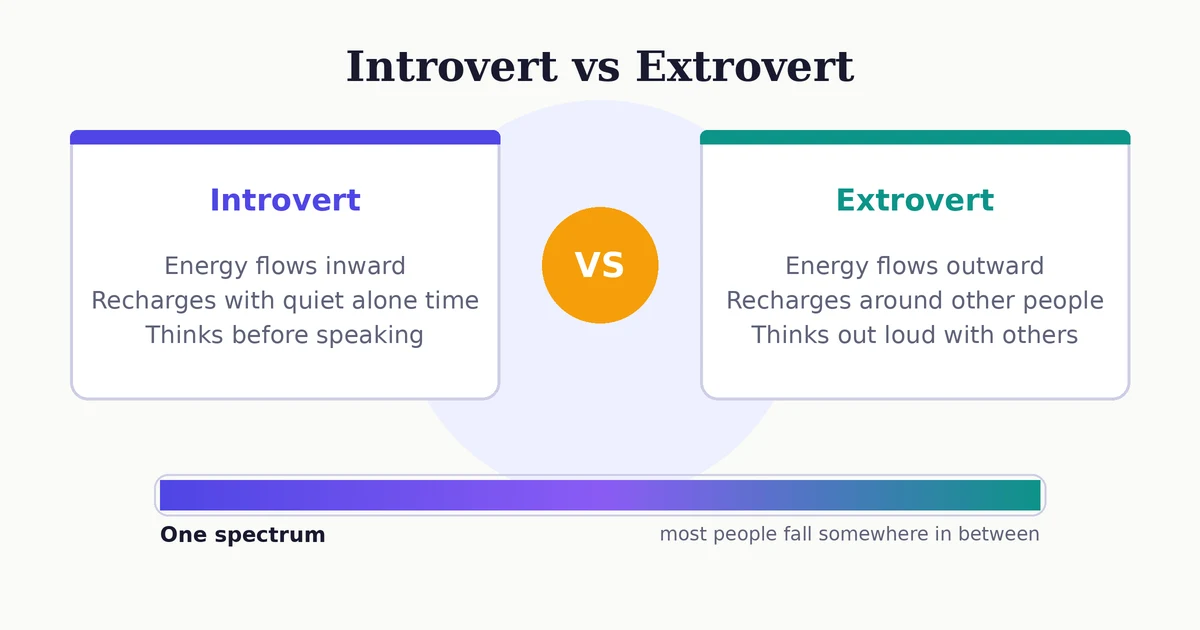
The real difference between introverts and extroverts isn’t shyness versus confidence — it’s orientation. An introvert’s energy flows inward, toward the private world of thoughts and feelings; an extrovert’s energy flows outward, toward people and the surrounding world. The American Psychological Association captures this directly: introversion is an “orientation toward the internal private world of one’s self and one’s inner thoughts and feelings, rather than toward the outer world of people and things” [1].
Here’s the part most people get wrong: these are not two boxes you fit into. Introversion and extraversion are the two ends of a single spectrum, and most people live somewhere in the middle. This guide compares the two styles across the areas where the differences actually show up — energy, social preferences, communication, and work — so you can understand yourself and the people around you a little better.
Table of Contents
Where the Terms Come From
The words introvert and extrovert were introduced into psychology by the Swiss psychiatrist Carl Jung, in his 1921 work Psychological Types. Jung described introverts as oriented inward, toward subjective experience, and extroverts as oriented outward, toward the external world — noting that each person has tendencies in both directions, with one direction generally predominating [1][2]. Jung himself didn’t propose strict boxes: he argued that everyone carries both tendencies.
Later psychologists kept the idea and built it into modern trait models. Extraversion became one of the five broad traits of the Big Five — the most widely used personality framework in research — with introversion sitting at its low end. (Our guide to extraversion covers the trait itself in depth; this article sticks to the comparison.)
The Core Difference: Energy and Orientation
Strip away the stereotypes, and the core difference is simple: what drains you, and what restores you.
- An introvert spends their energy engaging with the outer world — busy gatherings, constant conversation, high-stimulation environments — and recharges in quiet, low-stimulation time alone.
- An extrovert spends their energy in solitude and recharges through engagement with people and activity.
Think of it as a social battery that charges in opposite ways. A useful illustration: after a Saturday wedding reception, Daniel is buzzing and wants to keep the night going with the after-party crowd; his wife is depleted and wants to go straight home. Neither is being rude or dramatic — their batteries charge in opposite directions.
This is why the “shy versus outgoing” shorthand is misleading. Shyness is about fear or discomfort in social situations; introversion is about where your attention naturally goes. A shy extrovert can feel anxious at a party and still crave being there. A socially confident introvert can love a good conversation and still need to leave early to recover.
Key Differences at a Glance
| Area | Introvert | Extrovert |
|---|---|---|
| Energy and recharge | Recharges through quiet, low-stimulation time alone | Recharges through social interaction and activity |
| Social preferences | Smaller circles; prefers one-on-one or small groups | Larger circles; enjoys groups and meeting new people |
| Communication style | Thinks before speaking; listens first | Thinks out loud; speaks first, refines after |
| Work and focus | Deep, sustained focus in quiet settings; prefers working independently | Thrives on collaboration and lively environments |
| Stimulation | Finds heavy stimulation draining; seeks calm | Finds too little stimulation boring; seeks variety and buzz |
| Responding to change | Tends to process internally before reacting | Tends to react and talk through things in the moment |
“Table: the introvert–extrovert contrast across six everyday areas.”
No single row defines a person — these are tendencies, and everyone shows a mix. The pattern matters more than any one behavior: an introvert can give a great presentation and enjoy it, then need the evening to recover; an extrovert can value a quiet weekend and still seek out friends by Sunday.
One Spectrum, Not Two Boxes
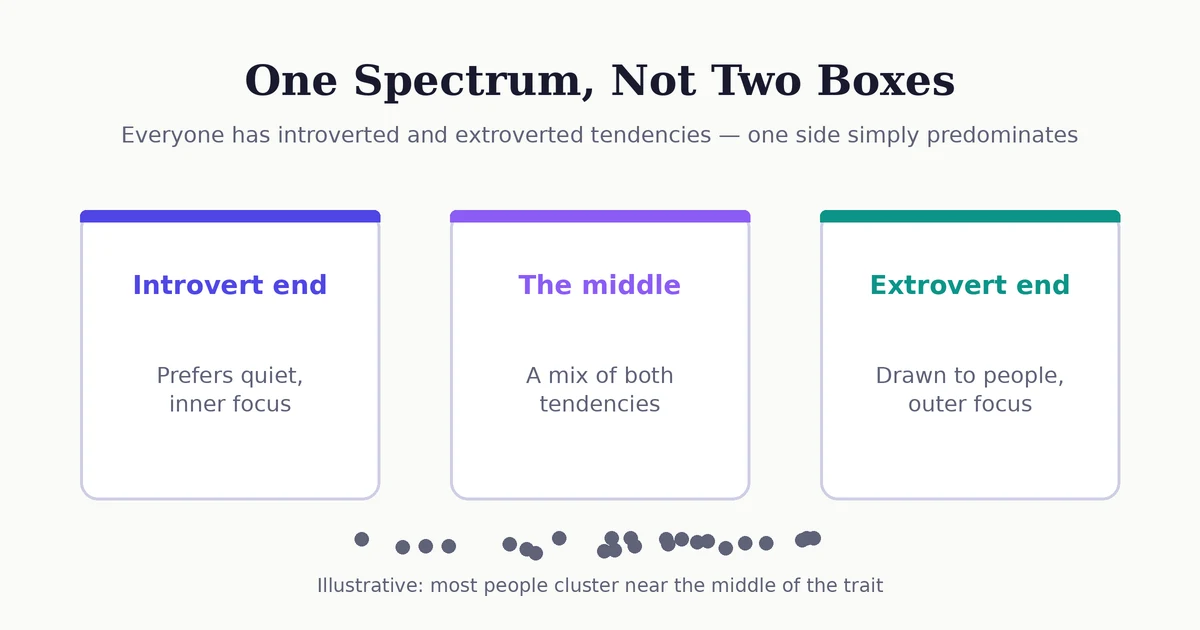
The most important point in this whole comparison: introversion and extraversion are not opposites locked in separate rooms. The APA defines each as existing “on a continuum of attitudes and behaviors,” and Jung himself noted that everyone has tendencies in both directions [1][2].
In practice, this means:
- Strong introverts feel the inward pull clearly and consistently.
- Strong extroverts feel the outward pull clearly and consistently.
- Most people land somewhere between — they enjoy people and time alone in roughly equal measure, they can think out loud and reflect privately.
The balanced middle is sometimes called ambiversion — the point on the spectrum where introverted and extroverted tendencies sit in rough equilibrium. If you’ve ever felt equally drained by a weekend with zero social contact and a weekend with zero alone time, that’s the middle talking.
Why the Distinction Actually Matters
This isn’t just self-knowledge trivia — it changes how you interpret other people.
For yourself, it tells you what to protect. If you’re more introverted, scheduling recovery time after a packed week isn’t laziness — it’s how your energy works. If you’re more extroverted, a month with no social contact will wear you down in a way a busy introvert might never understand. Designing your routines around your orientation instead of fighting it is one of the highest-value uses of personality psychology.
For others, it stops you from reading rejection into behavior. A concrete example: your coworker Mara rarely speaks in the big Monday brainstorming session but sends you a brilliant, fully-formed plan by email on Tuesday. She isn’t disengaged or unfriendly — she thinks before she speaks, and the format finally let her do it. The fix was trivial (ask for written input before the meeting), but it only became visible once her silence was understood as style rather than attitude.
Three Myths Worth Dropping
“Introverts are shy.”
Introversion is defined by orientation toward the inner world, not by fear of social situations [1]. Shy extroverts and socially confident introverts both exist — preference and anxiety are different things.
“Extroverts are shallow; introverts are antisocial.”
Preference for depth versus breadth says nothing about warmth or character. Many introverts maintain a small number of close relationships and invest in them deeply; many extroverts genuinely care about a wide circle. Antisocial behavior is a separate, clinical concept — not a personality style.
“You have to be one or the other.”
This is the myth the spectrum refutes. Jung’s original point — that everyone has both tendencies, with one generally predominating — still holds [2]. A label is only useful if it describes where you tend to land, not where you’re allowed to be.
Frequently Asked Questions
How can I tell whether I’m an introvert or an extrovert?
Ask yourself where you recharge. After a long stretch of intense social activity, do you crave quiet time alone to recover — or do you feel flat and bored until you’re around people again? The answer reveals your dominant orientation. Most people also recognize a mix, which is normal.
Can an introvert become an extrovert?
Personality traits are relatively stable, though they can shift somewhat over a lifetime — people tend, for example, to become somewhat less extreme as they age. What’s more practical than changing your orientation is expanding your range: an introvert can learn to thrive in social situations, and an extrovert can learn to enjoy solitude, without changing who they fundamentally are.
Is one better than the other?
No. As with all personality traits, there is no ideal setting — different orientations are advantages in different contexts. An introvert’s sustained focus suits deep work; an extrovert’s ease with people suits collaborative roles. The useful question is fit, not rank.
Can introverts and extroverts get along in relationships?
Absolutely — and they often do. The friction comes from misreading the other person, not from the difference itself. Once a couple understands that “I need an evening alone” means “I’m recharging” and not “I’m pulling away,” the difference becomes a logistics problem rather than an emotional one.
References & Further Reading
- Introversion — APA Dictionary of Psychology. https://dictionary.apa.org/introversion
- Extroversion and introversion — Columbia Electronic Encyclopedia via Infoplease. https://www.infoplease.com/encyclopedia/medicine/psychology/psychology-and-psychiatry/extroversion-and-introversion
Keep Exploring
For the science behind the trait itself, read our guide to extraversion. For the bigger picture of how personality is studied, start with what personality psychology is.
1 thought on “Introvert vs Extrovert: Key Differences Explained”