
Avoidant attachment is a pattern of relating to close others marked by discomfort with closeness and a strong pull toward independence. People with avoidant tendencies value self-reliance, keep emotional distance, and tend to withdraw — rather than reach out — when stressed. In the research literature it is also called dismissing attachment (Bartholomew & Horowitz, 1991) — the region of the map with low attachment anxiety and high avoidance: not worried about rejection, but uneasy with dependence [1][4].
If the secure pattern is “I trust the bond,” the avoidant pattern is closer to “I’m fine on my own — needing people costs more than it’s worth.” This guide describes the signs, where the pattern comes from, how it typically plays out in relationships, and — practically — what growth looks like. Nothing here diagnoses you; these are tendencies studied in research, described so you can recognize and work with them.
(For the full side-by-side picture, see our attachment styles guide.)
Table of Contents
The Signs of Avoidant Attachment
Avoidant attachment shows up as a cluster of tendencies, most visible when closeness is on offer or when stress hits:
- Discomfort with emotional intimacy. Deep conversations, vulnerability, and expressions of need — your own or others’ — feel uncomfortable rather than connecting. There is a preference for keeping things light, practical, or private.
- Prizing independence above interdependence. Self-reliance isn’t just a value; it’s the default operating system. Asking for help feels unnatural, and depending on someone can feel like a loss of self.
- Withdrawing under stress. Where others turn toward people when distressed, the avoidant move is to turn away: going quiet, getting busy, handling it alone. The APA’s definition captures the infant version precisely — the child does not seek proximity after separation and avoids the returning parent [1] — and the adult version rhymes with it.
- Downplaying the importance of close relationships. “I don’t really need anyone” is said and, on the surface, believed. Relationships may be described as less central than work, hobbies, or autonomy.
- Discomfort with others’ emotional needs. A partner’s tears, need for reassurance, or desire to “talk about us” can trigger irritation or shutdown rather than empathy — not from cruelty, but from a system that learned early that emotional neediness leads nowhere good.
- Valuing autonomy in a way that keeps people at arm’s length. Independence is healthy; here it functions partly as protection. There is often a subtle scanning for reasons a relationship won’t work — focusing on a partner’s flaws when closeness increases.
A crucial nuance, stated plainly: avoidance is about discomfort with dependence, not absence of feeling. Research on deactivating strategies (below) describes the active suppression of attachment needs — which means the needs are there, being managed, not missing [5]. “Cold” is usually the wrong read; “guarded” is closer.
A concrete picture: Lena tells her partner of two years, “I feel like I don’t really know what’s going on with you.” He hears criticism where she meant longing. He gets efficient — “Everything’s fine, work’s just busy” — and changes the subject. She feels shut out; he feels crowded. Nobody raised their voice. The distance did all the damage.
Why It Develops: The Roots (Probabilistic, Not Fate)
The developmental literature links avoidant patterns most consistently with caregiving that was rejecting or consistently unresponsive to distress signals. Ainsworth’s sensitivity research found that when a child’s bids for comfort were repeatedly rebuffed — picked up less, soothed less, met with irritation or withdrawal — the child learned a coherent lesson: showing need doesn’t help, so stop showing it [6].
The internal working model that forms is equally coherent: “closeness isn’t reliably available, so I will handle things myself.” In adulthood, that becomes the self-reliance and distancing described above — what researchers call deactivating strategies: ways of keeping the attachment system quiet by suppressing needs, minimizing the importance of relationships, and maintaining distance [5].
Three crucial qualifications:
- Probabilistic, not deterministic. Rejecting or unresponsive caregiving raises the odds of an avoidant pattern; it does not guarantee one. Temperament, family stress, later relationships, and plain individual variation all matter. Many people with difficult early experiences develop secure patterns.
- “Rejecting” doesn’t mean “bad parent.” Caregivers can be unresponsive for countless ordinary reasons — their own discomfort with emotion, depression, overwork, cultural norms about independence, a mismatch with the child’s temperament. The pattern describes an interaction history, not a moral judgment.
- Later experiences count too. Attachment patterns are shaped across life, not sealed in childhood. Relationships in adolescence and adulthood — for better and worse — continue to revise working models.
How It Plays Out in Relationships: Common Patterns
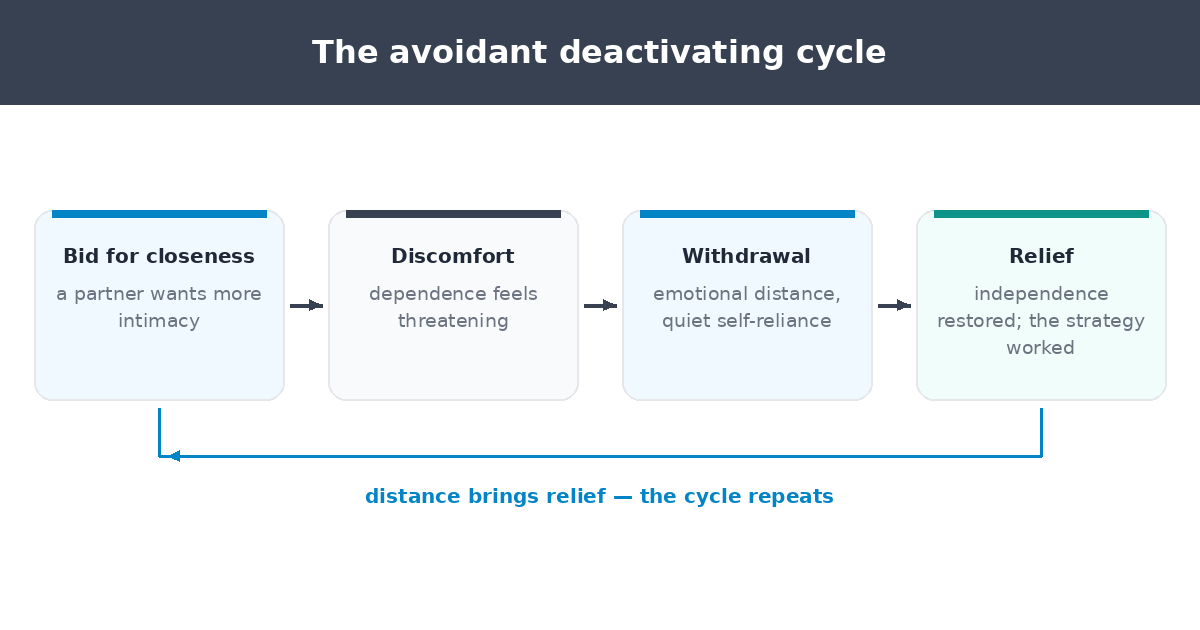
Researchers describe the avoidant pattern’s characteristic moves as deactivating strategies: ways of muting the attachment system when it threatens to activate. In Mikulincer and Shaver’s model of attachment-system dynamics, when closeness or need starts to stir the system, avoidantly attached people dampen it down rather than amplify it — the mirror image of the anxious pattern’s hyperactivation [5].
In everyday relationships, deactivation looks like this:
- Emotional withdrawal. Going quiet, physically leaving, or mentally checking out when conversations get intimate or conflictual. The partner experiences stonewalling; from the inside, it feels like self-protection.
- Minimizing. “It’s not a big deal” — about the partner’s feelings, about the relationship, about one’s own inner life. Minimizing keeps the attachment system from fully engaging.
- Compartmentalizing. Keeping parts of life separate: work self, friend self, partner self, with limited overlap. Intimacy requires integration; compartmentalization prevents it.
- Spotlighting flaws. When a relationship gets close, attention shifts to what’s wrong with the partner — the annoying habit, the incompatible taste. Researchers describe this as a distancing maneuver: finding reasons the bond doesn’t quite work keeps dependence at bay.
- Secret self-sufficiency. Handling crises alone and mentioning them only afterward (“oh, that got resolved last week”). The message received is “I don’t need you”; the message intended is often “I don’t want to be a burden.”
The quiet irony researchers note: deactivating strategies are designed to preserve independence, but they often produce the very outcomes the person fears — partners feeling unloved and pulling away, which then confirms that depending on people is disappointing [5]. Seeing this cycle clearly is usually the first step toward changing it.
None of this is inevitable for anyone who recognizes themselves here. Patterns describe tendencies under stress, not scripts. Plenty of people with avoidant tendencies build deeply satisfying relationships — often precisely because understanding the pattern lets them choose different responses.
Growth: What Actually Helps
Growth here doesn’t mean becoming a different person — the independence and self-knowledge are genuine strengths. It means making closeness less threatening, so the attachment system doesn’t have to be muted to feel safe. What follows is educational, not clinical advice:
1. Notice the deactivation in real time. The highest-leverage skill: catching the moment the wall goes up — the urge to change the subject, go quiet, or get busy — before acting on it. Label it plainly: “I’m distancing right now.” Awareness precedes choice.
2. Name needs out loud, in small doses. Deactivation thrives on never asking. Start where the stakes are low: “I’m stressed about tomorrow — could we just sit together for a bit?” Small, answered requests teach the system that depending on someone doesn’t end in disappointment.
3. Stay in the uncomfortable conversation a little longer. The instinct is to exit when intimacy rises. Practicing staying — not perfectly, just a few minutes longer — builds tolerance the way any exposure does. The partner’s emotional bid is data that closeness can be survived, even welcomed.
4. Let others be competent at caring. Avoidant patterns often include a quiet belief that no one can really help. Deliberately letting a partner, friend, or family member show up — and noticing when they do it well — revises that belief through evidence, not argument.
5. Distinguish independence from isolation. Ask: is this solitude restorative, or is it strategic? Genuine independence recharges; defensive independence just avoids. Learning to tell the difference is the work.
6. Consider professional support. A good therapist can function as a low-stakes practice ground for depending on someone — and there is nothing contradictory about getting help with a pattern organized around not needing help. This is one option among several, not a prescription; what matters is finding support that fits.
A note on what this article is (and isn’t)
This is educational content about a relationship pattern — not a diagnosis of you or anyone else. Attachment patterns are tendencies, not labels, and recognizing yourself in a description is the beginning of self-understanding, not a verdict. If relationship difficulties are persistent or overwhelming, a qualified mental health professional is the right next step.
Frequently Asked Questions
Is avoidant attachment a disorder?
No. It is a pattern of relating studied in personality and developmental research — not a clinical diagnosis. It describes tendencies (discomfort with closeness, preference for self-reliance, withdrawal under stress), and tendencies exist on continuums. That said, if these patterns cause significant distress or impair daily life, that distress itself is worth addressing with a professional, whatever label fits.
Do avoidantly attached people lack emotions?
No — and this is one of the most common misunderstandings. The research on deactivating strategies describes the suppression of attachment-related emotion, not its absence [5]: the needs are there, being actively managed, not missing. “Guarded” describes the pattern far better than “cold.”
Are avoidant people just introverted?
Not the same thing, though they can look similar from the outside. Introversion is a broad personality trait about where you get your energy (solitude recharges you). Avoidant attachment is specifically about discomfort with dependence and emotional closeness — an avoidantly attached extravert exists, happily social but walled off in intimate relationships. The two can co-occur, but one doesn’t explain the other.
Can avoidant attachment change?
The evidence says attachment patterns are malleable: longitudinal research finds meaningful stability but also real change in response to new relationship experiences. Our guide on whether attachment styles can change reviews the evidence. (A related question from a different field: whether personality can change.)
Keep Exploring
- Attachment Styles — all four patterns compared side by side.
- Secure Attachment — the dedicated profile: signs, development, and earned security — the direction growth points.
- Attachment Theory Explained — the full framework: Bowlby, Ainsworth, and adult attachment research.
References
- Avoidant attachment — APA Dictionary of Psychology (defines the infant avoidant pattern in the Strange Situation: the infant does not seek proximity after separation and avoids the returning parent). https://dictionary.apa.org/avoidant-attachment (opened and verified)
- Attachment in Young Adulthood — Lifespan Human Development: A Topical Approach (open textbook), Baylor University (adult attachment styles). https://openbooks.library.baylor.edu/lifespanhumandevelopment/chapter/chapter-17-2-attachment-in-adulthood/ (opened and verified)
- Hazan, C., & Shaver, P. (1987). Romantic love conceptualized as an attachment process. Journal of Personality and Social Psychology, 52(3), 511–524. https://doi.org/10.1037/0022-3514.52.3.511 (citation verified via PsycNet)
- What Do Self-Report Measures of Attachment Assess? — P. R. Shaver (chapter; Bartholomew & Horowitz, 1991 four-category model including dismissing-avoidance; Brennan, Clark, & Shaver, 1998 dimensions). https://adultattachment.faculty.ucdavis.edu/wp-content/uploads/sites/66/2015/09/Shaver_2004_What-Do-Self-Report-Measures-of-Attachment-Assess.pdf (opened and verified)
- Attachment Theory and Emotions in Close Relationships — M. Mikulincer & P. R. Shaver (chapter; attachment-system dynamics; deactivating strategies). https://adultattachment.faculty.ucdavis.edu/wp-content/uploads/sites/66/2015/09/Mikulincer_2005_Attachment-theory-and-emotion-in-close-relationships.pdf (opened and verified)
- Attachment — Culture and Psychology (open textbook), OpenStax via Maricopa Community Colleges (Ainsworth; caregiver sensitivity; Strange Situation). https://open.maricopa.edu/culturepsychology/chapter/attachment/ (opened and verified)