
Anxious attachment is a pattern of relating to close others marked by a deep craving for closeness mixed with a persistent fear of losing it. People with anxious tendencies monitor their relationships for signs of rejection, need frequent reassurance, and feel emotions intensely when the bond feels threatened. In the research literature it is also called preoccupied attachment (Bartholomew & Horowitz, 1991) or anxious–ambivalent attachment (Ainsworth; Hazan & Shaver, 1987) — different names for the same region of the map: high attachment anxiety, low avoidance [1][2][4].
If the secure pattern is “I trust the bond,” the anxious pattern is “I want the bond desperately, and I’m not sure it will hold.” This guide describes the signs, where the pattern comes from, how it typically plays out in relationships, and — practically — what growth looks like. Nothing here diagnoses you; these are tendencies studied in research, described so you can recognize and work with them.
(For the full side-by-side picture, see our attachment styles guide.)
Table of Contents
The Signs of Anxious Attachment
Anxious attachment shows up as a cluster of tendencies, most visible when the relationship feels uncertain:
- Worry about abandonment. A recurring fear that the partner will leave, lose interest, or find someone better — even without evidence. A delayed text reply can feel like confirmation.
- Need for frequent reassurance. “Do you still love me?” asked in various forms, often. The reassurance helps briefly, then the worry returns — because the doubt is in the internal working model, not in anything the partner did.
- Hypervigilance to the partner’s cues. Noticing the slightest shift in tone, a shorter-than-usual hug, a distracted glance — and reading threat into ambiguity. The attachment system is set to high sensitivity.
- Difficulty being soothed. Like the ambivalent infants in Ainsworth’s Strange Situation — who sought contact at reunion yet resisted it and stayed upset — anxiously attached adults can struggle to take in the comfort they seek [6]. The partner says all the right things; calm doesn’t quite land.
- Strong emotional reactions to distance. Cancelled plans, a partner needing alone time, or even normal independence can trigger disproportionate distress — not because the person is “too sensitive,” but because distance activates the attachment system hard.
- Overthinking and mental replay. Conversations get rehearsed and re-analyzed: What did they mean by that? Was that a sign? The mind keeps returning to the relationship’s security — which is exactly why Bartholomew and Horowitz named this pattern “preoccupied” [4].
A concrete picture: Daniel’s girlfriend says she’s tired and wants a quiet night in. Within an hour he has texted three times, re-read her last five messages for tone, and drafted a long message about “needing to talk about us” — then deleted it, then felt guilty, then felt anxious about feeling guilty. The evening ends with both of them exhausted. The trigger was ordinary; the system response was not.
Why It Develops: The Roots (Probabilistic, Not Fate)
The developmental literature links anxious patterns most consistently with inconsistent caregiving: comfort that sometimes comes and sometimes doesn’t. Ainsworth’s sensitivity research found that when a caregiver responds unpredictably — soothing the child’s distress on some occasions and missing or dismissing it on others — the child learns that bigger signals get better results. Crying louder, clinging harder, staying upset longer: these are strategies that worked, often enough, to keep an unreliable source of comfort engaged [6].
The internal working model that forms is coherent: “closeness is available sometimes, so I must stay alert and signal strongly.” In adulthood, that becomes the hypervigilance and reassurance-seeking described above.
Three crucial qualifications:
- Probabilistic, not deterministic. Inconsistent caregiving raises the odds of an anxious pattern; it does not guarantee one. Temperament, family stress, later relationships, and plain individual variation all matter. Many people with imperfect childhoods develop secure patterns, and researchers explicitly warn against reading a childhood like a fortune cookie.
- “Inconsistent” doesn’t mean “bad parent.” Caregivers can be inconsistent for countless ordinary reasons — depression, overwork, their own unresolved stress, a difficult temperament match with the child. The pattern describes an interaction history, not a moral judgment.
- Later experiences count too. Attachment patterns are shaped across life, not sealed in childhood. Significant relationships in adolescence and adulthood — for better and worse — continue to revise working models.
How It Plays Out in Relationships: Common Patterns
Researchers describe the anxious pattern’s characteristic moves as hyperactivating strategies: ways of keeping the attachment figure close by amplifying signals of need. In Mikulincer and Shaver’s model of attachment-system dynamics, when the system detects that the figure may not be reliably available, anxious individuals intensify rather than suppress their bids for connection [5].
In everyday relationships, hyperactivation looks like this:
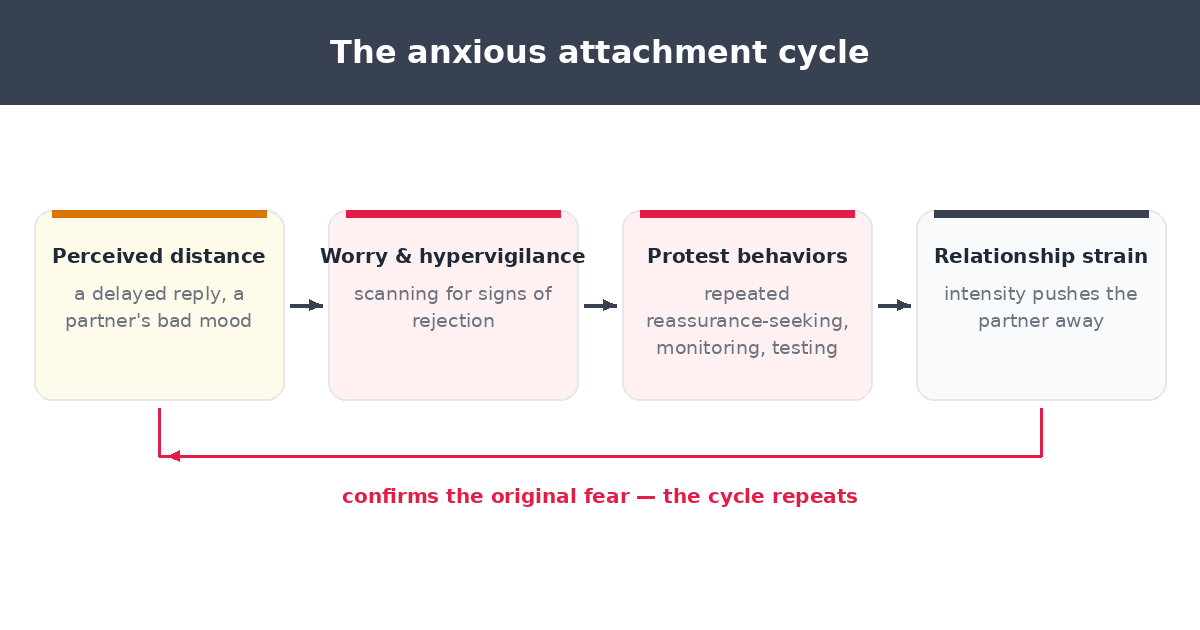
- Protest behaviors. Escalating contact when feeling disconnected: repeated calling or texting, picking a fight to force engagement, threatening to leave in order to be pursued. The goal is rarely the fight itself — it’s proof the other person cares enough to respond.
- Merging and self-sacrifice. Giving too much, too fast — abandoning one’s own needs, friends, or boundaries to keep the partner close. It feels like love; functionally, it’s insurance against abandonment.
- Jealousy and monitoring. Checking a partner’s phone, reading into friendships, needing to know where they are. Experienced from the inside as vigilance; experienced from the outside as control — which is why the pattern so often backfires.
- Difficulty with the partner’s independence. A partner’s separate life — hobbies, friends, solitude — can feel like a threat rather than a healthy given, creating pressure the partner experiences as suffocating.
The painful irony researchers note: hyperactivating strategies are designed to prevent abandonment, but they often strain the relationship — the intensity that seeks closeness can push partners away, which then confirms the original fear [5]. Seeing this cycle clearly is usually the first step toward changing it.
None of this is inevitable for anyone who recognizes themselves here. Patterns describe tendencies under stress, not scripts. Plenty of people with anxious tendencies build deeply satisfying relationships — often precisely because understanding the pattern lets them choose different responses.
That pattern — noticing mainly the signs that fit a fear of being left — is a relationship example of confirmation bias.
Growth: What Actually Helps
Growth here doesn’t mean eliminating the need for closeness — that need is human and healthy. It means making the attachment system less hair-trigger, so ordinary distance stops feeling like danger. What follows is educational, not clinical advice:
1. Name the pattern in real time. The single highest-leverage skill: noticing “my attachment system is activated right now” before acting on it. The pause between trigger and text message is where change lives. Many people find it helps to literally label it: “This is the worry, not the evidence.”
2. Say the need directly. Hyperactivation is indirect communication — hints, tests, protests. The secure alternative is directness: “I’m feeling insecure tonight; could we talk for ten minutes?” Direct requests get better responses than tests, and each answered request quietly revises the working model.
3. Build a life beyond the relationship. Anxious patterns intensify when the partner is the only attachment figure. Friendships, family bonds, absorbing work, and community distribute attachment needs across several relationships — so no single delayed text carries the full weight.
4. Practice tolerating uncertainty. The anxious system demands certainty now. Deliberately practicing small tolerances — not checking the phone for an hour, letting a vague message sit until morning — trains the system that ambiguity is survivable. Start small; this is exposure in the everyday sense, not a clinical protocol.
5. Let reassurance accumulate. One insight from the research: working models change through repeated experience, not single epiphanies. Keeping a simple record of times the feared outcome didn’t happen (“she was just tired; everything was fine Saturday”) gives the rational mind evidence the anxious system keeps ignoring.
6. Consider professional support. A good therapist can function as a secure base for exploring these patterns — and there is nothing contradictory about seeking help for a pattern organized around seeking help. This is one option among several, not a prescription; what matters is finding support that fits.
A note on “security priming”: some experimental research (Mikulincer & Shaver’s program) finds that briefly bringing to mind experiences of being cared for can temporarily soften insecure responses [5]. It’s a laboratory finding, not a self-help technique — mentioned here only to underline the deeper point: the system responds to experiences of reliable care, which is why the strategies above emphasize accumulating them.
A note on what this article is (and isn’t)
This is educational content about a relationship pattern — not a diagnosis of you or anyone else. Attachment patterns are tendencies, not labels, and recognizing yourself in a description is the beginning of self-understanding, not a verdict. If relationship anxiety is persistent or overwhelming, a qualified mental health professional is the right next step.
Frequently Asked Questions
Is anxious attachment a disorder?
No. It is a pattern of relating studied in personality and developmental research — not a clinical diagnosis. It describes tendencies (worry about abandonment, reassurance-seeking, emotional intensity under relationship stress), and tendencies exist on continuums. That said, if these patterns cause significant distress or impair daily life, that distress itself is worth addressing with a professional, whatever label fits.
Can anxious attachment change?
The evidence says attachment patterns are malleable: longitudinal research finds meaningful stability but also real change in response to new relationship experiences. Our upcoming guide on whether attachment styles can change reviews the evidence. (A related question from a different field: whether personality can change.)
Is anxious attachment the same as being “needy”?
“Needy” is a judgment; “anxiously attached” is a description of a mechanism. The behaviors that get labeled needy — frequent reassurance-seeking, difficulty with distance — make sense as hyperactivating strategies: attempts to keep an uncertain bond secure [5]. Understanding the mechanism tends to produce more compassion (for yourself and others) than the label does.
Why do anxiously attached people often end up with avoidant partners?
This is the well-known anxious–avoidant pairing: one partner’s closeness-seeking meets the other’s distance-keeping, and each partner’s strategy triggers the other’s — pursuit triggers withdrawal, withdrawal triggers pursuit. It’s a common dynamic, not a rule, and our upcoming guide to attachment pairings examines it in detail.
Keep Exploring
- Attachment Styles — all four patterns compared side by side.
- Secure Attachment — the dedicated profile: signs, development, and earned security — the direction growth points.
- Attachment Theory Explained — the full framework: Bowlby, Ainsworth, and adult attachment research.
References
- Attachment style — APA Dictionary of Psychology (describes adult attachment styles including the preoccupied pattern). https://dictionary.apa.org/attachment-style (opened and verified)
- Attachment in Young Adulthood — Lifespan Human Development: A Topical Approach (open textbook), Baylor University (Hazan & Shaver’s three adult styles). https://openbooks.library.baylor.edu/lifespanhumandevelopment/chapter/chapter-17-2-attachment-in-adulthood/(opened and verified)
- Hazan, C., & Shaver, P. (1987). Romantic love conceptualized as an attachment process. Journal of Personality and Social Psychology, 52(3), 511–524. https://doi.org/10.1037/0022-3514.52.3.511 (citation verified via PsycNet)
- What Do Self-Report Measures of Attachment Assess? — P. R. Shaver (chapter; Bartholomew & Horowitz, 1991 four-category model; Brennan, Clark, & Shaver, 1998 dimensions). https://adultattachment.faculty.ucdavis.edu/wp-content/uploads/sites/66/2015/09/Shaver_2004_What-Do-Self-Report-Measures-of-Attachment-Assess.pdf (opened and verified)
- Attachment Theory and Emotions in Close Relationships — M. Mikulincer & P. R. Shaver (chapter; three-phase model of attachment-system dynamics; hyperactivating vs. deactivating strategies). https://adultattachment.faculty.ucdavis.edu/wp-content/uploads/sites/66/2015/09/Mikulincer_2005_Attachment-theory-and-emotion-in-close-relationships.pdf (opened and verified)
- Attachment — Culture and Psychology (open textbook), OpenStax via Maricopa Community Colleges (Ainsworth; caregiver sensitivity; Strange Situation). https://open.maricopa.edu/culturepsychology/chapter/attachment/ (opened and verified)