
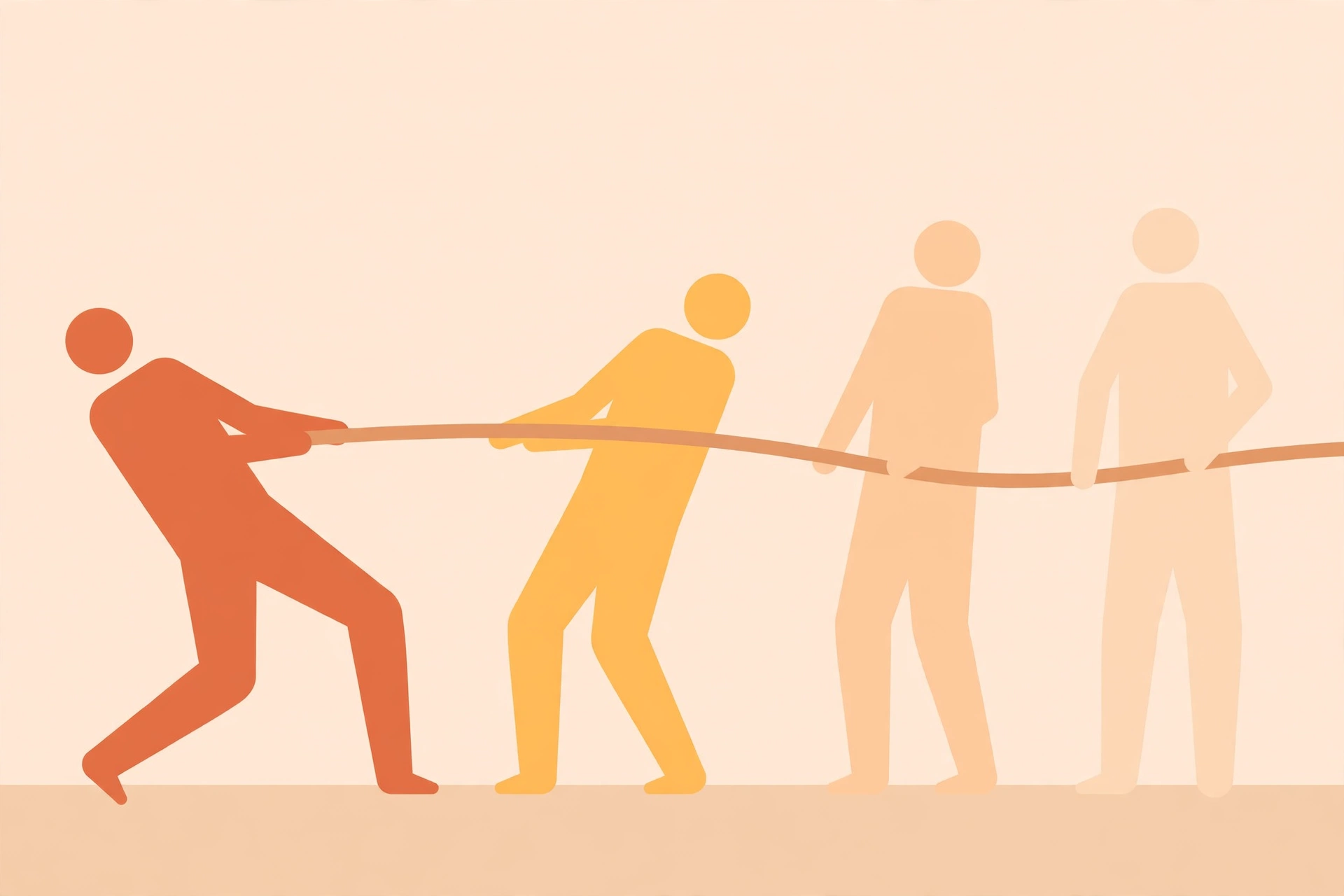
Social loafing is the tendency for people to put in less effort when they work as part of a group than when they work alone. The pattern was first documented by the French agricultural engineer Max Ringelmann, whose rope-pulling experiments were published in 1913: as more people pulled together, each person’s average contribution fell. The term “social loafing” itself was established later, in research by Bibb Latané, Kipling Williams, and Stephen Harkins in 1979, who separated the loss of motivation from simple problems of coordination.
What it looks like
Social loafing is familiar from group projects. In a team of six, one or two people often carry the work while others contribute little, even though each person would work harder alone. It also appears in workplaces, where shared tasks can drift because no single person feels responsible for the outcome, and in team sports, where a player may ease off when teammates seem to have the game covered.
Why it happens
Two causes combine. Coordination losses occur because group members struggle to combine their efforts efficiently — people pull at slightly different times, or duplicate each other’s work. Motivation losses occur because individual contributions become hard to identify: when effort is pooled, a person can feel that their own effort barely matters to the result, and the pressure to perform fades. Latané and colleagues showed the motivational part directly: people asked to shout or clap produced less noise when they believed they were part of a group than when they believed they were alone, even when the actual sound around them was the same.
An everyday example
A class is assigned a group presentation, graded as a team. One student researches thoroughly, while another does almost nothing, reasoning that the group’s grade will be fine either way. If the same student had to present alone, the work would fall squarely on them, and they would do it. The group setting did not make the student lazy in general; it made their individual effort feel invisible, and effort followed that feeling.