
Attachment pairings are the relationship dynamics that emerge when two people’s attachment patterns meet. Your own pattern is only half the story — the other half is what happens between two patterns: how one person’s closeness-seeking lands on a partner who needs space, or how two secure people’s habits reinforce each other.
The short answer to “which pairings work?”: the pairing shapes the starting conditions, but the behaviors — how you communicate, repair, and respond under stress — matter more than the label combination. This guide walks through the commonly described pairings, why they form, and what actually predicts how they go.
(A quick refresher, kept to one line each: secure — comfortable with closeness and independence; anxious — craves closeness, fears abandonment; avoidant — prizes independence, keeps distance; disorganized — wants closeness while fearing it. Full definitions live in our attachment styles guide.)
Table of Contents
The Commonly Described Pairings
These are patterns researchers and clinicians describe frequently — not categories anyone belongs to permanently, and not predictions about any specific couple.
Anxious + Avoidant: the pursuit–withdrawal cycle
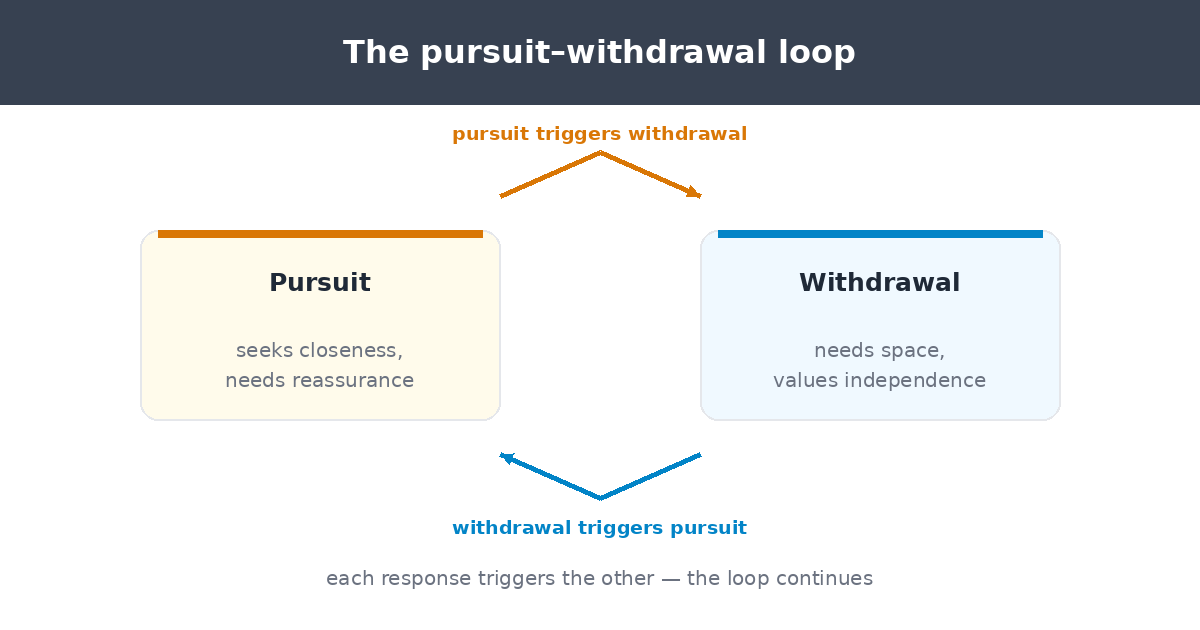
The most talked-about pairing, and the most instructive. One partner’s attachment system is set to amplify (anxious: seek closeness harder when uncertain); the other’s is set to mute (avoidant: create distance when closeness intensifies). Put them together and each person’s strategy triggers the other’s:
- She seeks reassurance → he feels crowded and withdraws → his withdrawal confirms her fear → she pursues harder → he withdraws further.
Researchers describe this as the collision of hyperactivating and deactivating strategies [5]. It’s a commonly described dynamic, not a clinical category — and it’s worth saying why it’s common rather than fated (see below). The painful part: both people are trying to feel safe, using opposite methods, and each method makes the other feel less safe.
Secure + Secure: the stable base
Two securely attached partners tend to do what secure functioning describes: communicate directly, tolerate each other’s bad days, repair after conflict. The pairing isn’t conflict-free — no pairing is — but disagreements get addressed rather than amplified or avoided. Longitudinal research has found that adult attachment security predicts the observed quality of romantic relationships over time, including how couples handle conflict [6].
Secure + Insecure: the buffering pairing
A secure partner doesn’t “fix” anyone — but secure behaviors are contagious in a limited, real sense. A partner who responds consistently, communicates directly, and doesn’t punish vulnerability provides exactly the repeated experiences of reliable care through which working models revise. The insecure partner’s patterns often soften over time in such relationships — not because the secure partner performed therapy, but because the environment stopped confirming the old alarm.
Same-style pairings: amplification, both ways
- Anxious + anxious: mutual reassurance-seeking can create intense closeness — and intense volatility. Both partners scan for threat; both need soothing the other is too activated to give. It works when both recognize the pattern; it spirals when neither does.
- Avoidant + avoidant: often comfortable and low-drama — two people who both prize space. The risk is drift: a relationship can quietly become two parallel lives, with neither partner noticing the distance growing until it’s structural.
What about disorganized (fearful-avoidant) pairings?
The push-pull conflict described in the disorganized pattern can make any pairing more volatile, because the instability comes from within one person’s system rather than from the combination. A fearful-avoidant person with a secure partner may still cycle through approach and withdrawal; with an anxious partner, the cycles can synchronize into exhausting loops. The same principle applies: the pairing sets the starting conditions, and awareness plus behavior decide more than the labels do.
Why These Pairings Form
Why do anxious and avoidant people so often find each other? Researchers offer hypotheses, not laws:
- Familiarity of working models. We tend to recognize — and be drawn to — dynamics that match our internal models of how closeness works, even when those dynamics are uncomfortable. The familiar can feel like chemistry.
- Complementary strategies. The anxious person’s pursuit and the avoidant person’s distance fit together like lock and key at first: one wants closeness, the other rations it, and the rationing makes the closeness feel precious.
- The early intensity. Pursuit–withdrawal generates strong emotion, which is easily mistaken for strong connection. Calm, consistent interest can feel boring by comparison to someone whose system equates intensity with love.
None of this is destiny. Pairings describe starting conditions — and starting conditions are exactly what awareness and behavior can change.
What Matters More Than the Pairing
Here’s the genuinely useful part, and the reason this article exists: research on relationship functioning keeps pointing at the same conclusion — what partners do predicts outcomes better than which patterns they started with:
1. Direct communication beats strategy. Saying “I’m feeling insecure tonight” works better than testing; saying “I need an hour to think” works better than vanishing. Secure functioning is largely a communication skill, and skills can be practiced regardless of pattern.
2. Repair beats perfection. Every pairing has ruptures. What distinguishes relationships that last isn’t the absence of conflict — it’s the presence of repair: returning, acknowledging, reconnecting. The secure-base cycle from childhood (explore, return for comfort, explore again) has an adult translation, and any pairing can learn it.
3. Responsiveness is the mechanism. Across the attachment literature, the active ingredient in change is experienced responsiveness — a partner who reliably notices and responds. That’s not a trait of a pairing; it’s a behavior, repeatable daily.
4. Awareness defuses the cycle. The pursuit–withdrawal loop runs on autopilot. Simply seeing it — “we’re doing the thing again” — interrupts it. Couples who can name the pattern together tend to fare better than couples who live inside it unnamed.
The bottom line: don’t ask “are we a doomed pairing?” Ask “what are we each doing when the system activates, and what could we do instead?” The first question has no useful answer. The second one does.
A note on what this article is (and isn’t)
This is educational content about relationship dynamics studied in research — not a diagnosis of you, your partner, or your relationship. Pairing descriptions are common patterns, not verdicts, and no article can tell you what your relationship should be. If relationship distress is persistent or overwhelming, a qualified professional — ideally one you see together or individually, not a webpage — is the right next step.
Frequently Asked Questions
Why do anxious and avoidant people seem to attract each other?
It’s one of the most commonly described dynamics in the attachment literature: the anxious partner’s closeness-seeking meets the avoidant partner’s distance-keeping, and the strategies complement each other at first — pursuit feels like passion, rationed closeness feels precious. Researchers describe it as the collision of hyperactivating and deactivating strategies [5]. It’s a frequent pattern, not a rule, and not a clinical category — plenty of anxious people partner securely, and vice versa.
Can two insecurely attached people have a good relationship?
Yes. The pairing sets starting conditions, not outcomes. Two people who understand their patterns — who can name the cycle when it starts and choose repair over autopilot — can build deeply satisfying relationships. What predicts success across the research is behavior (communication, responsiveness, repair), not the label combination. The pairing is the weather; how you sail in it is the skill.
Will a secure partner “fix” my attachment style?
No — and the framing matters. Nobody gets “fixed” by a partner; that’s not how attachment works and it puts an unfair burden on the relationship. What can happen is that a consistently responsive partner provides the repeated experiences of reliable care through which working models gradually revise. Change happens in the relationship, not because of it — and it still takes awareness and effort from the person changing.
Are some pairings doomed?
No pairing is doomed by its labels. What sinks relationships isn’t the combination of patterns — it’s the absence of the behaviors that make any pairing work: direct communication, repair after rupture, and responsiveness under stress. A so-called “difficult” pairing with those behaviors outperforms an “easy” pairing without them. Treat pairings as information about your starting conditions, not as fortune-telling.
Keep Exploring
- Attachment Styles — all four patterns compared side by side.
- Anxious Attachment — the dedicated profile: signs, roots, relationship patterns, and growth.
- Secure Attachment — the dedicated profile: signs, development, and earned security.
References
- Attachment style — APA Dictionary of Psychology (describes adult attachment styles). https://dictionary.apa.org/attachment-style (opened and verified)
- Attachment in Young Adulthood — Lifespan Human Development: A Topical Approach (open textbook), Baylor University (Hazan & Shaver’s three adult styles; adult attachment in relationships). https://openbooks.library.baylor.edu/lifespanhumandevelopment/chapter/chapter-17-2-attachment-in-adulthood/ (opened and verified)
- Hazan, C., & Shaver, P. (1987). Romantic love conceptualized as an attachment process. Journal of Personality and Social Psychology, 52(3), 511–524. https://doi.org/10.1037/0022-3514.52.3.511 (citation verified via PsycNet)
- What Do Self-Report Measures of Attachment Assess? — P. R. Shaver (chapter; Bartholomew & Horowitz, 1991 four-category model; Brennan, Clark, & Shaver, 1998 dimensions; relationship-specificity of attachment). https://adultattachment.faculty.ucdavis.edu/wp-content/uploads/sites/66/2015/09/Shaver_2004_What-Do-Self-Report-Measures-of-Attachment-Assess.pdf (opened and verified)
- Attachment Theory and Emotions in Close Relationships — M. Mikulincer & P. R. Shaver (chapter; attachment-system dynamics; hyperactivating vs. deactivating strategies). https://adultattachment.faculty.ucdavis.edu/wp-content/uploads/sites/66/2015/09/Mikulincer_2005_Attachment-theory-and-emotion-in-close-relationships.pdf (opened and verified)
- Adult Attachment Security and Young Adults’ Dating Relationships over Time — Holland, A. S., & Roisman, G. I. (2010), Developmental Psychology, 46(2), 552–557 (abstract verified via ERIC: https://eric.ed.gov/?id=EJ876011)