
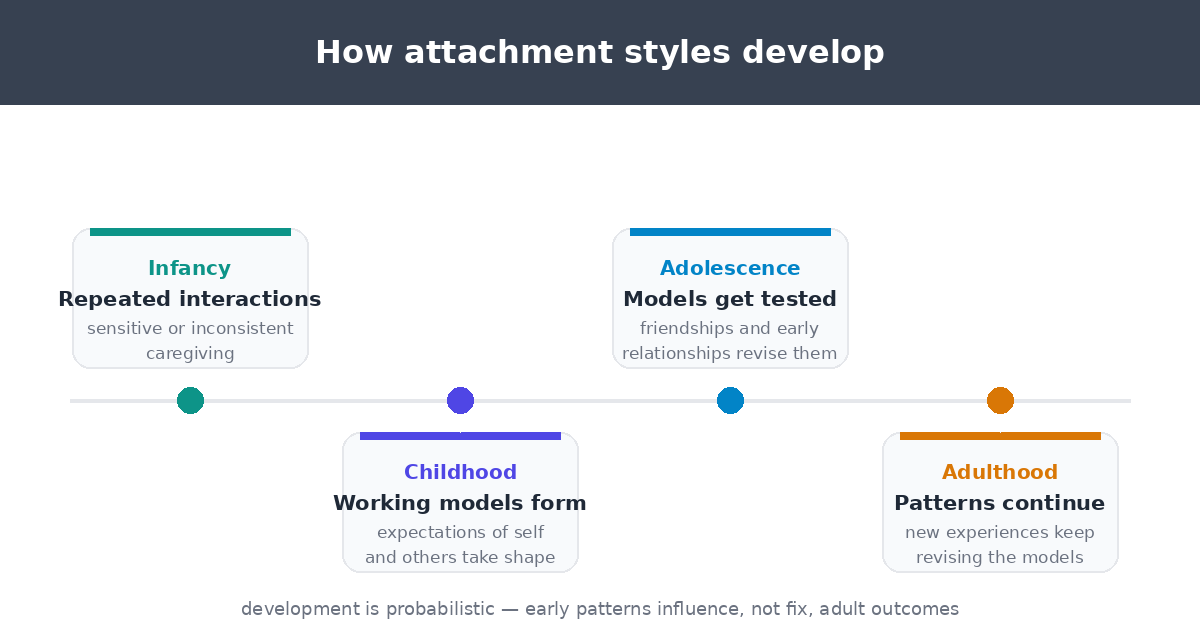
Where do attachment styles come from? The short answer from decades of research: mainly from repeated early interactions with caregivers, filtered through the child’s temperament, and revised — sometimes substantially — by later relationships. Early experience matters enormously, but it is not fate: development is probabilistic, and the story doesn’t end in childhood.
This guide covers the general science of how attachment patterns form. (For how attachment itself works as a bond, or the history of attachment theory, see those guides — here we focus on development.)
Table of Contents
The Core Idea: Caregiver Sensitivity
The single best-studied predictor of how attachment develops is caregiver sensitivity: the degree to which a caregiver notices an infant’s signals, interprets them accurately, and responds promptly and appropriately. This is Ainsworth’s caregiver sensitivity hypothesis, and it has held up across decades of research [3][4].
Sensitivity is not perfection, and it’s not a parenting style brand. Concretely, it looks like this:
- Noticing. The caregiver registers the signal — the cry, the reach, the averted gaze — rather than missing it.
- Interpreting accurately. Hunger gets food; fear gets comfort; overstimulation gets a quieter room. The response matches the need, not just the noise.
- Responding promptly and appropriately. Not instantly, not perfectly — but reliably enough that the infant learns a lesson: distress brings comfort; signals work.
The infant who internalizes that lesson builds what Bowlby called a secure internal working model — roughly, “I am worthy of care, and others are generally reliable.” The infant whose signals are repeatedly missed, rebuffed, or met unpredictably builds a different model — and a different strategy for handling need [3][4].
Crucially, researchers describe these as associations, not recipes. Sensitivity raises the odds of security; it doesn’t manufacture it on an assembly line. Which brings us to the rest of the story.
What the Strange Situation Revealed
Ainsworth’s Strange Situation — a ~20-minute laboratory procedure of separations and reunions with infants around 12–18 months — gave researchers their first systematic look at how these early patterns show up in behavior. It identified three organized patterns: secure infants (distressed at separation, soothed at reunion), avoidant infants (not visibly distressed, avoiding the returning caregiver), and ambivalent/resistant infants (distressed, hard to soothe, resisting comfort while seeking it). Main and Solomon later added the disorganized pattern [3].
The procedure matters for development because it showed something profound: by 12 months, infants already behave as if they have expectations about whether comfort will come. Those expectations — the early working models — were already shaping behavior. (The full story of the procedure and what it found lives in our guide to the Strange Situation.)
Beyond Caregiving: The Other Ingredients
Caregiving is the best-studied influence, but researchers are explicit that it isn’t the only one. The honest developmental picture includes:
- Temperament. Infants arrive with their own dispositions — how reactive they are, how easily soothed, how intense their signals. Temperament shapes the interaction from the child’s side: a highly reactive infant and a calm one can pull different responses from the same caregiver, and researchers debate the exact weights [1].
- Family circumstances and stress. Poverty, parental depression, marital conflict, social isolation — the conditions around the caregiver affect the caregiving. This is one reason researchers resist blaming parents: sensitivity is harder under strain, and strain is often not the parent’s choosing.
- Later relationships. Perhaps the most hopeful ingredient: attachment patterns keep developing. Friendships, mentors, romantic partners, and therapists in adolescence and adulthood provide new interaction histories — new evidence the working model must reckon with. Development doesn’t close the books at age two.
“Responsive caregiving raises the odds” is the accurate summary. “Responsive caregiving guarantees the outcome” is the version researchers warn against.
Do Early Patterns Last? Stability Is Modest
Here’s where the science gets honest in a way pop psychology often skips: attachment patterns show meaningful but modest stability across development — not the ironclad continuity people assume.
The key study: Groh, Roisman, Booth-LaForce, and colleagues (2014) followed attachment security from infancy to late adolescence and found stability that was “significant but very modest.” Strikingly, the broader quality of childhood experience predicted later security better than the infancy classification alone [1].
What this means: early patterns are a starting point with real predictive value, not a life sentence. The same research tradition that established that early experience matters also established its limits. Both findings are true, and any honest account of development holds them together.
Patterns Across Generations
One of the most replicated findings in the field: parents’ own attachment representations predict their infants’ attachment patterns. Van IJzendoorn’s (1995) meta-analysis on the Adult Attachment Interview found that how adults talk about their own early attachment experiences predicts their children’s Strange Situation classifications [2]. Later work (Verhage et al., 2016) synthesized three decades of this research and worked on “narrowing the transmission gap” — understanding how the transmission happens, with parental responsiveness as a key pathway [1].
The mechanism researchers propose is straightforward: adults carry working models built from their own early experiences; those models shape how they perceive and respond to their children’s signals; the children’s patterns form in response. It’s not genetic destiny — it’s interaction patterns, passed along through behavior. And because it’s behavioral, it’s interruptible: the same research shows that reflective, supported parenting can break the cycle.
The Four Styles’ Roots — In One Line Each
The general science above plays out differently for each pattern. One line each — the full stories live in the profiles:
- Secure: associated with consistently responsive caregiving — signals noticed, needs met, ruptures repaired. → Secure Attachment
- Anxious: associated with inconsistent caregiving — comfort that sometimes comes and sometimes doesn’t, teaching the child to signal louder. → Anxious Attachment
- Avoidant: associated with rejecting or consistently unresponsive caregiving — bids for comfort rebuffed, teaching the child to stop showing need. → Full profile in preparation: Avoidant Attachment
- Disorganized: associated with frightening or frightened caregiving — the caregiver as simultaneously safe haven and source of fear, the bind Main and Hesse called “fear without solution.” → Full profile in preparation: Disorganized Attachment
(For how the four compare as adult patterns, see the four attachment styles.)
What About Change?
Development doesn’t end — and neither does this story. The same working models that form in childhood stay open to revision: new relationship experiences can and do reshape them. Whether, how, and how much attachment patterns can change in adulthood is its own question, and our upcoming guide on whether attachment styles can change takes the evidence in full.
A note on what this article is (and isn’t)
This is educational content about developmental research — not a diagnosis of you, your parents, or your children. Developmental patterns describe probabilities across populations, not verdicts on individuals. If concerns about a child’s development or your own early experiences feel pressing, a qualified professional is the right next step — not a webpage.
Frequently Asked Questions
Are attachment styles caused by parents?
Parents — or more precisely, early caregivers — are the best-studied influence, but “caused by” overstates it. Caregiver sensitivity is associated with how patterns develop; temperament, family circumstances, and later relationships all contribute, and researchers describe probabilities, not certainties. Blaming parents also misses the point: sensitivity is harder under strain, and the same science that implicates early experience shows it isn’t destiny.
Can a difficult temperament override good caregiving?
Temperament and caregiving interact rather than compete. A more reactive infant may need more co-regulation; a calm infant may need less. Researchers describe goodness-of-fit: outcomes depend on the match between the child’s dispositions and the caregiving environment, not on either alone. This is one reason two children with the same parents can develop different patterns.
Do attachment patterns run in families?
To a degree, yes — and the mechanism is behavioral, not genetic. Meta-analytic research finds that parents’ own attachment representations predict their infants’ patterns, largely through parental responsiveness: the working models adults carry shape how they read and respond to their children’s signals [1][2]. Because the transmission runs through behavior, it can also be interrupted — which is why researchers study reflective parenting and support for struggling parents.
If early patterns don’t always last, why does childhood matter?
Because “not always” isn’t “never,” and because early experience shapes the starting point. Modest stability still means early patterns predict later functioning better than chance — and the broader quality of childhood experience predicts later security better than any single early classification [1]. Childhood matters the way a foundation matters: it influences everything built on it without determining the final shape.
Keep Exploring
- Attachment Theory Explained — the full framework: Bowlby, Ainsworth, the Strange Situation, and adult attachment research.
- Attachment Styles — all four patterns compared side by side.
- Secure Attachment — the dedicated profile: signs, development, and earned security.
References
- Attachment — From Theory to Practice (Fearon et al.; UCL-hosted PDF summarizing attachment theory progress, including Groh et al., 2014 on “significant but very modest” stability of attachment security from infancy to late adolescence, and Verhage et al., 2016 on intergenerational transmission). https://discovery.ucl.ac.uk/id/eprint/1543228/1/Fearon_Attachment%20theory_progress.pdf (opened and verified)
- Adult attachment representations, parental responsiveness, and infant attachment: A meta-analysis on the predictive validity of the Adult Attachment Interview — van IJzendoorn, M. H. (1995), Psychological Bulletin, 117(3), 387–403. https://doi.org/10.1037/0033-2909.117.3.387 (citation verified per research pack)
- Attachment — Culture and Psychology (open textbook), OpenStax via Maricopa Community Colleges (Ainsworth; caregiver sensitivity; Strange Situation). https://open.maricopa.edu/culturepsychology/chapter/attachment/ (opened and verified)
- Attachment Theory — Introduction to Psychology (open textbook), Bay Path University (caregiver sensitivity; patterns of attachment). https://open.baypath.edu/psy101introductiontopsychology/chapter/attachment-theory/ (opened and verified)
- Attachment style — APA Dictionary of Psychology (describes adult attachment styles). https://dictionary.apa.org/attachment-style (opened and verified)
- What Do Self-Report Measures of Attachment Assess? — P. R. Shaver (chapter; Brennan, Clark, & Shaver, 1998 dimensions; attachment across relationships). https://adultattachment.faculty.ucdavis.edu/wp-content/uploads/sites/66/2015/09/Shaver_2004_What-Do-Self-Report-Measures-of-Attachment-Assess.pdf (opened and verified)