
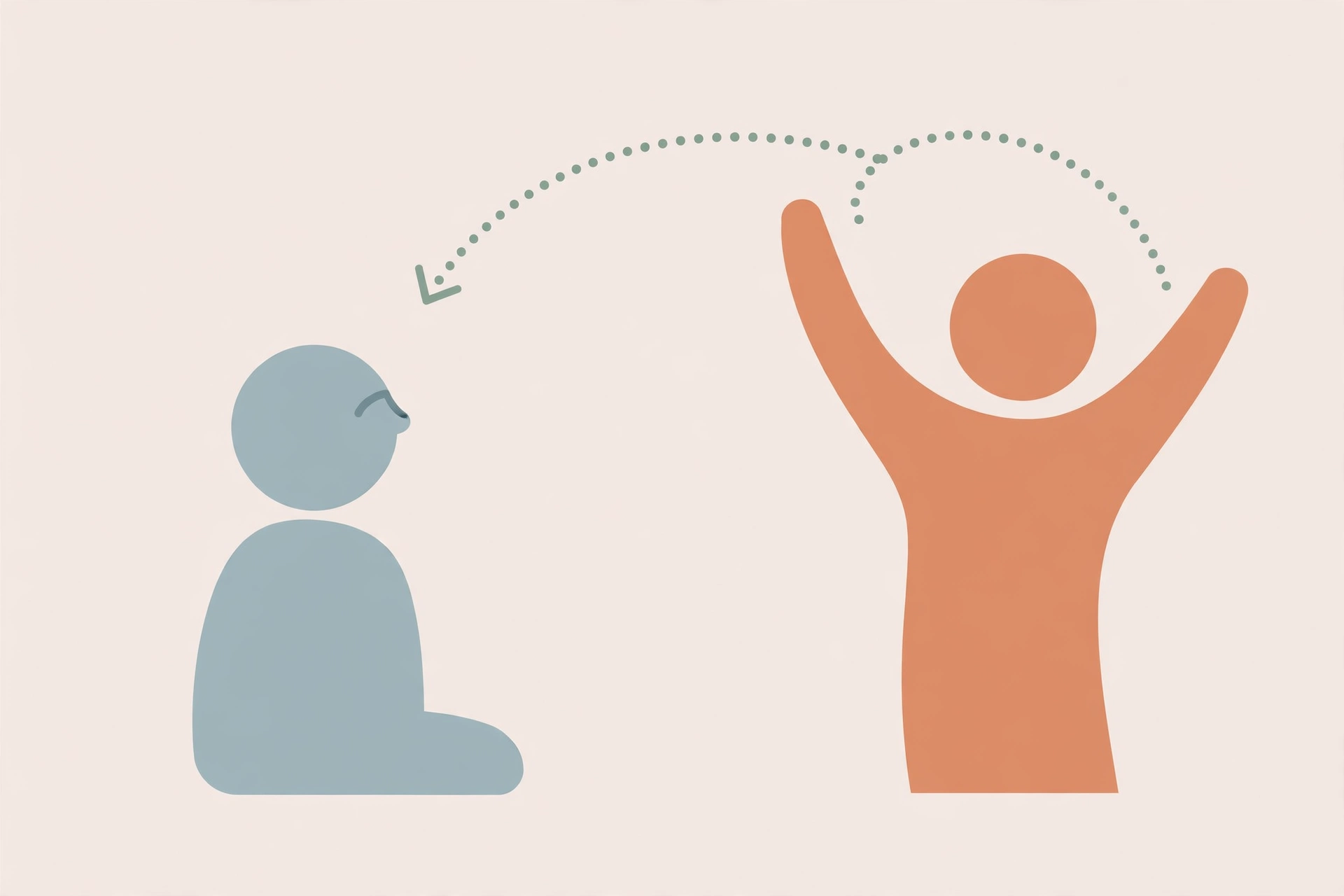
Observational learning is learning by watching: you pick up a behavior by seeing someone else perform it, without having to be rewarded or punished for it yourself. A child learns to tie shoes by watching a parent, a new employee learns office norms by watching colleagues, and a viewer can pick up phrases, gestures, and attitudes from people on screen. No direct reinforcement is needed for the learning itself — though reinforcement still decides whether the learned behavior gets performed.
This article is educational, not clinical. It explains the classic research, the conditions that make observation turn into imitation, and the practical implications — including the honest limits of what the famous studies actually showed.
Table of Contents
Bandura and the Bobo Doll Studies
The landmark research came from Albert Bandura in the early 1960s. In the best-known study, children watched an adult model behave aggressively toward an inflatable Bobo doll — hitting, kicking, and shouting at it — and were later left alone with the doll. Children who had seen the aggressive model imitated the aggression, often reproducing the model’s exact actions and phrases, while children who had seen a non-aggressive model did not (Bandura et al., 1961). The result challenged a core behaviorist assumption: learning had occurred without the children themselves being reinforced for anything. They learned by watching.
Bandura later formalised the account in Social Learning Theory (Bandura, 1977) and its expansion into social cognitive theory (Bandura, 1986). The key move was to put mental processes back into learning: observers do not just copy reflexively; they attend to a model, retain what they saw, reproduce it when they are able, and are motivated to perform it depending on the consequences they expect. A child who sees aggression rewarded is more likely to imitate it than one who sees it punished — vicarious reinforcement, learning from consequences that happen to someone else.
The Four Steps: Attention, Retention, Reproduction, Motivation
For observation to become behavior, four conditions must be met. Attention: the observer must actually notice the modeled behavior — distinctive, relevant, or admired models attract more attention. Retention: the observer must remember it, usually by encoding it in words or images that can be recalled later. Reproduction: the observer must be physically and cognitively capable of performing it — a toddler cannot imitate a tennis serve no matter how carefully they watch. Motivation: the observer must have a reason to perform it, which usually comes from expecting a reward, avoiding punishment, or identifying with the model. When any step fails, learning stays latent: the person knows how, but does not do.
This framework explains why modeling is so uneven in practice. A charismatic model with high status is imitated more than a low-status one. A behavior shown with clear steps is retained better than a confusing one. And a behavior the observer has no reason to perform remains knowledge, not action — which is why media exposure alone does not mechanically produce imitation, despite the fears the Bobo doll studies sometimes inspire.
What the Bobo Doll Studies Do and Do Not Show
The studies are often overread, so the limits deserve plain statement. First, the setting was artificial: a laboratory playroom, a doll designed to be hit, and children given permission to play aggressively. Imitating an adult’s play with a toy is not the same as real-world violence, and later research has debated how far the findings generalise. Second, the children were young, and younger children imitate more readily than adults. Third, the studies showed short-term imitation, not long-term character change. None of this erases the core finding — that observation alone can teach new behavior — but it does mean the studies should not be cited as proof that watching aggression makes people violent. The honest summary is narrower and still important: we learn a great deal by watching, and what models do matters, especially for children.
Observational Learning in Everyday Life
The applications are broad. Education relies on modeling constantly: worked examples, demonstrations, and apprenticeships all work because observation teaches. Therapy uses modeling too — a person afraid of dogs may first watch someone else interact calmly with a dog before approaching one themselves. Parenting is modeling in real time: children absorb how adults handle frustration, disagreement, and kindness, whether or not anyone intends to teach it. And at work, newcomers learn the unwritten rules — how meetings really run, what gets rewarded — mostly by watching, not from handbooks.
The same mechanism cuts the other way. Models who are rewarded for aggression, dishonesty, or cruelty teach those behaviors as surely as models who are rewarded for patience teach patience. That is why the choice of models — in families, classrooms, teams, and media — is a genuine responsibility, not just a preference. It is also why self-efficacy, Bandura’s later concept of belief in one’s own capability, matters: people imitate what they believe they can actually do, and watching someone similar succeed raises that belief more than watching an expert.
Key Takeaways
- Observational learning is learning by watching others, without needing direct reinforcement for the learning itself (Bandura, 1977).
- The Bobo doll studies showed children imitating an adult’s exact aggressive actions toward a doll after merely observing them (Bandura et al., 1961).
- Four steps govern whether observation becomes behavior: attention, retention, reproduction, and motivation.
- Vicarious reinforcement — consequences happening to the model — shapes whether learned behavior is performed.
- The studies’ limits matter: artificial setting, young children, short-term imitation; they do not prove that watching aggression makes people violent.
- Applications span education, therapy, parenting, and workplace culture — and make model choice a real responsibility.
References
- Bandura, A. (1977). Social Learning Theory. Prentice Hall.
- Bandura, A. (1986). Social Foundations of Thought and Action: A Social Cognitive Theory. Prentice Hall.
- Bandura, A., Ross, D., & Ross, S. A. (1961). Transmission of aggression through imitation of aggressive models. The Journal of Abnormal and Social Psychology, 63(3), 575–582. https://doi.org/10.1037/h0045925
Keep Exploring
- Behavioral Psychology: How Learning Shapes Behavior
- Classical Conditioning: How Association Creates Learning
- Operant Conditioning: How Consequences Shape Behavior
- Theories of Personality
What is observational learning in simple terms?
Learning by watching others: you acquire a behavior by seeing someone else do it, without being directly rewarded or punished yourself.
What did the Bobo doll experiment show?
Children who watched an adult act aggressively toward an inflatable doll later imitated those exact aggressive actions, while children who saw a non-aggressive model did not (Bandura et al., 1961).
What are the four steps of observational learning?
Attention (noticing the behavior), retention (remembering it), reproduction (being able to perform it), and motivation (having a reason to perform it).
Does watching violence make people violent?
The Bobo doll studies do not prove that. They show short-term imitation in an artificial setting with young children; real-world aggression has many more causes, and the studies should not be overread.
How is observational learning different from operant conditioning?
Operant conditioning changes behavior through direct consequences for your own actions; observational learning happens through watching consequences happen to someone else.