
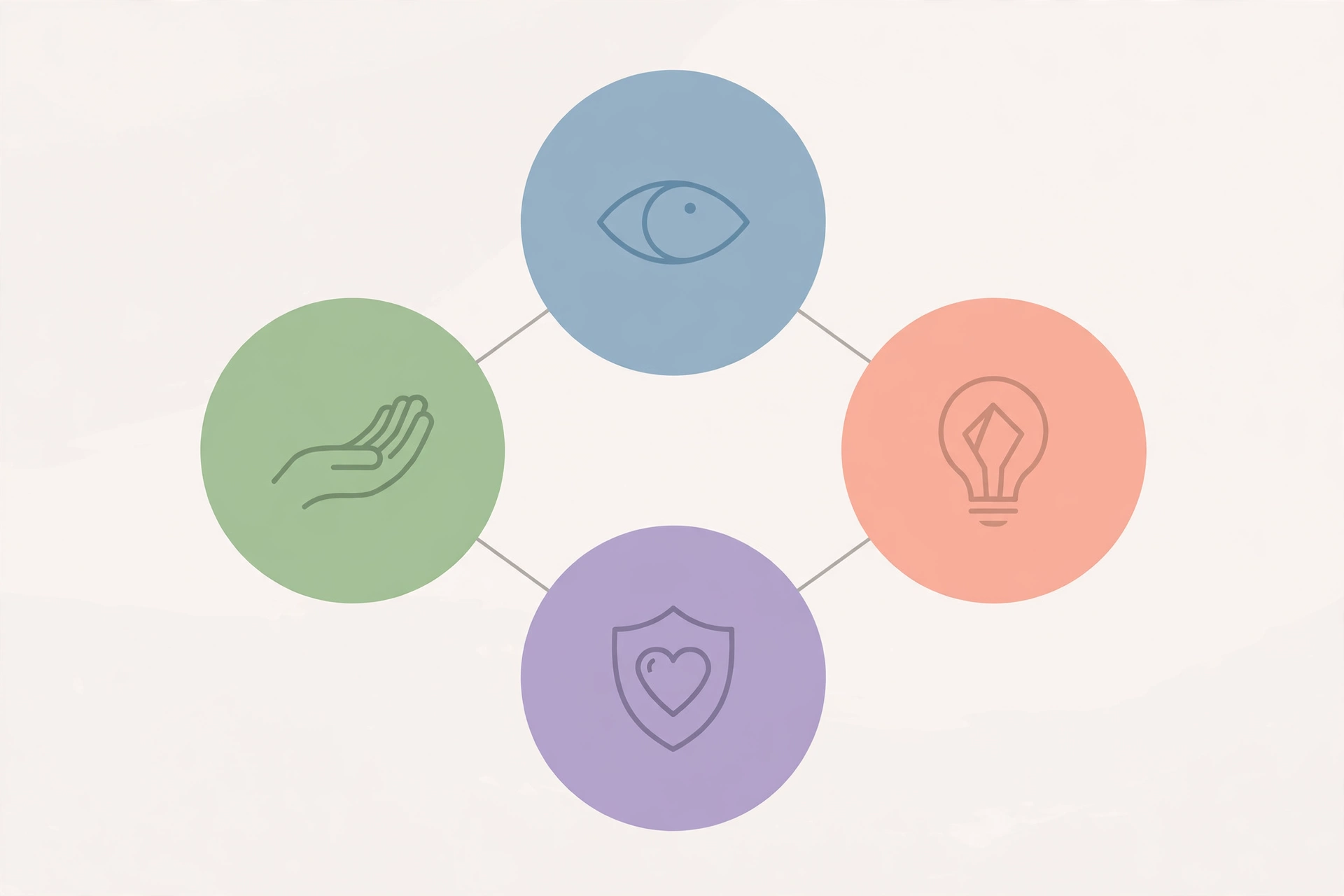
Emotional intelligence is two different things sharing one name, and most confusion about it comes from mixing them up. In the scientific ability model, emotional intelligence is a set of mental abilities: perceiving emotions accurately, using them to help thinking, understanding how they develop, and managing them in yourself and others. In the popular version, it is a broad bundle of character traits — persistence, optimism, social skill, self-control, and more or less everything admirable that is not IQ. The first is a testable claim about a specific ability. The second is a marketing category. This article keeps them apart and asks what the evidence actually supports.
This article is educational, not clinical. It explains the emotional intelligence construct, its measures, and the scientific debate around it. It is not a test, a diagnosis, or a program for raising your score, and no self-report quiz can measure the ability version of emotional intelligence.
Table of Contents
The Ability Model: Four Branches
The scientific concept began with Salovey and Mayer (1990), who defined emotional intelligence as the ability to monitor one’s own and others’ feelings, to discriminate among them, and to use that information to guide thinking and action. Mayer, Salovey, and Caruso (2004) developed this into the four-branch model: perceiving emotions (recognizing them in faces, voices, and art), facilitating thought (using emotions to assist reasoning and creativity), understanding emotions (knowing how emotions combine, change, and follow from situations), and managing emotions (regulating them in yourself and others to reach goals).
The four branches are arranged from basic to complex. Perceiving is the entry skill — you cannot reason with emotions you cannot detect. Managing is the most complex, because it requires the other three plus judgment about what outcome is wanted. The model is deliberately narrow: it claims emotional intelligence is an intelligence, meaning it should behave like one — developing with age and experience, showing a pattern of correlations with other abilities, and being measurable with right and wrong answers rather than self-descriptions.
That last point is what separates the ability model from the popular version. The standard ability test, the Mayer-Salovey-Caruso Emotional Intelligence Test (MSCEIT), asks people to solve emotional problems — identifying the emotion in a face, or choosing the best response to an emotional situation — and scores answers against expert or consensus criteria. Whether you think you are emotionally intelligent is irrelevant to your score, which is exactly the point.
The Popular Version: How a Narrow Idea Became Everything
Daniel Goleman’s (1995) bestselling book Emotional Intelligence took the early scientific model to a mass audience — and, as Mayer and his colleagues later noted, mixed in many other traits, including persistence, zeal, self-control, and character as a whole. The popular version that followed treats emotional intelligence as the secret of success in work, leadership, and relationships, often contrasted with IQ: the claim, in its strongest form, is that EI matters more than IQ for life outcomes.
That claim outruns the evidence. The traits bundled into popular EI — conscientiousness, optimism, social skill — do predict life outcomes, but they are largely personality traits by another name, and personality psychology already studies them. When a popular EI questionnaire predicts job performance, the honest question is whether it predicts anything beyond the Big Five personality traits and general cognitive ability. Often, once those are accounted for, the extra prediction shrinks substantially. The popular version’s success as a product is not evidence for it as a science.
What the Evidence Actually Shows
The ability model has real but modest support. Mayer, Salovey, and Caruso (2004) reviewed evidence that emotional intelligence exists as a measurable ability, that it satisfies many of the criteria for an intelligence, and that it predicts matters of consequence — for example, aspects of social functioning and relationship quality. Mayer, Roberts, and Barsade (2008) later reviewed the field and concluded that ability EI is a genuine, if narrow, human ability with meaningful correlates, while noting that its real-world predictive power is smaller than popular claims suggest.
Three qualifications matter. First, ability EI correlates with other abilities and with personality, so its unique contribution is smaller than its total correlation with outcomes. Second, measurement is imperfect: consensus scoring (marking answers right when most people agree) is philosophically awkward for an “intelligence,” and expert scoring depends on whose expertise counts. Third, most outcome studies are correlational — people with higher ability EI tend to have better relationships, but that does not prove that raising EI would cause better relationships, and training programs claiming large effects should be treated skeptically.
The Overlap Problem: Is EI Just Personality?
The sharpest scientific criticism of emotional intelligence is that it overlaps heavily with personality traits — especially for self-report measures. If a questionnaire asks whether you stay calm under pressure, stay optimistic, and get along with people, it is largely measuring emotional stability, optimism, and agreeableness, which personality psychology has measured for decades. Calling the total “emotional intelligence” adds a label, not a discovery.
The ability model answers this criticism better than the popular version, because ability tests correlate less with personality self-reports than self-report EI scales do. But the overlap does not vanish: ability EI still correlates with openness and other traits, and critics argue that even the four-branch model partly repackages social and practical intelligence. The fairest summary is that ability EI is a real but narrow construct with genuine incremental value in some domains, while trait EI — the popular bundle — is mostly personality under a newer brand. Anyone selling an EI test or training should be asked which version they mean, and what it predicts beyond personality and IQ.
Using the Idea Well
Emotional intelligence is most useful when treated precisely. If you want to know whether someone can read emotions accurately, use an ability test, not a self-report. If you want to predict workplace success, personality and cognitive ability remain the stronger, better-validated predictors, and EI adds at most a modest increment. If you want to improve how you handle emotions, the evidence points to emotion regulation skills — reappraisal, attention, situation management — rather than to raising a single EI score.
It is also worth separating skill from virtue. A person can be highly skilled at perceiving and managing emotions and use that skill manipulatively; emotional intelligence, in the ability sense, is morally neutral. The popular version’s habit of treating EI as goodness — empathy, kindness, character — smuggles a moral judgment into a measurement claim. Keeping the ability and the virtue apart makes both clearer: skills can be measured, virtues must be argued for.
Key Takeaways
- The ability model defines emotional intelligence narrowly: perceiving, facilitating, understanding, and managing emotions (Salovey & Mayer, 1990; Mayer, Salovey, & Caruso, 2004).
- The popular version bundles many personality traits — persistence, optimism, social skill — and its strong claims about success outrun the evidence (Goleman, 1995).
- Ability EI is measurable with right-and-wrong-answer tests like the MSCEIT, and has modest, real correlates with social functioning (Mayer, Roberts, & Barsade, 2008).
- The sharpest criticism is overlap: self-report EI largely restates personality traits, and even ability EI correlates with openness and other traits.
- For prediction, personality and cognitive ability remain stronger; EI adds at most a modest increment, and training claims should be treated skeptically.
- Emotional skill is morally neutral: perceiving and managing emotions well can serve manipulation as easily as kindness.
References
- Goleman, D. (1995). Emotional Intelligence. Bantam Books.
- Mayer, J. D., Roberts, R. D., & Barsade, S. G. (2008). Human abilities: Emotional intelligence. Annual Review of Psychology, 59, 507–536. https://doi.org/10.1146/annurev.psych.59.103006.093646
- Mayer, J. D., Salovey, P., & Caruso, D. R. (2004). Emotional intelligence: Theory, findings, and implications. Psychological Inquiry, 15(3), 197–215. https://doi.org/10.1207/s15327965pli1503_02
- Salovey, P., & Mayer, J. D. (1990). Emotional intelligence. Imagination, Cognition and Personality, 9, 185–211.
- Schutte, N. S., Malouff, J. M., Hall, L. E., Haggerty, D. J., Cooper, J. T., Golden, C. J., & Dornheim, L. (1998). Development and validation of a measure of emotional intelligence. Personality and Individual Differences, 25(2), 167–177. https://doi.org/10.1016/S0191-8869(98)00001-4
Keep Exploring
- The Psychology of Emotions: What Feelings Are and Why
- What Is Personality Psychology?
- Theories of Personality
- Cognitive Biases: How Your Mind Takes Shortcuts
- Emotional Intimacy
What is emotional intelligence?
In the scientific ability model, it is the ability to perceive, use, understand, and manage emotions (Salovey & Mayer, 1990; Mayer, Salovey, & Caruso, 2004). In the popular version, it is a broad bundle of personality traits.
Can emotional intelligence be measured?
Ability EI can be tested with problem-solving instruments like the MSCEIT, scored against expert or consensus answers. Self-report questionnaires mostly measure personality traits, not the ability.
Is emotional intelligence more important than IQ?
No — that popular claim outruns the evidence. Ability EI predicts some outcomes modestly, but cognitive ability and personality remain the stronger predictors, and EI’s unique contribution is small.
Is emotional intelligence just personality?
For self-report measures, largely yes — they overlap heavily with traits like emotional stability and agreeableness. Ability measures overlap less, but the overlap does not vanish.
Can you improve your emotional intelligence?
Specific skills can be trained — emotion perception, reappraisal, regulation — but there is no good evidence that a single EI score can be raised dramatically, and training programs claiming large effects should be treated skeptically.