
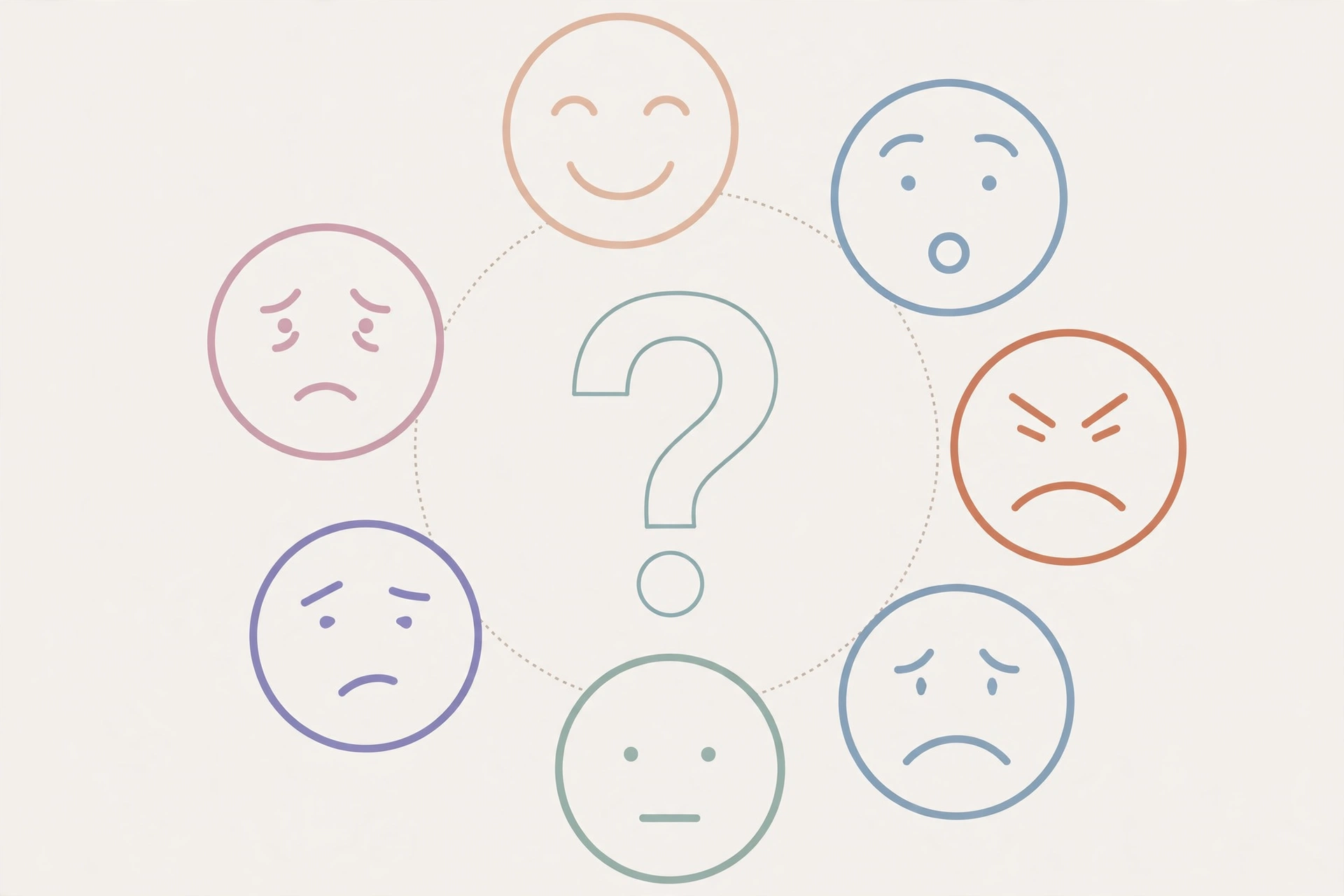
Faces are the most studied channel of emotional communication, and the most overclaimed. The classic finding is that some facial expressions are recognized across cultures at rates well above chance: a smile reads as happiness, a scowl as anger, a wide-eyed gasp as fear, in places as different as the United States and Japan. But recognition in a laboratory task is not the same as reading a mind in real life. What faces reliably show, what they only suggest, and where culture and context take over is a more careful story than either “faces are universal” or “faces mean nothing.”
This article is educational, not clinical. It summarizes research on facial expressions and emotion, including where the evidence is strong and where it is contested. It is not a guide to detecting lies or diagnosing anyone from their face.
Table of Contents
Darwin’s Starting Point
The scientific study of facial expression begins with Charles Darwin (1872), who argued in The Expression of the Emotions in Man and Animals that human expressions have evolutionary roots shared with other animals: baring teeth, widening eyes, and raising eyebrows are not arbitrary conventions but servicea/ble habits shaped by survival. Darwin’s book set the agenda that still organizes the field — are expressions inherited and universal, or learned and cultural? — even though his evidence was anecdotal by modern standards.
Darwin’s question lay mostly dormant until the 1960s, when Paul Ekman and colleagues took it up with systematic cross-cultural experiments. The contrast between the two eras matters: Darwin observed and reasoned; Ekman photographed, posed, and counted. The modern debate is about what those counts actually prove.
Ekman’s Cross-Cultural Evidence
Ekman and Friesen’s early work tested whether people in very different cultures matched the same faces to the same emotions. In one landmark study, members of a preliterate culture in New Guinea with minimal exposure to outside media associated the same emotion concepts with the same facial behaviors as members of Western and Eastern literate cultures (Ekman, Sorenson, & Friesen, 1971). A larger follow-up across 10 cultures found very high agreement about which emotion was most intense in each expression, though cultures differed in judgments of absolute intensity (Ekman et al., 1987).
Ekman (1992) drew these findings into an argument for basic emotions: happiness, sadness, anger, fear, disgust, and surprise form a set with distinctive signals, physiology, and antecedents, evolved to deal with fundamental life tasks. On this view, the face is a readout of an underlying emotional state, and the readout is substantially shared across humanity. That claim — not just that faces are recognized, but that they express biologically given emotions — is what made the work famous and controversial.
The Challenge: Context and Culture
The challenge comes from two directions. First, recognition in forced-choice tasks overstates real-world accuracy: when observers must pick from a short list of emotion words, agreement is high, but when they describe faces freely or judge them in rich contexts, agreement drops and context sways judgments heavily. A face that reads as “angry” in isolation may read as “in pain” or “concentrating” once a situation is supplied.
Second, cultural variation is real and substantial. Research with remote communities has found cases where facial expressions are not sorted into the same emotion categories as in Western samples. Gendron and colleagues (2014), for example, reported that perceptions of emotion from facial expressions were not culturally universal in a remote culture, a direct challenge to the strongest universality claims. Display rules also vary: cultures differ in when expressions are amplified, softened, masked, or suppressed, so the same feeling may be displayed very differently — or not at all.
The honest summary is a middle position. Some facial patterns — especially for happiness, and to a lesser extent for anger, fear, sadness, disgust, and surprise — are recognized across cultures at above-chance rates, which is a genuine and important finding. But recognition is not mind-reading: it is probabilistic, context-dependent, and shaped by the observer’s own categories. Faces provide evidence about emotion, not proof of it.
Facial Feedback: Does the Face Shape the Feeling?
A related question is whether expressions influence feelings, not just display them. The facial feedback hypothesis says that adopting an expression nudges experience in that direction — that smiling can make you feel slightly happier, and frowning slightly angrier. Early evidence was mixed and the most famous test, the pen-in-mouth study, failed to replicate cleanly.
Two large-scale efforts clarified the picture. A 2019 meta-analysis found facial feedback effects were small and variable (Coles, Larsen, & Lench, 2019). Then a preregistered multi-lab study with 3,878 participants across 19 countries found that mimicking smiling photographs and voluntarily posing a smile could both amplify and initiate feelings of happiness, while the pen-in-mouth manipulation was less conclusive (Coles et al., 2022). The current best reading is modest: facial feedback is real but small. Holding a smile will not manufacture joy, but expressions are part of the emotional system, not just its output — consistent with the embodied view that goes back to James (1884).
What Faces Cannot Tell You
Faces cannot reliably tell you whether someone is lying. The popular idea that microexpressions betray deception has far weaker support than television suggests: expressions are controllable, context-dependent, and variable, and no facial cue or combination has been shown to identify liars at rates useful for real decisions. Faces also cannot tell you the cause of an emotion — a fearful face does not say what is feared — nor its intensity with precision, since display rules and individual differences intervene.
Faces are also poor evidence about character. A “trustworthy-looking” face is a judgment made by the observer’s brain, shaped by resemblance to familiar people and cultural stereotypes, not a readout of the other person’s traits. The same applies to reading complex states like guilt, jealousy, or love from a face alone: these states involve appraisals and histories that no single expression encodes. The site’s articles on jealousy and emotional intimacy cover those states in their own terms precisely because a face cannot carry them.
Reading Faces Well
Reading faces well means treating them as one source of evidence among several. Combine the expression with context (what just happened?), voice, posture, words, and what you know about the person. Expect ambiguity: the same expression can mean different things, and the same feeling can wear different expressions. Discount forced certainty — anyone selling exact face-reading is selling past the evidence. And remember display rules: in some settings and cultures, a neutral face is politeness, not coldness, and a smile is greeting, not happiness.
Used that way, faces are genuinely informative. A friend’s sudden fear face is worth attending to; a child’s distress face is a signal to respond. The error is not in reading faces at all, but in reading them as if they were transparent windows rather than social signals — produced by people, shaped by culture, and best understood in context. Reading emotion from a face is one branch of emotional intelligence: perceiving emotions.
Key Takeaways
- Some facial expressions — especially happiness, and to a lesser extent anger, fear, sadness, disgust, and surprise — are recognized across cultures above chance (Ekman, Sorenson, & Friesen, 1971; Ekman et al., 1987).
- Ekman (1992) argued these reflect basic emotions with distinctive signals and evolutionary functions.
- Recognition is probabilistic and context-dependent, not mind-reading; free descriptions and rich contexts lower agreement and raise cultural variation (Gendron et al., 2014).
- Facial feedback is real but small: posing a smile can amplify or initiate happiness slightly, but it does not manufacture emotion (Coles et al., 2022; Coles, Larsen, & Lench, 2019).
- Faces cannot reliably detect lying, reveal the cause of an emotion, or show character traits.
- Read faces as one source of evidence among several — combined with context, voice, words, and knowledge of the person.
References
- Coles, N. A., Larsen, J. T., & Lench, H. C. (2019). A meta-analysis of the facial feedback literature: Effects of facial feedback on emotional experience are small and variable. Psychological Bulletin, 145(6), 610–651. https://doi.org/10.1037/bul0000194
- Coles, N. A., March, D. S., Marmolejo-Ramos, F., Larsen, J. T., Arinze, N. C., Ndukaihe, I. L. G., Willis, M. L., Foroni, F., Reggev, N., Mokady, A., Forscher, P. S., Hunter, J. F., Kaminski, G., Yüvrük, E., Kapucu, A., Nagy, T., Hajdu, N., Tejada, J., Freitag, R. M. K., … Liuzza, M. T. (2022). A multi-lab test of the facial feedback hypothesis by the Many Smiles Collaboration. Nature Human Behaviour, 6(12), 1731–1742. https://doi.org/10.1038/s41562-022-01458-9
- Darwin, C. (1872). The Expression of the Emotions in Man and Animals. John Murray.
- Ekman, P. (1992). An argument for basic emotions. Cognition and Emotion, 6(3–4), 169–200. https://doi.org/10.1080/02699939208411068
- Ekman, P., Friesen, W. V., O’Sullivan, M., Chan, A., Diacoyanni-Tarlatzis, I., Heider, K., Krause, R., LeCompte, W. A., Pitcairn, T., Ricci-Bitti, P. E., Scherer, K., Tomita, M., & Tzavaras, A. (1987). Universals and cultural differences in the judgments of facial expressions of emotion. Journal of Personality and Social Psychology, 53(4), 712–717. https://doi.org/10.1037/0022-3514.53.4.712
- Ekman, P., Sorenson, E. R., & Friesen, W. V. (1971). Constants across cultures in the face and emotion. Journal of Personality and Social Psychology, 17(2), 124–129. https://doi.org/10.1037/h0030377
- Gendron, M., Roberson, D., van der Vyver, J. M., & Barrett, L. F. (2014). Perceptions of emotion from facial expressions are not culturally universal: Evidence from a remote culture. Emotion, 14, 251–262. https://doi.org/10.1037/a0036052
- James, W. (1884). What is an emotion? Mind, 9(34), 188–205. https://doi.org/10.1093/mind/os-IX.34.188
Keep Exploring
- The Psychology of Emotions: What Feelings Are and Why
- Cognitive Biases: How Your Mind Takes Shortcuts
- Behavioral Psychology: How Learning Shapes Behavior
- The Psychology of Jealousy
Are facial expressions universal?
Partly. Some expressions, especially happiness, are recognized across cultures above chance (Ekman, Sorenson, & Friesen, 1971; Ekman et al., 1987), but recognition is probabilistic and shaped by context and culture, not absolute (Gendron et al., 2014).
Can you tell if someone is lying from their face?
No, not reliably. No facial cue or combination has been shown to identify liars at rates useful for real decisions, and expressions are controllable and context-dependent.
Does smiling actually make you happier?
Slightly. A large multi-lab study found that mimicking smiles and voluntarily posing a smile could amplify and initiate feelings of happiness, but the effects are small (Coles et al., 2022).
What did Darwin argue about facial expressions?
In 1872, Darwin argued that human expressions have evolutionary roots shared with other animals — they are serviceable habits shaped by survival, not arbitrary conventions.
Why do the same faces get read differently in different cultures?
Because emotion categories, display rules, and context differ: cultures vary in how expressions are produced and interpreted, and observers use their own learned categories when judging a face.