
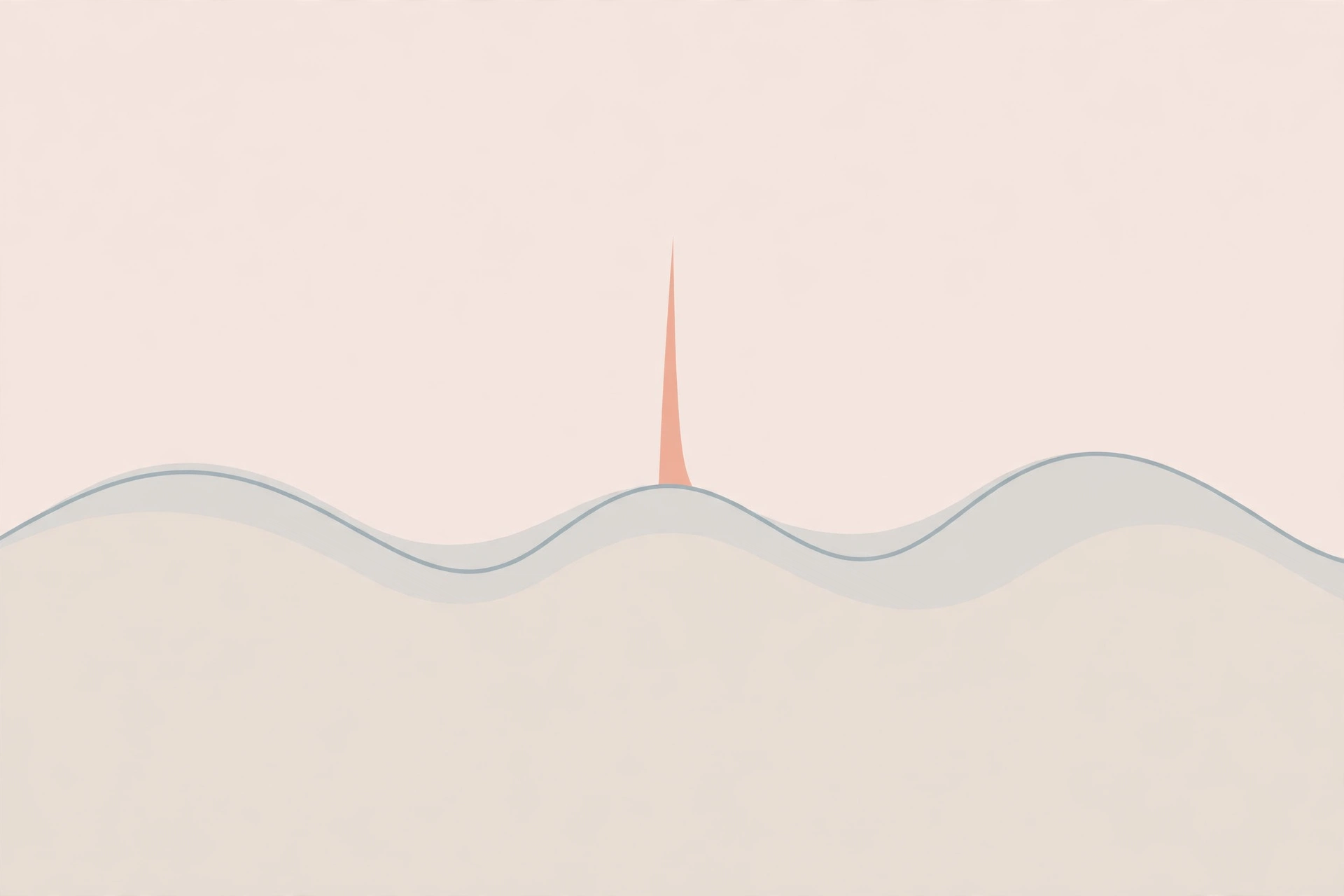
Emotions and moods are both feelings, but they are different kinds of feeling. An emotion is a brief, intense response to a specific trigger — you feel angry at an insult, afraid of a sudden noise, joyful at good news. A mood is a longer-lasting, gentler background state — feeling low all morning, or buoyant all weekend — often without any single identifiable cause. The distinction matters because the two respond to different interventions: an emotion usually passes or can be addressed at its trigger, while a mood needs a broader look at sleep, routine, context, and patterns over days.
This article is educational, not clinical. It explains how psychologists distinguish emotions from moods and why the distinction is useful. Persistent low or anxious moods that interfere with daily life are a matter for a qualified professional, not for a summary article.
Table of Contents
Duration: Minutes Versus Hours and Days
The clearest difference is time. In his argument for basic emotions, Ekman (1992) listed rapid onset and short duration among the defining features of emotions: an emotional episode starts quickly, peaks, and passes, typically within minutes to an hour, unless refreshed by rumination or new triggers. Moods run on a different clock. A mood can color a whole morning, day, or stretch of days, waxing and waning without sharp peaks.
This is why “I am angry” and “I am in a bad mood” describe different situations even when the felt unpleasantness seems similar. Anger has a target and a timeline: it flares at something and fades. A bad mood has no such shape — it is the weather rather than the storm. People often say they are “in a mood” precisely when they cannot point to a moment it started or a thing that caused it.
Duration also explains why emotions and moods feel different from the inside. An emotion demands attention now: fear interrupts thought, joy pulls focus to the good event. A mood operates in the background, tinting attention rather than seizing it — everything looks slightly worse, or slightly better, without any single thing commanding focus. That brief, coherent episode is exactly what the basic-emotion account describes: for the competing accounts of episodes, see the follow-up on theories of emotion.
Triggers: Specific Events Versus Diffuse Causes
Emotions have objects. You are afraid of something, angry at someone, sad about an event. Even when the object is vague (“I feel uneasy”), there is usually a situation, thought, or memory that set the episode off, and identifying it often clarifies the feeling. Moods frequently lack a clear object. You wake up low, or feel irritable all afternoon, without being able to say what did it — and often nothing did, in the sense of a single event.
Moods instead reflect diffuse causes: poor sleep, hunger, illness, accumulated stress, hormonal shifts, the weather, or the residue of several small events. That is why asking “what are you upset about?” can misfire for a mood — it assumes an object that may not exist. A better question is often “what has the last few days been like?” Moods summarize a period; emotions respond to a moment.
This distinction also explains why the same trigger produces different responses depending on mood. An insult that would roll off you on a good day stings on a bad-mood day, because the mood has already primed negative appraisals. The emotion is still a response to the insult, but the mood set the threshold. Psychologists describe this as mood-congruent processing: a low mood makes negative interpretations more available, which makes new negative emotions more likely.
Intensity and Function
Emotions are typically more intense than moods. Fear grips; sadness aches; joy surges. Moods are milder by comparison — a low mood is not the same as grief, and a good mood is not the same as elation. The intensity difference follows from function. Emotions mobilize specific action: fear prepares escape, anger prepares confrontation, disgust prepares rejection. That mobilization needs intensity to override competing concerns. Moods, lacking a specific target, have no specific action to mobilize; instead they tune general readiness — a low mood favors caution and withdrawal, a buoyant mood favors exploration and sociability.
Ekman (1992) also noted coherence among responses as a mark of emotions: feeling, bodily change, and expression hang together in an episode. Moods show less of this coherence. A low mood may involve tiredness and flat expression, but not the synchronized surge of a fear episode. This is one reason emotions are easier to read in others: a fearful face is a recognizable signal, while a mood must usually be inferred from behavior over time.
Why the Distinction Matters
Confusing emotions with moods leads to bad advice. Telling someone to “just get over it” treats a mood as if it were an emotion with a trigger to drop; moods do not work that way, and the advice lands as dismissal. Conversely, treating every emotional flare as a mood to be endured wastes the information the emotion carries: anger at a specific unfairness may call for a specific conversation, not a general improvement in lifestyle.
The distinction also guides regulation. Gross (1998) distinguished emotion regulation from mood regulation precisely because they operate differently: an emotion can often be addressed by reappraising its trigger or changing the situation, while a mood more often responds to broader levers — sleep, exercise, routine, social contact, and time. That is why the same strategy can help one and fail the other: reappraising a single insult is useful; reappraising “my whole week” is usually too diffuse to work.
Finally, the distinction matters clinically, though this article does not diagnose. A persistent mood — low for weeks, or anxious without letup — is a different kind of signal than a strong emotional reaction to a bad event, and professionals weigh duration and impairment heavily. Knowing which you are dealing with is the first step toward describing it accurately to someone who can help.
When the Line Blurs
The boundary is real but not sharp. An intense emotion can leave a mood behind: grief after a loss is an emotion that shades into a longer low mood. A mood can spawn emotions: an irritable mood makes angry episodes more frequent. And some states sit in between — anxiety can be a sharp episode before a presentation and a diffuse background hum across a stressful month.
The useful question is rarely “is this exactly an emotion or exactly a mood?” but “what is its timescale, does it have a trigger, and what would help?” A short, triggered, intense state calls for trigger-level responses; a long, diffuse, mild state calls for pattern-level responses. The categories are tools for thinking, not boxes that nature is obliged to respect — and the fact that they blur at the edges does not make the distinction useless.
Key Takeaways
- Emotions are brief, intense, and triggered by specific events; moods are longer-lasting, milder, and often lack a clear trigger.
- Emotions show rapid onset, short duration, and coherence among feeling, body, and expression (Ekman, 1992).
- Moods reflect diffuse causes — sleep, stress, routine, accumulated small events — and summarize a period rather than responding to a moment.
- Moods prime emotions: a low mood lowers the threshold for negative emotional episodes.
- The distinction guides action: emotions are often addressed at their trigger, while moods respond to broader patterns like sleep, routine, and social contact (Gross, 1998).
- The boundary blurs — emotions can leave moods behind and moods can spawn emotions — but timescale, trigger, and intensity remain useful guides.
References
- Ekman, P. (1992). An argument for basic emotions. Cognition and Emotion, 6(3–4), 169–200. https://doi.org/10.1080/02699939208411068
- Gross, J. J. (1998). The emerging field of emotion regulation: An integrative review. Review of General Psychology, 2(3), 271–299. https://doi.org/10.1037/1089-2680.2.3.271
Keep Exploring
- The Psychology of Emotions: What Feelings Are and Why
- Cognitive Biases: How Your Mind Takes Shortcuts
- Loneliness: What Psychology Knows
- The Psychology of Jealousy
What is the difference between emotions and moods?
Emotions are brief, intense responses to specific triggers; moods are longer-lasting, milder background states that often have no single identifiable cause.
How long does an emotion last compared to a mood?
An emotional episode typically peaks and passes within minutes to an hour, while a mood can color hours or days (Ekman, 1992).
Can a mood cause an emotion?
Yes. A low mood primes negative appraisals, so a trigger that would normally be shrugged off can produce a full emotional episode.
Is anxiety an emotion or a mood?
It can be either: a sharp episode of fear before a specific event is an emotion, while a diffuse, persistent sense of unease across weeks is closer to a mood.
Why does the emotion-mood distinction matter?
Because they respond to different interventions: emotions are often addressed at their trigger, while moods respond to broader patterns such as sleep, routine, stress, and social contact (Gross, 1998).