
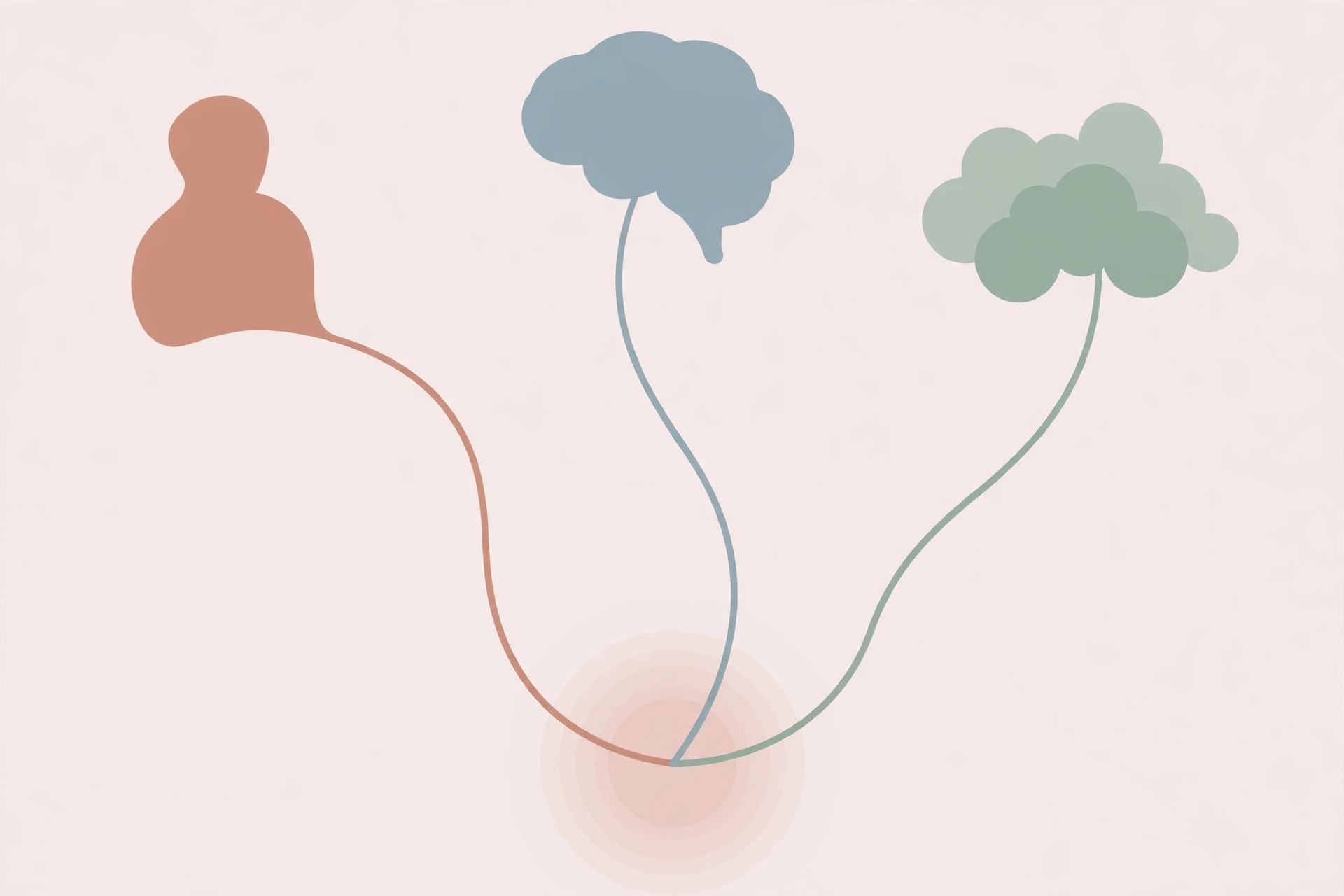
The theories of emotion disagree about a simple question: what comes first — the feeling, the bodily change, or the thought? James-Lange says the body comes first and feeling follows. Cannon-Bard says feeling and bodily response happen together, driven by the brain. Schachter-Singer says arousal comes first but the label you give it decides which emotion you feel. Appraisal theories say the evaluation comes first, and constructed-emotion theory says the brain builds the emotion from prediction and learned concepts. None of these has won outright, and comparing them shows why: each explains part of the evidence and struggles with the rest.
This article is educational, not clinical. It compares the major theories of emotion and the evidence for and against each. It is not therapy and not a treatment guide.
James-Lange: Feeling Follows the Body
William James (1884) proposed that emotions are the perception of bodily changes. His famous formulation reverses common sense: we feel sorry because we cry, angry because we strike, afraid because we tremble — not the other way around. The Danish physiologist Carl Lange (1885) reached a similar view independently, so the theory carries both names. On this account, if you removed all bodily feedback, emotional feeling would vanish; what remained would be a cold, intellectual perception of a situa/tion.
The theory’s strength is that it takes embodiment seriously, and some evidence supports it. People with reduced bodily feedback sometimes report blunted feeling, and deliberately adopting an expression or posture can shift experience slightly. Its weakness, pressed hardest by Cannon (1927), is differentiation: the body’s signals are too similar across emotions to explain their variety. A racing heart accompanies fear, anger, joy, and exercise. If feeling were only the reading of bodily changes, how would the brain know which emotion the same racing heart belongs to?
Cannon-Bard: The Brain Sends Two Signals at Once
Walter Cannon (1927) attacked the James-Lange theory directly. He argued that bodily changes are too slow to account for the speed of emotional experience, too undifferentiated to explain distinct feelings, and not necessary for emotion — animals and people with reduced visceral feedback still showed emotional behavior. His alternative, developed with Philip Bard, proposed that an emotional stimulus activates the brain (particularly subcortical centers), which then sends signals in two directions at once: one producing the bodily response, the other producing the conscious feeling. Feeling and bodily change are parallel outputs, not cause and effect.
Cannon-Bard’s strength is that it explains speed and the persistence of feeling when bodily feedback is limited. Its weakness is that it underplays the body’s genuine contribution. Later research showed that bodily feedback does modulate feeling, even if it does not create it alone. The theory is best read as a correction to James-Lange, not a replacement: the brain is central, but it listens to the body.
Schachter-Singer: Arousal Plus a Label
Schachter and Singer (1962) proposed that an emotional state is a function of two ingredients: physiological arousal and a cognition that labels it. Their experiment gave participants epinephrine (which raises arousal) or a placebo, with different information about what to expect. Participants who were not told what the drug would do, and who sat with a companion acting euphoric or angry, tended to describe their own feelings in line with the companion’s behavior — the same arousal became euphoria in one context and anger in another. Participants who knew exactly what to expect from the drug did not show this effect, because they had a ready explanation for their arousal.
The two-factor theory’s strength is that it explains a real phenomenon: unexplained arousal gets interpreted, and the interpretation shapes the feeling. Its weakness, documented in later reviews, is that the original experiment’s effects proved fragile and the theory overstates how undifferentiated arousal is. Different emotions do show somewhat different physiological patterns, and many emotions arise without any mysterious arousal needing a label. Still, the core insight survives: when arousal is ambiguous, context and explanation genuinely steer what you feel.
Appraisal Theories: Evaluation Comes First
Appraisal theories, developed most fully by Richard Lazarus (1991), argue that emotions arise from evaluations of a situation’s relevance to your goals and well-being. Different appraisals produce different emotions: a loss appraised as irreversible yields sadness; a threat appraised as looming yields fear; an offense appraised as blameworthy yields anger; a success appraised as your own achievement yields pride. The same event produces different emotions in different people because their appraisals differ — not because their bodies differ.
Appraisal theory’s strength is that it explains individual differences and the fine grain of emotional life: why the same criticism devastates one person and amuses another, or why an event’s meaning changes as new information arrives. Its challenge is timing: some emotional reactions seem too fast for a full evaluation, and some — like a startle at a loud noise — look more like reflexes than appraisals. Defenders reply that appraisals can be rapid and automatic, not only slow and deliberate. The debate then turns on what counts as an appraisal, which is why the theory remains influential but contested at its edges.
Constructed Emotion: The Brain Predicts
Lisa Feldman Barrett (2017) argues that emotions are not triggered circuits waiting in the brain but constructions built in the moment. On this view, the brain constantly predicts what the body needs, using past experience and the emotion concepts learned from your culture and language. When prediction meets incoming sensation, the brain categorizes the result — and that categorization is the emotion. There is no single “fear circuit” or “anger circuit” that fires the same way every time; instances of the same emotion category vary widely in brain activity and bodily pattern.
Constructed emotion’s strength is that it fits the variability researchers actually find: the same emotion label covers very different bodily states, and different cultures carve up the emotional landscape differently. Its challenge is that it must still explain the regularities — why fear so often involves vigilance and withdrawal, why some expressions are recognized across cultures at above-chance rates. Barrett’s answer is that construction uses real ingredients (body, prediction, concepts) that produce recurring patterns without fixed essences. Whether that fully accounts for the evidence is the liveliest current debate in emotion science. That debate turns directly on the expression evidence: for how faces are read across cultures, see the follow-up on facial expressions.
Comparing the Theories
The theories differ on three questions. First, what is universal? James-Lange and basic-emotion views lean toward universal bodily patterns; constructed emotion leans toward cultural and individual variation. Second, what is the body’s role? James-Lange makes it the cause, Cannon-Bard makes it a parallel output, Schachter-Singer makes it raw material for labeling, appraisal theory makes it one input among others. Third, what is an emotion? A perception of bodily change, a brain state, a labeled arousal, an appraisal outcome, or a constructed category?
A useful way to hold these together is to treat them as answers at different levels. The body provides signals; the brain appraises and predicts; language and culture supply categories; context supplies labels. Each classic theory spotlighted one level and mistook it for the whole. Modern emotion science increasingly studies how the levels interact rather than crowning one winner — which is why the old theories are still taught: each one names a mechanism that is genuinely part of the story. The same questions matter in practice, too: for how people shape feelings once they arise, see the follow-up on emotion regulation.
Key Takeaways
- James-Lange (James, 1884; Lange, 1885): feeling follows bodily change — we feel afraid because we tremble.
- Cannon-Bard (Cannon, 1927): the brain produces feeling and bodily response in parallel; bodily changes are too slow and undifferentiated to be the sole cause.
- Schachter-Singer (Schachter & Singer, 1962): arousal plus a cognitive label determines which emotion is felt; context steers the label when arousal is unexplained.
- Appraisal theory (Lazarus, 1991): different evaluations of a situation’s relevance produce different emotions, explaining individual differences.
- Constructed emotion (Barrett, 2017): emotions are built in the moment from prediction, bodily sensation, and learned concepts — not fixed circuits.
- The theories disagree about universality, the body’s role, and what an emotion is; modern work increasingly treats them as different levels of one system.
References
- Barrett, L. F. (2017). How Emotions Are Made: The Secret Life of the Brain. Houghton Mifflin Harcourt.
- Cannon, W. B. (1927). The James-Lange theory of emotions: A critical examination and an alternative theory. The American Journal of Psychology, 39(1/4), 106–124. https://doi.org/10.2307/1415404
- James, W. (1884). What is an emotion? Mind, 9(34), 188–205. https://doi.org/10.1093/mind/os-IX.34.188
- Lange, C. (1885). Om sindsbevaegelser: Et psyko-fysiologisk studie. Jacob Lunds.
- Lazarus, R. S. (1991). Emotion and Adaptation. Oxford University Press.
- Schachter, S., & Singer, J. (1962). Cognitive, social, and physiological determinants of emotional state. Psychological Review, 69(5), 379–399. https://doi.org/10.1037/h0046234
Keep Exploring
- The Psychology of Emotions: What Feelings Are and Why They Matter
- What Is Personality Psychology?
- Cognitive Biases: How Your Mind Takes Shortcuts
- Behavioral Psychology: How Learning Shapes Behavior
What is the James-Lange theory of emotion?
The view, proposed by William James (1884) and Carl Lange (1885), that emotions are the perception of bodily changes: we feel afraid because we tremble, not the reverse.
What is the Cannon-Bard theory?
Cannon’s (1927) alternative: the brain generates the feeling of emotion and the bodily response at the same time, as parallel outputs rather than cause and effect.
What is the Schachter-Singer theory?
The two-factor theory: an emotional state combines physiological arousal with a cognitive label for it, so the same arousal can be felt as different emotions depending on context (Schachter & Singer, 1962).
What is appraisal theory of emotion?
The view, developed by Lazarus (1991), that emotions arise from evaluations of a situation’s relevance to your goals — different appraisals (loss, threat, offense) produce different emotions.
What is the theory of constructed emotion?
Barrett’s (2017) view that emotions are built in the moment by the brain from prediction, bodily sensation, and learned emotion concepts, rather than triggered as fixed circuits.