
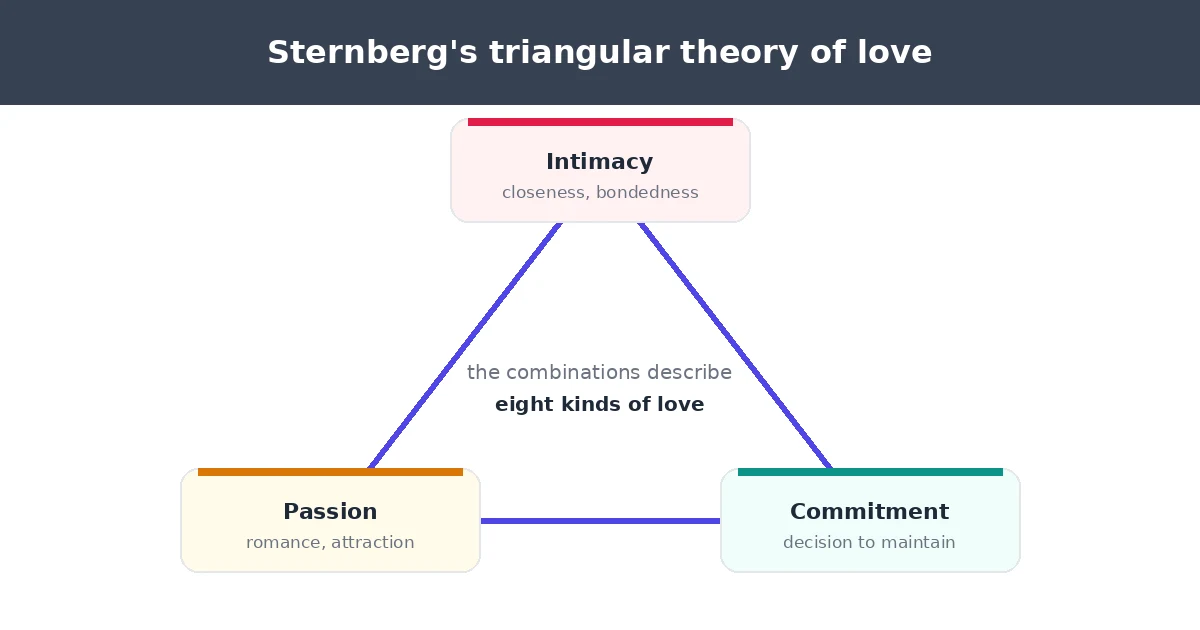
Robert Sternberg’s triangular theory of love (1986) proposes that love has three components: intimacy (closeness and connectedness), passion (romance, attraction, and physical drives), and commitment (the decision to love and to keep loving). Different combinations of these three components describe eight kinds of love — from liking to consummate love [1].
That is the whole theory in one paragraph. The rest of this article unpacks each component, walks through all eight types as a descriptive map, and then gets honest about what the theory explains well and where its limits are. This article is part of our psychology of relationships cluster, which maps the field’s main frameworks and what the evidence finds.
Table of Contents
The Three Components of Love
Sternberg proposed that every experience of love can be described by how much of each of three ingredients it contains. He also made a useful distinction: the kind of love depends on which components are present, while the amount of love depends on their overall strength — a large, balanced triangle means a lot of love; a small one means less, even if the shape is the same [1][2].
1. Intimacy: closeness, connectedness, bondedness
Intimacy is the emotional component: feelings of closeness, connectedness, and bondedness with another person. It is the warmth that comes from sharing, caring, mutual understanding, and emotional support — the sense of being genuinely known and accepted. It develops gradually, typically through reciprocal self-disclosure: people grow closer as they share personal thoughts and feelings and find them received with care [1].
Because intimacy is built through what partners share and how they respond to each other, it depends heavily on the quality of everyday interaction — how partners communicate in relationships shapes how close they become.
2. Passion: romance, attraction, and physical drives
Passion is the motivational component: the drives that lead to romance, physical attraction, and sexual consummation. It is the most intense and fastest-rising of the three — it can spike early, in the excitement of a new connection, and it is also the component most sensitive to change over time [1][2].
Research on how the components shift across relationship stages has found that the high levels of passionate love experienced in early encounters are unlikely to be maintained throughout a long-term relationship, while other components become relatively more important with time (Acker & Davis, 1992, as summarized in an open social psychology textbook) [4].
Passion captures the spark of attraction while research on what people want in a partner maps the fuller set of qualities that draw people together.
3. Decision/commitment: choosing love, then maintaining it
The commitment component has two sides, which Sternberg separated deliberately. In the short term, it is the decision that one loves someone — the conscious recognition “I love this person.” In the long term, it is the commitment to maintain that love: the decision to stay, to work at the relationship, and to keep choosing it through ordinary days [1]. Of the three components, commitment is the most deliberate and the most stable — and it is what keeps a relationship going when feelings fluctuate.
The Eight Types of Love: A Descriptive Map
Combine the three components in all possible ways, and you get eight kinds of love. Think of this as a map of love experiences, not a set of boxes people belong in. A relationship can contain one combination at one stage and a different one later — the types describe what a bond looks like right now, not what kind of people are in it.
| Intimacy | Passion | Commitment | Type | What it describes |
|---|---|---|---|---|
| — | — | — | Nonlove | The absence of all three components — most casual, everyday interactions. |
| ✓ | — | — | Liking | The warmth of true friendship: genuine closeness without romance or long-term commitment. |
| — | ✓ | — | Infatuated love | “Love at first sight”: intense attraction before closeness or commitment exist. |
| — | — | ✓ | Empty love | The decision to stay remains after closeness and attraction have faded. |
| ✓ | ✓ | — | Romantic love | Closeness and attraction without long-term commitment — many early romances live here. |
| ✓ | — | ✓ | Companionate love | Deep closeness and commitment with little romantic passion — close friendships, and often long marriages. |
| — | ✓ | ✓ | Fatuous love | Intense attraction rushed into commitment before real closeness has developed — whirlwind romances. |
| ✓ | ✓ | ✓ | Consummate love | All three components together — the theory’s ideal, not a requirement for a good relationship. |
A few of these deserve a second look, because they quietly explain familiar relationship patterns. Companionate love — intimacy plus commitment, without much passion — is what many long marriages gradually become, and Sternberg’s framework treats that as a genuine form of love, not a failure of one. Empty love describes the other edge of the same process: the commitment persists after closeness and attraction have thinned out. And fatuous love captures the risk of committing on the fuel of passion alone, before closeness has had time to form [1][2]. One intense, obsessive form of early attraction has its own name in psychology: limerence.
Consummate love — all three components, fully present — is what Sternberg called the ideal the theory points toward. It is best understood as a theoretical north star: a complete love that is difficult to form and difficult to maintain, not a standard every relationship must meet. Many deeply satisfying relationships never contain all three at full strength at once, and the theory does not claim they should.
What the Theory Explains Well
The theory’s strength is that it gives a precise vocabulary for something people usually describe vaguely. Saying “the passion faded but the commitment deepened” is a far more useful description than “we grew apart” — and it is exactly the kind of description Sternberg’s three components make possible. Two contributions stand out.
It explains why relationships change shape over time. Because the components rise and fall on different schedules — passion often peaking early, intimacy building slowly, commitment deepening with shared history — the kind of love in a relationship can shift even when the amount stays high. That matches what independent researchers found when they tested the theory: Acker and Davis (1992) examined the three components in adult romantic relationships and found their levels associated with relationship duration and other relationship features, supporting the theory’s dynamic view [4].
It has held up to measurement. Sternberg (1997) developed a 45-item Triangular Love Scale and ran construct-validation studies — internal validation (does the scale’s structure match the theory?) and external validation (does it correlate sensibly with other measures?) — finding support for the theory’s structure [3]. Later cross-cultural work went further: a study of 7,332 participants across 25 countries confirmed that the three-component structure holds across cultures, and found that component levels track relationship duration the way the theory predicts [5]. A shortened 15-item version of the scale has since been validated across 37 languages [6]. Few theories of love have been tested this thoroughly.
Early passion can also carry a halo effect, where one striking quality colours the whole impression of a partner.
Honest Limits of the Theory
No framework should be treated as the final word, and this one has real limits worth knowing.
The early research was culturally narrow. The initial studies, including Sternberg’s own scale-validation work, drew on Western samples — adults from the New Haven, Connecticut area [3]. The large 25-country study explicitly set out to expand this “culturally homogeneous” body of research, and it confirmed that the three-component structure of love holds across cultures [5]. But that is about the structure of the experience. How love is expressed, what it is expected to look like, and which components a culture values most can still differ. One cross-cultural study comparing free-choice and arranged marriages across five non-Western societies found no significant overall difference in average love scores between the two marriage types — a finding that challenges the Western assumption that arranged marriages lack love, while also showing that the details vary within cultures [7].
The components blur in real data. In the theory, intimacy, passion, and commitment are cleanly separable. In people’s actual responses, they tend to correlate — someone high on intimacy usually scores higher on commitment too. Adolescent validation studies, for example, found three underlying factors, but correlated ones rather than fully independent ones [8]. The eight-type table is therefore a conceptual map: useful for thinking, blurrier in practice.
It is a framework, not a diagnostic. The types describe combinations of feelings and decisions, not conditions to be diagnosed or boxes to sort people into. Nothing in the theory can tell you what your relationship “is” — and no type is a verdict on anyone’s worth as a partner.
Sternberg’s Theory and Attachment Theory: Two Different Lenses
Readers coming from our attachment articles may wonder how the two theories fit together. They classify different things. Sternberg’s theory classifies love experiences — what combination of intimacy, passion, and commitment a relationship contains. Attachment theory classifies relational patterns — how people tend to handle closeness, through the lenses of anxiety and avoidance. A securely attached person and an anxiously attached person could both experience companionate love; the difference would show in how they experience it, not which type it is.
The lenses complement each other: Sternberg gives you the vocabulary for what kind of love is present, attachment explains the patterns people bring into it. Neither replaces the other. For the full attachment picture, see the four attachment styles compared.
A note on what this article is (and isn’t)
This is educational content about a psychological theory, not clinical advice. The eight types are descriptive combinations, not categories of people — “you are fatuous love” is not a sentence this framework licenses. Research describes patterns across groups; it cannot diagnose your relationship, and no article substitutes for a qualified professional if you are experiencing persistent distress.
Key Takeaways
- Sternberg’s triangular theory (1986) describes love with three components: intimacy (closeness and connectedness), passion (romance, attraction, physical drives), and commitment (the decision to love and to maintain it).
- The eight types of love — nonlove, liking, infatuation, empty love, romantic, companionate, fatuous, and consummate — are combinations of these components: a descriptive map, not boxes people belong in.
- The theory separates the kind of love (which components are present) from the amount of love (their overall strength).
- It has been tested extensively: scale validation studies, independent tests, and cross-cultural research across 25 countries and 37 languages support its structure.
- Honest limits: early samples were Western, the components blur in real measurement, and the framework describes love — it does not diagnose relationships.
- Attachment theory and Sternberg’s theory classify different things (relational patterns vs. love experiences) and complement rather than compete with each other.
What are the three components of Sternberg’s triangular theory of love?
Intimacy (feelings of closeness, connectedness, and bondedness), passion (the drives behind romance, physical attraction, and sexual consummation), and decision/commitment (the short-term decision that one loves someone, plus the long-term commitment to maintain that love) [1]. Every kind of love in the theory is a combination of these three.
What are the eight types of love in Sternberg’s theory?
Nonlove (no components), liking (intimacy only), infatuated love (passion only), empty love (commitment only), romantic love (intimacy + passion), companionate love (intimacy + commitment), fatuous love (passion + commitment), and consummate love (all three) [1][2]. They describe combinations of components in a relationship at a given time, not fixed categories of people.
What is consummate love?
Consummate love is the type in which all three components — intimacy, passion, and commitment — are fully present [1][2]. Sternberg treated it as the theory’s ideal: a complete love. It is difficult to form and difficult to maintain, and the theory does not present it as a requirement — many deeply satisfying relationships never contain all three at full strength simultaneously.
Is the triangular theory of love proven?
It is one of the most researched theories of love rather than a proven fact. Sternberg validated a measurement scale for it [3], independent researchers tested it in adult romantic relationships [4], and large cross-cultural studies (25 countries; a shortened scale across 37 languages) confirmed its three-component structure [5][6]. Known limits remain: the early samples were Western, and the components blur together in real measurement [7][8].
How is Sternberg’s theory different from attachment theory?
They classify different things. Sternberg’s theory classifies love experiences — which combination of intimacy, passion, and commitment a relationship contains. Attachment theory classifies relational patterns — how people tend to handle closeness, along the dimensions of anxiety and avoidance. The two complement each other: one describes the kind of love present, the other the patterns people bring into it. See the four attachment styles compared.
References
- Sternberg, R. J. (1986). A triangular theory of love. Psychological Review, 93(2), 119–135. https://doi.org/10.1037/0033-295X.93.2.119
- Sternberg, R. J. (1988). The Triangle of Love: Intimacy, Passion, Commitment. New York: Basic Books.
- Sternberg, R. J. (1997). Construct validation of a triangular love scale. European Journal of Social Psychology, 27(3), 313–335. https://doi.org/10.1002/(SICI)1099-0992(199705)27:3<313::AID-EJSP824>3.0.CO;2-4
- Acker, M., & Davis, M. H. (1992). Intimacy, passion, and commitment in adult romantic relationships: A test of the triangular theory of love. Journal of Social and Personal Relationships, 9(1), 21–50. https://doi.org/10.1177/0265407592091002
- Kervyn de Meerendré, N., Sorokowski, P., Sorokowska, A., Karwowski, M., Groyecka, A., Aavik, T., Herak, I., et al. (2021). Universality of the triangular theory of love: Adaptation and psychometric properties of the triangular love scale in 25 countries. Journal of Sex Research, August, 1–10. https://doi.org/10.1080/00224499.2020.1787318
- Kowal, M., Sorokowski, P., Dinić, B. M., Pisanski, K., Gjoneska, B., Frederick, D. A., Pfuhl, G., Milfont, T. L., Bode, A., Aguilar, L., Kavčič, T., Miroshnik, K. G., Ndukaihe, I. L. G., Šafářová, K., Valentova, J. V., Aavik, T., … Sternberg, R. J. (2024). Validation of the short version (TLS-15) of the triangular love scale (TLS-45) across 37 languages. Archives of Sexual Behavior, 53(2), 839–857. https://doi.org/10.1007/s10508-023-02702-7
- Sorokowski, P., Groyecka-Bernard, A., Kowal, M., Butovskaya, M., Stefanczyk, M. M., Huanca, T., Stefanczyk, M. M., Huanca, T., Kumar, A., Manral, U., Odo, O. M., Onyishi, I. E., & Jędryczka, W. (2024). Love components in free-choice and arranged marriages among five non-Western populations from Africa, Amazonia, and Himalayas. Archives of Sexual Behavior, 53(1), 85–94.
- Overbeek, G., Ha, T., Scholte, R., de Kemp, R., & Engels, R. C. M. E. (2007). Brief report: Intimacy, passion, and commitment in romantic relationships — validation of a “triangular love scale” for adolescents. Journal of Adolescence, 30(3), 523–528.
- Social Psychology Principles. (n.d.). 8.2 Close relationships: Liking and loving over the long term. Flat World Knowledge. https://flatworldknowledge.lardbucket.org/books/social-psychology-principles/s11-02-close-relationships-liking-and.html
Keep Exploring
- The Psychology of Relationships — the cluster hub: the field’s main frameworks, what the evidence keeps finding, and where the research is honest about its limits.
- The Four Attachment Styles Compared — secure, anxious, avoidant, and disorganized patterns side by side: the other major lens on close relationships.
- Communication in Relationships — bids for connection, repair attempts, and the interaction patterns that distinguish satisfying couples — the engine that builds intimacy.