
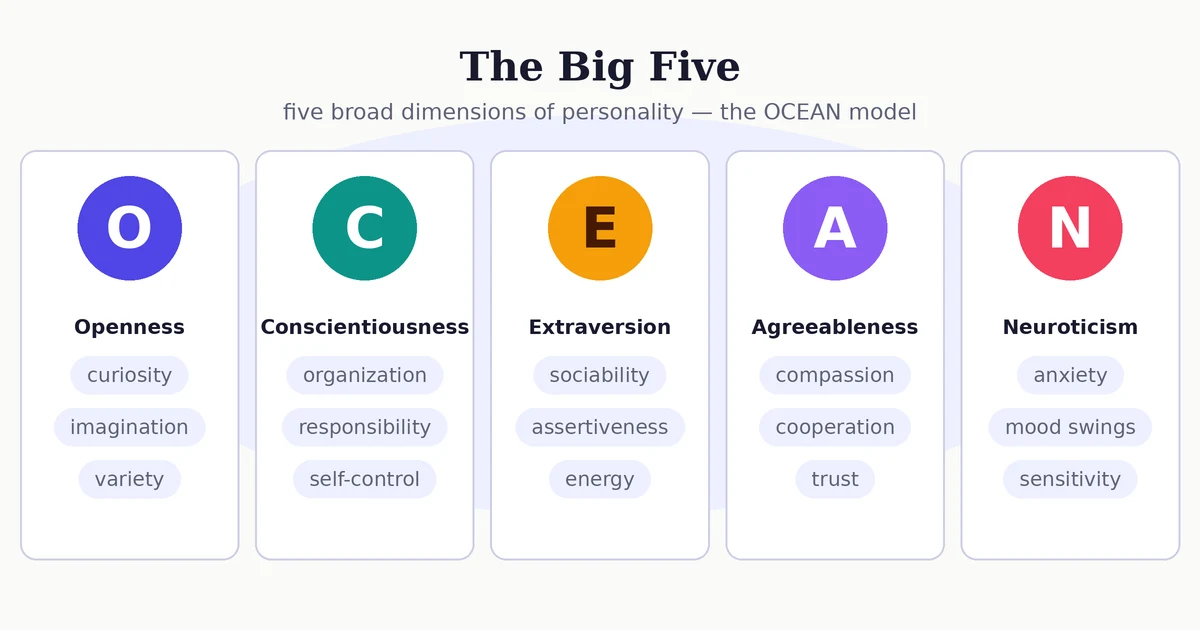
The Big Five — also called the five-factor model — is a widely used framework in personality psychology for describing how people differ. It reduces the enormous variety of human personality to five broad dimensions, remembered by the acronym OCEAN: openness to experience, conscientiousness, extraversion, agreeableness, and neuroticism [1]. Each trait is measured on a continuous scale, so you don’t land in a box — you fall somewhere along each dimension, usually nearer the middle than the extremes [2].
This guide is the hub of our Big Five coverage. It explains where the model came from, what each trait means in plain language, how the traits are measured, what research says they predict, and where the model falls short. Each trait also gets its own dedicated deep-dive — we’ll point you to them along the way.
Table of Contents
What Is the Big Five Model?
Personality is the pattern of how a person tends to think, feel, and behave — and personality itself is defined by individual differences in exactly those patterns. The Big Five is an attempt to organize those differences as efficiently as possible: instead of thousands of adjectives, five broad factors capture most of the variation [1].
A few facts that shape everything below:
- The traits are independent-ish, not mutually exclusive. Being high in openness says nothing automatic about your extraversion — someone can be highly conscientious yet low in agreeableness, for example [2].
- Each trait is a continuum. Scores tell you roughly where you sit relative to other people — higher or lower, not a type [2].
- The traits are broad. Each one contains narrower sub-traits called facets, which we’ll return to shortly.
A Brief History of the Big Five
The Big Five wasn’t invented by one person in one study — it grew out of a decades-long attempt to sort the language people use to describe each other. The logic was the lexical hypothesis: if a personality difference matters, people will have words for it. British scientist Francis Galton first proposed building a taxonomy of personality from language in 1884 [1].
The milestones:
- 1936 — Gordon Allport and Henry Odbert combed a dictionary and produced a list of 4,504 adjectives they judged descriptive of stable traits [1].
- 1940s — Raymond Cattell used factor analysis — a statistical method that finds clusters of things that vary together — to compress the list, eventually building his 16-factor questionnaire [1].
- 1949 — Donald Fiske found five factors emerging from ratings of other people [1].
- 1958–1961 — Ernest Tupes and Raymond Christal analyzed peer ratings of U.S. Air Force officers and derived five core dimensions, later renamed by others [1][2].
- 1963 — Warren Norman replicated the five factors; his colleague Lewis Goldberg continued the work [1].
- 1981 — Goldberg coined the term “Big Five” for the factors [1][2].
- 1985–1992 — Paul Costa and Robert McCrae built on their three-factor NEO model, adding agreeableness and conscientiousness; the 1992 NEO PI-R set the factor names now most commonly used, with six facets under each [1].
So the model arrived where it is through convergence: different researchers, using different methods and samples, kept finding roughly the same five dimensions [1]. (For the broader story of how personality theory developed, see our guide on theories of personality.)
The Five Traits Explained
Each trait below gets an honest overview: what it measures, what high and low scorers tend to look like in everyday life, and where the deep-dive will take you further. (We gave a one-paragraph version of this in our guide to personality psychology — here we go properly deeper.) For the general concept of a trait, see what personality traits are.
Openness to Experience
Openness measures creativity, curiosity, and willingness to entertain new ideas [1] — including intellectual curiosity and creative imagination [2].
High scorers are curious, imaginative, and drawn to novelty. They might try an unfamiliar cuisine on the first night of a trip rather than the last, or keep a shelf of books from genres they picked up on a whim. They tend to be more aware of their feelings and more comfortable with unconventional ideas [1].
Low scorers prefer the familiar: routines, concrete facts, and proven approaches — the same trusted holiday spot, genuinely enjoyed for its familiarity. They’re often described as pragmatic and data-driven [1].
→ Deep-dive coming: /openness-to-experience/ (facets, creativity research, culture and openness).
Conscientiousness
Conscientiousness measures self-control, diligence, and attention to detail [1] — organization, productivity, and responsibility [2].
High scorers are organized, dependable, and plan ahead. They might map out a project timeline before starting, or keep a workspace where everything has its place. Conscientiousness is the trait most reliably tied to job performance and academic success in research [1].
Low scorers are more spontaneous and flexible — improvising a weekend trip the morning of, or leaving dishes until “later” without anxiety. They adapt easily when plans change, though follow-through can be a struggle.
→ Deep-dive coming: /conscientiousness/ (facets, goal pursuit, work and school performance).
Extraversion
Extraversion measures boldness, energy, and social interactivity [1] — sociability and assertiveness, with introversion as the opposite end [2].
High scorers are sociable, assertive, and energized by company. They might strike up a conversation with the person next to them on a train, or naturally take the floor in a group discussion. Research links extraversion with subjective well-being [2].
Low scorers (introverts) are reserved, reflective, and recharge with solitude. They might prefer a dinner with two close friends to a party of fifty, or think carefully before speaking in a meeting. Introversion is not shyness — it’s a lower drive for social stimulation.
Most people aren’t total extroverts or total introverts — most of us live in the wide middle [2]. → Deep-dive coming: /extraversion/ (facets, energy and well-being, the introversion spectrum).
Agreeableness
Agreeableness measures kindness, helpfulness, and willingness to cooperate [1] — compassion, respectfulness, and trust in others [2].
High scorers are warm, cooperative, and give others the benefit of the doubt. They might volunteer for the unpopular committee task, or instinctively mediate when two friends argue. In research, agreeableness has been associated with outcomes like religiousness in Western samples [2].
Low scorers are more skeptical, competitive, and direct — the ones who negotiate hard on a price others would accept, or give a blunt no where an agreeable person would hedge. In the right role, that directness is an asset.
→ Deep-dive coming: /agreeableness/ (facets, cooperation and conflict, trust and skepticism).
Neuroticism
Neuroticism measures proneness to anxiety, irritability, and low mood [1] — tendencies toward anxiety and depression [2]. The low end is emotional stability: calm, even-tempered, resilient under pressure.
High scorers worry more, feel stress more intensely, and experience mood swings. They might replay an awkward conversation at 2 a.m., or find an approaching deadline physically tense. Note: some researchers now prefer the term negative emotionality, which describes the same dimension without the loaded sound of “neurotic” [2].
Low scorers stay composed: they might sleep soundly the night before a big presentation, or shrug off criticism that would rattle someone else.
High neuroticism isn’t a diagnosis or a flaw; it’s a tendency, and it’s the trait most linked to mental-health vulnerability in research — for example, studies connect neuroticism with risk markers such as self-harm and suicidal behavior at the population level [1]. But tendencies are not destinies: context, coping, and support matter enormously. → Deep-dive coming: /neuroticism/ (facets, stress and coping, emotional stability).
| Trait | High scorers tend to be… | Low scorers tend to be… |
|---|---|---|
| Openness | Curious, imaginative, drawn to novelty | Pragmatic, routine-loving, grounded in the familiar |
| Conscientiousness | Organized, dependable, plan-driven | Spontaneous, flexible, relaxed about structure |
| Extraversion | Sociable, assertive, energized by people | Reserved, reflective, recharged by solitude |
| Agreeableness | Warm, cooperative, trusting | Skeptical, direct, competitive |
| Neuroticism | Worry-prone, stress-sensitive, emotionally reactive | Calm, even-tempered, emotionally stable |
Facets: The Traits Inside the Traits
Each broad trait breaks down into narrower facets — sub-components that are correlated with each other but can be measured separately [2]. For example, sociability and assertiveness are distinct facets of extraversion, while organization and responsibility are facets of conscientiousness [2]. The NEO instruments developed by Costa and McCrae use six facets per factor [1] — which is why a relatively extroverted person can be highly sociable but not especially assertive [2]. The trait deep-dives will unpack facets trait by trait.
How the Big Five Is Measured
The Big Five is typically assessed with questionnaires. Items ask how much you agree or disagree that you are someone described by statements like “is curious about many different things” (openness) or “likes to keep things in order” (conscientiousness); agreeableness and neuroticism items cover compassion and mood swings respectively [2]. Your ratings across dozens of statements are averaged into a score for each trait [2].
Scores are interpreted relatively: comparing your results with a large sample of test-takers shows where you stand — how open, conscientious, extraverted, agreeable, or emotionally reactive you are relative to others [2]. Many widely used measures exist, and while they use slightly different terms for the traits, they cover essentially the same five dimensions [2].
Reliability — does the test give consistent results? Big Five scores tend to be fairly stable over short periods in adulthood [2]. Validity — does it measure what it claims, and does it predict anything real? The five-factor structure has been independently replicated across cultures and time, and scores show predictive validity against external measures — including ratings by other people, job performance and academic success (predicted by conscientiousness), and self-harm and suicidal behavior (predicted by neuroticism) [1].
One caution applies to every self-report measure: it works best with honest answers about your typical behavior, and it describes tendencies, not fixed identities.
Why the Big Five Matters
The model isn’t just descriptive — personality psychologists use it to explore reliable associations between traits and consequential life outcomes, including physical health and well-being and success in social, academic, and professional contexts [2][3].
What has research found? At least in Western samples, there is reliable evidence that extraversion is associated with subjective well-being, neuroticism with lower work commitment, and agreeableness with religiousness; certain traits have been linked to mortality risk [2]. But — and this matters — these are overall patterns across large groups. They don’t mean a trait causes an outcome, and they say nothing definite about any one person [2].
Scores are not set in stone, either. Trait measures are fairly consistent over short periods in adulthood, but they do change over the life course, and there is reason to believe deliberate personality change is possible [2].
Criticisms and Limitations
No model deserves a free pass, and the Big Five has real criticisms:
- It describes more than it explains. Some critics note the model grew out of data rather than theory — factor analysis found the clusters first, and the explanation of why these five dimensions exist came later [2]. It maps personality’s structure without fully explaining its causes.
- It may miss something. Not every researcher agrees five is the right number. The HEXACO model, for example, adds a sixth factor — honesty-humility — to the original five [2].
- Culture and language matter. The lexical approach leans on the words a language has for personality, and current tests provide less reliable results outside Western, industrialized countries [2]. The factor structure replicates broadly [1], but the instruments are not culture-free.
- Self-reports have limits. Scores depend on self-knowledge and honesty — people can misjudge themselves or answer the way they wish they were.
None of this disqualifies the model, but it keeps it honest: a widely used framework, not a finished theory.
Big Five vs MBTI
You’ll meet both outside academic psychology, but they work differently: the Big Five places you on five continuous dimensions, while the Myers-Briggs Type Indicator sorts people into discrete types [2]. Many personality psychologists view Big Five measures more favorably, citing concerns about the reliability of MBTI-assigned types and the test’s validity, though the two overlap on the extraversion–introversion dimension [2]. We’re publishing a full, fair comparison soon → /big-five-vs-mbti/.
Frequently Asked Questions
Is the Big Five accurate?
It’s one of the most empirically supported frameworks in personality psychology: the five-factor structure has been independently replicated across cultures and time, and scores predict real outcomes like job performance and academic success [1]. But it’s a map of tendencies, not a diagnosis — and it has genuine limitations, as the criticisms section above explains.
What’s the difference between the Big Five and MBTI?
The Big Five measures five traits on continuous scales; the MBTI sorts people into 16 types [2]. Personality psychologists generally regard the Big Five as the better-validated approach, though both appear in popular use. Our dedicated comparison article will go deeper.
Can my Big Five scores change?
Probably, slowly. Scores are fairly consistent over short periods in adulthood, but they shift over the life course — and there is reason to believe deliberate change is possible [2].
Is neuroticism a bad trait?
No. It’s a dimension, not a verdict — high scorers are more prone to anxiety and low mood, low scorers are more emotionally stable [1][2]. Some researchers prefer “negative emotionality” for exactly this reason [2]. A high score describes a tendency, not a destiny or a diagnosis.
Are there really only five traits?
Five broad ones, each containing narrower facets [1][2]. Some researchers argue for more — the HEXACO model adds honesty-humility as a sixth factor [2] — and the debate continues.
Which trait matters most for work?
Conscientiousness has the most consistent research support for predicting job performance and academic success [1]. But “matters most” depends on the role — extraversion, agreeableness, and openness all have their arenas, and patterns across groups never determine an individual’s outcome [2].
References & Further Reading
- Big Five personality traits — Wikipedia. https://en.wikipedia.org/wiki/Big_Five_personality_traits
- Big 5 Personality Traits — Psychology Today. https://www.psychologytoday.com/us/basics/big-5-personality-traits
- Personality — Department of Psychology, Penn State. https://psych.la.psu.edu/about-us/research/personality/
Keep Exploring
The Big Five sits at the center of modern personality science. Next, explore the five traits in depth: /openness-to-experience/, /conscientiousness/, /extraversion/, /agreeableness/, /neuroticism/ — plus our full /big-five-vs-mbti/ comparison.
6 thoughts on “Big Five Personality Traits: The OCEAN Model Explained”