
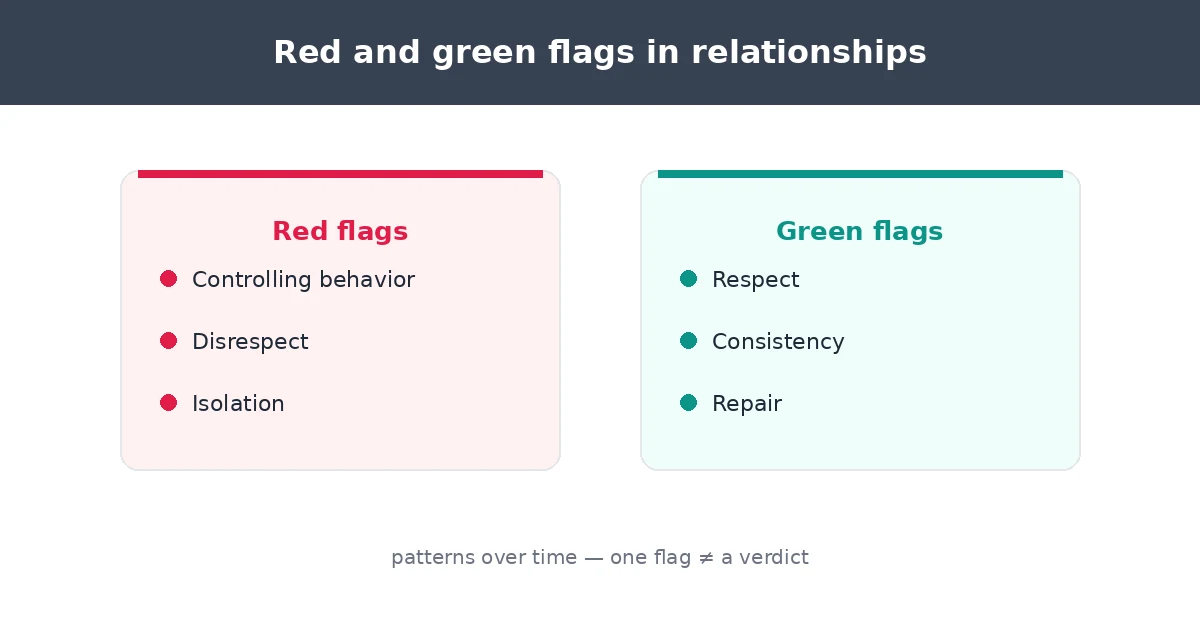
Red flags in a relationship are recurring patterns — not single bad days — that show how someone tends to treat the people close to them: controlling behavior, disrespect, chronic inconsistency, or cutting you off from others. Green flags are the reverse: consistent respect, follow-through, and repair when things go wrong. The skill is watching for patterns over time, because a single flag on its own is never a verdict.
This article is about assessment, not maintenance: it helps you notice what’s there in a dating situation or early relationship. If you’re past that stage and the question is how to handle disagreements together, see Conflict in Relationships.
Table of Contents
What ‘Red Flags’ and ‘Green Flags’ Actually Mean
The words get thrown around a lot — sometimes for anything from a mildly annoying habit to genuinely harmful behavior. Stripped back, a “red flag” is simply a repeated pattern of behavior that tends to predict trouble in a close relationship, while a “green flag” is a repeated pattern that tends to predict safety, satisfaction, and trust. The emphasis is on repetition: one canceled plan is an incident; canceled plans every week, with no acknowledgment, is a pattern.
Three principles make the idea useful rather than weaponizable. First, patterns, not incidents: judge the trend across weeks and months, not the worst (or best) single day. Second, context matters: the same behavior can mean different things in different circumstances, so look at the whole picture — stress, history, and how the person responds when it’s named. Third, and most important: one flag is not a verdict. A single observation is a reason to pay closer attention, not a conclusion about a person or a relationship.
Note what this framework does and doesn’t do. It describes behaviors — things someone says and does, repeatedly — never diagnoses of people. No one here is being labeled with a disorder or handed a character verdict. The goal is clearer observation, so your decisions rest on evidence rather than anxiety, hope, or other people’s opinions.
Red Flags Worth Noticing
None of these is damning on its own — remember, one flag is not a verdict. What earns each a place on this list is that, when repeated, it reliably erodes trust, safety, or satisfaction.
Controlling behavior. Notice who gets to decide: what you wear, who you see, how you spend your time, how quickly the relationship moves. Caring sounds like “text me when you get home safe.” Surveillance sounds like demands to share your location, read your messages, or account for every hour. The difference is whether your freedom expands or shrinks.
It helps to recognize when jealousy in relationships becomes a tool for control rather than a sign of care.
Disrespect, especially contempt. Occasional irritation is human; mockery is different. Watch for belittling jokes, eye-rolling, name-calling, or a tone that treats you as beneath them — especially during disagreements. Contempt is among the most corrosive patterns researchers have documented in close relationships; to understand why it does so much damage, see our article on Conflict in Relationships.
Isolation from others. This rarely arrives as an outright demand to drop your friends. More often it’s friction: sighs when you make plans, picking a fight before you go out, or slowly painting the people close to you as untrustworthy. The result is the same — fewer outside perspectives, and a relationship that becomes your whole world by default rather than by choice.
Chronic inconsistency between words and actions. Promises are easy; follow-through is the data. A stable gap between what’s said and what’s done — big declarations, small delivery, every time — tells you which one to believe. Trust is built on the actions column, not the words column.
Avoidance of accountability. Everyone messes up; the question is what happens next. A person who can never say “I was wrong” — who deflects, counter-attacks, or rewrites what just happened — leaves you with no way to resolve anything. Without ownership, the same hurt repeats on a loop.
Repeated boundary violations. A boundary stated clearly and crossed repeatedly is information. It may look like showing up uninvited, pushing past a “no,” or treating your limits as opening bids in a negotiation. For a clearer picture of what healthy limits look like, see Boundaries in Relationships.
One more lens is worth having: fairness. Equity theory proposes that people are most satisfied in relationships that feel roughly fair — where both partners’ contributions and benefits feel balanced — and that perceived unfairness breeds dissatisfaction (Walster, Walster, & Berscheid, 1978). You don’t need a ledger; you just need to notice whether, over time, the give and take feels mutual or chronically one-sided.
Green Flags: Patterns That Build Trust
Green flags rarely make dramatic stories — that’s the point. They’re steady, unspectacular, and easy to overlook precisely because they don’t create drama.
Consistent respect. Most visible when you disagree: do they argue the point without attacking you? Respect that survives conflict — listening, no name-calling, no storming out mid-sentence as a tactic — is the foundation everything else builds on.
Follow-through. Small promises kept are the raw material of trust: they call when they say they will, they show up, the little things happen without chasing. To go deeper on why reliability matters so much, see Trust in Relationships.
Repair after small ruptures. Every relationship has friction; healthy ones have repair. A green flag is someone who circles back after a tense moment — apologizes sincerely, asks what you need, adjusts. Rupture is normal; repair is the skill.
Support for your autonomy. They like that you have a life beyond them: friends, ambitions, odd hobbies, opinions of your own. Instead of competing with your independence, they’re enthusiastic about it — because they’re looking for a partner, not a project.
Accountability. The mirror image of red flag number five: when they’re wrong, they say so — plainly, without garnish. “I was wrong, I’m sorry, and here’s what I’ll do differently” keeps small problems small and tells you that conflict with this person has a resolution path.
Willingness to invest. They put time, attention, and care into building something together — making plans, remembering what matters to you, showing up for the unglamorous parts. It fits what relationship researchers have long observed: commitment is central to how relationships persist (Rusbult, 1980).
How to Assess Without Armchair-Diagnosing
Noticing patterns is a skill; diagnosing people is a trap. Here’s how to keep your assessment honest.
Describe behaviors, not people. Stick to what a camera could record: what was said, what was done, how often. “They’ve canceled our last four plans by text, an hour before” is an observation you can act on; “they’re a narcissist” is a diagnosis you’re not qualified to make — and it ends the conversation instead of informing it.
Watch how they treat people who can’t help them. How someone treats waitstaff, colleagues, ex-partners, or anyone they don’t need to impress is a preview of how they’ll treat you once the early-relationship performance fades.
Take trusted others seriously. If several people who know you well raise the same concern independently, don’t dismiss it. Outsiders aren’t flooded with the same chemistry and hope you are — that distance is data.
Check your own lens too. Your history shapes what you notice: if closeness has felt unsafe before, you might read threat into neutral behavior — or miss real warning signs because chaos feels familiar. Understanding your own patterns helps; see Attachment Styles.
Give it time. Patterns need time to reveal themselves. Resist the urge to decide everything in week three — in either direction. Infatuation hides red flags; anxiety invents them. Time is the cheapest, most reliable assessment tool you have.
A strong first impression can also create a halo effect that makes real concerns harder to notice.
A Brief Note on Safety
This article covers ordinary dating situations — the gray areas where you’re unsure what you’re seeing. If there is intimidation, threats, or aggression, this framework no longer applies: trust your fear, tell someone you trust, and contact a local support helpline or a professional. You don’t need to be sure it “counts” before asking for help. Seeing the pattern clearly is one step; the harder question that follows is when to leave a relationship.
Key Takeaways
- Red and green flags are patterns, not incidents — repetition across weeks and months is what makes a flag worth noticing.
- One flag is never a verdict on its own; it’s a reason to look closer.
- Red flags to watch for: controlling behavior, disrespect and contempt, isolation from others, chronic inconsistency between words and actions, avoidance of accountability, and repeated boundary violations.
- Green flags that build trust: consistent respect, follow-through on small promises, repair after ruptures, support for your autonomy, plain accountability, and a visible willingness to invest.
- Fairness matters: people are most satisfied when a relationship feels roughly fair, and perceived unfairness breeds dissatisfaction.
- Describe behaviors, not people — and remember that safety outranks assessment: if you feel unsafe, get support first.
Frequently Asked Questions
What are the most common red flags in a relationship?
The patterns people most often report: controlling behavior (monitoring, jealousy framed as love), disrespect or mockery, attempts to isolate you from friends and family, chronic inconsistency between words and actions, never taking accountability, and repeatedly crossing stated boundaries. What makes each a flag is repetition — a pattern, not one bad day.
Can a relationship survive red flags?
Sometimes — a flag is a reason to look closer, not an automatic ending. What matters is the pattern’s severity and frequency, whether the person acknowledges it when raised, and whether behavior actually changes. A single acknowledged lapse that gets repaired is very different from a denied pattern that keeps repeating. And if you feel unsafe, that question is secondary to getting support.
What are examples of green flags?
Consistent respect (especially during disagreement), follow-through on small promises, genuine repair after friction, enthusiasm for your independence and outside relationships, plain accountability when wrong, and visible investment in building something together. Green flags are steady and unspectacular — that’s what makes them reliable.
How do I tell the difference between a red flag and a bad day?
Ask three questions: Has this happened before? Does it form a pattern across weeks or months? And does the person acknowledge it and adjust, or deny and repeat? A bad day is isolated, owned, and doesn’t recur. A red flag repeats, gets minimized, and the underlying behavior doesn’t change.
Should I confront my partner about red flags?
For ordinary patterns (inconsistency, mild control, poor follow-through), a calm, specific conversation is reasonable — name the behavior, not the person. But calibrate to safety: if there’s intimidation, threats, or aggression, don’t confront to test a theory. Get support first. Your safety outranks any assessment framework.
References
- Walster, E., Walster, G. W., & Berscheid, E. (1978). Equity: Theory and research. Boston: Allyn & Bacon.
- Rusbult, C. E. (1980). Commitment and satisfaction in romantic associations: A test of the investment model. Journal of Experimental Social Psychology, 16(2), 172–186. https://doi.org/10.1016/0022-1031(80)90007-4
- Reis, H. T., & Shaver, P. (1988). Intimacy as an interpersonal process. In S. Duck, D. Hay, S. Hobfoll, W. Ickes, & B. Montgomery (Eds.), Handbook of personal relationships: Theory, research and interventions (pp. 367–389). Chichester: Wiley.
Keep Exploring
- The Psychology of Relationships — pillar overview
- Conflict in Relationships — deeper dive on destructive communication patterns
- Boundaries in Relationships — what healthy boundaries look like
- Attachment Styles — how your own patterns shape what you notice