
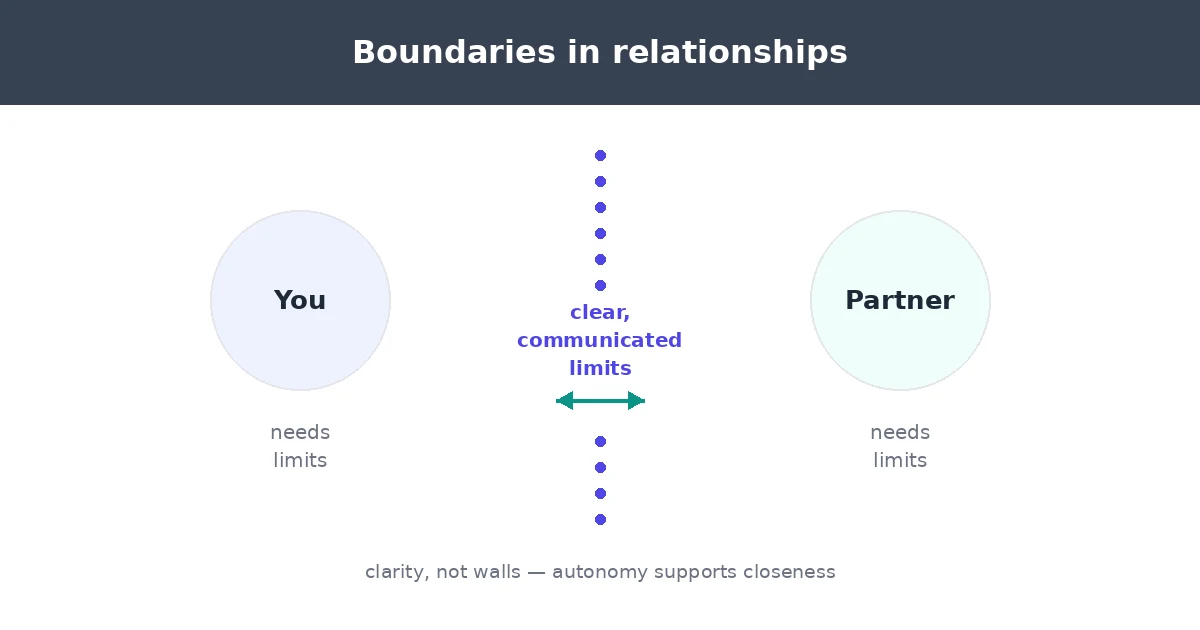
Boundaries in a relationship are clear, communicated understandings about each person’s needs, limits, and expectations — covering everything from alone time to how you handle money and conflict. Research in relationship psychology suggests boundaries work not by creating distance, but by protecting each partner’s autonomy: when people feel free to remain themselves inside a relationship, the relationship itself tends to be stronger.
This article explains what boundaries are (and aren’t), what research finds about why they matter, the main types, and how to set them with clarity and care.
Table of Contents
What Are Boundaries in a Relationship?
A boundary is a communicated limit: a clear statement of what you need, what you will and won’t accept, and how you want to be treated. Boundaries are not walls. Walls shut people out and end conversation; boundaries do the opposite — they make relationships workable by replacing guesswork with understanding. A partner who knows you need an hour alone after work to decompress isn’t being pushed away; they’re being given a map.
Healthy boundaries share a few traits. They’re specific rather than vague: “I need quiet time between 6 and 7 pm” works better than “I need space.” They’re communicated directly instead of hinted at or enforced through sulking. And they’re mutual — both partners get to name their needs, even when those needs differ.
Why Boundaries Matter: What the Research Finds
The case for boundaries rests on one of the most replicated ideas in relationship psychology: autonomy is a core psychological need. Self-determination theory (Ryan & Deci, 2000) identifies autonomy — the feeling that your actions are your own choice — as one of three basic needs underlying well-being. Relationships that support each partner’s autonomy tend to produce more satisfied partners.
That idea has been tested directly in romantic relationships. Patrick, Knee, Canevello, and Lonsbary (2007) found that when people’s basic psychological needs were fulfilled within their relationship, both relationship functioning and personal well-being were higher. Similarly, La Guardia, Ryan, Couchman, and Deci (2000) showed that on days and in relationships where partners felt their needs for autonomy, competence, and relatedness were met, they reported greater felt security and well-being. The pattern is consistent: feeling like yourself inside the relationship predicts feeling good about the relationship.
The flip side matters too. Uysal, Lin, Knee, and Bush (2012) found that self-concealment from one’s partner — hiding important feelings, needs, or aspects of the self — was associated with lower relationship well-being. Note the careful wording: this is an association, not proof of causation. But it fits the broader picture: relationships where people can be open about who they are, limits included, tend to fare better than those where people perform a version of themselves.
The Main Types of Boundaries
It helps to think of boundaries in five overlapping areas. Most couples need at least a few in each.
Emotional boundaries protect your inner life. Example: “I can listen and support you, but I can’t be responsible for fixing your mood every evening — when you’re upset, I need you to tell me what would help rather than expecting me to guess.” Emotional boundaries also mean you’re allowed to feel differently from your partner about the same event.
Physical and sexual boundaries cover your body, touch, and intimacy: what kinds of affection feel welcome, when, and when they don’t. Example: “I’m not up for sex when I’m exhausted — let’s find another way to connect on those nights.” Consent isn’t a one-time conversation; it’s an ongoing boundary that either partner can revisit.
Time boundaries protect how your hours are spent. Example: “I need two evenings a week for my own friends and hobbies — that’s non-negotiable for me, not a comment on us.” Time boundaries also cover punctuality expectations and how much advance notice you need for plans.
Digital boundaries are the newest frontier: phone privacy, social media, and availability norms. Example: “I don’t want us reading each other’s messages — if something worries you, ask me directly.” Other common ones: no phones at dinner, agreed expectations around reply times, and what’s okay to post about the relationship publicly.
Material and financial boundaries cover money and possessions: how expenses are split, what counts as a joint decision versus a personal one, and rules about lending. Example: “Any purchase over $200, we discuss first.” Money is one of the most common conflict sources in relationships, which makes explicit financial boundaries especially valuable.
How to Set Boundaries That Work
Knowing you need a boundary is one thing; stating it so it lands well is another. A few principles make the difference.
Be specific. Vague boundaries invite vague compliance. “I need you to respect my space” leaves your partner guessing; “I need the bedroom to myself for 30 minutes after work to unwind” gives them something concrete to honor. Specificity is kindness — it tells your partner exactly how to succeed.
Use clear, kind “I” language. Frame the boundary around your needs, not your partner’s faults: “I need…” and “I feel…” rather than “You always…” and “You never…” Compare “You never give me any breathing room” with “I need some quiet time in the evenings to recharge — it’s about my energy, not about you.” The first starts a fight; the second starts a conversation. Good communication in relationships is largely this skill, repeated.
Pick a calm moment. Raise boundaries outside of conflict, not in the middle of it. A boundary announced mid-argument sounds like punishment; the same boundary raised over coffee on a calm Saturday sounds like care. If a boundary becomes urgent during a fight, it’s fine to table the topic: “I want to talk about this properly tomorrow.”
Revisit as life changes. Boundaries aren’t set in stone. A new job, a baby, an illness, or simply growing older can all shift what each person needs. Treat boundaries as living agreements with a natural check-in point — “let’s see how this is working in a month” — rather than permanent rulings.
Tolerate the initial discomfort. If you’re new to boundary-setting, expect guilt, awkwardness, or fear of conflict at first. That’s normal, especially if you grew up equating love with self-sacrifice. The discomfort usually fades as you see that clear limits, respectfully stated, tend to make relationships calmer rather than colder.
What Boundaries Are Not
Boundaries get a bad reputation from being confused with three things they aren’t.
First, boundaries are not walls. A wall says “stay out”; a boundary says “here’s how to come closer.” Walls are built from fear and shut down communication. Boundaries are built from self-knowledge and invite it — they tell your partner what you need so the relationship can actually meet those needs.
Second, boundaries are not ultimatums or tools of control. “I need us to stop yelling during arguments” is a boundary — it describes what you will do (step away until things calm down) and protects the relationship. “You’re not allowed to see your friends” is control — it restricts your partner’s freedom rather than stating your own limit. The test is simple: a boundary governs your behavior; control governs theirs.
Third, boundaries are not secrecy. Privacy — having thoughts, friendships, or parts of your inner life that are simply yours — is healthy and normal. Concealment — hiding things your partner would reasonably expect to know, like debts, ongoing contact with an ex, or how you really feel — is different, and the research above suggests it erodes well-being. Privacy says “this is mine to share or not”; secrecy says “you can’t know this.” Honesty remains the foundation that makes boundaries work, which is why boundaries and trust in relationships grow together.
When Boundaries Keep Getting Crossed
Even well-stated boundaries get missed sometimes. Your partner forgets, misreads the moment, or falls back on old habits. An occasional miss, followed by acknowledgment and repair — “You’re right, I’m sorry, I’ll do better” — is normal relationship friction, not a crisis. What matters is the pattern over time, not any single slip.
A pattern is different. If a boundary was stated clearly, more than once, in calm moments — and it’s still repeatedly dismissed, mocked, or punished — treat that as information about the relationship, not just a communication problem to solve harder. Persistent boundary violations often pair with other warning signs; it’s worth reading about relationship red flags with clear eyes if you recognize this dynamic.
Watch for the moment when jealousy becomes control, because that changes the conversation entirely.
One cultural note: directness norms vary. In some families and cultures, stating needs plainly is expected; in others, it’s softened through hints, intermediaries, or deference to elders. You can adapt the style — the words, the timing, the framing — to fit your context while keeping the limit itself intact. A boundary expressed gently is still a boundary; a boundary abandoned for politeness isn’t one at all. When limits keep being crossed despite clear communication, the question can shift from setting boundaries to when to leave a relationship.
Key Takeaways
- Boundaries are communicated limits, not walls — they tell your partner how to love you well instead of leaving them to guess.
- Research links autonomy and need fulfillment to relationship satisfaction: feeling free to be yourself inside the relationship tends to strengthen it.
- The main types are emotional, physical/sexual, time, digital, and material/financial — most couples need a few boundaries in each area.
- Effective boundaries are specific, stated with clear and kind “I” language, raised in calm moments, and revisited as life changes.
- Privacy is healthy; concealment is different. Having an inner life that’s yours is normal — hiding things your partner would reasonably expect to know erodes trust.
- An occasional crossed boundary, followed by repair, is normal friction. A repeated pattern of dismissed or punished boundaries is information about the relationship worth taking seriously.
Frequently Asked Questions
What are some examples of healthy boundaries in a relationship?
Common ones include needing alone time to recharge, keeping certain friendships or hobbies independent, agreeing on digital privacy norms, deciding how money is handled, and stating how you want conflict discussed (e.g., no yelling, no silent treatment). The healthiest boundaries are specific, communicated kindly, and revisited as life changes.
How do I set boundaries without hurting my partner?
Use clear, kind “I” language (“I need…”, “I feel…”), be specific about what you’re asking for, and raise it in a calm moment rather than mid-conflict. Most partners respond better than feared — clarity removes guesswork, which most people experience as relief rather than rejection.
Are boundaries selfish?
No — though they can feel that way at first, especially if you’re used to accommodating. Research on autonomy in relationships finds that when partners’ basic psychological needs — autonomy, competence, and relatedness — are fulfilled within the relationship, both relationship functioning and well-being tend to be higher (Patrick, Knee, Canevello, & Lonsbary, 2007). Boundaries protect the individuality that makes the relationship work.
What should I do if my partner keeps ignoring my boundaries?
First, check the boundary was stated clearly and more than once — unspoken expectations don’t count. If it was clear and it’s still repeatedly dismissed or punished, treat that as information about the relationship, not just a communication issue. Persistent patterns of boundary violations are worth taking seriously.
Do boundaries mean less closeness?
The evidence points the other way. Closeness built on freely chosen connection — where both people could be elsewhere but choose each other — tends to be more satisfying than closeness built on obligation or control. Boundaries protect the autonomy that genuine closeness needs.
References
- Ryan, R. M., & Deci, E. L. (2000). Self-determination theory and the facilitation of intrinsic motivation, social development, and well-being. American Psychologist, 55(1), 68–78. https://doi.org/10.1037/0003-066X.55.1.68
- Patrick, H., Knee, C. R., Canevello, A., & Lonsbary, C. (2007). The role of need fulfillment in relationship functioning and well-being: A self-determination theory perspective. Journal of Personality and Social Psychology, 92(3), 434–457. https://doi.org/10.1037/0022-3514.92.3.434
- La Guardia, J. G., Ryan, R. M., Couchman, C. E., & Deci, E. L. (2000). Within-person variation in security of attachment: A self-determination theory perspective on attachment, need fulfillment, and well-being. Journal of Personality and Social Psychology, 79(3), 367–384. https://doi.org/10.1037/0022-3514.79.3.367
- Uysal, A., Lin, H. L., Knee, C. R., & Bush, A. L. (2012). The association between self-concealment from one’s partner and relationship well-being. Personality and Social Psychology Bulletin, 38(1), 39–51.
- Cloud, H., & Townsend, J. (1992). Boundaries: When to say yes, how to say no to take control of your life. Zondervan. (Popular origin of the boundaries framework.)
Keep Exploring
The Psychology of Relationships — our pillar overview of what makes relationships work, from attachment to conflict.
Communication in Relationships — how to talk so your partner can hear you, especially about hard topics.
Relationship Red Flags — warning signs worth taking seriously, including persistent boundary violations.