
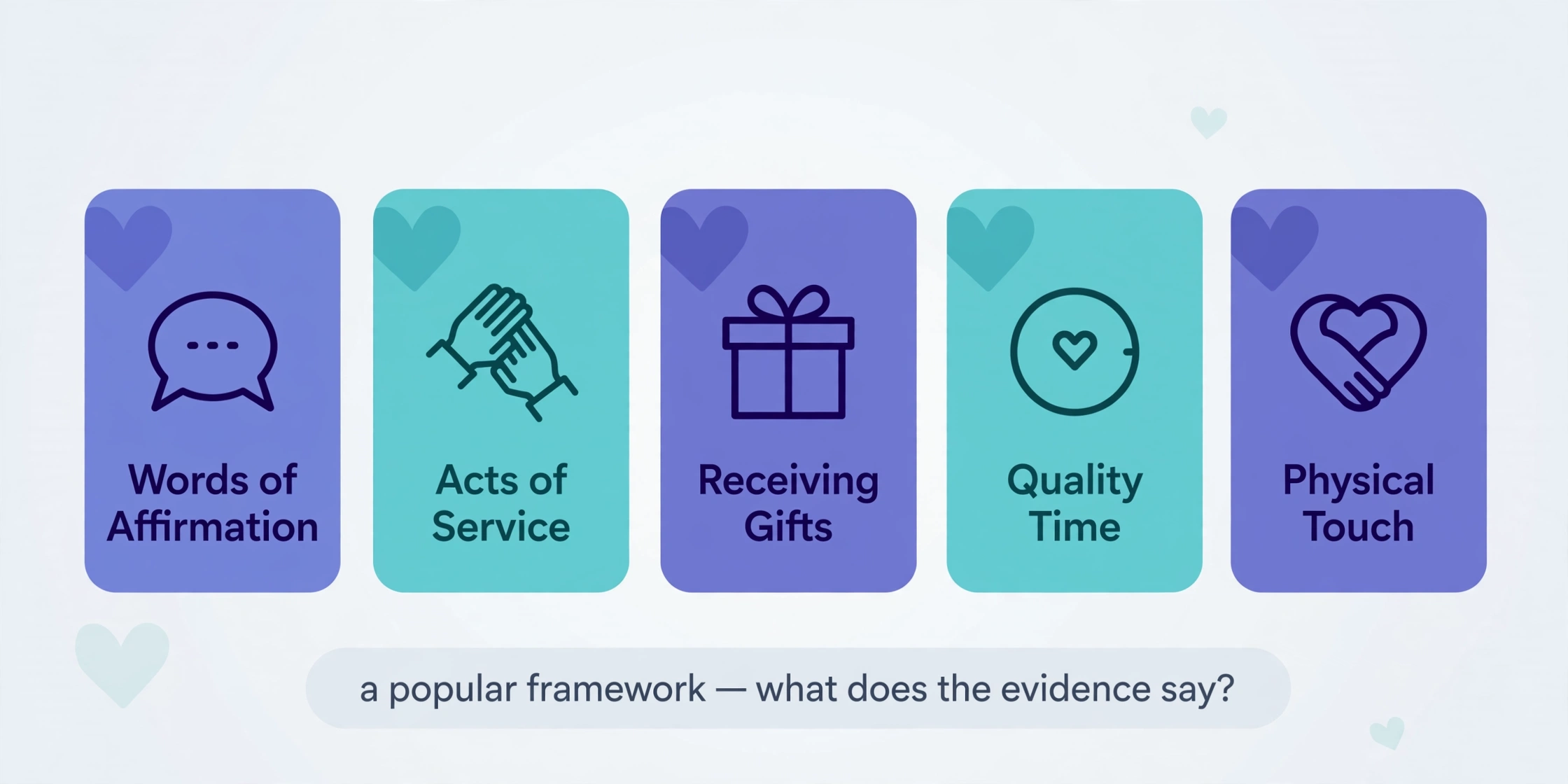
The five love languages — words of affirmation, acts of service, receiving gifts, quality time, and physical touch — come from Gary Chapman’s 1992 bestselling book, which proposes that people express and feel love in different preferred ways. It’s one of the most widely discussed relationship ideas of the past few decades. But when researchers put its core claims to the test, the evidence didn’t cooperate: most people don’t appear to have one primary language, and “matching” languages doesn’t reliably predict happier relationships.
This article presents Chapman’s framework fairly, then reports what peer-reviewed research actually found — so you can keep what’s useful and set aside what isn’t.
Table of Contents
What Are the Five Love Languages?
According to Chapman, everyone tends to both express love and feel most loved through one or more of five “languages”:
Words of affirmation. Feeling loved through expressed appreciation — compliments, encouragement, “I love you”s, verbal acknowledgment of effort.
Acts of service. Feeling loved when a partner does helpful things — handling a chore without being asked, running an errand, lightening your load.
Receiving gifts. Feeling loved through thoughtful presents — not the price tag, but the signal: you were on my mind.
Quality time. Feeling loved through undivided attention — real presence, eye contact, uninterrupted conversation.
Physical touch. Feeling loved through physical closeness — hand-holding, hugs, a hand on the shoulder.
Chapman’s central claims are threefold: each person has one primary love language; there are exactly five; and couples are happiest when partners “speak” each other’s primary language — or learn to.
Where Did the Idea Come From?
Chapman was a Baptist pastor who spent years counseling couples, and the framework grew out of those counseling conversations, not out of controlled research (Chapman, 1992). That’s worth stating plainly — not as a dismissal, but as context. Clinical observation can generate good hypotheses. But a hypothesis isn’t a finding, and the love languages were presented to the public as answers before researchers ever tested them as questions.
This matters for how to read everything that follows. The framework’s popularity tells us it resonates; it doesn’t tell us it’s accurate. Those are different things, and only the second one can be settled by research.
What Does the Research Actually Say?
In 2024, relationship researchers Emily Impett, Haeyoung Gideon Park, and Amy Muise published a review of the existing empirical literature on love languages in Current Directions in Psychological Science. Their conclusion: taken together, the studies do not provide strong support for the framework’s three central assumptions — that each person has one preferred language, that there are exactly five, and that matching languages makes couples more satisfied (Impett, Park, & Muise, 2024).
Here’s what the individual studies found:
Most people don’t seem to have one primary language. Chapman’s quiz forces this-or-that choices — gifts or touch, words or time — which manufactures the appearance of a single winner. But when researchers ask people to rate each language independently, most rate all five highly (Impett, Park, & Muise, 2024). The “primary language” looks less like a discovery about people and more like an artifact of how the quiz is built.
“Speaking” the primary language didn’t predict satisfaction. In a direct, preregistered test with 696 adults, researchers examined whether feeling loved in one’s supposed primary language predicted relationship satisfaction better than feeling loved in the lower-ranked languages. It did not. Instead, words of affirmation and quality time predicted perceived love and satisfaction better than anyone’s “primary” language — for everyone (Flicker & Sancier-Barbosa, 2025).
There may not be exactly five. Using a bottom-up approach across three studies (nearly 1,700 participants in long-term relationships), researchers found that models with seven to ten love languages fit people’s responses better than Chapman’s five — and predicted relationship quality better too, suggesting the original five are too narrow a vocabulary for how people actually give and receive love (Flicker et al., 2025). Separately, an early validity test found the five categories overlap substantially with an already-established typology of relationship-maintenance behaviors — in other words, the framework may relabel known behaviors more than it discovers new ones (Egbert & Polk, 2006).
Matching languages showed little payoff. In a study of 67 couples, researchers found only limited evidence that having aligned love languages predicted satisfaction. What contributed more was self-regulation — partners’ ability to manage their own behavior constructively — especially when couples’ preferences differed (Bunt & Hazelwood, 2017).
One finding in the framework’s favor. For balance: one study found that people who felt their partner used their preferred love language reported greater feelings of love and relationship satisfaction (Hughes & Camden, 2020). This is the strongest pro-framework result in the literature — and notably, it’s about perceiving effort from a partner, which brings us to the next section.
Why the Idea Feels True Anyway
If the evidence is this thin, why do so many couples swear by it? The review’s authors discuss possible reasons for the idea’s popularity; what follows builds on those with plausible explanations — offered as interpretations, not research findings.
First, the framework gives couples a shared vocabulary. “My love language is quality time” is an easy, non-accusatory way to say “I need more of your attention.” Any tool that helps partners articulate needs clearly is doing something useful, whether or not the theory behind it holds up.
Second, it directs attention outward. Asking “what makes my partner feel loved?” is itself a caring act. A partner who starts paying closer attention — in any language — will usually be perceived as more loving. The improvement people credit to “learning my language” may come from the attention, not the taxonomy.
Third, it offers a balanced-diet alternative. Impett and colleagues suggest replacing the language metaphor: lasting love may be less like learning one language and more like maintaining a balanced diet — people need a full range of expressions, and those needs shift as life and relationships evolve (Impett, Park, & Muise, 2024).
A More Useful Way to Think About It
You don’t need to throw the idea out — just demote it from law to suggestion:
Express love in multiple ways, not one. The research consistently points the same direction: variety beats targeting. Words, time, touch, help, thoughtfulness — do all of it, and let your partner’s responses guide the mix.
Ask instead of quiz. Rather than assigning each other a language, have the conversation directly: “What makes you feel most cared for lately?” People’s answers change with circumstances — a new parent and an empty-nester may need different things from the same partner.
Pay attention to responsiveness. What seems to matter most isn’t matching a category but the felt sense that your partner notices and responds to you. Our article on Trust in Relationships explores how that responsiveness builds over small, everyday moments. And for the mechanics of expressing needs clearly, see Communication in Relationships.
Love Languages and Other Lenses on Love
It’s worth noting that psychology already has research-built frameworks for understanding love — Chapman’s categories are only one lens, and the thinnest-tested one. Sternberg’s triangular theory, for example, describes love in terms of intimacy, passion, and commitment, and has decades of empirical work behind it (see Triangular Theory of Love). The love languages aren’t competing with these frameworks so much as operating at a different level: a pop-psychology shorthand for affectionate behavior, useful as a conversation starter, unreliable as a theory of relationships. Intimacy on its own — what it is and how it grows — is a larger topic, covered in our article on emotional intimacy.
Key Takeaways
- The five love languages (words of affirmation, acts of service, receiving gifts, quality time, physical touch) are a popular framework from Chapman’s 1992 book — presented fairly, but originating in counseling observation, not research.
- A 2024 review found the empirical literature does not strongly support the three core claims: one primary language per person, exactly five languages, and matching predicting satisfaction (Impett, Park, & Muise, 2024).
- Direct tests found no advantage for “speaking” a primary language; words of affirmation and quality time predicted satisfaction best across the board (Flicker & Sancier-Barbosa, 2025).
- Broader models (seven to ten languages) fit the data better than five, suggesting the original set is too narrow (Flicker et al., 2025).
- What’s useful: a shared vocabulary for needs, attention directed at the partner, and varied expressions of love — the “balanced diet” rather than one language.
- For research-built frameworks on love itself, see the triangular theory of love.
References
- Chapman, G. (1992). The five love languages: How to express heartfelt commitment to your mate. Chicago: Northfield Publishing. (Popular source; the framework’s origin. Cited as a popular work, not empirical research.)
- Impett, E. A., Park, H. G., & Muise, A. (2024). Popular psychology through a scientific lens: Evaluating love languages from a relationship science perspective. Current Directions in Psychological Science, 33(2), 87–92. https://doi.org/10.1177/09637214231217663
- Flicker, S. M., & Sancier-Barbosa, F. (2025). Testing the predictions of Chapman’s five love languages theory: Does speaking a partner’s primary love language predict relationship quality? Journal of Marital and Family Therapy, 51(1), e12747. https://doi.org/10.1111/jmft.12747
- Flicker, S. M., Sancier-Barbosa, F., Clemons-Castanos, C. R., Field, S. A., Jackson-Zambon, S. K., Phelan, M., & Impett, E. A. (2025). How many love languages are there? Examining Chapman’s five love languages using a bottom-up approach. Journal of Marital and Family Therapy, 51(4), e70072. https://doi.org/10.1111/jmft.70072
- Egbert, N., & Polk, D. (2006). Speaking the language of relational maintenance: A validity test of Chapman’s (1992) five love languages. Communication Research Reports, 23(1), 19–26. https://doi.org/10.1080/17464090500535822
- Bunt, S., & Hazelwood, Z. (2017). Walking the walk, talking the talk: Love languages, self-regulation, and relationship satisfaction. Personal Relationships, 24(2), 280–290. https://doi.org/10.1111/pere.12182
- Hughes, C., & Camden, A. A. (2020). Using Chapman’s five love languages theory to predict love and relationship satisfaction. Psi Chi Journal of Psychological Research, 25(3).
Keep Exploring
- The Psychology of Relationships — the pillar overview: the frameworks researchers use and what evidence finds matters most.
- Triangular Theory of Love — a research-built framework for understanding love: intimacy, passion, and commitment.
- Communication in Relationships — the everyday patterns — bids, repair, responsiveness — behind feeling heard and cared for.
- Trust in Relationships — how responsiveness in small moments builds the expectation that a partner will be there.
What are the five love languages?
Words of affirmation, acts of service, receiving gifts, quality time, and physical touch, from Gary Chapman’s 1992 book. The book claims each person has one primary language — a claim peer-reviewed research has not strongly supported.
Are love languages scientifically proven?
Not in their strong form. A 2024 review in Current Directions in Psychological Science concluded the studies do not strongly support the three central claims (one primary language per person, exactly five languages, matching predicting satisfaction). Some related findings (for example, that perceiving a partner’s effort predicts satisfaction) do have support — but they don’t require the five-language framework to be true.
Do I have one primary love language?
Probably not as a fixed type. Chapman’s quiz forces binary choices that manufacture a single winner; when people rate each language independently, most rate all five highly.
What if my partner and I “speak different love languages”?
Research suggests this matters less than claimed; matched couples showed little satisfaction advantage. General effort and responsiveness mattered more.
What’s the best way to make my partner feel loved?
Express love in varied ways, ask directly what they need, and stay responsive. Words of affirmation and quality time showed the most consistent links to satisfaction — but attentiveness beats any formula.